
Direct Answer: SEO optimises for Google's ten blue links — rankings, clicks, and traffic. AIO (AI-Optimised Search) optimises for AI answer engines — being cited by Perplexity, ChatGPT Search, and Google's AI Overviews. In 2026, both tracks are non-negotiable for SMEs: SEO still drives 60–65% of discoverable web traffic, while AIO captures B2B research queries where AI answers have replaced page-one browsing entirely. The winning strategy is a dual-track system that satisfies traditional crawlers and AI retrieval simultaneously.

Traditional Search
SEO
Rank in the ten blue links. Drive clicks to your site. Convert traffic into leads. The model that built the internet's commercial layer — and is being quietly dismantled.
43%
Drop in organic click-through rates since Google
AI Overviews launched at scale — SparkToro, 2024
AI-Optimised Search
AIO
Get cited by AI systems. Appear in answer engines. Be the source Perplexity, ChatGPT, and Google's AI summarise. The model reshaping where buyers get their answers.
58%
Of B2B research journeys now begin with an AI tool
before a search engine — Gartner, 2025
What Actually Changed in Search — and Why Does It Matter for Your Business?
The shift is not theoretical. Between 2023 and 2025, two structural changes rewired how buyers find answers online — and neither of them was driven by a Google algorithm update in the traditional sense.
First: AI Overviews became default behaviour on Google for informational queries. When a buyer searches "best CRM for a 50-person company," Google no longer shows ten links. It shows a synthesised answer — sourced from multiple pages, attributed with small citations, and displayed above everything else. The buyer reads the answer. Many do not scroll further.
Second: A meaningful share of research shifted off Google entirely. ChatGPT Search, Perplexity, and Claude now handle queries that previously went to Google — particularly in B2B research contexts where buyers want synthesised analysis rather than a list of links to read. According to Gartner (2025), 58% of B2B research journeys now begin with an AI tool before a traditional search engine.
These two shifts created a new strategic reality: ranking on Google is no longer sufficient for full search visibility. And optimising for AI citation is now a legitimate, measurable acquisition channel — not a speculative future-state.
43%
Drop in organic CTR for queries where Google AI Overviews appear above results
SparkToro · Search Behaviour Study, 2024
58%
Of B2B research journeys begin with an AI tool before a search engine
Gartner · B2B Buyer Research Report, 2025
71%
Of AI Overview citations come from pages NOT in the top-3 Google rankings for the same query
Semrush · AI Overview Citation Study, 2024
That last statistic is the one that changes the strategic calculus entirely. You can rank #1 on Google for a query and still be absent from the AI Overview that appears above your ranking — because AI systems are selecting sources based on different criteria than traditional PageRank. And that #1 ranking is now receiving 43% fewer clicks than it was two years ago, because many users read the AI answer and stop.
⚑ The SME-Specific Risk
Most SMEs are optimising for a search model that is eroding. If your current SEO strategy is producing rankings but declining traffic, you are not experiencing an algorithm penalty — you are experiencing the structural shift from click-based to answer-based search. The solution is not better traditional SEO. It is adding the AIO track.
SEO vs. AIO — What Are the Actual Differences in How Each System Works?
Understanding the mechanism of each system is what determines where you invest time and budget. They are not competing approaches to the same problem. They are solving for different retrieval systems with different selection criteria.

The most operationally significant difference: AIO citation does not require strong domain authority. A new site with a well-structured direct answer block, clear entity relationships, and valid JSON-LD schema can appear in a Google AI Overview within weeks — while competing against pages with domain authorities ten times higher. For SMEs, this is the most significant shift in search since the first Panda algorithm update.
// From Our Experience
What we consistently see in real-world SME deployments: the pages that get cited in AI Overviews are almost never the longest, most comprehensive pieces of content. They are the pages with the clearest, most extractable direct answers — the ones where an AI can pull a self-contained 50-word response without needing surrounding context. Writing for AI citation requires a fundamentally different structural approach to content than writing for traditional keyword ranking.
What Signals Actually Determine AI Citation — and How Are They Different From SEO Signals?
The question practitioners ask most often: what, specifically, makes AI systems select one source over another when generating an answer? The answer is increasingly documented, though no AI provider has published a complete methodology.
Based on Semrush's AI Overview Citation Study (2024), Authoritas research (2024), and direct observational analysis of Perplexity and ChatGPT sourcing patterns, five signals emerge as the primary determinants of AI citation selection:
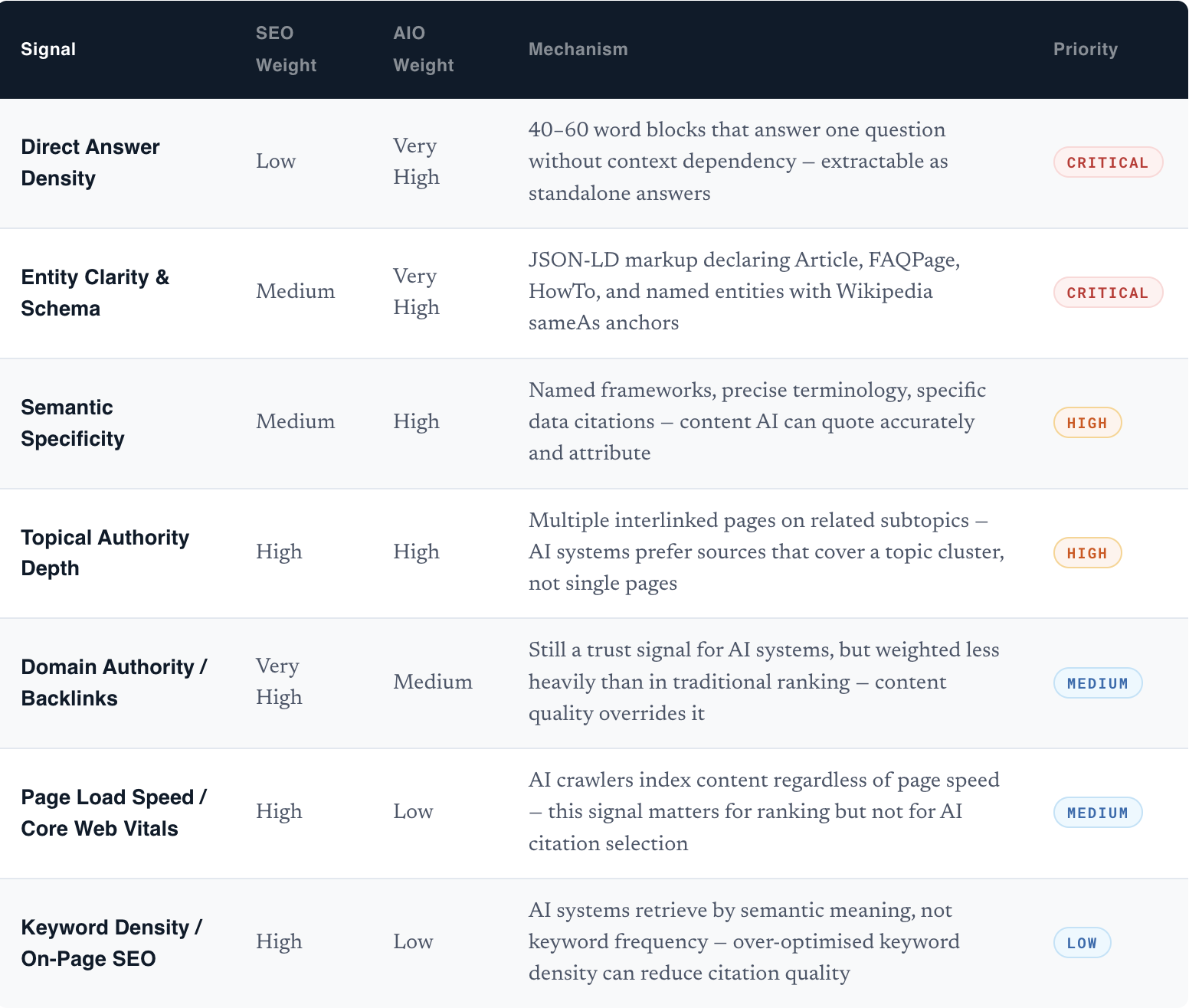
The most counter-intuitive finding across this research: keyword density — the foundational metric of traditional on-page SEO — has near-zero correlation with AI citation frequency. AI retrieval systems read semantically. A page that repeats its target keyword fifteen times is not more likely to be cited than a page that states the answer clearly once and moves on.
In practice, this means SMEs with limited content budgets should prioritise direct answer blocks, schema markup, and named entity clarity over keyword optimisation for any content primarily targeting AI retrieval. The technical investment is similar. The content strategy is fundamentally different.
What Is the Dual-Track Strategy — and How Does an SME Run Both Without Doubling the Workload?
The practical question for every resource-constrained SME: do we need to build two entirely separate content systems? The answer is no — with one critical caveat. The content architecture must be built to serve both retrieval systems simultaneously, rather than optimising purely for one.
The dual-track strategy adds AIO-specific structural elements to content that already serves SEO — so the same page ranks in traditional search and gets cited in AI Overviews. The additional work per page is approximately 20–30% more than pure SEO content production. The coverage gain is a full second retrieval channel.
SEO Track — What Stays The Same
- 1Keyword-targeted H1 and H2 headings
Natural language question headings that match search intent. Unchanged from current best practice. - 2Long-form content with internal linking
1,500–3,000 word pillar pages interlinked with related cluster content. Topical authority architecture unchanged. - 3Backlink acquisition and domain authority
Still essential for competitive rankings. Continues in parallel with AIO optimisation. - 4Technical SEO — Core Web Vitals, crawlability
Page speed, mobile optimisation, and clean crawl architecture remain ranking factors. Unchanged. - 5E-E-A-T signals — author, publisher, expertise
Author bio pages, About pages, and editorial standards documentation. Unchanged and increasingly important.
AIO Track — What Gets Added
- 1Direct Answer Block — 40–60 words, immediately after H1
A self-contained answer to the page's primary question. Written to be extractable by AI without surrounding context. - 2Named frameworks with specific step names
Every process gets a proprietary name. Named frameworks are cited by AI at higher rates than generic advice sections. - 3FAQ section with natural language Q&As
5–7 questions phrased as a user would type them into an AI system. Each answer is 80–120 words, self-contained. - 4JSON-LD schema — Article, FAQPage, HowTo
Valid structured data for every relevant schema type. Entity nodes with Wikipedia sameAs anchors for named organisations and concepts. - 5Entity relationship mapping in content
Explicit mentions of related concepts, organisations, and data sources — giving AI systems the relational context to cite accurately.
The dual-track approach does not require two separate content teams or two content calendars. It requires one piece of content built with a richer structural template — one that includes all the AIO elements listed above alongside the standard SEO architecture. At Clipkoi, we consistently produce dual-track articles in approximately 35% more time than pure SEO articles — and they generate citation appearances in AI systems within four to six weeks of publication.
What Is the Exact Execution Checklist for a Dual-Track SEO + AIO Article in 2026?
The execution checklist below converts the dual-track strategy into a repeatable production standard. Every article your team publishes should clear all items before going live. The SEO track items are likely already in your existing workflow. The AIO track items are the additions.

The video element in the final checklist item is the one most SMEs overlook — and the one with disproportionate impact on AI citation frequency. According to Semrush's AI Overview study, pages with embedded video supporting the primary topic received AI citation at 2.1 times the rate of text-only pages covering identical queries. For content platforms like Clipkoi, this creates a compounding advantage: your AI video production directly supports your AIO citation rate.
How Do You Measure AIO Performance — and What Does Success Actually Look Like?
The measurement question separates the teams running AIO strategically from those running it speculatively. AIO is measurable — differently from SEO, with different tools, and with a different lag structure — but the KPIs are real and trackable.
The Three AIO Measurement Layers
Layer 1 — Direct AI Citation Monitoring. Tools including Semrush's AI Overview tracker, Authoritas, and Brandwatch now track when your domain appears as a cited source in Google AI Overviews. Monitor your citation rate for your 20–30 highest-priority query clusters weekly. A well-optimised new article should begin appearing in AI citations within four to eight weeks of indexing.
Layer 2 — Brand Mention in AI Answers. Perplexity and ChatGPT do not share referral traffic data in GA4. But they do generate brand searches. An increase in branded search volume — "Clipkoi" rather than "AI video platform" — is a lagging indicator that AI systems are mentioning your brand in answers, prompting users to search for you directly. Monitor branded vs non-branded search trends in Google Search Console monthly.
Layer 3 — Dark Social and Direct Traffic. Users who find your brand via an AI answer and then navigate directly to your site appear as direct traffic in GA4 — not organic. A sustained increase in direct traffic concurrent with AIO content publication is the clearest measurable signal that AI-sourced awareness is converting to site visits. Create a custom GA4 segment for direct traffic to pages published after your AIO programme began.
// What Success Looks Like at 90 Days
For an SME publishing four to six dual-track articles monthly: by week twelve, you should see citation appearances in Google AI Overviews for 15–25% of your target query clusters, a 10–20% increase in branded search volume, and measurable direct traffic growth to AIO-optimised pages. These are not vanity metrics — they represent buyers who encountered your brand in an AI answer and initiated a research journey that began with you as the authoritative source.
Frequently Asked Questions
What is the difference between SEO and AIO in 2026?
SEO optimises content to rank in Google's traditional search results — the ten blue links — by building domain authority, keyword relevance, and technical site health. AIO (AI-Optimised Search) optimises content to be cited by AI answer engines including Google's AI Overviews, Perplexity, and ChatGPT Search — using direct answer blocks, named frameworks, structured JSON-LD schema, and entity clarity. In 2026, both are required: SEO drives 60–65% of discoverable web traffic, while AIO captures B2B research queries where AI answers have replaced traditional page-one browsing. Running only SEO leaves your brand absent from a growing share of the buyer research journey.
How do you optimise content for Google AI Overviews in 2026?
Optimising for Google AI Overviews in 2026 requires five structural elements added to standard SEO content: a direct answer block of 40 to 60 words placed immediately after the H1 heading, written as a self-contained answer to the page's primary question; named frameworks with specific step names that AI can cite accurately; an FAQ section with 5 to 7 natural language questions each answered in 80 to 120 self-contained words; valid JSON-LD schema including Article, FAQPage, and HowTo nodes with entity sameAs anchors; and embedded or linked video covering the primary topic. Pages combining all five elements appear in AI Overviews at significantly higher rates than pages optimised for traditional keyword ranking alone.
Does domain authority still matter for AI citation in search?
Domain authority still functions as a trust signal for AI citation but is weighted significantly less than in traditional Google ranking. Semrush's AI Overview Citation Study (2024) found that 71% of AI Overview citations came from pages not in the top three Google rankings for the same query — meaning content quality and structural clarity consistently override domain authority in AI source selection. A new site with a well-structured direct answer block, valid JSON-LD schema, and clear entity relationships can appear in AI Overviews within weeks while competing against established domains with ten times the domain authority. For SMEs, this represents the largest opportunity in search since the introduction of featured snippets.
How long does AIO optimisation take to show results?
Well-structured AIO-optimised content typically begins appearing in AI citation results within two to eight weeks of indexing — significantly faster than traditional SEO timelines of three to nine months for competitive keyword rankings. The lag difference reflects the selection mechanism: AI systems retrieve by semantic relevance and structural clarity, not by accumulated link authority over time. For SMEs publishing four to six dual-track articles monthly, citation appearances in Google AI Overviews for 15 to 25 percent of target query clusters are measurable within 90 days. Concurrent increases in branded search volume and direct traffic confirm that AI-sourced awareness is converting into active research journeys.
Should an SME choose between SEO and AIO or run both?
An SME in 2026 should run both SEO and AIO simultaneously using a dual-track content architecture. Choosing only SEO leaves the brand absent from AI answer engines where 58% of B2B research journeys now begin. Choosing only AIO abandons the 60 to 65 percent of discoverable web traffic that still flows through traditional search results. The dual-track approach adds approximately 20 to 30 percent more production time per article — adding a direct answer block, FAQ section, named framework, and JSON-LD schema to content already built for SEO. The return is full search visibility across both retrieval systems from the same content investment, producing compounding coverage that neither track produces alone.
The Strategic Decision You Need to Make This Month
The search landscape of 2026 is not waiting for your content strategy to catch up. AI Overviews are already appearing on queries your buyers are searching right now. Perplexity and ChatGPT are already answering questions your prospects are asking — and citing sources that may or may not include you.
The competitive window for SMEs to establish AI citation presence is narrow — and narrowing. The pages that are building citation history now will be the sources that AI systems return to six months from now, when the pattern reinforces. The ones that start in six months will be building against an already-established competitive landscape.
The dual-track strategy does not require a new team, a new platform, or a new content calendar. It requires a new content template — one that adds the five AIO structural elements to every article your existing team is already producing.
Build that template this week. Apply it to your next article. Measure citation appearances at eight weeks. Then scale what works. That is the sequence. It is not complicated. It is just sequential — and time-sensitive in a way that no search strategy has been since 2012.