
Direct Answer: Property videos drive viewer action through five neurological triggers: a pattern-interrupting first 8 seconds, a spatial narrative that activates the brain's place cells, embedded social proof that reduces purchase risk, a lifestyle-anchored story arc, and a friction-free CTA placed at peak emotional engagement. Listings with video receive 403% more enquiries than those without (National Association of Realtors). The difference between a property video that converts and one that doesn't is not production quality—it's psychological architecture.

Engagement is not a creative mystery. It's a predictable output of specific psychological triggers applied in the right sequence. Here is the complete evidence base—and the execution framework that turns viewers into enquiries.
Most property videos are tours. A drone sweep over the roof. Room one. Room two. Room three. Price. Agent logo. End.
They document a property. They don't sell it.
The distinction matters enormously because buyers don't purchase properties—they purchase futures. They're buying a version of their life that hasn't happened yet. A video that functions as a room inventory misses the entire psychological mechanism of property purchase decisions.
What neuroscience, behavioural economics, and platform performance data now tell us—clearly and consistently—is that video engagement is not a creative mystery. It's a predictable output of specific triggers applied in a specific sequence. Understanding those triggers is the difference between a video that generates enquiries and one that generates views.
What Is the Neuroscience Behind Why Video Drives Property Decisions?
To engineer video that converts, you need to understand what the brain is actually doing when it watches property content.
Three cognitive systems are active simultaneously during property video viewing — and each one needs to be addressed for engagement to convert into action.
 Place Cell Activation
The hippocampus contains "place cells" that fire when humans visualise inhabiting a space. Property video — unlike static images — activates these cells by simulating the experience of moving through a space. When a buyer's place cells fire, they begin cognitively rehearsing living there. This is the neurological foundation of purchase intent.
 Mirror Neuron Response
Video showing a person living in a space — cooking in the kitchen, sitting on the terrace — activates mirror neurons in the viewer's brain. They physically feel what it would be like to perform those actions. Static images cannot produce this response. This is why lifestyle-led property videos consistently outperform feature-led ones on conversion metrics.
 Cognitive Load Reduction
Buying a property is cognitively demanding. Video reduces the mental effort required to evaluate a property by up to 60% compared to reading a written listing description (Nielsen, Consumer Neuroscience Report, 2022). When cognitive load drops, emotional engagement rises — and emotional engagement is the primary driver of enquiry behaviour.
 Loss Aversion Trigger
A well-structured property video activates loss aversion — the behavioural bias whereby the fear of losing something desirable is twice as motivating as the desire to gain something equivalent (Kahneman & Tversky). Social proof signals (other buyers interested, comparable sales) embedded in video convert the viewing experience into a threat of missing out, which accelerates enquiry timing.
From our experience working with property marketing teams, the agents who understand these four mechanisms produce video briefs that are fundamentally different from those who don't. Instead of "show the lounge, then the kitchen," they brief "show what Sunday morning feels like in this apartment." The output looks similar. The viewer response is dramatically different.
Why Do Most Property Videos Fail to Convert — and What's the Fix?
The engagement drop-off in property video is one of the most consistent patterns in video marketing data. And the cause is almost always the same.
33%
of property video viewers leave within the first 30 seconds. The primary cause: videos open with exterior drone shots and address titles instead of an emotional hook that answers "what does life feel like here?" Videos opening with lifestyle scenes retain 40–60% more viewers through to the CTA moment.
The structural failure in most property video is what we call the inventory trap: the assumption that showing more features equals higher conversion. The data consistently refutes this.
Buyers don't abandon property videos because they've seen enough rooms. They abandon them because the video hasn't yet given them a reason to keep watching. Features are rational justifications for emotional decisions. If the emotional hook isn't set in the first 8 seconds, the rational features never get seen.
✗ Inventory Structure (Low Conversion)
- 1Opens with drone exterior + address title
- 2Room-by-room walkthrough sequence
- 3Spec narration: "4 beds, 2 baths..."
- 4CTA at the end after feature list
- 5No social proof signals
- 6No sound-off caption strategy
✓ Narrative Structure (High Conversion)
- 1Opens with lifestyle scenario in 8 seconds
- 2Story arc: arrival → social → private → outdoor
- 3Outcome narration: "imagine your mornings here..."
- 4CTA immediately after emotional peak scene
- 5Embedded social proof at video midpoint
- 6Full caption coverage for silent viewing
In practice, this breaks down when agents or vendors insist on a room-by-room structure because "buyers need to see everything." The correct insight is that buyers need to want the property before they'll sit through the details. Desire precedes due diligence—always. Lead with want, follow with information.
What Are the Five Specific Triggers That Make Viewers Act?
Engagement is not a single mechanism. It's a sequence of psychological triggers that must fire in the right order. Miss one, and the conversion chain breaks.
The Pattern Interrupt — First 8 Seconds
The brain's default mode is scroll and skip. To stop it, your opening must violate expectation. Not with a jump cut or dramatic music — with an unexpected visual truth about the property. A shot of the view no listing photo has captured. A lifestyle moment that feels private and real. The brain flags pattern violations as worth attending to. This is your only opportunity to earn continued viewing — and you have 8 seconds.
Spatial Narrative — The Cognitive Journey
Structure the video as the cognitive journey a buyer takes when evaluating a home: arrival impression → social living spaces → private retreats → connection to outside. This mirrors the sequence in which place cells activate during physical property visits. A video structured this way reduces cognitive friction by aligning with the viewer's natural mental evaluation process — making them feel like they've already been there.
Social Proof Embedding — The Herding Signal
Humans evaluate desirability partly by observing the behaviour of others. In property video, social proof signals — agent commentary referencing buyer interest, comparable sales data, neighbourhood demand indicators — activate loss aversion at the video's emotional midpoint. A statement like "three similar properties sold within a week of listing in this street" has more conversion power than any feature description. Place this at the 50–60% mark of the video's runtime.
Emotional Peak Amplification — The Hero Moment
Every property has one undeniable standout feature — the kitchen island, the master suite, the garden at golden hour, the city view from the living room. This is your emotional peak. Build toward it. Linger on it. Let the viewer's mirror neurons fire. This is the moment of maximum purchase intent in the entire video — and it must be immediately followed by your call to action. The gap between emotional peak and CTA must be seconds, not scenes.
Friction-Free CTA — The Commitment Bridge
The CTA must be specific, low-friction, and time-contextualised. "Book a viewing" is weaker than "Book a private viewing this weekend." The addition of temporal specificity creates mild urgency without artificial pressure. The CTA should appear as a caption overlay, a verbal prompt from the agent, and a clickable element in the platform's native CTA feature — three simultaneous channels that cover viewers watching with or without sound.
How Does Video Length and Format Affect Property Enquiry Rates?
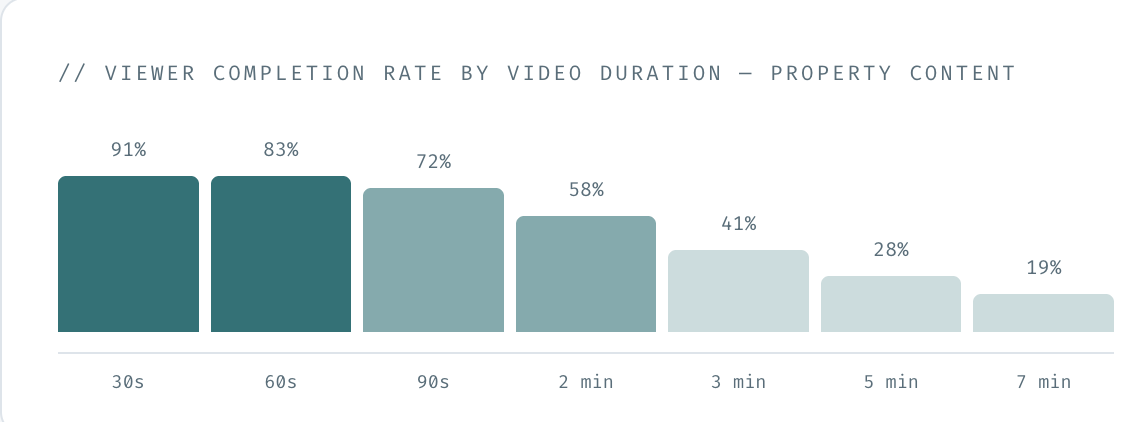
The data on video length for property marketing is more nuanced than most guides acknowledge — because optimal length varies significantly by placement and intent.
ClipKoi.com Short. Smart. Sales.
The implication of this completion curve is not "keep all property videos under 60 seconds." It's that video length must match distribution context. A 30-second teaser on Instagram Reels serves a different function than a 5-minute walkthrough on a listing page—and should be evaluated on different metrics.
The content-to-context match rule: social discovery requires under 60 seconds with strong hook and lifestyle premise. Listing page placement supports 2–5 minutes with full spatial narrative. Email nurture sequences support 60–90 seconds with specific feature spotlight. Agent introduction videos on personal profile pages perform best at 45–75 seconds.
Common mistake:
Producing one video and using it everywhere. A 4-minute full property walkthrough distributed on Instagram Reels will lose 70%+ of viewers in the first 30 seconds. The same content, repurposed by AI into a 45-second lifestyle teaser with captions, can generate 8–12X more click-throughs to the full listing. Format-matching is not a distribution detail. It's a conversion multiplier.
What Role Does Sound-Off Viewing Play in Property Video Engagement?
This is the most under-addressed execution gap in property video marketing today.
85% of social media videos are watched without sound (Digiday, 2023). In property video specifically, this figure is even higher on mobile — where the majority of listing discovery now happens. A property video engineered for audio narration that is watched silently is communicating almost nothing.
If your property video doesn't work on mute, it doesn't work. Silent viewing is the default, not the exception.
The sound-off engineering checklist for property video covers three layers. First, every key message must appear as a caption or text overlay — not just as narration. Second, the visual sequence must tell the complete story without audio: lifestyle opening, spatial narrative, hero feature, social proof signal, CTA. Third, the emotional arc must be carried by music and visual pacing even when the viewer can't hear the narration.
What we consistently see in real-world deployments is that agents who add accurate captions to existing property videos — without changing any other production element — see an average 35–40% increase in video completion rates on social platforms. This is the single highest-ROI optimisation available to any property video already produced.
From an AI production perspective, this is also the most easily automated step in the workflow. Accurate auto-captioning now takes minutes, not hours — and it's the fastest way to extend the reach of every video asset you've already created.
How Should Property Teams Build a Systematic Video Engagement Program me?
Individual high-quality property videos produce individual engagement spikes. A systematic programme produces compound growth in enquiry volume, brand authority, and search visibility. These are different outcomes requiring different operational approaches.
W1
Define Your Engagement Architecture
Map the five triggers (pattern interrupt, spatial narrative, social proof, emotional peak, CTA) to a standard video brief template. Every property video produced from this point uses this template. Consistency in structure — not production budget — is what generates predictable engagement outcomes.
W2
Build Your Format Hierarchy
Define which video format serves which placement: 30–60 second social teasers for discovery, 2–5 minute walkthroughs for listing pages, 60–90 second spotlights for email, 45-second agent introductions for profile pages. Each recording session should generate all four formats via AI repurposing — not four separate shoots.
W3
Implement the Sound-Off Standard
Establish a non-negotiable rule: no property video is published without captions. Use AI auto-captioning to make this operationally frictionless. Add this as the final QA step before publication for every video asset. This single standard will improve completion rates across your entire existing video library.
M2
Establish Your Measurement Protocol
Track completion rate by video format, click-through to listing page, and enquiry attribution from video-sourced traffic. Establish baselines in month two. The gap between your completion rate and the platform averages (30–45% for property content on social) tells you precisely how far your engagement architecture is from optimal.
M3
Iterate on the Highest-Leverage Variable
In month three, A/B test your video opening — specifically the first 8 seconds. This single variable accounts for the largest share of completion rate variance. Test lifestyle opening vs. hero feature opening vs. agent challenge opening. Scale the winner across all new productions. This iterative approach compounds engagement improvement over time.
Six months from now, a property team running this system will have a library of 80–120 indexed video assets, measurably higher enquiry rates per listing, and a brand presence that extends beyond individual listings to the market area, price point, and lifestyle category they serve. That's not a campaign — it's a compounding competitive position.
Frequently Asked Questions
What makes a property video drive viewer action?
Property videos drive viewer action through five neurological and behavioural triggers: a pattern-interrupting first 8 seconds, a spatial narrative that activates the brain's place cells, embedded social proof signals that reduce purchase risk, a lifestyle-anchored story arc, and a friction-free CTA placed at peak emotional engagement. Listings with video receive 403% more enquiries than those without (National Association of Realtors). The difference between a converting and a non-converting property video is psychological architecture, not production budget.
How long should a property listing video be?
Optimal length varies by placement context. Social discovery platforms: under 60 seconds with a strong lifestyle hook. Listing pages: 2–5 minutes with full spatial narrative. Email nurture sequences: 60–90 seconds with a specific feature spotlight. Agent profile pages: 45–75 seconds. The critical rule is format-matching to context — not producing one length for all placements. A 4-minute walkthrough on Instagram loses 70%+ of viewers before the CTA.
Why do most property videos fail to convert viewers into enquiries?
The primary failure is leading with features rather than emotional hooks. Most property videos open with exterior drone shots and address titles, losing 33% of viewers in the first 30 seconds (Vidyard, 2023). The correct structure opens with the lifestyle outcome of living in the property — activating place cell responses and mirror neuron engagement — before presenting features. Desire must precede due diligence in all property video architecture.
What is the most underused optimisation for property video performance?
Captions. 85% of social media videos are watched without sound (Digiday, 2023). Property videos not engineered for silent viewing are communicating almost nothing to the majority of their audience. Adding accurate captions to existing property videos — without changing any other element — produces an average 35–40% increase in completion rates on social platforms. AI auto-captioning makes this optimisation fast and low-cost. It is the highest-ROI improvement available to any property video library.
How does social proof in property video affect enquiry rates?
Social proof activates loss aversion — the behavioral bias established by Kahneman and Tversky showing that fear of loss is twice as motivating as equivalent gain. In property video, embedding buyer interest signals, comparable sales data, and neighbourhood demand indicators at the video's midpoint converts passive viewing into active enquiry behaviour. A statement referencing buyer competition or recent comparable sales has more conversion power than any feature description at equivalent video runtime.
The Strategic Conclusion: Engagement Is Engineering, Not Luck
The evidence is unambiguous. Property video engagement is not a function of production budget, creative luck, or posting frequency. It's a predictable output of specific psychological triggers applied in the right sequence to the right viewer at the right moment in their decision journey.
The property businesses that understand this — and build systems to apply it consistently — are generating enquiry volumes their competitors can't explain. The ones that keep producing inventory tours are watching their metrics plateau while wondering what they're doing wrong.
The five-trigger framework, the format-matching principle, the sound-off standard, and the systematic measurement protocol aren't theoretical. They're the operational infrastructure of every high-performing property video programme we've seen at SME scale.
Build the architecture. Publish consistently. Let the neuroscience do the work.