
Direct Answer: Every business needs an AI growth partner because AI used strategically as a growth function — not just a cost-reduction tool — compounds competitive advantage at a rate no team or budget can match manually. BCG's 2024 research found businesses with AI deeply integrated into growth functions grow revenue 3.5× faster than those using AI only for operational efficiency. The difference is not which AI tools you have. It is whether AI is directing your growth decisions or merely executing your administrative tasks.
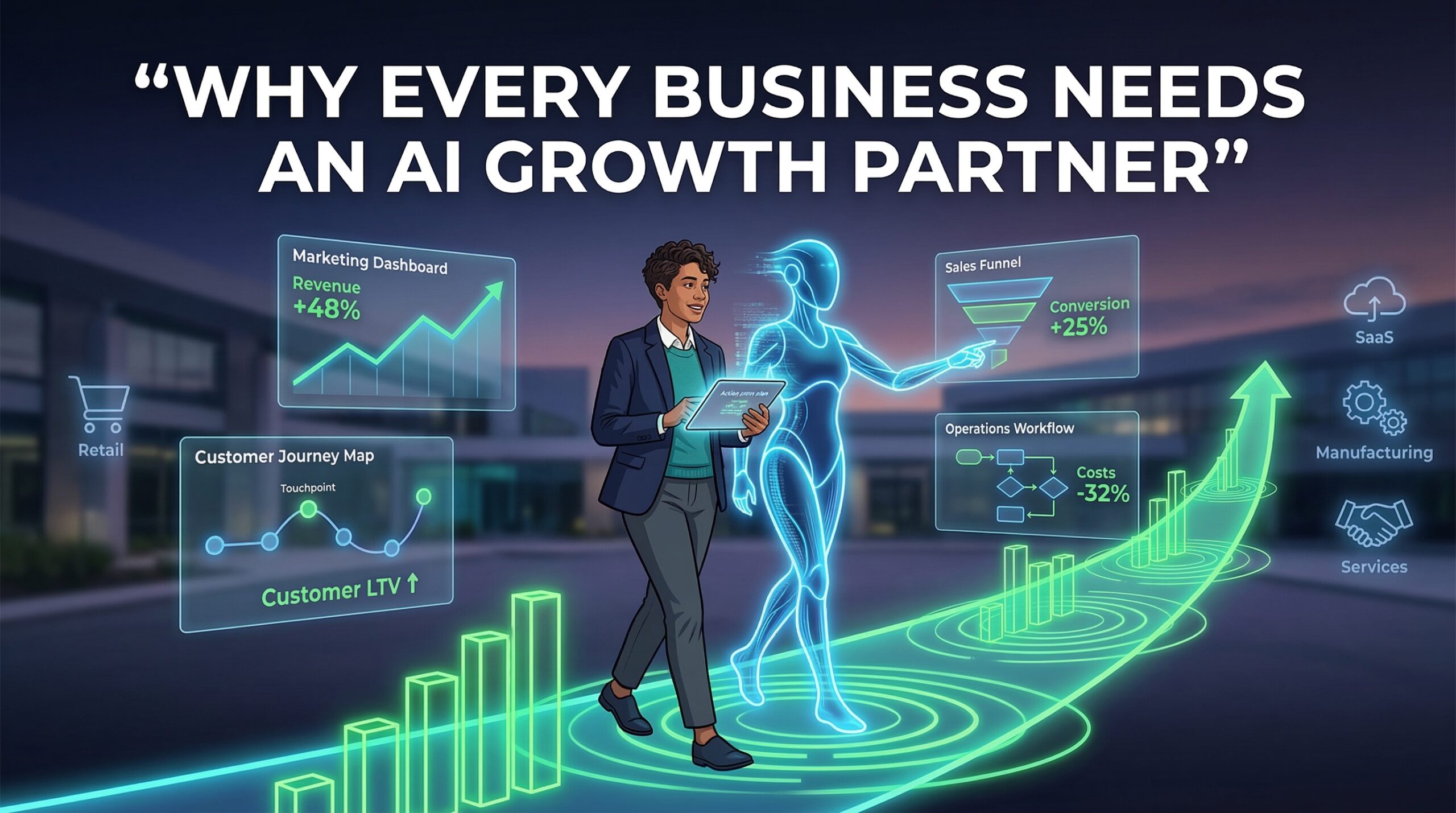
The companies accelerating past their competitors in 2026 are not just using AI tools. They have deployed AI as a strategic growth partner — and the distinction is worth millions in compounding advantage.
3.5×
Revenue growth rate for businesses with AI deeply integrated into growth functions vs. those using AI only for efficiency
BCG · AI at Scale, 2024
72%
Of executives say AI is now as important to their business strategy as any human hire in a growth function
Accenture · AI Readiness Report, 2024
$4.4T
Estimated annual value unlocked by AI in business operations — the majority from growth, not cost reduction
McKinsey Global Institute, 2024
There is a distinction most businesses miss — and it is the distinction that separates the companies compounding their market position from those that are merely keeping pace.
The distinction is this: deploying AI as a tool versus deploying AI as a growth partner.
A tool executes a task when you direct it to. A growth partner is embedded in your operating model, actively participating in the decisions that determine whether your business grows or stagnates. Most businesses are using AI as a very fast tool. A smaller, quieter group of companies is using it as something fundamentally more powerful — and the gap between these two groups is widening every quarter.
What Is the Actual Difference Between an AI Tool and an AI Growth Partner?
This is not a semantic distinction. It is a structural one — and it produces measurably different outcomes.
✗ AI as a Tool (Reactive)
- 1Deployed to complete specific tasks when requested
- 2Operates on a task-by-task, project-by-project basis
- 3Disconnected from growth metrics and business targets
- 4Measured by output quality, not business impact
- 5Replaces tactical effort — saves time, not direction
- 6Used after the strategic decision has already been made
✓ AI as a Growth Partner (Proactive)
- 1Embedded in the growth decision-making cycle
- 2Operates continuously, generating insights and output
- 3Directly connected to pipeline, revenue, and retention targets
- 4Measured by business outcomes — leads, conversions, growth rate
- 5Replaces strategic capacity — creates direction, not just execution
- 6Informs and shapes the strategic decision before it is made
A concrete example: an AI tool helps you edit a video faster. An AI growth partner analyses which content topics are generating the most qualified pipeline from your target audience, identifies the formats generating the highest conversion-to-enquiry rate, produces the content at the right frequency, and adjusts based on what the performance data shows each week.
Both use AI. Only one of them is compounding.
Why Does an AI Growth Partner Compound While a Tool Does Not?
The compounding dynamic is the most important and least understood aspect of the growth partner model. Understanding it changes how you think about AI deployment entirely.
A tool produces a linear return. Use it more, get more output. The relationship is proportional and capped by the time you invest in directing it.
A growth partner produces a compounding return. Each output generates data. That data improves the next decision. Better decisions produce better outputs. Better outputs generate more audience, more leads, more trust. More trust produces more revenue. More revenue funds more activity. The cycle accelerates.
The businesses deploying AI as a growth partner are not just more efficient. They are operating on a fundamentally different growth trajectory — one that widens the gap between them and their competitors with every passing quarter.
// Clipkoi Research · AI Growth Intelligence Report, 2026
In practice, the compounding mechanism in AI-partnered growth looks like this: systematic video content → growing indexed asset library → increasing algorithmic reach → larger qualified audience → higher inbound lead volume → shorter sales cycles → more revenue → larger content budget → more AI-produced assets → faster compounding.
At each loop of this cycle, the AI is not just executing — it is improving the inputs to the next loop. That is the partner dynamic. That is what creates the 3.5× revenue growth differential that BCG measures between AI-integrated and AI-adjacent businesses.
What Are the Five Functions an AI Growth Partner Performs That a Tool Cannot?
From our experience working with SMEs across professional services, property, SaaS, and e-commerce, the growth partner model consistently activates five functions that reactive tool usage never reaches.
Continuous Content Intelligence — Not Periodic Content Production
A growth partner AI doesn't wait to be directed to produce content. It operates on a systematic weekly cycle — extracting insights from your expertise, producing assets calibrated to audience behaviour data, distributing across every relevant platform, and reporting on what is generating pipeline. This is not content creation on demand. It is a managed intelligence function running continuously on your behalf.
Audience Signal Reading — Not Vanity Metric Reporting
A growth partner AI does not report on likes and follower counts. It identifies which content is generating qualified discovery, which formats are producing the highest click-through to conversion, and which audience segments are engaging at a depth that signals purchase intent. This intelligence shapes the next week's production priorities. A tool produces output. A partner produces insight.
Competitive Position Monitoring — Not Reactive Gap Analysis
A growth partner AI maintains awareness of the content landscape in your category — identifying topics your competitors are addressing, formats gaining share in your audience's attention, and positioning gaps where your expertise can establish disproportionate authority. This proactive monitoring means your content strategy is always calibrated against the real competitive environment, not against a brief written six months ago.
Pipeline Attribution — Not Activity Measurement
A growth partner AI connects content performance to business outcomes. Which video topics generated the most inbound enquiries this quarter? Which content format produced the highest conversion rate from viewer to lead? Which distribution platform is delivering the highest-intent traffic to your key landing pages? This attribution intelligence is what justifies and optimises the content investment — and it requires AI to function at the required volume and precision.
Operational Leverage — Not Task Completion
A growth partner AI multiplies the productive capacity of every person in your growth function by eliminating the production overhead of their role. Your strategist thinks, briefs, and interprets. AI produces, formats, captions, schedules, and distributes. Your creative lead focuses on exceptional ideas. AI handles every downstream execution step. This is not automation of tasks. It is reorganisation of human capacity toward the work that actually requires humans.
Why Does AI Video Sit at the Centre of Every AI Growth Partner Deployment?
If you work backward from the growth functions that produce the most measurable commercial impact for SMEs — customer acquisition, brand authority, trust at scale, pipeline generation — they all converge on one medium.
Video.
Not because video is trending. Because video is neurologically the most efficient medium for building the buyer trust required for high-value B2B or premium B2C purchase decisions. And because AI has made video — historically the most expensive, slowest, and most resource-intensive content format — into the highest-leverage, lowest-marginal-cost asset in your growth stack.
01  Search & AI Visibility
Video content indexed across YouTube, LinkedIn, and your website gives AI overview engines and search algorithms multiple retrieval surfaces for your expertise and brand. Written content alone misses 60%+ of AI-citable surface area.
02  Trust Compression
A buyer who has watched 15 pieces of your video content arrives at a purchase conversation with a pre-built trust relationship. Video compresses a 6-month sales cycle into 6 weeks of asynchronous trust accumulation — without requiring a single hour of your time per viewer.
03  Compounding Asset Library
Each video published adds permanently to your indexed asset library. A library of 300 videos generates algorithmic discovery 365 days per year with no additional investment. The compounding effect of a growing library means distribution reach accelerates without proportional cost increase.
04  Multi-Platform Presence
One AI-processed video recording generates assets for LinkedIn, YouTube, Instagram, TikTok, and email simultaneously. Your brand maintains consistent presence across every platform your buyers use — from a single weekly recording investment of under two hours.
05  Sales Cycle Enablement
Video content shared proactively at key sales stages — after a discovery call, alongside a proposal, in onboarding — reduces buyer hesitation, answers objections before they are raised, and accelerates commitment. Your sales team is supported by an always-available expertise asset library.
06  Category Authority
Consistent video presence in a defined niche builds category authority faster than any other content format. After 12 months of systematic AI video production, your brand occupies a visible, searchable, AI-citable position in the minds of every buyer actively researching your category.
From our experience working with SMEs, the moment a business transitions from ad-hoc video content to a systematic AI-powered video production cycle, the compounding mechanics of the growth partner model become immediately visible in their inbound metrics. The content was never the constraint. The system was.
What Is the Diagnostic Question to Know If You Have a Tool or a Partner?
Here is the single most useful diagnostic test for your current AI deployment, and it requires no data to answer.
Ask yourself: If I stopped actively directing my AI tools tomorrow, would my business growth slow or stop?
If the answer is yes — if the AI only functions when you are consciously steering it toward a task — you have a tool. A powerful one, potentially. But a tool.
If the answer is no — if the AI is embedded in a workflow system that continues producing, distributing, and improving without requiring your daily direction — you have a growth partner. And you are compounding.
// Growth Partner Readiness Diagnostic
Does your AI video system produce output on a fixed weekly schedule without requiring a production decision from you?
If no — you have a tool, not a partner.
Can you identify which piece of content generated your last three inbound leads?
If no — your AI is producing assets, not intelligence.
Does your AI stack automatically format and distribute content across all relevant platforms from a single source recording?
If no — you are adding production steps, not removing them.
Does the volume of your AI-produced content increase your competitive differentiation each month?
If the answer is unclear — your AI is not connected to your growth objectives.
The diagnostic is not meant to be discouraging. Most SMEs answer "no" to at least three of the four questions — because most SMEs have adopted AI tools without designing a growth partner system around them. This is correctable. Quickly.
What we consistently see in real-world deployments is that the transition from AI-as-tool to AI-as-growth-partner takes between two and six weeks of system redesign — not months of implementation. The technology is already available. The gap is always in the operating model around it.
What Does the 12-Month Compound Trajectory Look Like When AI Becomes a Growth Partner?
Six months from now, the businesses that transition from reactive AI tool usage to a systematic AI growth partner model will be operating from a structurally different competitive position. Here is what that trajectory actually looks like in the businesses we work with.
// 12-MONTH AI GROWTH PARTNER COMPOUND TRAJECTORY
WEEKS 1–4
System design and deployment. AI video workflow installed. Weekly recording rhythm established. Content brief framework designed. Baseline metrics documented across all channels. First 20–30 video assets published and indexed.
Foundation
MONTHS 2–3
Library building and first audience signals. 80–120 video assets indexed. Algorithmic reach begins compounding. First inbound leads attributable to video content. Content performance data begins informing production priorities. Email list building accelerates from content-driven lead magnets.
Traction
MONTHS 4–6
Pipeline generation becoming self-sustaining. 200–300 video assets generating consistent daily organic discovery. Inbound lead volume measurably higher than pre-AI baseline. Content topics identified as highest pipeline generators now prioritised for production. Sales cycle length beginning to decrease as pre-sold buyers arrive from video content.
Acceleration
MONTHS 7–9
Category authority position establishing. Content library approaching 400 indexed assets. Your brand occupies visible, AI-citable positions for key category search terms. Competitors without systematic AI video are visibly absent from the discovery channels your buyers now use. Inbound pipeline is generating consistent qualified opportunities without outbound supplementation.
Authority
MONTHS
10–12
Compound position becomes structural. 500+ indexed video assets. Brand present at every stage of the buyer journey across every platform your audience uses. The gap between your digital presence and competitors who have not deployed AI systematically is now structural — not a temporary advantage, but a different operating model. Year two begins from a position no competitor can replicate quickly.
Compound
The most important number in this trajectory is not the asset count. It is the cumulative effect on inbound lead volume, qualified pipeline, and the sales cycle length reduction that comes from buyers arriving pre-sold through video-built trust. These metrics compound independently of any additional marketing spend.
How Do You Transition from AI Tool User to AI Growth Partner in Practice?
The transition is not a technology decision. Every SME already has access to the technology required. The transition is a system design decision — and it requires three specific changes to how you operate.
Change one: From project-based to rhythm-based AI usage. Stop using AI when you have a project that needs doing. Start building a fixed weekly operational rhythm: one recording session, one AI processing run, one distribution cycle, one performance review. The rhythm is what converts AI from a tool into a partner. Without rhythm, there is no compounding.
Change two: From output measurement to outcome measurement. Stop measuring what your AI produces (number of posts, number of videos). Start measuring what it generates for your business (inbound leads per week, qualified pipeline per month, content-attributed conversion rate). The moment your AI usage is measured in business outcomes rather than output volume, it starts behaving as a growth partner rather than a content factory.
Change three: From human-led to AI-led production. Stop designing content calendars by committee and tasking AI to execute them. Start letting the performance data and AI signal analysis direct the content priorities, with humans providing the expertise fuel and quality review. The AI becomes the strategist for production decisions. You become the subject matter expert it channels. This is the operating model inversion that produces the 3.5× growth differential.
// What consistently gets missed
The transition from AI tool to AI growth partner requires no new technology purchases in most cases. The majority of SMEs we work with already have the tools — they are missing the system design, the rhythm, and the outcome measurement framework. The gap is not in the software stack. It is in the operational architecture built around it. That architecture can be designed and deployed in days, not months.
Frequently Asked Questions
What is the difference between an AI tool and an AI growth partner?
An AI tool executes specific tasks when directed to, operates on a project-by-project basis, and is measured by output quality rather than business impact. An AI growth partner is embedded in the growth decision-making cycle, operates continuously on a fixed weekly rhythm, connects directly to revenue and pipeline targets, and is measured by business outcomes — leads, conversions, and growth rate. The distinction produces a 3.5× revenue growth differential between businesses deploying each model, according to BCG's 2024 AI at Scale research.
Why does AI used as a growth partner compound while tool usage does not?
A growth partner AI compounds because each output cycle generates performance data that improves the next production decision. Better decisions produce better-performing content. Better content builds larger, more qualified audiences. Larger audiences generate more inbound pipeline. More pipeline produces more revenue, which funds more content activity. The cycle accelerates with each loop. Tool usage is linear — more input produces proportionally more output — but it does not generate intelligence that improves future inputs.
Why is AI video central to the AI growth partner model?
AI video sits at the centre of the growth partner model because it is the format that simultaneously builds audience, establishes authority, generates AI-citable search surface area, compresses sales cycles through trust accumulation, and produces a growing indexed asset library with zero marginal cost per additional viewer. AI makes video — historically the most expensive and slowest content format — into the highest-leverage, lowest-cost asset in the growth stack. One weekly recording session produces 15–20 assets distributed across every platform your buyers use.
How do I know if I have an AI tool or an AI growth partner right now?
Ask this single diagnostic question: if you stopped actively directing your AI tools tomorrow, would your business growth slow or stop? If yes, you have a tool. The growth partner test has four criteria: your AI video system produces output on a fixed weekly schedule without your daily direction; you can identify which content generated your recent inbound leads; your AI stack automatically formats and distributes from a single source recording; and your AI-produced content measurably increases your competitive differentiation each month. Most SMEs currently fail at least three of the four criteria — the gap is in system design, not technology access.
How long does it take to transition from AI tool usage to AI growth partner deployment?
The transition from reactive AI tool usage to a systematic AI growth partner model typically takes two to six weeks of system redesign — not months. The technology required is already available to most SMEs. The missing components are the operating rhythm (a fixed weekly recording and distribution cycle), the outcome measurement framework (connecting content performance to pipeline and revenue data), and the production model inversion (AI-led production direction with human expertise as the input). All three changes are operational, not technological, and can be designed and deployed rapidly.
The Strategic Imperative: Partner, Not Tool
The businesses winning in 2026 are not the ones with the most AI subscriptions. They are the ones that made a single upstream decision: to deploy AI as a strategic growth partner embedded in their operating model — not as a faster way to execute pre-existing processes.
That decision changes the growth trajectory. Not incrementally. Not gradually. Structurally — in a way that becomes more difficult for competitors to close with every passing quarter.
The AI growth partner model does not require a large budget. It does not require a large team. It requires a system designed around a fixed rhythm, connected to measurable business outcomes, with AI handling the production and distribution layer while humans provide the expertise and strategic direction.
The five functions, the diagnostic, the compound trajectory, and the three operating changes in this article are the operational blueprint. The only remaining question is when you choose to implement it.
Start the system. Build the rhythm. Let the compound effect become your most durable competitive advantage.