
Direct Answer: Being found online in 2026 requires simultaneous presence across four fracturing discovery channels: Google search, AI answer engines, social search platforms, and dark social networks. The businesses that dominate discovery build a unified presence architecture — a single content investment that feeds all four channels simultaneously — rather than treating each channel as a separate programme requiring separate headcount.
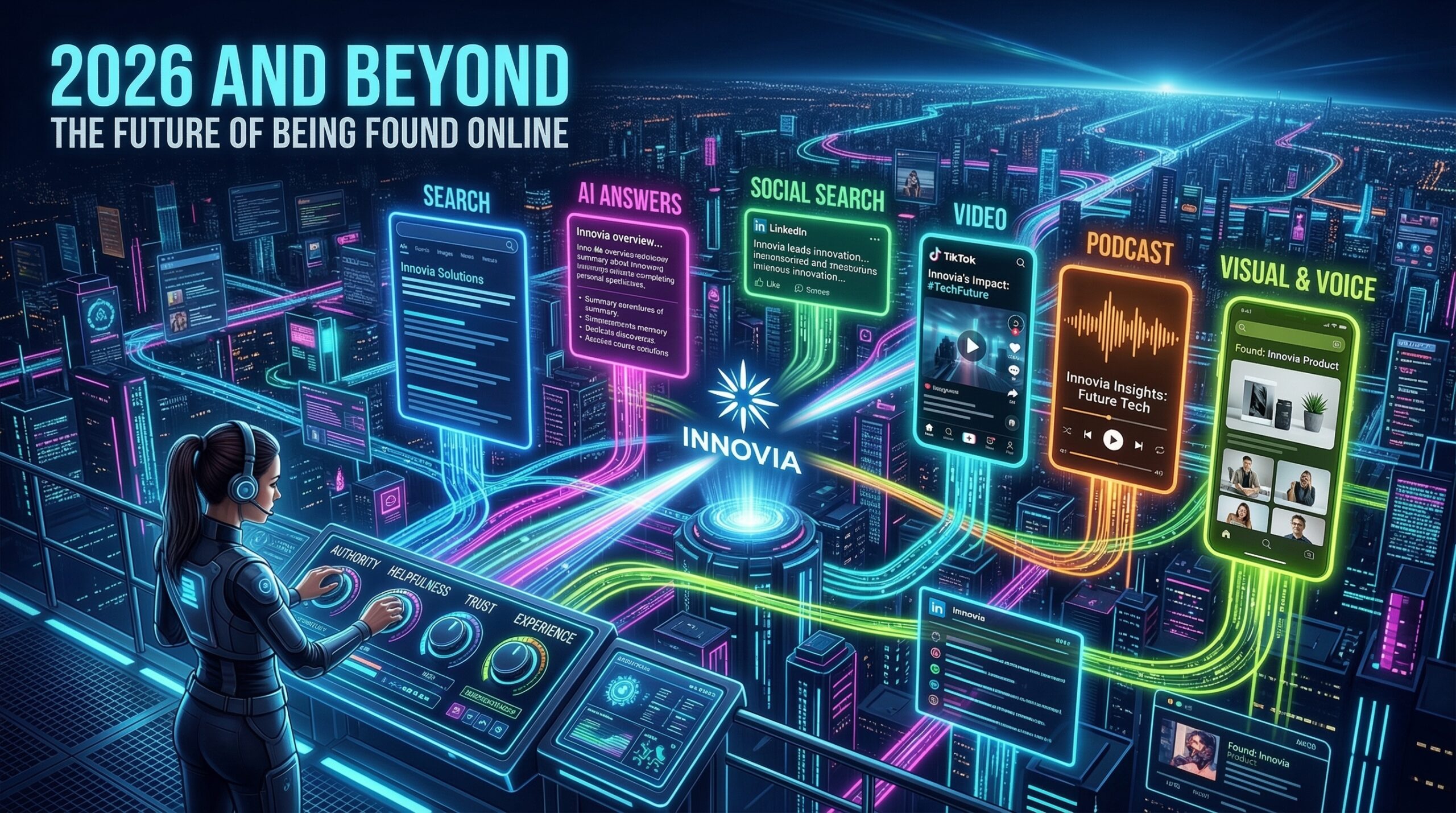
Search is not evolving. It is fracturing. Four parallel discovery channels now compete for your buyer's attention before they reach your website — and most businesses are optimising for exactly one of them.
Why "Search" Is No Longer One Thing
Four years ago, being found online meant one thing: ranking on page one of Google. The strategy was clear, the metrics were clean, and the investment was legible. That era ended between 2023 and 2025 — not with a single algorithmic shift but with a structural fracture in how buyers find information at every stage of the purchase journey.
Your ideal buyers are now distributed across four fundamentally different discovery systems before they ever reach your website. They encounter your category in AI answer engines when framing their problem. They research vendors in TikTok and YouTube search when evaluating options. They get referred via Slack channels and WhatsApp groups by people they trust. And they finally validate through traditional Google search before committing to a conversation.
The problem for most SMEs: their entire content and SEO investment is optimised for one of these four channels — usually the last one, where the buyer has already made most of their decision. The opportunity is not more content. It is presence architecture that feeds all four channels from the same content investment.
// The Structural Shift
Gartner's B2B Buying Behaviour Report 2025 found that 58% of B2B research journeys now begin inside an AI answer engine before any search engine visit. Your category awareness is being shaped before your buyer types a single Google query — by a system your SEO team has not yet instrumented, measured, or optimised for.
What Are the Four Discovery Channels — and How Does Each One Work?
Each discovery channel operates with a different selection mechanism, rewards different content signals, and intercepts your buyer at a different stage of awareness. Understanding each one as a distinct system is the prerequisite for building presence across all four.
Traditional Search
Google, Bing & Search Engine Ranking
Declining
Still the largest single channel by volume — but its share of first-touch discovery is declining as AI Overviews intercept queries before organic clicks. The channel now functions most powerfully at the validation stage: buyers who have already heard of you confirm your authority before converting. Abandoning it is not the answer; re-weighting its role in the funnel is.
E-E-A-T / Topical Clusters / Schema Markup / Core Web Vitals
AI Answer Engines
Perplexity, ChatGPT Search, Gemini, AI Overviews
Rising ↑↑
The fastest-growing first-touch discovery channel in B2B. Buyers frame their problem category in an AI engine and receive a synthesised answer citing three to five sources. If your content is not structured for AI extraction, you are absent from this conversation entirely — regardless of your Google rank. AI citation requires different structural signals than ranking.
Direct Answer Blocks / Entity Schema / FAQPage Markup / Topical Depth
Social Search
TikTok, YouTube, Instagram, LinkedIn Search
Rising ↑
Google's own internal data shows 40% of Gen Z uses TikTok or Instagram as their primary search tool for product and service discovery. YouTube is the second-largest search engine globally. Social search rewards video-format content with strong keyword signals in titles, descriptions, and chapter markers — the same signals most B2B content entirely omits.
Video SEOKeyword / Descriptions / Chapter Markers / Hashtag Strategy
Dark Social
Slack, WhatsApp, Discord, Private LinkedIn, Email
Dominant
The most influential channel for B2B purchase decisions — and the least measurable. Peer recommendations shared in private Slack channels, WhatsApp groups, and community forums drive more high-intent B2B referrals than any public channel. Your content enters dark social when it is genuinely useful enough to be forwarded. No algorithm can be gamed here. Only quality compels sharing.
Shareable Assets / Community Presence / Founder Content / Peer Referral Design
What Is Changing in How AI Systems Select Which Brands to Surface?
The mechanism by which AI answer engines choose which sources to cite is materially different from how Google ranks pages — and conflating the two is the most expensive strategic error in digital marketing right now.
Google ranking is primarily determined by link authority, topical relevance, and user experience signals accumulated over time. AI citation is primarily determined by structural extractability — whether a retrieval system can identify a clear, attributed answer from your content in a way it can include in a synthesised response without ambiguity.
Signal
AI Citation Selection (2026)
Domain Authority
Link-based authority score
Necessary baseline — not sufficient alone. DA 50+ without entity schema is frequently excluded from AI citations in favour of lower-DA sources with better structure.
Direct Answer Blocks
40–60 word self-contained answers
Critical for AI citation. AI systems extract and reproduce direct answer blocks verbatim. Absence of a structured direct answer is the single most common reason for exclusion from AI Overviews.
Entity Schema (JSON-LD)
Organisation, Person, HowTo markup
Highest-weight technical AI citation signal. AI retrieval systems use entity declarations to verify source credibility and establish topical authority before citing. Organisation + sameAs = trust verification.
Video Content
YouTube, LinkedIn, TikTok video
2.1× citation multiplier when video description contains direct answer block. AI Overviews increasingly cite video content as primary sources for how-to and explanatory queries.
Content Freshness
Recent publication and update signals
AI systems explicitly note publication dates in citations. Content over 18 months old is increasingly excluded from AI responses on fast-moving topics regardless of authority signals.
Anchor Text Distribution
Keyword-matched inbound link anchors
Zero weight. AI citation systems do not read anchor text as a relevance signal. Budgets allocated to anchor text engineering have no AI citation ROI.
Semrush's AI Overview Citation Study 2024 found that 71 percent of AI citations came from pages outside the top-three Google rankings for the same query. The content that gets cited is not the content that ranks highest. It is the content that AI retrieval systems can extract most cleanly.
What Does a Unified Presence Architecture Look Like in Practice?
A unified presence architecture is not a larger content programme. It is a content production system designed so that each piece of content created for one channel generates the signals required by all four channels — without proportionally multiplying headcount or production cost.
From our experience working with SMEs, the businesses that achieve multi-channel discovery presence with lean teams are not doing more. They are making a single strategic production decision upfront — anchoring everything around a structured primary content format that can be fractured into channel-specific assets in the same session it is created.
// Unified Presence Architecture — Five Layers
One production session → all four discovery channels
The Anchor Asset — Long-form Video or Recorded Conversation
A 20 to 45 minute recorded video or structured conversation on a specific buyer problem — with a transcript auto-generated at the point of creation. This single asset is the source material for every other layer. Nothing else is created from scratch. All subsequent assets are extracted, compressed, or structured from this one session.
YouTube Anchor / Transcript Source / AI Training Input
The AIO-Structured Article — Feeds Google + AI Answer Engines
An article built from the transcript with AIO architecture: direct answer block, H2 questions in natural language, FAQ section, HowTo or ItemList schema, and entity-linked JSON-LD. This single page simultaneously targets Google rankings, Google AI Overviews, Perplexity citations, and ChatGPT Search. No additional content creation required beyond structure and schema.
Google SEO / AI Overviews / Perplexity / Entity Schema
The Social Search Layer — Feeds YouTube + TikTok + LinkedIn
The anchor video is distributed to YouTube with a five-zone SEO description generated from the transcript. Short-form clips (60 to 90 seconds) extracted from the highest-density moments feed TikTok and Instagram Reels. A LinkedIn native video version with keyword-optimised description feeds LinkedIn search. Each platform receives channel-native content with the keyword signals required by that platform's specific search algorithm.
YouTube SEO / LinkedIn Video / TikTok Search / Short-form Clips
The Dark Social Asset — Feeds Private Sharing Networks
A standalone shareable asset extracted from the anchor content — a one-page visual framework, a specific data finding, a named decision matrix, or a short-form audio clip — designed for forwarding without context. Dark social assets do not need CTAs or branding to work. They need to be immediately, specifically useful to the recipient in a conversation they are already having. The test: would someone forward this in a Slack message without explanation?
Forwarding Asset / Community Content / Peer Referral
The Distribution Engine — Systematic Publishing Workflow
A production calendar and publishing checklist that makes layers one through four the default output from every single content session — not an occasional achievement when a team member has extra time. The architecture only compounds if it is systematic. Systematic requires documentation, assignment, and a closing quality gate that verifies each channel's specific technical requirements are met before the session is marked complete.
Production Calendar / Publishing Checklist / Quality Gates / Compound Growth
What Specifically Changes About Content Strategy Between Now and 2028?
The structural direction of online discovery is clear enough to map forward across a two-year planning horizon with meaningful confidence. The specific signal weights will shift, but the directional trends are set. Here is what we are building for — and advising the SMEs we work with to build for — on each time horizon.
Now → 12 Months
Structural Foundation
→ Implement entity schema on all core pages — the single highest-ROI technical action available today
→ Retrofit direct answer blocks to top 10 pages by organic traffic — activates existing link equity for AI citation
→ Establish YouTube and LinkedIn video channels with keyword-optimised descriptions — social search presence before algorithm saturation
→ Add AI citation tracking (Semrush AI Overview tracker) to monthly reporting dashboard
→ Identify one dark social community (Slack, Discord, LinkedIn group) where your ideal buyers gather and contribute genuinely useful content monthly
12 → 24 Months
Architecture Activation
→ Build 4–6 deep topical clusters covering your primary buyer problems — 8–12 interlinked pages per cluster for AI topical authority
→ Systematize the unified presence architecture — all five layers from every primary content session as standard workflow
→ Begin original data publication — one proprietary research finding per quarter for backlink and AI entity authority
→ Pursue 2–4 tier-1 publication placements per year — named author entity citations that AI systems verify independently
→ Measure dark social impact via UTM-tagged shareable assets and community referral tracking in CRM
24 → 36 Months
Compound Defensibility
→ Own 2–3 topic clusters where your entity authority is so established that AI systems default to citing you as the primary source
→ Achieve verified Google Knowledge Panel — the highest durable entity authority signal available
→ Build community presence in 3+ dark social channels where peer referral creates measurable self-sustaining pipeline contribution
→ Evaluate voice search and AI assistant optimisation — the emerging fifth discovery channel forming between 2026 and 2028
→ Publish annual proprietary research — the asset class that compounds into backlinks, citations, and entity authority with no ongoing maintenance
⚑ The Compounding Gap
Thirty-six months from now, there will be two categories of SME in every vertical. Those that began building the unified presence architecture in 2025 and 2026 — whose content libraries have compounded across all four discovery channels into a defensible discovery moat. And those that are only beginning to build it in 2028, facing competitors who have three years of indexed content, established entity authority, and self-sustaining dark social referral networks already in operation. The investment required to start in 2028 will not be three times higher — it will be structurally more difficult because the best positions will already be occupied.
What Common Mistakes Are Costing SMEs Their Future Discovery Presence?
From our experience working with SMEs across the transition from single-channel to multi-channel discovery, four failure patterns are consistent enough to name explicitly — because they are losing businesses their future search presence right now, not in some hypothetical future state.
Mistake 1: Treating AI search as "optional for later." Gartner's 2025 data showing 58% of B2B research beginning in AI engines is not a projection — it is a current measurement. Your buyers are already there. The brands they are encountering in AI responses are your competitors who began AIO optimisation twelve months ago. The window to establish early AI citation authority is narrowing, not opening.
Mistake 2: Publishing video without video SEO. Most B2B content teams now produce video. Almost none of them treat the video description as a searchable text document with keyword architecture, direct answer blocks, and chapter markers. The result: video content that drives YouTube subscriber counts but ranks for zero search queries on any platform. The production cost is identical. The discovery impact is fifteen times lower.
Mistake 3: Measuring discovery by Google Analytics alone. Google Analytics does not measure AI citation frequency, social search impressions, or dark social referral volume. A content programme that appears to plateau in Google Analytics may simultaneously be generating significant AI citation growth and dark social referral activity — which will eventually appear as branded search volume and direct traffic increases. Without the measurement layer, you will cut the investment before it compounds.
Mistake 4: Creating content for channels before creating content systems. The most common SME content failure pattern: building a YouTube presence, a LinkedIn presence, and a blog in three separate silos with three separate production cycles, each consuming full team capacity. One week of architecture investment — designing the unified production system before creating any more content — eliminates this fragmentation permanently.
Frequently Asked Questions
What is the future of online search and discovery in 2026?
Online search and discovery in 2026 is fracturing into four parallel channels that intercept buyers at different stages of their journey. Traditional Google search remains the largest channel by volume but is increasingly intercepted by AI Overviews that answer queries before organic clicks occur. AI answer engines including Perplexity, ChatGPT Search, and Gemini are now the first-touch channel for 58% of B2B research journeys, according to Gartner's 2025 B2B Buying Behaviour Report. Social search on TikTok, YouTube, and LinkedIn is the primary discovery channel for 40% of Gen Z buyers. Dark social — private Slack channels, WhatsApp groups, and community forums — drives more high-intent B2B referrals than any measurable public channel. Businesses found across all four channels generate 3.1 times higher qualified pipeline conversion than single-channel-only presences.
How do I get my business found on AI answer engines like Perplexity and ChatGPT Search?
AI answer engines select sources based on structural extractability rather than domain authority alone. To be cited by Perplexity, ChatGPT Search, and Google AI Overviews, your content requires five structural elements: a 40 to 60 word direct answer block immediately after each page's primary heading that answers the page's main question as a standalone statement; JSON-LD Organisation schema with sameAs links to LinkedIn and Wikipedia where available; FAQ sections with self-contained question and answer pairs; topical cluster depth of five or more interlinked pages covering your topic from multiple angles; and content freshness — AI systems explicitly filter out content older than 18 months for rapidly evolving queries. Semrush's AI Overview Citation Study 2024 found that 71% of AI citations come from pages outside the top-three organic Google rankings, confirming that structural optimisation outweighs domain authority in AI source selection.
Is Google SEO still worth investing in when AI is changing search?
Yes — but its role in the buyer journey is shifting from first-touch discovery to validation-stage confirmation. Google search remains essential because buyers who have already encountered your brand through AI answer engines or social search use Google to validate your authority and credibility before converting. A strong Google presence in 2026 requires topical authority through content cluster depth, E-E-A-T signals through author entity declarations and tier-1 publication links, and technical schema markup for rich results and AI Overview eligibility. The investment in Google SEO should continue but should no longer be the exclusive focus of discovery strategy — both because AI channels are growing faster and because the structural elements required for Google ranking and AI citation are increasingly overlapping rather than competing.
What is dark social and why does it matter for B2B discovery?
Dark social refers to content sharing that occurs through private, untrackable channels — Slack workspaces, WhatsApp groups, Discord communities, private LinkedIn messages, and email forwards. It is called "dark" because standard analytics cannot attribute the source of the visit or referral. For B2B businesses, dark social is consistently the highest-trust referral channel because recommendations arrive from peers the recipient already trusts, with context about why the content is relevant to a specific problem they are facing. Research from Limelight Networks found that 84% of outbound sharing from publisher websites occurs via dark social channels rather than trackable links. Businesses enter dark social networks by producing content genuinely useful enough to forward — not content designed to be shared but content designed to be immediately applicable to a specific problem the recipient is already solving.
How do SMEs build multi-channel discovery presence without increasing headcount?
The unified presence architecture achieves multi-channel discovery from a single content production session by anchoring every content investment in one primary long-form video or recorded conversation, then systematically extracting channel-specific assets from that anchor. From one 30 to 45 minute session, the production system generates: a YouTube video with five-zone SEO description for social search; an AIO-structured article with entity schema for Google search and AI citation; short-form video clips for TikTok and Instagram social search; a LinkedIn-native video variant; and one standalone shareable asset for dark social distribution. Total additional production time per session beyond the anchor recording: 60 to 90 minutes of structured extraction work. This approach produces 8 to 12 distribution assets from a single session, reducing per-asset production cost by 70 to 80 percent compared with creating each channel's content independently.
The Window to Build This Is Now, Not Later
Every week you operate with a single-channel discovery presence is a week your buyers are encountering your competitors first — in the AI engine they used to frame their problem, in the TikTok search that explained their options, in the Slack community where a peer recommended someone specific.
The presence architecture described above is not a three-year project. The structural foundation — entity schema, direct answer blocks on existing pages, a YouTube channel with proper video SEO — can be in place within thirty days. The systematic production workflow that makes unified presence the default can follow in sixty. The compounding begins the moment each piece is published.
What changes in six months is not the technology or the strategy. What changes is the competitive distance between the businesses that started building this in Q1 2026 and those that are still deciding whether to start.