
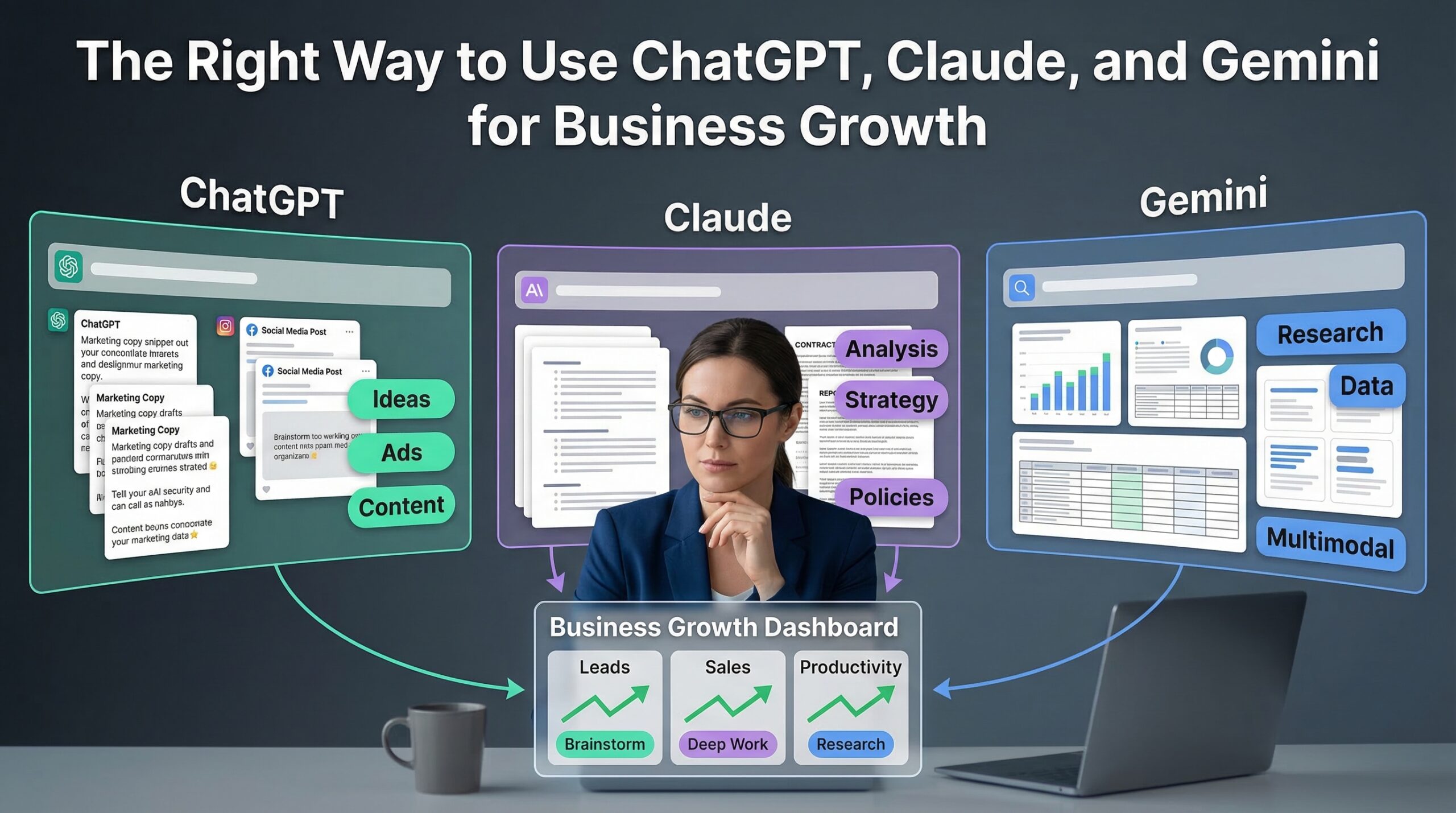
Direct Answer: The right way to use ChatGPT, Claude, and Gemini for business growth is to deploy each according to its specific strength: Claude for long-form content, nuanced writing, and document analysis; ChatGPT for structured output, social formatting, and plugin-connected workflows; and Gemini for real-time research, Google Workspace integration, and multimodal tasks. Using all three as a coordinated three-model stack — rather than one model for everything — reduces per-output cost, increases quality per task category, and eliminates the quality ceiling of any single model.
// Model Strength Index
ChatGPT // OpenAI
Best for: structured output, format-sensitive tasks, plugin integrations, high-volume social content
Claude // Anthropic
Best for: long-form writing, nuanced analysis, document reasoning, transcript-to-article quality
Gemini // Google DeepMind
Best for: real-time data, Google Workspace integration, multimodal tasks, search-informed research
Use all three, selectively
// Field Brief
ChatGPT, Claude, and Gemini are not interchangeable. Each has a distinct strength profile and a defined set of business use cases where it outperforms the others. Using all three correctly — as a coordinated production stack — produces better outcomes at lower cost than any single model used for everything.
// 01 · The Misconception
Why Is Using One AI Model for Everything the Most Expensive Mistake in Business AI Adoption?
The most common pattern we see when working with SMEs adopting AI tools is the single-model trap: a founder discovers ChatGPT, subscribes to the Pro tier, and uses it for everything — email writing, content strategy, research, financial analysis, customer service scripts, and social media posts. The output is adequate for most tasks. But adequate is not the same as optimal, and the quality gap between the right model for a specific task and the default model for all tasks is measurable, consistent, and commercially significant.
The three leading AI models — ChatGPT (OpenAI), Claude (Anthropic), and Gemini (Google DeepMind) — are trained on different data, optimised for different output types, and architecturally suited to different task categories. Using Claude for the task categories where ChatGPT excels produces weaker output. Using ChatGPT for the task categories where Claude excels produces weaker output. Using either for the research and integration tasks where Gemini excels produces both weaker output and higher research time.
// The Real Cost of Single-Model Lock-In
A founder paying £20/month for ChatGPT Pro and using it as their only AI tool is not paying for one tool — they are paying full price for a tool they use at 60% efficiency for the content and analysis tasks where Claude would produce materially better output, and at 40% efficiency for the research tasks where Gemini's real-time data access would eliminate the manual verification step they are currently doing in a separate browser tab. The three-model stack costs approximately £60/month total. The single-model approach costs £20/month for output that is consistently sub-optimal in two of the three primary AI use case categories.
Understanding why each model has a distinct strength profile requires understanding what each model was optimised to do — which is not the same as what each model can do. All three can write emails, generate content, and answer questions. But the architectural and training differences that make Claude the best long-form writer, ChatGPT the best format-compliance executor, and Gemini the best real-time researcher are not marginal — they are the direct commercial consequence of different design priorities, training data compositions, and optimisation targets.
// 02 · The Model Profiles
What Are the Specific Strengths and Best Business Use Cases for Each AI Model?
ChatGPT // OpenAI · GPT-4o and above
// Primary Strength
Structured output compliance, format-sensitive production tasks, plugin-connected workflows, and high-volume social content where consistent formatting matters more than creative depth. ChatGPT follows format instructions with the highest reliability of the three models — critically important for tasks where the output must meet a specific structural requirement (word count, bullet format, character limit, HTML structure) rather than where expressive quality is the primary metric.
Social media posts / Email templates / Structured data output / Custom GPT workflows / Plugin integrations / Short-form content
Claude // Anthropic · Claude Sonnet 4.6 and above
// Primary Strength
Long-form written output quality, nuanced analysis, document and transcript reasoning, and the register conversion from spoken to written language that makes transcript-to-article production reliable. Claude produces the highest-quality long-form blog articles, case study narratives, and in-depth analysis documents of the three models — and is the most reliable model for processing long transcripts, legal documents, financial reports, and research papers while maintaining analytical coherence across the full document length.
Blog articles / Transcript-to-article / Case studies / Document analysis / Email sequences / Strategy documents
Gemini // Google DeepMind · Gemini 2.5 Pro and above
// Primary Strength
Real-time information access, Google Workspace integration (Gmail, Docs, Sheets, Slides), multimodal reasoning across text and image inputs, and research tasks requiring current data that is beyond the training cutoff of static models. Gemini's native integration with the Google ecosystem makes it the highest-efficiency model for founders already operating in Google Workspace — eliminating the copy-paste workflow between AI tools and office applications that adds 20–40 minutes to every AI-assisted research or document creation session.
Market research / Real-time data / Google Workspace / Image analysis / Competitive intelligence / Current events
// The Model Selection Rule
Before running any AI task, ask one question: is the primary success metric for this output quality of expression (Claude), compliance with a specific format or structure (ChatGPT), or accuracy of current information (Gemini)? The answer determines which model to use. Asking this question consistently — for every task, every session — is the practice that converts single-model efficiency to three-model leverage within 30 days of adoption.
// 03 · The Matrix
Which Specific Business Tasks Should Go to Which AI Model?
The use case matrix below is not a preference ranking — it is an efficiency ranking based on output quality measurement across task categories. The "Best" classification indicates the model that consistently produces output requiring the least editing time to reach publication standard, based on real-world production data from SME content and business operations programmes.
Business Task
ChatGPT
Claude
Gemini
Long-form blog article
1,500–3,000 words, SEO-optimised
Good
Best
Good
Social media posts
LinkedIn, Twitter/X, format-specific
Best
Good
Good
Transcript-to-article conversion
Spoken-to-written register conversion
Good
Best
Adequate
Market research
Competitive analysis, current data
Good
Good
Best
Email nurture sequence
3-part B2B sequence, conversion-optimised
Good
Best
Good
Structured data / JSON output
Schema markup, data transformation
Best
Good
Good
Document analysis
Contracts, reports, long PDFs
Good
Best
Good
Google Workspace tasks
Gmail, Docs, Sheets automation
Adequate
Adequate
Best
Custom workflow automation
GPT plugins, API calls, structured pipelines
Best
Good
Good
Case study narrative
Situation-challenge-result structure
Good
Best
Adequate
From our experience running content production systems for SMEs, the three task categories with the largest quality differential between the optimal model and the default model are: long-form writing (Claude versus ChatGPT — average 35% editing time reduction), real-time research (Gemini versus Claude — eliminates manual verification entirely), and structured JSON or schema output (ChatGPT versus Claude — near-zero formatting error rate versus 15–20% correction rate). These are the three task categories where model selection has the most direct commercial impact on production efficiency.
// 04 · The Prompt Architecture
What Prompt Structure Produces the Highest-Quality Output From Each Model?
The single biggest quality improvement available to any founder using AI tools is not switching to a better model — it is building better prompts for the models they already have. The prompt is the instruction set that determines what the model attempts to produce. A weak prompt given to the right model produces worse output than a strong prompt given to the wrong model in most task categories.
The five-part prompt architecture works across all three models with minor model-specific adjustments. The core structure is consistent because it addresses the five informational requirements that all three models need to produce high-quality task-specific output: the goal, the audience, the output structure, the constraints, and the format. Missing any one of the five parts reliably reduces output quality in a predictable way.
// Five-Part Prompt Architecture — Works Across All Three Models
// GOAL
State the specific task with the primary success metric. Not "write a LinkedIn post" but "write a LinkedIn post that stops a B2B founder scrolling and positions [claim] as counterintuitive but credible." The goal includes what success looks like, not just what the output type is.
// AUDIENCE
Describe the specific reader — their role, sophistication level, primary concern, and the assumption you want to challenge. The model calibrates vocabulary, tone, and argument density to this specification.
// STRUCTURE
Specify the required output structure explicitly: section order, word count per section, heading format, paragraph length, and any mandatory elements (direct answer block, FAQPage pairs, H2 question format). This is the field where ChatGPT most directly outperforms the other models when the structure is complex.
// CONSTRAINTS
State what not to do: no generic marketing language, no filler phrases, no beginner explanations, no passive voice, no hedge qualifiers, no lists where prose is appropriate. Constraints eliminate the most common quality failures before the model generates them.
// FORMAT
Specify the output format precisely: plain text, markdown, semantic HTML, JSON-LD, or a named structured format. Include any schema or code format requirements. For Claude, specify that the output should feel like expert-written prose, not AI-generated text. For ChatGPT, specify the exact structural format with character or word count limits. For Gemini, specify whether the output should reference current data sources.
The model-specific adjustments to this architecture are small but commercially significant. For Claude: add "write as a senior expert who has worked with dozens of SMEs in this space — precise, opinionated, and practical" to the constraint field. For ChatGPT: add explicit format character counts and specify "output as numbered list / bulleted list / table / structured markdown" when the format matters — ChatGPT's compliance with explicit format instructions is measurably more reliable than the other two models. For Gemini: add "search for current data from the past 90 days to support this analysis" to the goal field when the task benefits from real-time information.
// 05 · The Business Growth Stack
How Do You Build a Three-Model AI Stack That Compounds Business Growth Systematically?
The three-model AI stack is not three separate subscriptions — it is an integrated production architecture where each model handles the task category it is most efficient at, and the outputs from one model feed into the inputs for another. The integration is what converts three adequate AI tools into one high-performance business growth system.
The right way to use AI for business growth is not to use one tool better. It is to build a production system where the right tool handles the right task — and the outputs compound into authority, discoverability, and revenue automatically.
// The core distinction between AI tool usage and AI production system architecture for SME business growth
01 Research Phase — Gemini Handles All Current-Data Intelligence
Every piece of content production, competitive analysis, and market positioning work begins with a Gemini session that answers the current-data questions the other two models cannot answer reliably: What has changed in this market in the past 90 days? What are competitors publishing on this topic? What data points from verified sources support the article's primary claim? What questions are buyers actually asking right now on this topic? Gemini's real-time search access and Google ecosystem integration make it 40–60% faster for research tasks than running the same research manually in a browser — and it eliminates the common AI failure mode of confident confabulation from training data that is 12–18 months out of date. Save the Gemini research output as a brief that feeds directly into the Claude writing session. This creates a research-to-writing pipeline that maintains factual accuracy while allowing Claude to focus entirely on the writing quality optimisation it does best.
02 Production Phase — Claude Handles All Long-Form Writing and Analysis
Feed the Gemini research brief into Claude using the five-part prompt architecture with Claude-specific constraint instructions. Claude's long-form writing quality is most visibly superior in four specific output characteristics: prose that reads as genuinely expert rather than as AI-generated (register authenticity), logical argument coherence maintained across 2,000+ words without repetition or contradiction, nuanced position-taking that acknowledges trade-offs without hedging all claims to meaninglessness, and register conversion from transcript to article that preserves the speaker's argument structure while converting spoken idiom to written precision. For the content repurposing system — where one recorded video becomes seven content assets — run the transcript-to-article prompt through Claude for the blog article and email sequence, and the Twitter/X and LinkedIn prompt through ChatGPT for the social posts. The split takes 12 additional seconds per session and produces measurably better output in both categories than using either model alone for both.
03 Distribution Phase — ChatGPT Handles All Structured Formatting and Social
ChatGPT handles the distribution-ready formatting tasks: social media posts with exact character limits, email subject line variations in specific formats, structured data output for schema markup (Article, FAQPage, VideoObject JSON-LD), and any output where the format compliance matters as much or more than the expressive quality. For the AI content repurposing system, this means running the LinkedIn post prompt and Twitter/X thread prompt through ChatGPT using the format-explicit version of the five-part prompt architecture — specifying exact character counts, bullet formats, and platform-native structural conventions that ChatGPT handles more reliably than Claude. For schema markup, use ChatGPT with the specific schema.org field requirements as the structure specification in the prompt — its JSON output reliability is measurably higher than the other two models, producing near-zero formatting errors in structured data output that Claude and Gemini occasionally introduce when handling complex schema nesting.
04 Iteration Phase — Use Model Strengths for Review and Improvement
The iteration phase uses model-specific capabilities for output review: paste Claude-generated long-form content back into Gemini for fact-checking against current data sources (Gemini will identify any claims that contradict recent data or require updating based on information published after Claude's training cutoff). Paste ChatGPT-generated social posts into Claude for tone and authenticity review (Claude will identify posts that read as promotional or generic and suggest more precise, expert-voiced alternatives). Paste Gemini research briefs into ChatGPT for structured output transformation when the research needs to be converted into a specific report or template format. This cross-model review creates a quality verification loop that catches the specific failure mode of each model — Claude's occasional overconfidence on specific data points, ChatGPT's occasional format-over-substance trade-off, and Gemini's occasional source citation inconsistency — before those failures reach published content.
05 Infrastructure Phase — Clipkoi Handles VideoObject Schema and Host Page Production
The AI production stack's final output layer is the video discovery infrastructure that converts every recording into a rankable, AI-citable, entity-attributed business asset. After Claude generates the transcript article and ChatGPT generates the social distribution content, the VideoObject schema and host page production step is handled by Clipkoi — generating the exact JSON-LD schema fields (name, description, thumbnailUrl, uploadDate, duration, embedUrl) and the host page structure that attributes every video's ranking equity to your owned domain rather than YouTube. This step completes the content production system's loop: the Gemini research feeds Claude's writing, which feeds ChatGPT's distribution formatting, which feeds Clipkoi's schema infrastructure — producing a fully schema-marked, entity-verified, AI-citable content asset from a single recording session in approximately 90 minutes of total AI-assisted production time.
Frequently Asked Questions
What is the difference between ChatGPT, Claude, and Gemini for business use?
The key differences between ChatGPT, Claude, and Gemini for business use are their strength profiles across output quality, format compliance, and data currency. Claude (Anthropic) produces the highest-quality long-form written output — blog articles, email sequences, case studies, and transcript-to-article conversions — and is the best model for document analysis and nuanced strategy writing. ChatGPT (OpenAI) has the highest format-instruction compliance of the three models, making it the best choice for social media posts, structured data output, JSON schema generation, and any task where the output must meet specific format requirements. Gemini (Google DeepMind) has real-time internet search access and native Google Workspace integration, making it the best choice for market research, competitive analysis, current data verification, and any task requiring information more recent than the static training cutoffs of Claude or ChatGPT. Using all three according to their strength profile — rather than one model for all tasks — reduces per-output editing time by 35–50% across the primary business content categories.
Which AI model is best for content marketing and SEO?
For content marketing and SEO, the optimal approach is a three-model workflow rather than a single model. Claude is best for the actual content writing — blog articles, pillar content, case study narratives, and email sequences — because its long-form prose quality and register authenticity produce output that reads as genuinely expert-written rather than AI-generated. ChatGPT is best for the structured data and schema markup components — Article JSON-LD, FAQPage schema, VideoObject schema — because its format instruction compliance produces near-zero error JSON output that Claude occasionally introduces formatting inconsistencies in. Gemini is best for the research phase — identifying current data points, competitor content gaps, and buyer search intent patterns — because its real-time search access produces research briefs that are current to the week of writing rather than to the model's training cutoff. Together, the three-model workflow produces SEO and content marketing assets that are better researched, better written, and more reliably schema-marked than any single model can produce across all three functions.
How much do ChatGPT, Claude, and Gemini cost for business use?
The monthly cost for running all three AI models at business production volume is approximately £55–£65 per month in total: Claude Pro costs approximately £18–£22 per month (Anthropic pricing varies by region), ChatGPT Plus costs approximately £20 per month (OpenAI), and Gemini Advanced costs approximately £17–£19 per month (Google). At full production volume of one video per week with the seven-output repurposing system, this combined cost of approximately £60 per month replaces content production services that would otherwise cost £2,000–£4,000 per month from an agency — a 33–67× cost leverage ratio on the tool investment. The split across three models rather than one is commercially justified not by cost but by output quality: the same £60 spent across three specialised models produces measurably better output per task category than £60 spent on a single model subscription and £40 unused.
Is Claude better than ChatGPT for writing business content?
Claude consistently produces better long-form business writing than ChatGPT across the specific quality dimensions that determine whether content generates authority and AI citation appearances: prose authenticity (the degree to which the output reads as expert-written rather than AI-generated), argument coherence over long document lengths, and the register conversion quality when processing spoken transcripts into written articles. ChatGPT produces better output than Claude for social media posts, structured data generation, and format-sensitive tasks where the specific character count, bullet structure, or JSON format compliance is the primary success metric. The most accurate answer is that Claude is better than ChatGPT for writing business content in the categories where expressive quality is the primary metric, and ChatGPT is better than Claude in the categories where format compliance is the primary metric. The practical business decision is to use Claude for blog articles, email sequences, and case studies, and ChatGPT for social posts, schema markup, and structured templates.
When should I use Gemini instead of ChatGPT or Claude?
Use Gemini instead of ChatGPT or Claude in three specific scenarios: when the task requires current information that is more recent than the static training cutoffs of the other two models (market research, competitor analysis, current event summaries, or data from the past 6–12 months); when you are working within the Google Workspace ecosystem and need the AI output to integrate directly with Gmail, Google Docs, Google Sheets, or Google Slides without copy-paste workflow interruption; and when the task involves multimodal inputs where you are analysing images alongside text — Gemini's image reasoning capability is the most developed of the three models for business analysis tasks involving screenshots, diagrams, product images, or visual data. For all other business content production tasks — writing, analysis of documents you upload, and structured output — Claude or ChatGPT will typically produce better results than Gemini at the equivalent subscription tier.
→ The Operator's Decision
The Three-Model Stack Is Not a Tech Investment — It Is a Production Infrastructure Decision
The founders who produce the most consistent, highest-quality AI-assisted content in 2026 are not the ones using the most sophisticated prompts with a single model. They are the ones who understand that each model is a specialist tool and treat them accordingly — routing each task category to the model most architecturally suited to produce excellent output in that category, with minimal editing overhead.
Six months of operating the three-model stack with model-appropriate routing produces a content library that is better researched (Gemini), better written (Claude), and more reliably formatted for distribution and schema markup (ChatGPT) than a six-month library produced by any single model. The quality differential is visible in the AI Overview citation rate, the editorial polish of the published content, and the reduction in per-output editing time — three metrics that compound directly into business growth.
The decision to adopt the three-model stack is not a technology decision. It is a production infrastructure decision — the same decision a serious publisher makes when they hire specialists for different roles rather than generalists for all roles. The models are your specialists. Route accordingly.