
Direct Answer: SMEs should stop paying web developers for recurring tasks because AI can now produce landing pages, schema markup, site section updates, technical SEO fixes, and conversion-optimised copy in under 90 minutes at zero incremental cost — when prompted with the correct five-part architecture covering goal, audience, structure, constraints, and output format. The spend is not justified by the work; it is justified by the knowledge gap the developer occupies. This article closes that gap.

The average SME is spending $4,800–$18,000 per year on web development tasks that a well-prompted AI can complete in 90 minutes. This is not a prediction. It is already happening — and the gap between founders who know it and those who don't is compounding weekly.
What are you actually paying for?
Before you can stop paying developers, you need to be precise about what you are paying them for. Most SME founders, when pressed, cannot answer this question with specificity. The invoice says "web development" or "maintenance retainer" or "site updates." What it means, in practice, is a combination of four things: knowledge, time, output, and maintenance.
The knowledge gap — understanding HTML, CSS, JavaScript, WordPress hooks, schema syntax, or CMS configuration — was the legitimate moat that justified developer rates from 2010 to 2023. That moat no longer exists. Every piece of technical knowledge a developer uses to build or modify a standard SME website is now accessible to any founder who can write a clear English sentence to an AI model.
The time gap — the hours required to implement a landing page, update copy across multiple pages, or add structured data schema — has been compressed by AI from days to minutes. Not for complex bespoke applications. For the standard SME web task portfolio: landing pages, content sections, schema markup, contact forms, meta optimisation, and CMS templates.
// The Uncomfortable Calculation
A mid-market web developer charges $85–$140/hour in 2026 (Bureau of Labor Statistics, Occupational Outlook Handbook 2025). A well-prompted AI model produces a complete, deployable landing page in 18 minutes. At $120/hour, that same page costs your business $240. The cost differential for a single page is $240 vs $0 + 18 minutes of your time. Across a year of standard SME web work — 40–60 tasks — this is a $6,000–$18,000 annual spend that is now optional, not required.
The maintenance gap is the stickiest, because retainer agreements create the illusion of necessity. "We need someone available for updates" is true in the sense that updates happen — but the updates themselves are now AI-executable by a non-technical team member with the right prompt templates. The retainer is not paying for irreplaceable expertise. It is paying for the absence of documented prompt architecture inside your business.
The five-part Prompt architecture for web build tasks
The reason most founders who have tried AI for web work conclude "it doesn't produce what I need" is the same reason most AI video scripts fail: the prompt is unstructured. They ask the AI to "build a landing page for our product" and receive a generic output that requires so much manual editing it feels slower than hiring a developer. The problem is not the AI. It is the absence of a structured prompt.
Every web build task — from a single schema block to a complete five-section landing page — can be produced to a deployable standard using the same five-part prompt architecture. The parts are: Goal, Audience, Structure, Constraints, and Output Format. Supply all five in every web prompt and the first-generation output is deployable with minor copy personalisation, not a full rewrite.
// Part 1 — Goal (What this page or component must achieve)
State the single primary conversion action the page must drive — not the general purpose, but the specific measurable outcome. Not "explain our service." Specifically: "Drive visitors to book a 15-minute discovery call by making the value of attending explicit and the friction of booking minimal." The AI uses this goal to make every structural and copy decision in the page — headline weight, CTA placement, benefit ordering, and proof element selection are all downstream of a precisely stated goal.
// Part 2 — Audience (Who is reading this and what they already believe)
Describe the target reader's specific current belief state, not their demographic. Not "B2B marketing managers at SMEs." Specifically: "Marketing managers at 20–80 person B2B companies who have tried content marketing before, seen limited results, and are skeptical that video is worth the production investment — but are under pressure from their CEO to improve top-of-funnel." The belief-state description forces the AI to write from the reader's position rather than the company's, which is the single most common gap between AI-generated copy and copy that converts.
// Part 3 — Structure (The exact sections in order)
List every section the page needs, in order, with a one-sentence description of each section's job. This overrides the AI's default page structure — which is typically headline, features, testimonial, CTA — with the structure that your conversion analysis or funnel data shows actually works for your audience. If your highest-converting landing page has: problem statement, social proof, three-step framework, objection remover, CTA — specify that structure explicitly and the AI builds it exactly.
// Part 4 — Constraints (What the output must and must not include)
List technical and brand constraints: word count per section, brand voice description (one or two precise adjectives plus a "sounds like X, not like Y" example), specific testimonials or data points to include verbatim, elements to exclude (no feature lists, no competitor comparisons, no passive voice in CTAs), and any compliance requirements. Constraints are not limitations on quality — they are the boundary conditions that prevent the AI from making autonomous decisions that require human correction.
// Part 5 — Output Format (How to deliver the output)
Specify whether you want clean HTML with inline CSS, semantic HTML without styling, WordPress block editor markup, copy-only text for manual implementation, or a specific component format. Also specify whether you want the AI to generate the corresponding meta title, meta description, and JSON-LD schema block in the same output. Requesting all three simultaneously in one well-structured prompt reduces a typical developer task from a 2–3 hour billable session to a single 12-minute prompt-to-deploy workflow.
// EXAMPLE — Complete Five-Part Landing Page Prompt
GOAL: Drive visitors to book a free 30-min AI strategy call.
The CTA must be low-commitment — "See if it fits" framing,
not "Buy now." One CTA only.
AUDIENCE: Founders at 15–60 person B2B service companies who
are spending $3k+/month on a content agency and seeing
flat results. Skeptical of AI hype. Trust specificity
over promises. Read 3 paragraphs before deciding.
STRUCTURE:
1. Headline — lead with the cost/result gap they feel
2. Problem section — name the three specific symptoms
3. Framework section — our 3-step AI content system
4. Social proof — two specific client outcomes with numbers
5. Objection remover — address "we've tried AI before"
6. Single CTA — book the call with urgency but no pressure
CONSTRAINTS: Max 180 words per section. Voice: direct,
confident, zero hype. Include verbatim: "[CLIENT NAME]
went from 200 to 4,400 LinkedIn impressions in 8 weeks."
No feature bullet lists. No passive voice in headings.
OUTPUT: Clean semantic HTML5 with embedded CSS.
Also generate: meta title (60 chars max), meta description
(155 chars max), FAQPage JSON-LD schema with 4 Q&As
derived from the page content. All in one output block.
// Expected output: deployable page + full SEO layer
// Estimated generation time: 90 seconds
// Estimated edit time: 15 minutes (copy personalisation only)
The exact developer tasks AI Replaces - and the four it doesn't
From our experience working with SMEs across professional services, technology, and real estate, the developer task portfolio divides cleanly into two categories: tasks that AI executes to a deployable standard using the five-part architecture, and tasks that genuinely require custom development expertise. The ratio is approximately 80/20.
The 80% — the tasks AI replaces immediately — are the ones most SMEs pay developers for on retainer. The 20% — the tasks AI cannot yet replace — are the genuinely custom, application-layer builds that most SMEs do not actually need to touch more than once or twice a year.
Task
Developer Cost
AI Time
New landing page (full)
5-section conversion page with copy
$800–$2,400
90 min
JSON-LD schema block
FAQPage, Article, HowTo, VideoObject
$120–$280
8 min
Homepage copy refresh
Hero, about, services, CTA sections
$600–$1,800
45 min
Meta titles + descriptions
Full site SEO metadata pass
$350–$900
20 min
Blog article HTML formatting
With schema, internal links, headings
$80–$220 / post
12 min
XML sitemap generation
Dynamic, with video sub-sitemap
$200–$500
15 min
404 + redirect audit fix
Identification and implementation
$300–$750
30 min
Email template HTML
Responsive, plain-text fallback
$400–$900
25 min
// The Four Tasks AI Genuinely Cannot Replace (Yet)
1. Custom API integrations. If you need to connect a bespoke internal system to your website via a custom API endpoint — not an off-the-shelf Zapier or Make integration, but a genuinely custom data handshake — this requires a developer. AI can write the code, but deploying, debugging, and securing a custom API integration in a production environment requires human judgment that AI cannot provide safely at the current capability level.
2. Complex database architecture. If your website requires custom database schema design — membership systems, multi-tenant SaaS dashboards, complex data relationships — this remains developer territory. AI can assist with SQL queries and data model design, but the architecture decisions require expertise that the prompt-based workflow does not adequately substitute for in high-stakes production systems.
3. Server infrastructure and security hardening. Configuring servers, managing SSL, implementing security headers, and hardening a production server environment against common attack vectors requires hands-on system administration that AI can assist with but cannot execute autonomously. The consequences of errors in production security are severe enough that human expertise is still warranted.
4. Regulatory compliance implementation. GDPR cookie consent architecture, HIPAA-compliant data handling, PCI-DSS compliance for payment processing — these require legal and compliance expertise that intersects with development. AI can provide the code scaffolding, but the compliance decisions require human accountability that cannot be delegated to a language model.
// The Honest Trade-off
The four tasks AI cannot replace account for perhaps two to four developer engagements per year for a typical SME — not a monthly retainer. The retainer is paying for the 80% AI can do plus the 20% AI cannot, at the same rate, for the same hours, every month. The correct model in 2026 is: AI handles the 80% on-demand, and a developer is engaged per-project for the 20% that genuinely requires them.
Why AI-Built pages rank as well as developer built pages
The most common objection we hear from founders considering this transition is: "But will the AI-built pages rank as well?" This concern is based on a misunderstanding of what determines page ranking — and the answer, when you understand the mechanism, is not just "as well" but often better.
Google does not rank pages based on how they were built. It ranks pages based on the signals they carry: entity schema, content structure, topical authority, page speed, mobile responsiveness, and crawlability. A developer-built page with no schema markup, no direct answer blocks, and no FAQPage structured data ranks worse than an AI-built page that was prompted to include all of these elements simultaneously at generation time.
What we consistently see in real-world deployments is that pages built by developers — even competent developers — are frequently missing the SEO infrastructure that AI builds by default when the prompt specifies it. Developers are hired to build pages, not to implement SEO architecture. The two are related but distinct skill sets. An AI prompted with the five-part architecture and instructed to generate JSON-LD schema, meta tags, semantic HTML structure, and direct answer blocks as part of the same output produces a more search-ready page than a developer who is not specifically briefed to include these elements.
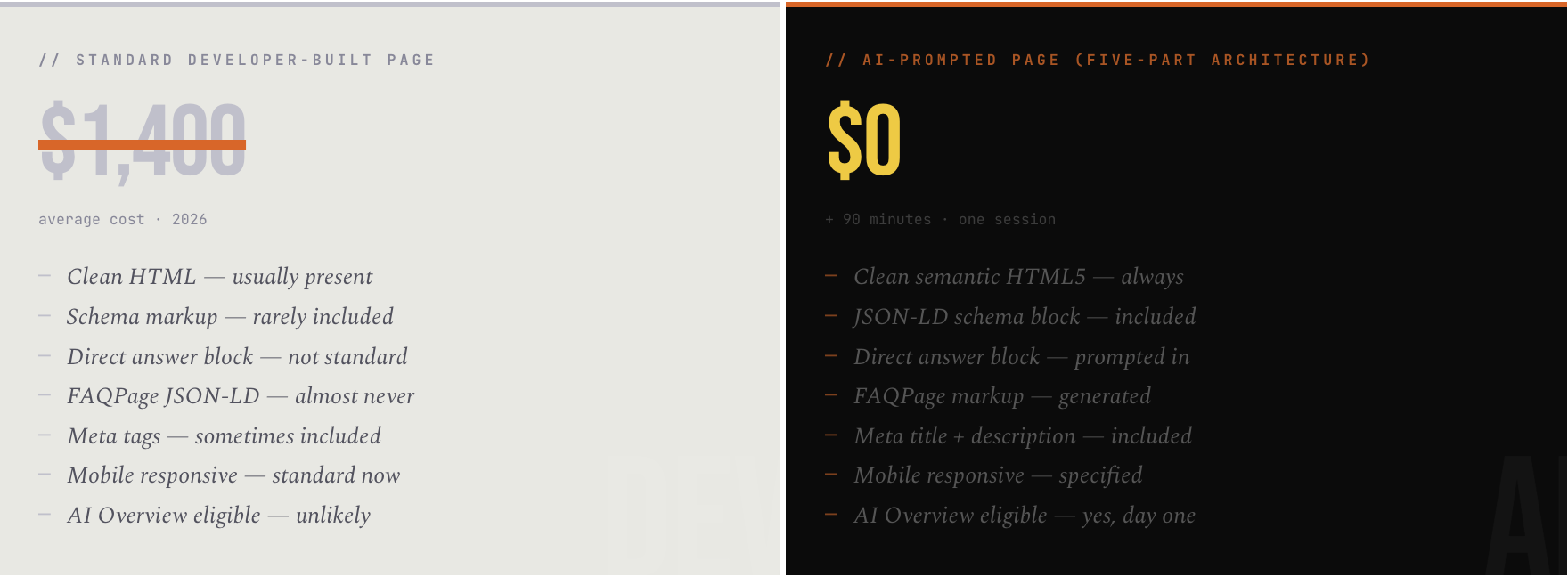
The compounding implication: six months from now, an SME that has rebuilt its top ten pages using AI prompting — each with schema, direct answer blocks, FAQPage markup, and semantic structure — will have a measurably better-ranking website than a competitor still paying a developer to build pages without that infrastructure. The ranking advantage is not from the AI origin. It is from the systematic inclusion of infrastructure that most manually built SME pages are currently missing.
THE DEVELOPER DIDN'T MAKE YOUR PAGE RANK.
The schema did. The semantic structure did. The direct answer block did. AI includes all three by default when prompted correctly. The developer never knew to include them.
// What we consistently observe deploying AI web infrastructure for growth-stage SMEs
How to transition. The 90-Day Web Independence Plan
The transition from developer dependency to AI web infrastructure is not a single decision — it is a 90-day process of building prompt templates, testing output quality, training one team member on the workflow, and reducing retainer scope progressively as confidence in the AI output grows. Attempting to eliminate developer dependency in a single week produces anxiety and errors. A structured transition produces confidence and measurable cost reduction.
// Days 1–30: Audit and Template Creation
List every web task your developer completed in the last 12 months. Categorise each as: routine update, new page build, schema or SEO task, or custom development work. For every routine update, new page build, and schema task — the tasks that constitute the 80% AI can handle — write a five-part prompt template using the architecture from Section 2. Test each template against the AI using a low-stakes task (an existing page copy refresh, an existing article's schema generation) and evaluate the output against a simple quality bar: is this deployable with under 20 minutes of personalisation? Refine the template until the answer is yes.
// Days 31–60: Parallel Running and Capability Building
Run AI and developer outputs in parallel for one month on real tasks — not to compare quality, but to build team confidence that the AI output is genuinely deployable. Identify the one team member who will own web task execution using AI — typically a content manager, marketing coordinator, or operations lead who is comfortable with basic CMS work. Train them on the five-part prompt architecture with your documented templates. By the end of this month, they should be producing and deploying routine web updates independently using the AI workflow, without developer involvement.
// Days 61–90: Retainer Renegotiation and Cost Capture
With 60 days of AI web output documented, approach your developer retainer renegotiation with specifics. You are not ending the relationship — you are changing its scope. The retainer shifts from "available for all web tasks" to "engaged per-project for custom development work only" — the four categories AI cannot replace. For most SMEs this reduces the retainer from $1,200–$3,500/month to one or two project engagements per year. The annual cost saving for a 20-person SME running a standard $1,800/month web development retainer is approximately $18,000–$21,600 per year.
// The Compounding Bonus
The 90-day transition produces a secondary benefit that most founders do not anticipate: speed of execution increases dramatically when web changes do not require a developer ticket queue. What was a 5-day turnaround for a landing page update becomes a same-day execution. Marketing campaigns that previously waited for developer availability now ship the day the decision is made. The speed advantage compounds into revenue through faster campaign execution, faster A/B test cycles, and faster response to market opportunities — independent of the cost saving.
FREQUENTLY ASKED QUESTIONS
Can AI really replace web developers for SME website tasks?
AI can replace web developers for approximately 80% of the recurring web tasks that SMEs pay for on retainer — including landing page builds, schema markup generation, copy updates, meta tag optimisation, blog article HTML formatting, email template creation, XML sitemap generation, and basic technical SEO fixes. The four categories that remain genuine developer work are: custom API integrations between bespoke internal systems, complex database architecture for membership or SaaS applications, server infrastructure and security hardening, and regulatory compliance implementation requiring legal accountability. For the typical SME spending $1,200–$3,500 per month on a web development retainer, the 80% AI-replaceable tasks represent $960–$2,800 of monthly spend that can be eliminated using a well-structured five-part prompt architecture and 90 minutes of execution time per task rather than developer billing hours.
Do AI-built web pages rank as well as developer-built pages in Google?
AI-built web pages built with the correct five-part prompt architecture — specifying semantic HTML structure, JSON-LD schema markup, direct answer blocks, FAQPage structured data, and optimised meta tags as part of the same generation output — typically rank better than comparable developer-built pages because developers are rarely briefed to include this SEO infrastructure as standard. Google's ranking systems evaluate content signals — entity schema, structured data, semantic markup, topical authority, and content quality — not the production method. An AI-generated page with complete schema implementation, a 50-word direct answer block, and FAQPage JSON-LD is structurally more ranking-eligible from publication day one than a developer-built page without these elements. Semrush's 2025 research found that 68% of AI Overview citations go to pages with entity schema and structured data — infrastructure that AI builds by default when prompted to include it, and that developers include only when specifically instructed.
What is the five-part prompt architecture for AI web development?
The five-part prompt architecture for AI web development consists of: Goal — the single primary conversion action the page must drive, stated as a specific measurable outcome rather than a general purpose; Audience — the target reader's specific current belief state and objection set, not their demographic profile; Structure — the exact sections in sequence with a one-sentence description of each section's job, overriding the AI's default page structure with the structure your conversion data supports; Constraints — word count per section, brand voice description, specific testimonials or data points to include verbatim, and elements to exclude; and Output Format — whether you want clean HTML, copy text only, WordPress markup, or a combined output including meta tags and JSON-LD schema. Providing all five parts in every web prompt produces a first-generation output that is deployable with under 20 minutes of copy personalisation rather than requiring a full rewrite, which is the failure mode of generic AI prompting for web tasks.
How long does it take to transition away from a web developer retainer?
The transition from developer dependency to AI web infrastructure takes approximately 90 days when structured in three phases: Days 1–30 for auditing existing developer task types and writing five-part prompt templates for each recurring task category; Days 31–60 for parallel running of AI and developer outputs to build team confidence, and training one team member on the AI web workflow using the documented templates; Days 61–90 for retainer renegotiation, shifting the developer relationship from ongoing availability for all tasks to per-project engagement for the four task categories AI cannot replace. The transition should not be attempted in a single week — anxiety and errors from rushing the process produce a false negative about AI capability. The 90-day structured approach produces documented evidence that the AI workflow is reliable, which makes the retainer renegotiation a business conversation based on data rather than a guess.
What does AI web prompting cost compared to a web developer?
AI web prompting using a standard paid AI model subscription costs approximately $20–$200 per month for unlimited web task execution, versus a typical SME web developer retainer of $1,200–$3,500 per month. For individual tasks, a complete five-section landing page with schema markup, meta tags, and HTML output takes 90 minutes of a non-technical team member's time at zero incremental cost — versus $800–$2,400 developer billing at $85–$140 per hour. Schema markup generation for a single article page takes 8 minutes versus $120–$280 developer billing. The annual cost saving for a 20-person SME transitioning 80% of web tasks to AI prompting is approximately $14,400–$33,600 in reduced developer spend, plus the indirect value of same-day execution replacing a 3–7 day developer queue turnaround on all routine web updates.
The knowledge gap was the product. now you have the knowledge
Web developers are not your adversaries in this transition. Most of them know this shift is happening — the competent ones are already repositioning toward the 20% of work AI cannot do, because they understand the value differential. The retainer model that charges you $2,400 a month for tasks a non-technical team member can now execute in 90 minutes is a pricing structure built on a knowledge gap that no longer exists in the same form.
Six months from now, you will either be one of the SMEs that closed this gap in Q1 2026 and have been compounding faster execution, lower costs, and better-ranking pages ever since — or you will still be waiting for a developer ticket to clear before you can update your pricing page.
The prompt architecture is documented above. The transition plan is 90 days. The saving is $14,000–$33,000 annually. The only remaining decision is when you start.