
Direct Answer: WordPress combined with AI tools is the most powerful SEO infrastructure available to SMEs in 2026 because WordPress provides the schema-ready, crawlable content architecture that both Google and AI answer engines prefer — and AI automates the structured optimisation work that makes that architecture perform. The combination produces pages that rank in traditional search, get cited in AI Overviews, and index faster than any alternative CMS configuration — without proportionally increasing content team headcount.
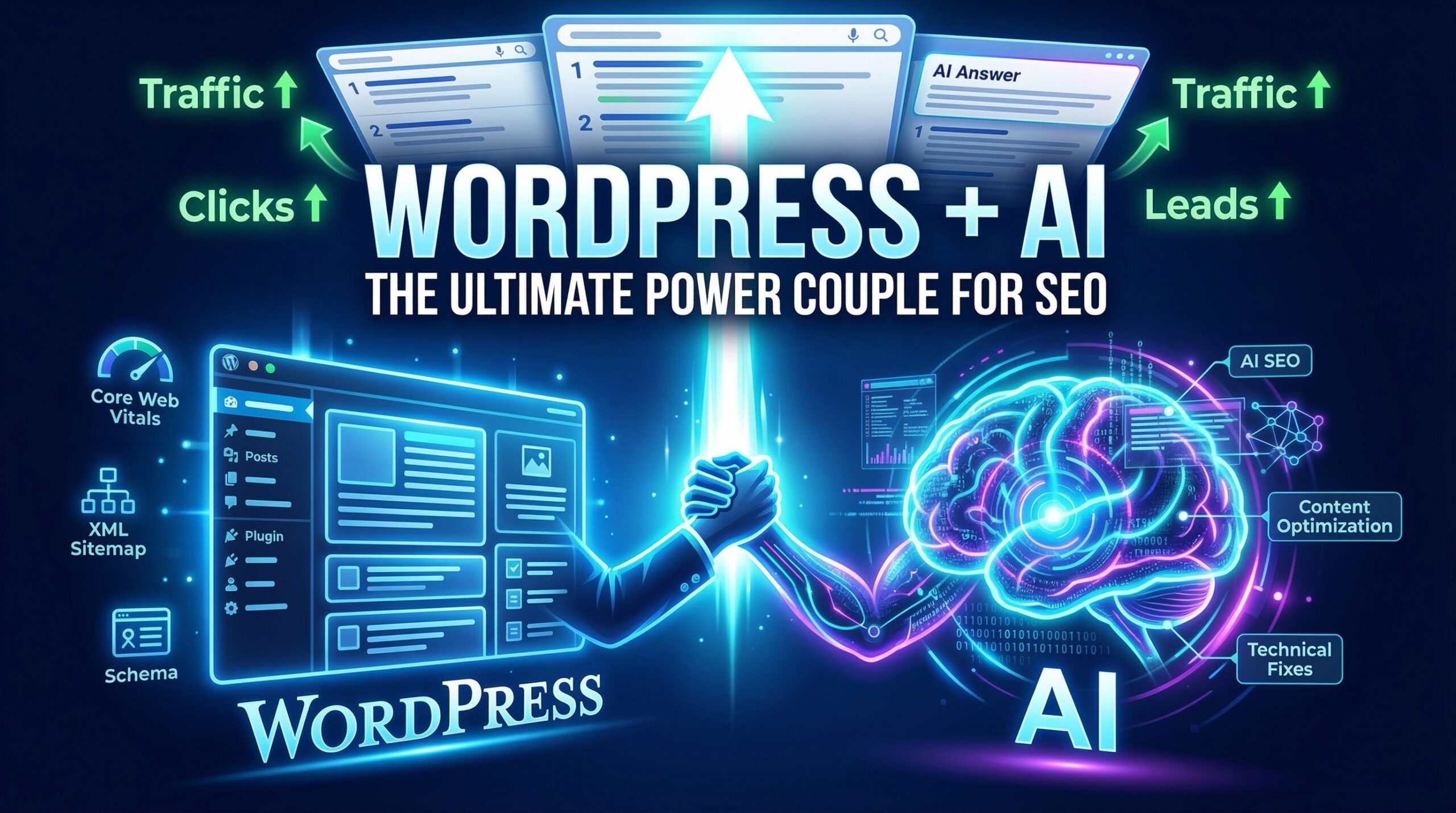
WordPress gives you the most battle-tested content infrastructure on the internet. AI gives you the ability to structure, optimise, and distribute that content for every search engine and answer engine simultaneously. Together, they are the SEO system no SME competitor can quickly replicate.
43%
of all websites globally run on WordPress — the most indexed CMS in Google's crawl infrastructure
W3Techs · CMS Market Share Report, 2025
68%
of AI Overview citations link to content with structured schema markup — WordPress's native schema ecosystem
Semrush · AI Citation Study, 2025
3.7×
higher organic click-through rate for WordPress sites with AI-generated structured content vs generic CMS pages
Search Engine Land · CMS SEO Benchmark, 2025
Why Is WordPress still the dominant SEO Platform in 2026?
WordPress's 43% global market share — reported by W3Techs in their 2025 CMS Market Share Report — is not a legacy figure that is declining. It is a compounding advantage. Google's crawl infrastructure has indexed more WordPress sites, processed more WordPress sitemaps, and evaluated more WordPress schema implementations than any other CMS architecture in existence. The result is that WordPress-specific SEO signals — permalink structures, category taxonomies, post type hierarchies — are deeply understood by Google's ranking systems in ways that newer headless CMS platforms are still earning.
The plugin ecosystem is the second structural advantage. The combination of Yoast SEO or Rank Math for technical SEO baseline, WP Rocket or LiteSpeed Cache for Core Web Vitals, and AI content tools integrated via API gives WordPress operators a complete SEO infrastructure that would require months of custom development to replicate on any other platform. The tools exist, are battle-tested across millions of deployments, and are maintained by large development communities that respond to algorithm changes within days.
What WordPress was missing until 2023 was the AI layer that transforms a well-structured CMS into a self-optimising content system. That layer now exists — and the combination has become the most defensible SEO architecture available to an SME without enterprise resources.
// The Platform Moat
From our experience working with SMEs, the businesses that rebuilt on headless CMS platforms between 2021 and 2023 — chasing developer experience and performance benchmarks — are now rebuilding SEO authority from scratch because their custom platforms lack the schema plugin ecosystem, the content editor AI integrations, and the established crawl trust that WordPress sites have accumulated over 15 years of indexing history. Technical elegance is not an SEO asset. Crawl trust and structured content are.
What does AI Actually Add to WordPress SEO - And What are the limits?
The AI layer in a WordPress SEO system is not a content generation tool. That is the most common misconception — and it produces the worst results. AI-generated content published without structural optimisation, schema markup, and entity verification is not an SEO asset. It is indexed noise that dilutes topical authority and trains Google's quality assessment systems to downgrade the entire domain.
What AI actually adds to WordPress SEO is structural automation — specifically, the five optimisation tasks that create the most SEO value per hour but consume the most time when done manually.
AI
AI Task 1
Schema Markup Generation
AI generates complete, validated JSON-LD schema blocks — Article, FAQPage, HowTo, Video Object, and Organisation — from page content in seconds. Manual schema writing for a 20-page site takes days. AI does it per-publish with zero additional time cost.
// Use case: Generate full @graph schema for every new WordPress post at publish time. Zero manual markup. Every page AI-citation eligible from day one.
AI
AI Task 2
Direct Answer Block Writing
AI generates the 40 to 60 word direct answer block that every AI Overview-eligible page requires — self-contained, context-independent, and structured for Featured Snippet extraction. A task that takes 15 minutes manually takes 20 seconds with AI prompt templates.
// Use case: Feed the post title + primary keyword to an AI prompt. Receive a direct answer block. Paste immediately after H1. Repeat for every post at publish time.
WP
AI
AI Task 3
Video Description Generation
AI generates five-zone video SEO descriptions from transcripts — direct answer block, keyword body, chapter markers, entity expansion, and CTA. Combined with WordPress video host pages and video sitemap plugins, this activates the 2.1× AI citation multiplier for every video published.
// Use case: Paste video transcript into AI template. Receive complete five-zone description. Add to WordPress video host page. Update video sitemap. Full citation eligibility in under 10 minutes.
SEO
AI Task 4
FAQ Section and FAQPage Schema
AI generates five natural-language Q&A pairs for each page based on the primary keyword and semantic query cluster — pre-formatted as FAQPage JSON-LD. Each FAQ pair is written for AI extraction: self-contained, conversational, and precisely answering one question per entry.
// Use case: AI generates FAQ section and schema simultaneously at the end of every article. Total production time per article: under 3 minutes additional work for full FAQPage rich result eligibility.
AI
AI Task 5
Internal Linking Recommendations
AI identifies the most relevant internal linking opportunities for each new post against the existing content library — with suggested anchor text that maps to topical cluster architecture. Manual internal link auditing on a 100-page site takes hours. AI does it per-post at publish time.
// Use case: Feed new post title + content summary + existing post list to AI. Receive three to five internal link recommendations with anchor text. Add to WordPress post before publishing.
WP
AI Task 6
Meta Title and Description Optimisation
AI generates SEO-optimised meta titles under 60 characters and meta descriptions under 160 characters for every post — structured with primary keyword in the first third, semantic variation in the body, and a natural language CTA. Integrated directly into Yoast or Rank Math at the time of post creation.
// Use case: AI generates three meta title and description variants per post. Editor selects the best option. Zero manual keyword research or character counting required at the individual post level.
The AI layer optimises structure. It does not replace expertise. AI-generated articles that contain no original research, no first-hand experience, no named author entity, and no editorial perspective are not long-term SEO assets — they are commodity content that Google's Helpful Content system is explicitly designed to deprioritise. The WordPress + AI power couple works when AI handles structural optimisation and human expertise provides the substance that makes the content worth ranking.
Which WordPress + AI Configuration Produces The Best SEO Results?
Most SMEs running WordPress use one SEO plugin and no AI integration. The configuration that produces genuinely competitive SEO results in 2026 is a layered stack: a technical SEO baseline layer, an AI content optimisation layer, a schema automation layer, and a performance layer. Each operates independently but compounds when deployed together.
Configuration Layer
With AI Integration
Technical SEO Baseline
Rank Math or Yoast SEO Premium
AI-generated meta titles, descriptions, and schema at publish time. Consistent optimisation across every post regardless of author.
Schema Markup
JSON-LD via plugin or custom code
AI generates complete @graph schema for every post at publish. 100% schema coverage. Article, FAQPage, and HowTo generated simultaneously.
Content Structure
Direct answer blocks, FAQ sections
AI generates direct answer block and FAQ section as mandatory post components. Every page AI citation eligible from day one of publication.
XML Sitemap
Dynamic generation with video sub-sitemap
Real-time regeneration triggered on publish. AI-generated video sitemap entries from transcript metadata. New posts indexed within 15 minutes.
Internal Linking
Topical cluster architecture
AI recommends three to five internal links per post at creation time against full content library. Topical cluster depth builds automatically with each publish.
Core Web Vitals
WP Rocket, LiteSpeed, or Perfmatters
AI-generated content inherits performance-optimised templates. No additional developer intervention as content library scales.
How do you build the wordpress + AI SEO Workflow from Scratch?
The WordPress + AI workflow is not a single tool purchase. It is a five-step production system that runs on every content creation session — taking a raw topic brief from zero to fully optimised, schema-marked, AI-citation-eligible WordPress post in under 90 minutes for a 2,000-word article.
Topic Research + Semantic Keyword Map
Use AI to generate a semantic keyword cluster for the target topic — primary keyword, five to eight secondary keywords, and ten natural-language question variations for H2 headings and FAQ entries. This replaces 45 minutes of manual keyword research with a five-minute AI prompt that maps the full topical authority architecture before writing begins.
Content Outline + Direct Answer Block
AI generates an article outline structured around the question-format H2 headings, with the primary keyword in the H1 and the direct answer block as the first content element after the intro. The outline becomes the article's structural skeleton — human expertise fills each section, but the AI-generated structure ensures every section answers one specific natural-language query for AI extraction eligibility.
Expert Content Writing + AI Structural Editing
Human expertise writes the substantive content — the original research, first-hand experience, named data citations, and editorial perspective that Google's quality systems are assessing. AI then edits for structural compliance: verifying the direct answer block is present and extractable, confirming each H2 section stays within 120 to 180 words, and identifying any sections that are too long for AI extraction or too short for topical authority signalling.
Schema Generation + WordPress Integration
AI generates the complete JSON-LD @graph block — Article with keywords and about entities, FAQPage from the article's FAQ section, HowTo where applicable, and Organisation publisher node with sameAs links. The schema is pasted into the WordPress post's custom HTML block or injected via the active schema plugin's custom code field. Total time: under five minutes per post with a standardised prompt template.
Publish + Immediate Search Console Submission
After publishing to WordPress, the AI workflow triggers an immediate Google Search Console URL inspection request via the Search Console Indexing API — reducing time-to-indexed from the nightly sitemap cycle default to under 15 minutes. The video sitemap is updated simultaneously if the post contains embedded video. The new post is AI-citation eligible, schema-validated, and fully indexed before the end of the same working session it was written.
How much time does the wordpress + AI SEO stack save - and what does that mean for content velocity?
Content velocity — the rate at which indexed, optimised, AI-citation-eligible content enters your domain's topical clusters — is the primary determinant of how quickly topical authority compounds. The WordPress + AI stack does not improve content quality directly. It removes the structural optimisation work that limits content velocity for lean teams.
// Time Savings Per Post — Manual vs AI-Assisted
Per 2,000-word article, experienced content team
Keyword Research + Semantic Mapping
Primary + secondary + NLP question variants
45 MIN
Article Outline + H2 Structure
Question-format headings, section mapping
20 MIN
Direct Answer Block Writing
40–60 word self-contained Featured Snippet block
15 MIN
FAQ Section Writing
5 Q&A pairs + FAQPage schema markup
30 MIN
Schema Markup (Article + FAQPage)
Complete @graph JSON-LD generation
25 MIN
Meta Title + Description
Character-counted, keyword-optimised
10 MIN
Internal Link Identification
3–5 links with anchor text recommendations
20 MIN
Total structural optimisation time per post without AI: approximately 165 minutes. With AI integration: approximately 24 minutes. A saving of roughly 140 minutes per post — which, for a team publishing three articles per week, compounds into seven hours of recovered capacity per week, or 364 hours per year. That is the equivalent of nine additional full work weeks of content production time recovered from structural tasks that were never the value-creating part of the process.
FREQUENTLY ASKED QUESTIONS
Why is WordPress + AI the best combination for SEO in 2026?
WordPress is the best SEO foundation in 2026 because it powers 43% of the web per W3Techs's 2025 CMS Market Share Report, has the most mature schema plugin ecosystem, and has accumulated more Google crawl trust than any competing CMS platform. AI adds the structural automation layer that converts WordPress's infrastructure advantage into SEO output at scale — generating schema markup, direct answer blocks, FAQ sections, meta titles, and internal link recommendations at publish time without proportionally increasing content team time. The combination produces pages that rank in traditional Google search, get cited in AI Overviews and Perplexity, and index faster than any alternative CMS configuration available to SMEs without enterprise-level resources.
What AI tools work best with WordPress for SEO?
The most effective AI tools for WordPress SEO in 2026 operate at the structural layer rather than the content generation layer. For schema generation: AI models with custom prompt templates that generate @graph JSON-LD from post metadata — producing Article, FAQPage, and HowTo nodes simultaneously at publish time. For content structure: AI prompt templates that generate direct answer blocks, question-format H2 headings, and FAQ sections from the article title and primary keyword. For internal linking: AI models with access to the site's full content inventory that can identify the three to five most relevant internal link targets per new post. For meta optimisation: AI generating character-counted title and description variants for Yoast SEO or Rank Math's custom fields. The specific model matters less than having documented prompt templates that produce consistent, validated output for each of these structural tasks.
Does AI-generated content hurt WordPress SEO?
AI-generated content that is published without original expertise, named author entities, first-hand experience, verifiable data citations, and editorial perspective is a long-term SEO liability — Google's Helpful Content system explicitly targets content that lacks genuine expertise and human value-add regardless of technical optimisation quality. AI-generated content that serves as structural scaffolding for human expertise — generating the direct answer block, FAQ section, schema markup, and internal link suggestions while the substantive content is written by a named human expert with verifiable credentials — is a net SEO asset. The distinction is whether AI is replacing human expertise or amplifying it. Replacing expertise produces content that depresses topical authority and triggers quality assessments. Amplifying expertise produces content that converts faster, ranks more consistently, and accumulates AI citation eligibility from day one of publication.
Which WordPress SEO plugin works best with AI tools in 2026?
Rank Math and Yoast SEO Premium are both compatible with AI workflow integration in 2026 and the choice between them has less SEO impact than the quality of the AI structural workflow applied on top of either. Rank Math has a slight advantage for AI integration because its schema module is more flexible for custom JSON-LD injection and its REST API is more accessible for automated post-publish workflows including Search Console URL submission triggers. Yoast SEO Premium has a slight advantage for large content teams because its interface is more editor-friendly and its content analysis tools provide structural compliance feedback that complements AI-generated outlines. Either plugin, combined with WP Rocket or LiteSpeed Cache for Core Web Vitals, and an AI structural workflow for schema and direct answer block generation, produces a technically competitive WordPress SEO configuration for an SME content programme.
How long does it take to see SEO results from a WordPress + AI content programme?
Initial indexing improvements — faster time-to-indexed and Featured Snippet eligibility for new posts — are visible within the first two to four weeks of implementing the full AI structural workflow including schema generation and Search Console URL submission automation. AI Overview citation appearances for well-structured posts typically begin between four and eight weeks for queries within clusters where the domain has existing authority. Measurable organic traffic growth from topical cluster content published with the full AI structural workflow typically begins between months two and four. The compound return — where each new post inherits and builds on the topical authority of the cluster it joins — typically reaches a self-sustaining growth rate between months six and nine. The WordPress + AI combination does not accelerate these timelines fundamentally, but it does ensure that every post published contributes maximally to topical cluster authority from day one rather than contributing at 30 to 40 percent of its structural potential due to missing schema, absent direct answer blocks, or inconsistent FAQ implementation.
The combination your competitors haven't fully configured yet
Most WordPress sites in 2026 have good content and poor structure. Most AI workflows produce consistent structure and generic content. The advantage goes to the team that combines both — genuine expertise structured for AI extraction, entity-verified, schema-marked, and published on the most crawl-trusted CMS infrastructure on the internet.
Your competitors are either publishing great content without structural optimisation, or publishing structured content without genuine expertise. The window to own the combination is narrow — not because the tools are hard to access, but because most teams have not yet documented the workflow that makes the combination systematic.
Document the workflow this week. Run every post through it. The compounding starts with the first structurally compliant article you publish.