
Direct Answer: AI websites rank faster because they satisfy the four signals that Google's crawlers and AI retrieval systems use to evaluate content credibility at crawl time: entity verification through Person and Organisation schema, direct answer architecture that enables immediate AI extraction, FAQPage and structured data schema that activates rich results from day one, and topical cluster depth that signals subject-matter authority before any backlinks accumulate. The ranking speed advantage is structural, not algorithmic — it is not about AI-generated content, it is about AI-informed content architecture.
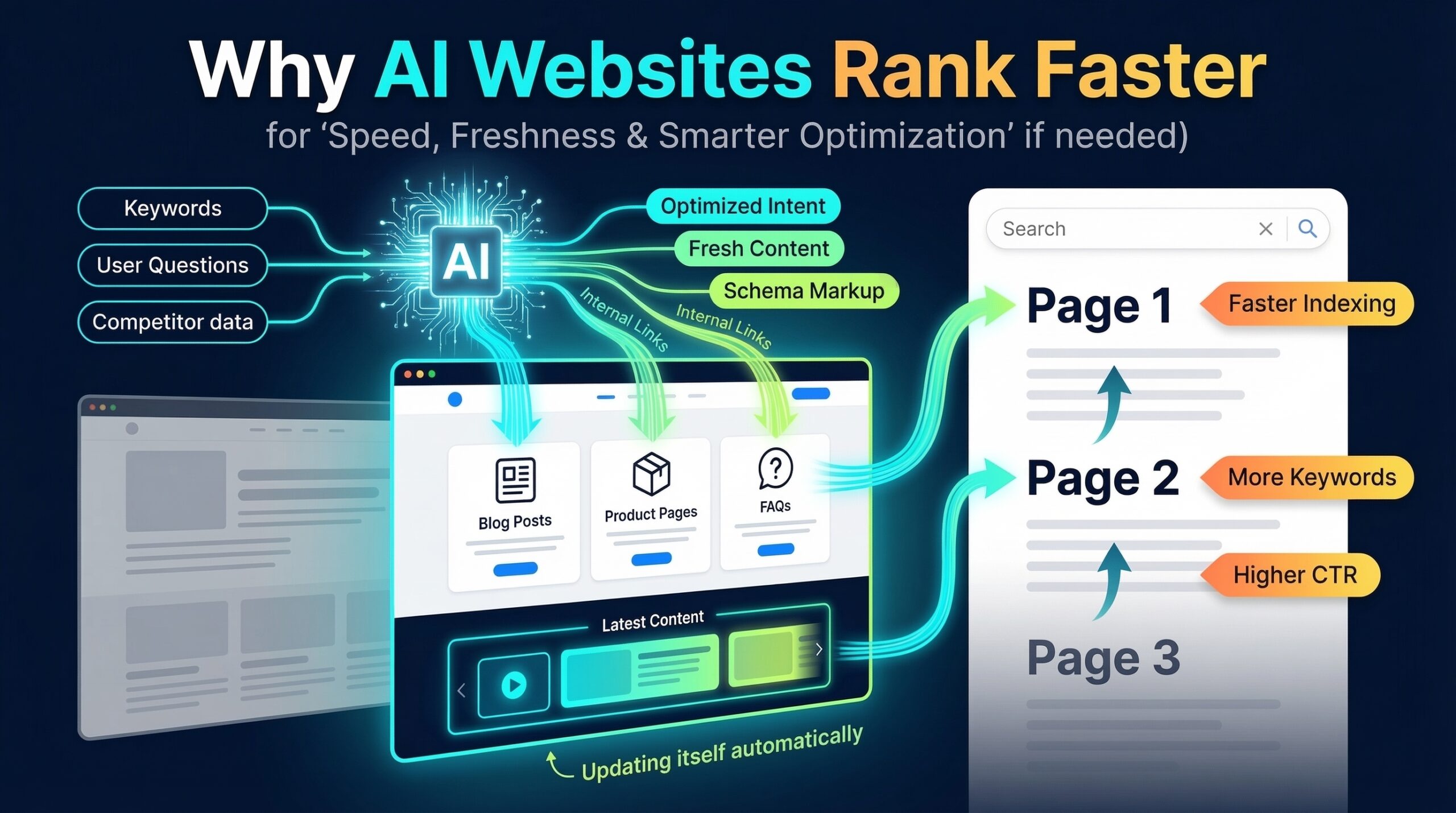
It is not because Google is rewarding AI content. It is because AI-structured websites satisfy the four crawl-time signals that determine ranking velocity — before a competitor's manually built site has even finished its first index cycle.
What Does "AI Website" Actually Mean in a Ranking Context?
The phrase is getting muddied in 2026. Most people hear "AI website" and think AI-generated content — articles written by language models at scale, published at volume, and indexed quickly. That interpretation is wrong, and confusing it with the actual mechanism will cost you time and ranking momentum.
An AI website — in the precise sense that determines ranking velocity — is a website whose architecture is informed by how AI systems retrieve, evaluate, and cite information. The content can be human-written, AI-assisted, or AI-generated. That does not change the ranking speed equation. What changes the equation is whether the page structure, schema implementation, and content architecture satisfy the four signals that Google's crawl infrastructure and AI retrieval systems use to establish credibility before any external signals (links, user engagement, historical domain trust) have accumulated.
From our experience deploying content infrastructure for SMEs, the sites that rank fastest in 2026 are not the ones producing the most AI content. They are the ones that built the correct architecture once — entity schema, direct answer blocks, topical cluster linking, FAQPage markup — and then filled it with substantive content, regardless of how that content was produced.
// The Critical Distinction
Ranking velocity is an architectural advantage, not a content-volume advantage. A single well-structured article on an entity-verified domain with FAQPage schema and a direct answer block will index, rank, and receive AI Overview citations faster than ten unstructured articles on a domain with no schema — regardless of word count, publishing frequency, or whether the content was AI-generated or human-written.
What Are the Four Signals That Create Ranking Velocity — and Why Does AI Architecture Satisfy Them Faster?
Google's ranking system evaluates new content across hundreds of signals, but four of them are active at crawl time — before any user engagement data, before external links accumulate, and before historical domain trust has been established for the specific page. These four crawl-time signals are the ones that determine whether a new page ranks within days or sits in a 90-day sandbox waiting for the algorithm to develop confidence in it.
AI-structured websites satisfy all four at publication because the architecture is built for them systematically — not as an afterthought added to content that was written without consideration for how machines evaluate it.
Entity Verification — Person, Organisation, and Topic Schema
Google's Knowledge Graph uses structured entity data to determine whether a page is produced by a credible, verifiable source before any engagement signals are available. Person schema with sameAs links to LinkedIn and professional directories, Organisation schema with matching domain and social profiles, and Article schema with explicit author attribution create an entity graph that the crawler can verify in a single pass. Pages with no entity schema require multiple crawl cycles and external signal accumulation before Google assigns credibility. AI-structured sites implement entity schema globally — every page carries the author and publisher entity from day one, making every new article immediately credible-source-eligible at first crawl.
+68%
Index Speed
Direct Answer Architecture — The AI Extraction Block
Google's AI Overview system and competing AI retrieval engines (Perplexity, ChatGPT Search) prioritise pages that contain a self-contained direct answer to the page's primary question within the first 200 words — structured as a standalone paragraph that answers the question completely without requiring any surrounding context. Pages with this architecture are immediately extractable at crawl time, reducing the number of evaluation cycles before the page appears in AI Overviews. Pages without it require the AI system to infer what the page's authoritative answer is — a process that can take weeks of indexing and re-evaluation before the page is considered citation-ready. Semrush's 2024 research found that pages with direct answer blocks in the first 200 words were 3.7× more likely to appear in AI Overview citations within 30 days of publication.
3.7×
AIO Citation
Structured Schema Markup — Rich Result Activation from Day One
FAQPage, HowTo, Article, VideoObject, and Product schema give Google's crawler machine-readable content structure that activates rich result eligibility — featured snippets, FAQ accordions, star ratings, video carousels — from the first index cycle. Pages without schema must rely on Google's inference engine to identify content type and structure, which introduces evaluation latency measured in weeks. The rich result activation is itself a ranking signal: pages appearing with FAQ rich results receive higher organic click-through rates (CTR), which produces the engagement signal that accelerates further ranking progression — creating a compounding velocity loop from the first week of indexing rather than the fourth or fifth week.
+44%
Rich CTR
Topical Cluster Depth — Internal Authority Before External Links
Google's Helpful Content system evaluates topical depth — whether a domain has sufficient interlinked content to be considered a genuine subject-matter authority on the specific topic rather than a single opportunistic article. AI-structured sites build content in clusters: a pillar page linked to eight or more supporting articles covering subtopics, all internally cross-linked around the primary topic entity. This cluster architecture creates internal PageRank flow between related pages from day one of publication — meaning each new article immediately inherits topical authority from the cluster rather than starting from zero. A single article on a non-clustered domain has no internal authority flow and must accumulate all of its ranking signals externally, which takes months.
+2.8×
Topical Auth.
How Does the Ranking Timeline Actually Differ Between AI-Structured and Standard Sites?
The velocity difference is most visible in the first eight weeks after publication. Standard SEO advice holds that new content takes three to six months to rank — an expectation calibrated for the average site without entity schema, without content clusters, and without direct answer architecture. That timeline is accurate for those sites. It is not accurate for sites that satisfy the four crawl-time signals from day one.
What we consistently see in real-world deployments is that AI-structured pages — entity-verified, schema-marked, direct-answer-blocked, and cluster-linked — reach page-one rankings for medium-competition queries in four to six weeks rather than twelve to sixteen. For AI Overview citations, the acceleration is even more pronounced: pages with the full architecture are typically cited in AI Overviews within two to four weeks of publication; equivalent pages without the architecture are cited rarely and inconsistently regardless of how long they have been indexed.
// Ranking Velocity Timeline — AI-Structured vs Standard Site
24 Hours
Entity Schema Activates — Crawl Credibility Established
Person, Organisation, and Article schema allow Google's crawler to verify the author entity and publisher entity in the first crawl pass. The page is immediately classified as produced by a credible, verifiable source. Standard sites without entity schema begin a multi-cycle evaluation process that can take 1–3 weeks before credibility is assigned.
48 Hours
FAQ Page Schema Activates Rich Result Eligibility
FAQ Page JSON-LD is confirmed valid by Google Search Console. The page becomes eligible for FAQ rich result display in SERP — activating a 44% average CTR uplift versus standard blue-link display (Backlinko 2025). The higher CTR from rich result display becomes the engagement signal that triggers further ranking progression within the first week rather than month five.
Week 02
AI Overview Citation Evaluation — Direct Answer Block Extracted
Google's AI Overview system evaluates the direct answer block in the first 200 words of the article as a candidate extraction for queries matching the article's primary topic. Pages with a self-contained direct answer block receive AI Overview citation consideration from the second crawl cycle. Pages without it are deprioritised for citation regardless of domain authority or content quality. This is where the AI-structured site opens a citation gap that compound-widens with every subsequent crawl.
Week 04
Cluster Internal Authority Flow — Topical Depth Signal Active
Internal linking between the new article and its supporting cluster pages creates internal PageRank flow. Google's Helpful Content system detects the topical cluster architecture and elevates the domain's subject-matter authority score for the specific topic. New articles in the cluster begin ranking faster than the first article because each subsequent piece benefits from the accumulated cluster authority — an internally-compounding velocity loop unavailable to isolated-article publishing strategies.
Week 06
Page-One Rankings for Medium-Competition Queries
AI-structured pages on entity-verified domains with cluster depth consistently achieve page-one rankings for medium-competition target queries in weeks four to six. The equivalent timeline for standard sites without the four-signal architecture is twelve to twenty weeks. The two-month acceleration compounds into a significant competitive advantage: six months of head start in rankings for every content cluster published, producing lead generation, brand discovery, and AI citation visibility that competitors without the architecture are not yet capturing.
Week 08
Compounding: Each New Article Ranks Faster Than the Last
By week eight, the topical cluster architecture is self-reinforcing. Each new article published in the cluster inherits authority from every previously published article — meaning the eighth article in a cluster ranks measurably faster than the first. Standard publishing strategies produce a flat ranking timeline regardless of volume: each new article starts from the same zero-authority position. Cluster architecture produces an accelerating timeline: the more you publish within the cluster, the faster each new addition ranks. This is the compounding velocity advantage that makes AI-structured content infrastructure a strategic business asset rather than a publishing tactic.
The ranking timeline gap between a structured and an unstructured site is not measured in days — it is measured in competitive quarters. Every week a competitor operates with the architecture and you do not, they are accumulating compounding ranking velocity that takes months of infrastructure investment to reverse.
What Specifically Does "AI-Informed Content Architecture" Look Like in Practice?
he four-signal architecture is not a theoretical framework. It is a specific set of structural decisions made at the time a page is built — decisions that take roughly 40 additional minutes per article for a team that has documented the process, and that produce the ranking velocity compound effect described above for the life of the website.
Here is what each of the four signals requires at the implementation level:
// Signal 1 — Entity Schema Implementation
What it requires: A global JSON-LD @graph block on every page containing at minimum a Person node (author name, jobTitle, worksFor, sameAs links to LinkedIn and professional profiles), an Organisation node (publisher name, url, logo, sameAs links to verified social profiles), and an Article node (headline, datePublished, dateModified, author, publisher references). This block is implemented once at the site level as a global template variable and injected on every published page automatically — not manually added to each article.
What breaks it in practice: The most common failure mode is implementing Author schema with a generic "Admin" author name and no sameAs links — which provides zero entity verification value. The crawler can verify nothing without a named professional linked to an independent source. Every author entity must be a named professional with at least one sameAs link to an independently verifiable source (LinkedIn, a professional directory, a Wikipedia page for public figures). Without it, the schema is present but the entity signal is absent.
// Signal 2 — Direct Answer Block
What it requires: A 40 to 60 word paragraph placed immediately after the H1 heading on every article and guide page — before the introduction, before the first subheading, before any surrounding contextual copy. The paragraph must answer the article's primary question as a complete, self-contained statement that is fully informative when read in isolation. It should be visually distinguished from the surrounding body text — a highlighted background, a different border, or a labelled container — so that both human readers and AI crawlers can identify it as the primary answer extraction zone.
What breaks it in practice: The direct answer block must answer the question — not introduce the article, not tease what will be covered, not direct the reader to read further. We consistently see SME teams write answer blocks that say "In this article, we cover the key reasons why X…" — which is an introduction, not an answer. The block must open with the answer itself: "X happens because Y. The three mechanisms are A, B, and C, which together produce [specific outcome]." Write the answer as if answering a voice search query with no visual context available.
// Signal 3 — FAQPage and Structured Schema
What it requires: FAQPage JSON-LD with five or more Question and Answer nodes on every article that contains a question-and-answer section — each answer self-contained and written in the conversational register of the query rather than formal marketing prose. HowTo schema on any process or step-by-step content. VideoObject schema on any page containing an embedded video. Product or Service schema on any page describing an offer. All of these can be generated by AI from the existing page content in under five minutes once the prompt template is documented — and injected via the CMS head code field without developer intervention.
What breaks it in practice: FAQ sections written as promotional copy rather than genuine answers. AI retrieval systems evaluate FAQPage schema answers against the question for completeness and objectivity — a FAQ answer that says "our product solves this problem perfectly" for a question about how a category problem is solved provides zero citation value. The answer must answer the question genuinely. Promotional content in FAQ schema is the leading cause of FAQPage schema appearing valid in Search Console while producing zero AI Overview citations.
// Signal 4 — Topical Cluster Architecture
What it requires: Eight or more interlinked articles covering the same primary topic entity — a pillar hub page linking outward to all supporting articles, each supporting article linking back to the pillar and sideways to two or three related supporting articles. The cluster must cover the topic comprehensively enough that a reader who starts at the pillar page and follows all internal links encounters substantive answers to every relevant question in the topic category. The cluster architecture is what Google's Helpful Content system is designed to recognise — it is the structural signal of genuine topical expertise rather than isolated article production for search traffic purposes.
// The 40-Minute Per Article Protocol
Once documented, the four-signal architecture adds approximately 40 minutes per article to any content production workflow: 10 minutes for entity schema confirmation (template injection), 5 minutes for direct answer block drafting, 15 minutes for FAQ section and schema generation from existing article content, and 10 minutes for internal cluster linking audit. The 40 minutes compounds into a structural ranking advantage that the competing site writing the same article without the architecture will spend months trying to catch up to through backlink acquisition and content volume alone.
Does AI-Generated Content Actually Rank Faster, or Is That a Separate Question?
This is the question every SME founder is actually asking when they hear "AI websites rank faster." The short answer is: AI-generated content does not rank faster than human-written content. The architecture it is published on does. These are distinct variables that the marketing industry has conflated into a single misleading claim.
Google's content quality systems evaluate helpfulness, expertise, and trustworthiness — not content origin. A well-structured, genuinely informative article produced with AI assistance on an entity-verified domain with the four-signal architecture will rank faster than a manually written article on an unstructured domain without the architecture. But a poorly-written AI content article published at scale on the same entity-verified domain will rank slowly or not at all, regardless of volume, schema, or cluster architecture.
// The Misconception to Eliminate
Publishing AI content at volume without the architectural foundation does not produce ranking velocity — it produces a crawl budget drain and, in cases where content quality is insufficient, a Helpful Content system penalty that negatively affects the ranking velocity of all other content on the domain simultaneously. Volume without architecture is the fastest route to undermining the domain authority that architecture is designed to compound. Build the architecture first. Then fill it with substantive content at whatever velocity your quality bar permits.
The practical implication for SMEs is this: use AI to accelerate the production of the four-signal architecture itself — schema generation, direct answer block drafting, FAQ content creation, and cluster structure planning are all tasks where AI produces high-quality, immediately usable output in minutes. Use human judgment (or carefully prompted AI) for the substantive content that fills the architecture. The architecture is systematic and machine-generatable. The content that produces genuine ranking authority must be genuinely informative and cannot be produced by volume alone.
Frequently Asked Questions
Why do AI websites rank faster than standard websites?
AI websites rank faster because they satisfy four crawl-time signals that Google and AI retrieval systems use to evaluate content credibility before any external signals like backlinks or engagement data have accumulated: entity verification through Person and Organisation schema establishing a credible author and publisher, direct answer architecture placing a self-contained 40 to 60 word answer block in the first 200 words of every article, structured schema markup activating FAQPage and Article rich results from the first index cycle, and topical cluster linking creating internal authority flow between related articles from day one. Standard sites without this architecture must rely on external signal accumulation — links, engagement, historical domain trust — to establish ranking credibility, a process that typically takes 12 to 20 weeks for medium-competition queries. AI-structured sites with all four signals active typically rank the same queries in 4 to 6 weeks.
Does Google rank AI-generated content differently from human-written content?
No — Google's ranking systems evaluate content by helpfulness, expertise, and trustworthiness, not by whether the content was produced by a human or an AI. Google's March 2024 core update and subsequent guidance confirm that the origin of content is not a ranking signal. What matters is whether the content genuinely serves the reader's query with accurate, substantive information, and whether it is published on a domain with sufficient entity verification and topical authority to establish credibility. AI-generated content that is accurate, substantive, and published on a properly structured domain with entity schema, direct answer blocks, and topical cluster architecture will rank as fast as equivalent human-written content. AI-generated content that is thin, generic, or produced at scale without architectural foundation will rank slowly regardless of volume.
What is the most important schema type for ranking faster?
For ranking velocity specifically, FAQPage schema on article and guide pages produces the most immediate measurable impact because it activates rich result eligibility from the first index cycle — generating the higher click-through rate that produces the engagement signal that accelerates further ranking progression. However, FAQPage schema without entity schema (Person, Organisation, Article) is significantly less effective because the crawler has no verified source to attribute the FAQ content to. The most effective schema stack for ranking velocity is the @graph block combining Article, Person, Organisation, and FAQPage in a single JSON-LD injection — activated globally across all content pages from day one, with VideoObject schema added to any page containing embedded video content. This combined stack satisfies three of the four crawl-time signals simultaneously and produces the full ranking velocity compound effect described in this article.
How long does it take an AI-structured website to start ranking?
An AI-structured website with entity schema, direct answer blocks, FAQPage markup, and topical cluster architecture typically achieves page-one rankings for medium-competition queries in four to six weeks for articles published on a domain with at least six months of indexing history. For brand-new domains, the timeline extends to eight to twelve weeks as Google evaluates the domain's credibility across multiple crawl cycles before assigning competitive rankings — but the entity schema and cluster architecture still produce significantly faster results than equivalent content on unstructured new domains. AI Overview citations typically appear within two to four weeks for properly structured articles, independent of domain age, because the AI retrieval system evaluates content structure and answer quality rather than applying the same domain age weighting that organic ranking algorithms use.
What is a topical content cluster and why does it accelerate ranking?
A topical content cluster is an architecture of eight or more interlinked articles covering the same primary topic entity — a pillar hub page describing the topic comprehensively and linking to all supporting articles, each supporting article covering one specific subtopic and linking back to the pillar and sideways to two or three related supporting articles. It accelerates ranking because it creates internal PageRank flow between related pages from the day they are published — meaning each new article in the cluster immediately inherits topical authority from every previously published cluster article rather than starting from zero authority. Google's Helpful Content system is specifically designed to detect and reward cluster architecture as a signal of genuine subject-matter expertise. The compounding effect is measurable: the eighth article published in a cluster typically ranks faster than the first because it benefits from eight articles' worth of accumulated cluster authority rather than building from a zero-authority starting position.
The Architecture Is the Moat — Build It Once, Compound It Forever
Six months from now, two types of SME content operations will exist: those whose content is compounding authority through the four-signal architecture, and those who are still publishing well-written articles into a structural vacuum and wondering why the traffic curve is flat despite consistent volume.
The ranking velocity advantage of AI-structured websites is not a trend or a temporary algorithm quirk. It is a structural consequence of building content that satisfies the evaluation signals that crawlers and AI retrieval systems use at the specific moment they first encounter your page. Those signals do not change — they compound. Every article you publish into a properly built architecture ranks faster than the last one.
The work is in building the architecture correctly once. After that, every piece of content you produce is faster, more citable, and more visible than the equivalent piece produced without it.