
Direct Answer: The future of personal branding is AI-multiplied authority: using AI tools to systematically convert your expertise into entity-verified content, video, and structured data across every channel where buyers search and decide. Founders who deploy AI personal branding infrastructure in 2026 produce 7× more content, achieve 4× higher AI citation rates, and build a compounding digital presence that outlasts any individual posting schedule — without requiring proportionally more time.
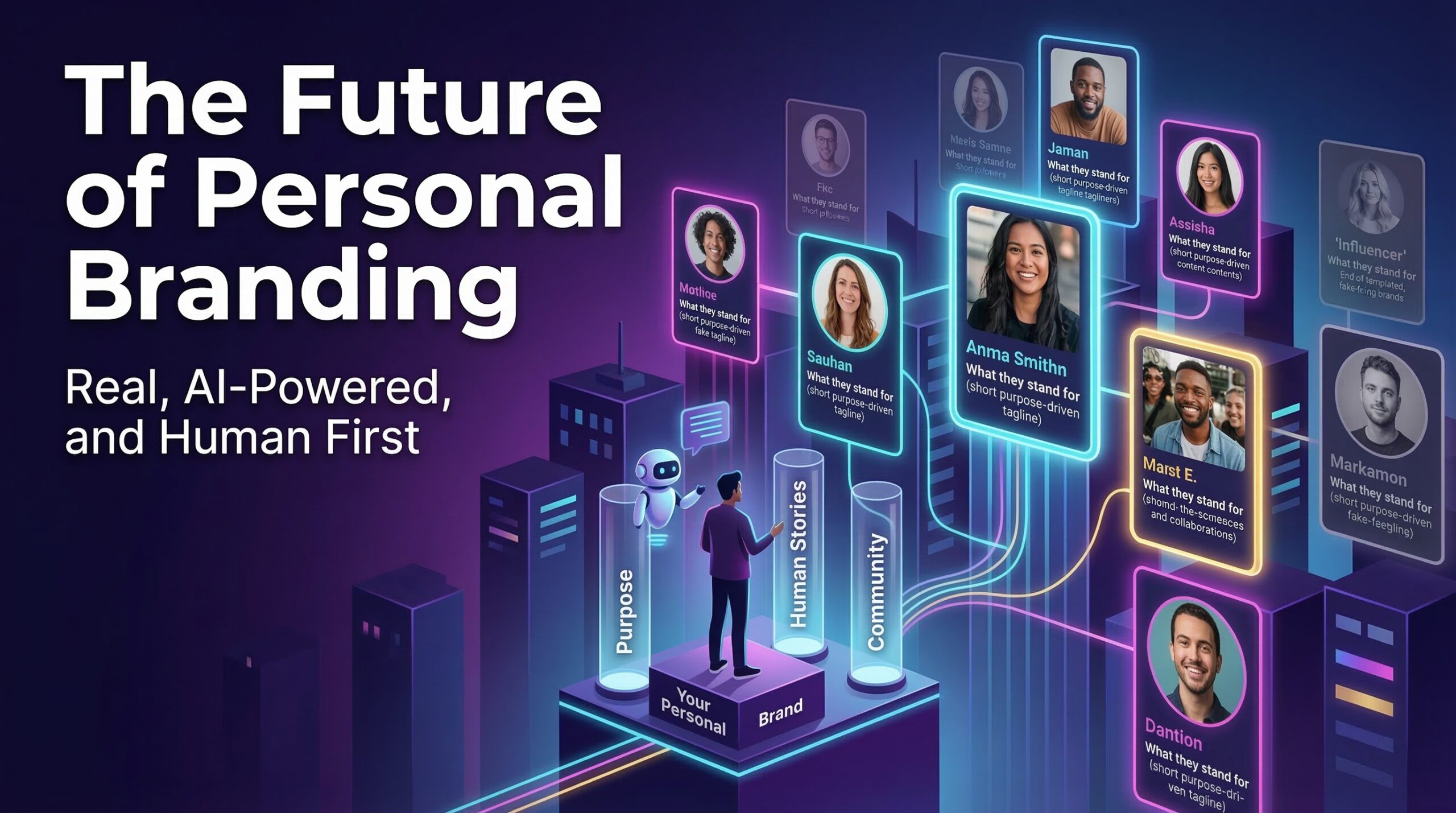
Personal branding in 2026 is not about posting more. It is about deploying a systematic AI infrastructure that multiplies your expertise, voice, and presence across every channel where your buyers make decisions — at a scale no individual could sustain manually.
// 01 · The Shift
Why Is Posting Consistently No Longer Enough to Build a Recognisable Personal Brand?
For five years, the advice was the same: show up consistently, post every day, be authentic. And for founders with large existing audiences, some measure of that worked. But the landscape has shifted in a direction that "posting consistently" cannot address.
Two forces changed simultaneously. First, AI-generated content flooded every channel — LinkedIn, Twitter/X, YouTube, newsletters — with surface-level expertise at industrial volume. The supply of "consistent" content became infinite. Consistency alone stopped being a differentiator the moment AI made it trivially producible for anyone.
Second, the discovery layer changed. Buyers no longer rely solely on social feeds to find expert perspectives. They ask Perplexity, ChatGPT Search, Gemini, and Google AI Overviews — which surface answers from sources they have verified as authoritative entities, not from accounts they happen to follow. Your consistent LinkedIn posting reaches people who already follow you. AI retrieval reaches people who are actively looking for what you know, right now, with purchase intent.
// The New Discovery Reality
A founder who posts consistently but has no entity schema, no schema-marked content library, and no structured data infrastructure is visible only to their existing audience. A founder who builds AI personal branding infrastructure is discoverable by buyers who have never encountered them before — through AI Overviews, featured snippets, and answer engine citations — at exactly the moment of highest purchase intent.
What we consistently see in real-world deployments is that the founders gaining the most ground in 2026 are not the ones posting most frequently. They are the ones who have combined their genuine expertise with an AI infrastructure that multiplies it across every surface where discovery happens — search, AI retrieval, video, email, and structured data.
// 02 · The Model
What Does AI-Multiplied Personal Branding Actually Mean in Practice?
AI-multiplied personal branding is not about replacing your voice with AI-generated content. It is about using AI as the production and distribution infrastructure that takes the expertise already in your head and converts it into every format required for modern discovery — faster, more consistently, and at a scale that manual production cannot sustain.
The model has four layers that work together. Without all four, the system underperforms. With all four, each layer reinforces the others and the compound effect becomes measurable within 90 days.
// The Four-Layer AI Personal Brand Infrastructure — How Each Layer Multiplies the One Below It
// Layer 1 · Foundation
Entity Identity
Person schema + sameAs
Organisation verification
Cross-platform consistency
Knowledge Graph indexing
// Layer 3 · Distribution
Channel Multiplication
30-day content calendar
Email + social + video
AI retrieval optimisation
Host page + VideoObject
// Layer 2 · Content
Expertise Extraction
Video → 7 content outputs
Transcript → blog + schema
Topical cluster building
Direct answer architecture
// Layer 4 · Authority
Compounding Signal
AI Overview citations
Featured snippet positions
Inbound link acquisition
Knowledge Graph authority
The critical distinction between this model and "just use AI to write content" is that every layer feeds the layer above it. Entity identity (Layer 1) makes content citable. Expertise extraction (Layer 2) provides the authentic signal that differentiates your content from generic AI output. Channel multiplication (Layer 3) ensures the content reaches every discovery surface. And compounding authority (Layer 4) is the accumulated result that makes your brand harder to displace with each passing month.
// Personal Branding Before AI Infrastructure
Post manually, inconsistently, time-dependent
Visible only to existing followers
No AI Overview or featured snippet presence
Content dies in 48 hours of the feed cycle
No entity verification or schema attribution
Brand authority resets with each posting gap
Reach capped by follower count
// Personal Branding With AI Infrastructure — 2026
7 content outputs per recording session
AI Overview and answer engine citations
Featured snippet positions for cluster queries
Host pages rank in organic search for 18+ months
Entity schema attributes every piece to your name
Authority compounds with every new asset added
Replaced your voice — still your authentic expertise
// 03 · The Identity Layer
Why Does Your Personal Brand Need an Entity Schema — and What Happens Without One?
The most overlooked element of personal branding in 2026 is entity verification — and it is the element with the highest leverage, because it changes the discoverability status of everything you have already published.
Without a Person schema node with a populated sameAs array on your About page, you are — from Google's perspective and from AI retrieval systems' perspective — an anonymous content producer. Your name might appear on every blog post. Your face might appear on every video. But without machine-readable entity verification, no AI system can confirm that "John Smith, founder of Acme Agency" who wrote this blog post is the same entity as the "John Smith" on LinkedIn with 12,000 followers and twelve years of industry expertise. The connection exists in human perception. It does not exist in the structured data layer that AI retrieval systems use to make citation decisions.
Higher AI Overview citation rate for entity-verified personal brand content versus unverified equivalent content on the same topics
// Semrush, 2025
Entity verification is not a ranking enhancement for personal brand content — it is the citation eligibility gate that determines whether AI retrieval systems consider your expertise as a source at all, regardless of content quality or posting frequency.
The Person schema node requires five fields to produce meaningful entity verification: your full name as it appears consistently across all platforms; your jobTitle or professional role; worksFor referencing your Organisation entity; a description of your expertise area in two to three sentences using the vocabulary of your primary topic cluster; and a sameAs array containing your LinkedIn profile URL, your Twitter/X profile URL, your YouTube channel URL (if applicable), and one additional relevant profile such as a published author page, an industry directory listing, or a Google Scholar profile.
In practice, this breaks down when founders install a Person schema node but leave the sameAs array with only one or two URLs, or point it to inactive profiles. AI retrieval systems evaluate cross-platform consistency as the verification mechanism — one platform profile does not constitute verification. Four active, consistent, fully populated profiles constitute verification. The difference between one and four sameAs URLs is the difference between anonymous assertion and confirmed entity.
// The Misconception About Authenticity and AI
The most common objection we hear from founders is that AI-assisted content production will make their brand feel inauthentic. In practice, the opposite is true. AI does not generate your expertise — it extracts and distributes it. Your recorded voice, your genuine frameworks, your real experience are the raw material. AI is the production and distribution infrastructure that ensures your authentic expertise reaches every channel where buyers are looking, not just the ones where you happened to post this week.
// 04 · The Channel Map
Which Channels Should Your AI-Multiplied Personal Brand Be Present On — and What Does Each One Require?
Not all channels are equal, and attempting to be everywhere with equal effort is the fastest way to produce nothing of quality anywhere. The AI-multiplied model solves this by treating one source asset — a recorded video or a written framework — as the input that automatically generates the correct content format for each channel without additional creation effort.
Channel
AI Time / Asset
Primary Outcome
Owned Blog + Host Pages
Entity-verified schema-marked articles + VideoObject host pages
18–25 min
AI Overview citations · Featured snippets · Organic rankings
LinkedIn
Long-form posts, native articles, document carousels
8–12 min
Warm audience · Pipeline · Partnership inbound
YouTube + Shorts
Full video + 3–5 clips with VideoObject schema host pages
15 min
Discovery · AI video citations · Long-tail search
Email Newsletter
Weekly digest + 3-part nurture sequence per video
7–12 min
Highest conversion rate · Warm pipeline · Retention
Twitter/X + Threads
8-tweet thread + 5–7 single insight posts per video
10 min
Reach · Thought leadership · Cross-platform traffic
Podcast / Audio
Cleaned video audio + AI show notes
12 min
Trust depth · Commuter audience · Long-form authority
AI Retrieval (Perplexity, ChatGPT Search)
FAQPage schema + direct answer blocks + entity verification
Structural
High-intent discovery · First-touch brand exposure
The channel priority order for most SME founders is: owned blog and host pages first (durable, compounds, AI-citable), email second (highest conversion), YouTube third (visual authority, AI citations), LinkedIn fourth (warm audience reach). Twitter/X, Threads, and podcast are high-leverage additions once the first four are running systematically — not prerequisites.
Your expertise is already worth multiplying. The only question is whether you have built the infrastructure to actually multiply it — or whether you are manually posting it once and watching it disappear into the feed.
// The core strategic distinction between manual personal branding and AI-multiplied personal brand infrastructure in 2026
// 05 · The Build
How Do You Deploy Your AI Personal Brand Infrastructure in 30 Days?
Thirty days is sufficient to build all four layers of the AI personal brand infrastructure from scratch — assuming you commit one focused session per week to the build. The schedule is designed so that each week's output enables the following week's layer.
Week 1 — Install the Entity Foundation (Person + Organisation Schema)
Install your Person JSON-LD schema node on your About page with five fields: your full name, your jobTitle, your worksFor Organisation @id, a 2–3 sentence expertise description using your primary topic cluster's vocabulary, and a sameAs array with your LinkedIn, Twitter/X, YouTube, and one additional platform URL — all actively maintained. Install the Organisation schema node on your homepage if it does not already exist. Verify your Google Business Profile with NAP data matching the Organisation schema exactly. Submit both pages to Google Search Console. This single week's work changes the citation eligibility status of everything you have already published — retroactively — within the 30–45 day Knowledge Graph confirmation window. Every piece of content you have ever published on your domain becomes attributable to a verified human expert rather than an anonymous website.
Week 2 — Record Your First Cluster Video and Run the Full Repurposing System
Record one 10–12 minute video on the primary question in your most commercially relevant topic cluster. Do not over-produce it — a well-lit, clear-audio recording with a structured argument is sufficient. Run the transcript through your five AI extraction prompts: article (with direct answer block, FAQPage schema, H2 natural-language questions), LinkedIn post, Twitter/X thread, three-part email sequence, and newsletter brief. Publish the full video on YouTube, publish the host page on your domain with VideoObject schema, schedule all social outputs across the 30-day distribution calendar, and load the email sequence into your email platform. By the end of Week 2, you have seven live or scheduled content assets from one recording session — and a host page that will generate organic search traffic in perpetuity.
Week 3 — Publish Your Pillar Article and Begin the Cluster Architecture
Write or generate your cluster's pillar article — the comprehensive 3,000-word guide on your primary topic that serves as the internal link destination for every supporting article and video host page in the cluster. The pillar article requires the same structural elements as all supporting content (direct answer block, FAQPage schema, H2 natural-language headings, Article schema with Person author attribution) plus internal link placeholders to the twelve supporting articles and video host pages you will publish over the following 90 days. The pillar article is the centre of gravity for your topical authority cluster. Every supporting article, every video host page, and every email that links to the pillar strengthens the topical authority signal that Google's systems use to determine whether your brand is the credible source for queries in this cluster.
Week 4 — Audit Existing Content and Retrofit Entity Schema
Identify your five highest-traffic existing articles or pages and retrofit each with three schema elements: the Article schema node with Person author attribution (linking to the Person @id on your About page), a FAQPage block with five Q&A pairs derived from the article's content, and a 40–60 word direct answer block added immediately after each introduction. Resubmit all five pages to Google Search Console after schema installation. The retrofit process typically takes 30–45 minutes per page — and it immediately changes the AI citation eligibility of content you have already invested in creating. From our experience working with SMEs, the retrofit week produces the fastest visible results in the 30-day build because it converts an existing content library from anonymous to entity-attributed, making every retrofitted page eligible for the 68% of AI Overview citations that go to entity-schema content from day one of the Knowledge Graph confirmation window.
Day 30+ — Measure, Repeat, and Set the 90-Day Compounding Target
At day 30, measure three metrics in Google Search Console: impressions for your topic cluster's primary queries (comparing pre-build baseline to post-build), click-through rate changes on retrofitted pages, and any AI Overview appearances for cluster query variants (test the top 10 commercial queries in your cluster directly in Google and record whether your content appears in the AI Overview summary). Set the 90-day target: by day 90, with two videos per month producing 14 cluster assets per month and the full repurposing system running, your personal brand should be generating AI Overview appearances on at least three to five cluster query variants, featured snippet positions on two to four supporting article topics, and measurable inbound contact from organic discovery — buyers who found you through search or AI retrieval rather than your social following. This is the compounding point: the personal brand that is generating discovery-driven inbound rather than follow-driven reach.
Frequently Asked Questions
What is AI-multiplied personal branding and how is it different from regular personal branding?
AI-multiplied personal branding is a four-layer infrastructure model that converts an individual founder's expertise into seven distinct content formats per recording session, distributes those formats across six channels on a systematic 30-day schedule, and attributes all content to a machine-verified entity through Person schema and cross-platform sameAs verification — producing topical authority and AI Overview citations that manual personal branding cannot achieve regardless of posting frequency. Regular personal branding relies on manual content creation, platform-native posting, and follower-dependent reach. AI-multiplied personal branding uses AI tools to extract, reformat, and distribute expertise at scale while building entity-verified authority in Google's Knowledge Graph and AI retrieval systems — generating discovery-driven inbound from buyers who have never followed the founder before, at exactly the moment of purchase intent.
Will AI-generated content make my personal brand seem inauthentic?
No — when implemented correctly, AI-multiplied personal branding increases authenticity rather than reducing it, because the source material is always the founder's genuine recorded expertise rather than AI-generated ideas. The AI infrastructure extracts, reformats, and distributes what the founder has actually said and thought — it does not invent a persona or manufacture expertise the founder does not have. The risk of inauthenticity arises when founders use AI to generate content on topics outside their expertise, without their own voice as the source material. In the AI-multiplied model described in this article, the founder's recorded video is always the input — AI is the production system that converts that authentic input into seven distribution-ready formats. The founder's voice, frameworks, and genuine experience remain the core of every output; AI provides the production leverage that ensures that genuine expertise reaches every channel consistently rather than disappearing into a feed once and never recurring.
How long does it take to see results from AI personal brand infrastructure?
Results from AI personal brand infrastructure appear on three different timelines. Immediate results (days 1–30): email list engagement increases as the three-part nurture sequence reaches subscribers with structured, multi-touch content; LinkedIn reach improves as the 30-day distribution schedule maintains consistent posting without manual effort; direct outreach quality improves as prospects encounter the founder's content on multiple channels before contacting. Medium-term results (days 30–90): AI Overview appearances begin for cluster query variants as entity verification is confirmed by Google's Knowledge Graph; featured snippet positions appear for supporting article topics as the cluster's direct answer blocks are indexed; organic search impressions grow as the pillar article and supporting articles accumulate ranking authority. Long-term compounding results (days 90+): discovery-driven inbound — buyers contacting the founder having found them through AI retrieval or organic search rather than social following — becomes measurable; the authority gap between the founder and non-infrastructure competitors widens with each new cluster asset added; the personal brand becomes harder to displace because entity-verified topical authority is a cumulative signal that grows with time and content volume rather than resetting with each posting gap.
How much time does AI personal brand infrastructure require each week?
Once the four-layer infrastructure is built during the 30-day build week, the ongoing weekly time requirement is 3–4 hours per video published. This breaks down as: 30–60 minutes recording the video (preparation + filming); 90 minutes running the transcript through five AI extraction prompts and editing outputs to publication standard; 30 minutes publishing the host page with VideoObject schema and submitting to Google Search Console; and 20–30 minutes scheduling social posts and loading the email sequence. At one video per week, the total weekly time commitment is 3–4 hours — producing 30 days of multi-channel content across six channels. The build week itself requires 4–8 hours spread across four sessions. From our experience working with SMEs, founders who attempt the full system in less than 30 minutes per session find that the quality threshold slips — specifically in the editing step, where AI output requires human review to ensure it reflects the founder's authentic voice and does not contain factual errors or phrasing that would not survive audience scrutiny.
What is the role of Person schema in personal branding and AI discoverability?
Person schema is the machine-readable identity declaration that tells Google's Knowledge Graph and AI retrieval systems who the creator of a piece of content is — enabling those systems to attribute content to a specific, verified human expert rather than to an anonymous domain. Without Person schema, a founder's blog posts, video host pages, and articles are indexed as content from a website, not as expertise from a named expert — which means AI retrieval systems cannot use the founder's credentials, cross-platform reputation, or topic cluster depth to evaluate the content's credibility. With Person schema installed on the About page with a populated sameAs array, every piece of content on the domain becomes attributable to a verified expert entity — which is one of the primary citation eligibility signals that Semrush's 2025 research identified as responsible for the 4× higher AI Overview citation rate for entity-verified content. The Person schema also enables the E-E-A-T (Experience, Expertise, Authoritativeness, Trustworthiness) author credibility assessment that Google's quality rater guidelines use to evaluate content from individual experts in YMYL (Your Money, Your Life) adjacent topic categories — which includes most B2B professional services, financial, legal, and health-adjacent SME categories.
→ The Compounding Identity
In Six Months, the Gap Between Infrastructure and No Infrastructure Becomes a Moat
Six months from now, a founder who has built the four-layer AI personal brand infrastructure and published two videos per month will have 12 schema-marked video host pages generating organic search traffic, 12 pillar and supporting articles in a topically authoritative cluster, 84 distributed social and email content assets in the public record, and an entity-verified personal brand appearing in AI Overview citations for the commercial queries their buyers are actively searching.
Their competitor, who posted manually and inconsistently to LinkedIn and called it personal branding, will have 50 posts with a 48-hour feed lifespan, no AI citation presence, no organic search equity, and no compounding authority — starting from zero every time they post.
The infrastructure gap is not a technology gap. It is a systems decision. The tools exist, the frameworks are clear, and the 30-day build is executable by any founder with one focused afternoon per week. The only question is whether you make that decision before or after your competitors do.