
Direct Answer: To build a brand AI trusts to recommend, you must pass five verification gates: entity schema installation confirming the brand is a known, verifiable organisation; a topical authority cluster covering your primary subject at expert depth; direct answer architecture making your content extractable by AI systems; third-party citation density confirming external validation; and a consistent publishing cadence that maintains the freshness signal AI retrieval systems weight heavily. Semrush's 2025 research found that 68% of AI Overview citations go to entity-verified, schema-marked content — establishing entity verification as the foundational gate that all other trust signals depend on.
// The Core Argument
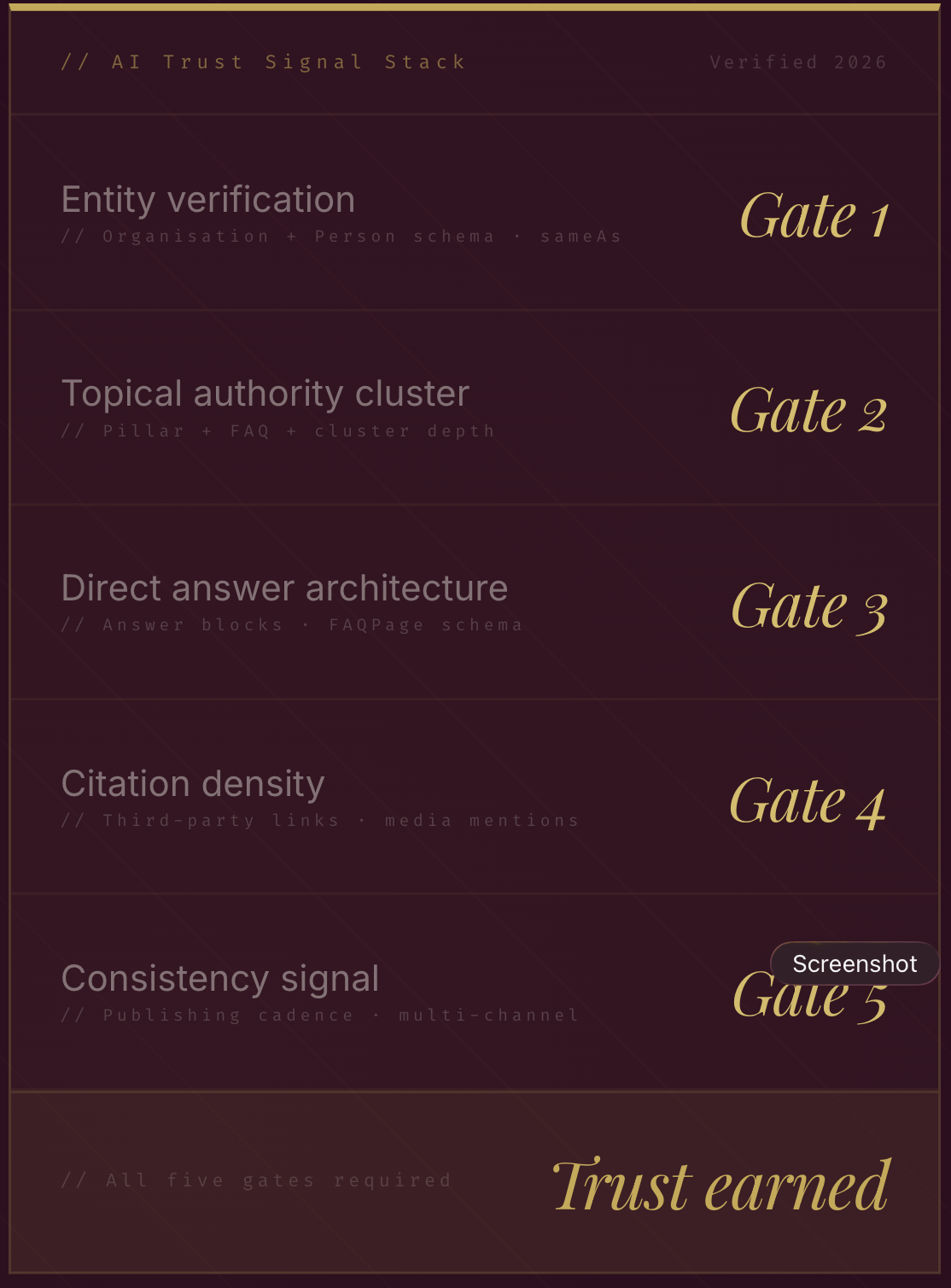
AI systems don't recommend brands randomly. They recommend brands that have passed five specific verification gates — entity confirmation, topical authority, direct answer architecture, citation density, and consistency signal. Miss any gate, and your brand remains invisible regardless of how good your product actually is.
// 01 · The Mechanism
How Does an AI System Decide Which Brand to Recommend?
Most founders assume AI recommendations work the way Google rankings work — that the brand with the most content, the most backlinks, or the most domain authority wins the citation. This is the most expensive misconception in 2026 brand strategy, because AI recommendation logic is structurally different from search ranking logic, and the gap between understanding this and not understanding it is the gap between appearing in AI Overviews and Perplexity answers or being completely invisible to the buyers who use them.
AI systems recommend brands that they can verify — not brands they can merely find. The distinction is critical. Google can rank a page it cannot verify the authorship of, because ranking is about relevance signals. An AI system recommending a brand to a user is making a quality claim on behalf of that brand — and quality claims require verification. The AI's recommendation is an act of trust transfer: it is telling the user "this brand is trustworthy in this context." Without verification signals, that trust transfer is not possible.
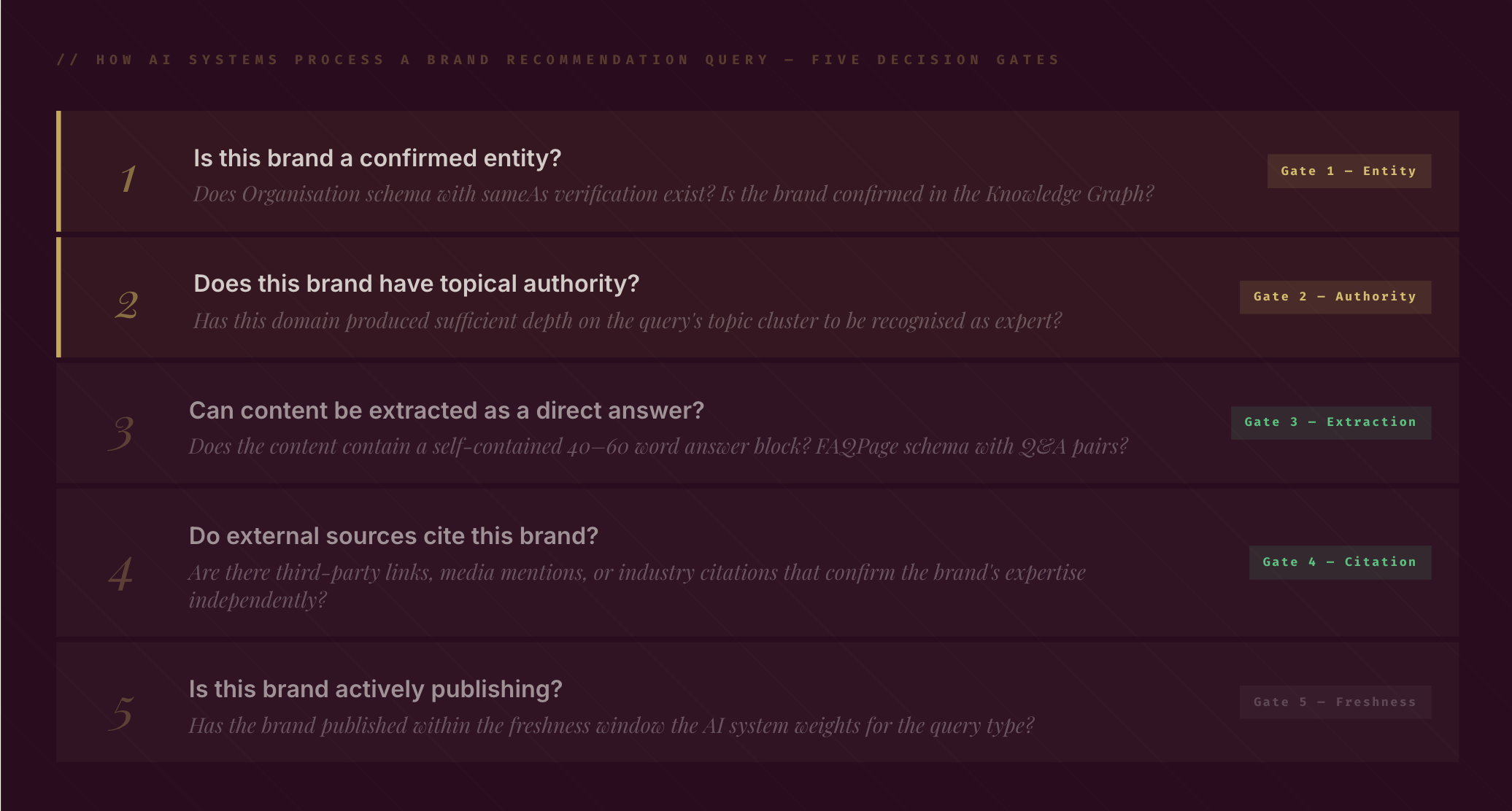
The five-gate decision architecture explains why brilliant brands with excellent products remain invisible in AI recommendations while mediocre brands with solid schema infrastructure appear consistently. The AI system is not evaluating product quality — it is evaluating verifiability. A brand that fails Gate 1 (entity verification) is not evaluated on Gates 2 through 5, because the system cannot safely attribute any content on that domain to a verified, trustworthy source. Entity verification is not an SEO enhancement — it is the prerequisite for all other trust signals to function.
// The Verification Distinction
Ranking signals and trust signals are different. Google ranks pages. AI systems recommend brands. A page can rank without a verified brand behind it. A brand cannot be recommended by an AI system without verification — because the recommendation is a trust transfer, and trust requires identity confirmation before it can be extended. This is why entity schema is the highest-priority single infrastructure action available to any brand seeking AI visibility.
// 02 · The Five Gates
What Are the Specific Requirements for Each AI Trust Gate?
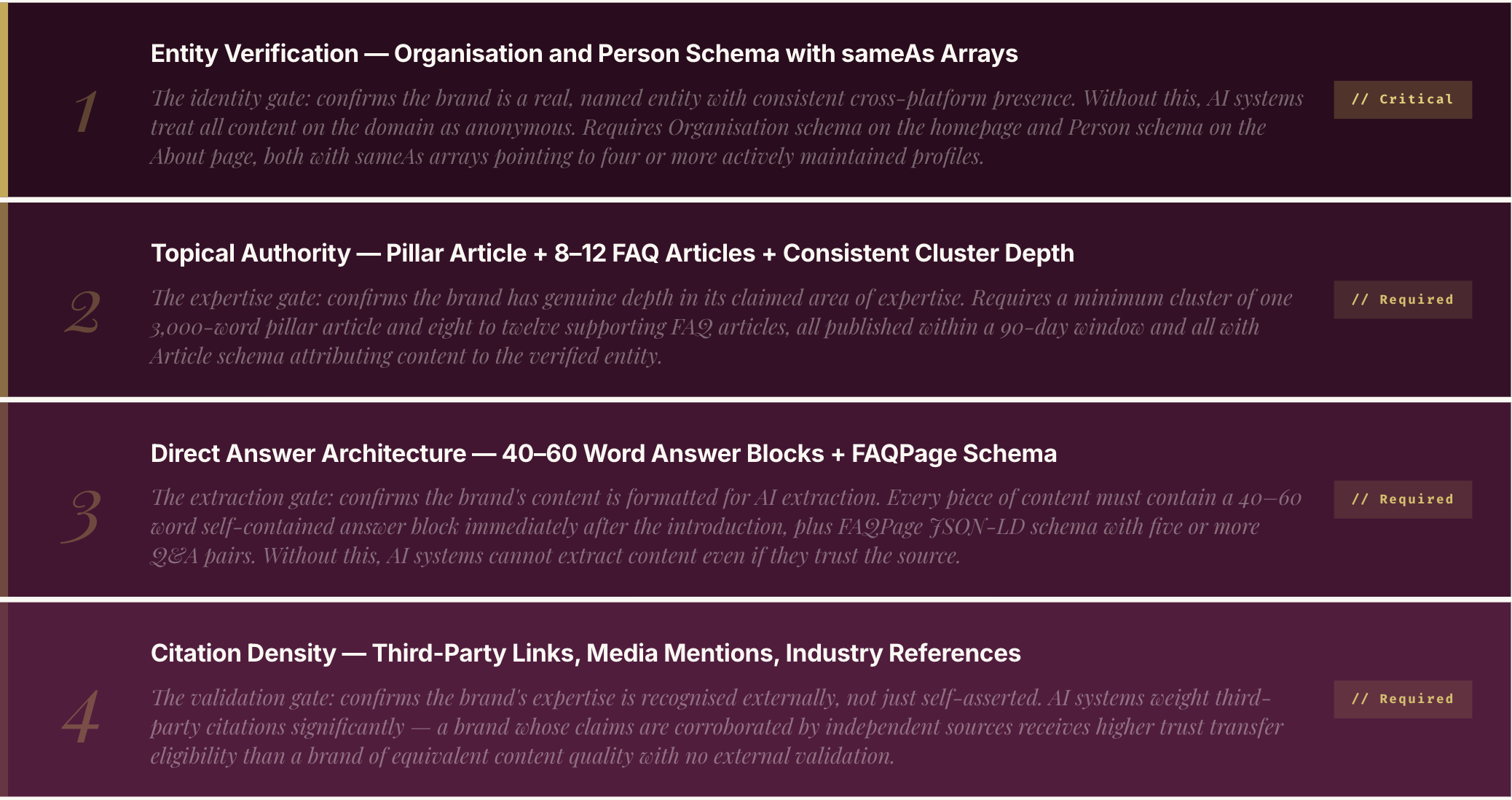
Building a brand that AI trusts to recommend is not a content strategy problem — it is an infrastructure problem. The five gates are not content quality thresholds; they are technical and structural requirements that must be met before AI retrieval systems will include a brand in their recommendation pool. Understanding what each gate specifically requires is the difference between implementing a strategy that compounds and implementing one that stalls at gate one.
// Why Most SME Brands Stall at Gate 1
From our experience working with SMEs, the majority of brands attempting to build AI visibility stall at Gate 1 — not because they lack content or expertise, but because they have never installed entity schema. Their content library can be extensive, their expertise genuine, and their audience engaged — and none of it is attributable to a verified entity in the AI retrieval system's perspective. Every piece of content published before entity schema is installed is effectively anonymous from the AI system's viewpoint. Entity schema's retroactive benefit — changing the attribution status of all existing content — is why installation should always happen before any other trust-building investment.
// 03 · The Evidence
What Does the Research Show About AI Brand Recommendation Patterns?
The academic and industry research on AI recommendation patterns is converging on a consistent finding: AI systems preferentially cite content from sources that demonstrate multiple corroborating trust signals, not just content that is topically relevant or highly ranked in traditional search. The specific signal that produces the highest individual citation lift is entity verification — confirming that the AI recommendation algorithm weights identity verification more heavily than any other single signal.
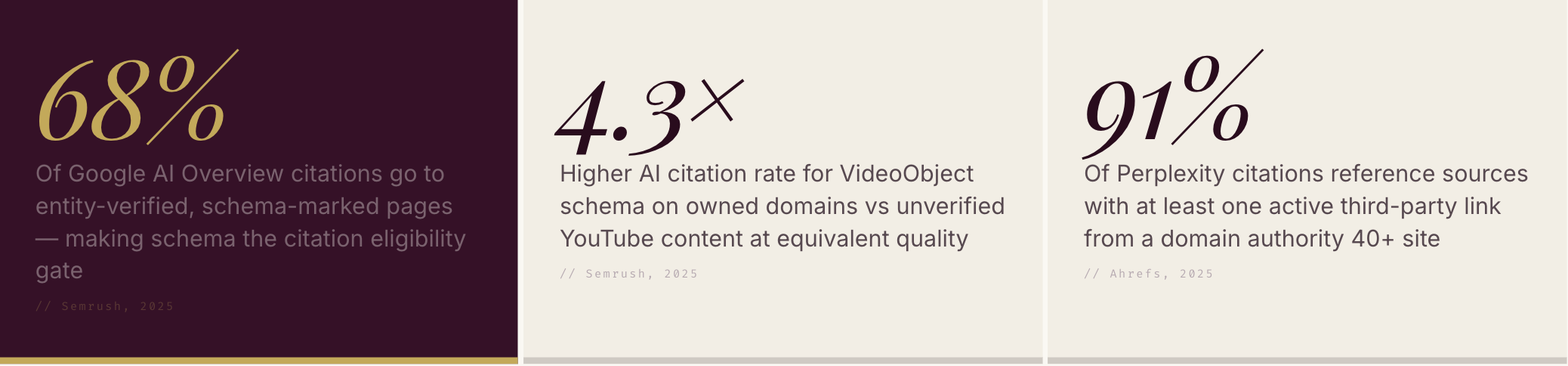
The 91% Perplexity citation figure from Ahrefs' 2025 analysis is particularly significant because it quantifies Gate 4's commercial threshold: a brand with zero third-party citations from meaningful external sources is structurally excluded from 91% of Perplexity's recommendation pool regardless of content quality or entity verification status. This establishes citation density not as a nice-to-have enhancement but as a near-mandatory requirement for Perplexity AI visibility specifically.
The convergence of these data points produces a clear commercial picture: entity verification is the gate that the majority of brands are failing (68% citation share concentrated in schema-marked content means 32% of citation opportunities are distributed among all non-schema content on the web), and citation density is the gate that filters out the majority of remaining brands (91% of Perplexity citations require external validation). A brand that passes both gates is already in the top 5–10% of AI citation eligibility for its topic cluster.
The question is not whether your brand is good enough for AI to recommend. The question is whether your brand has passed the verification requirements that allow AI systems to recommend it safely — regardless of how good it is.
// The reframe that separates AI visibility strategy from brand quality strategy in 2026
// 04 · The Build
How Do You Build a Brand AI Trusts to Recommend — in 90 Days?
The 90-day AI trust build is the minimum investment required to pass all five gates and establish your brand in the AI recommendation pool for your primary topic cluster. The gates must be addressed in sequence — entity verification first, because the retroactive benefit of schema installation means every day you delay is a day the existing content library remains anonymous. The remaining gates are built in parallel after entity verification is confirmed.
01 Gate 1 Build — Install Entity Schema and Trigger Knowledge Graph Confirmation (Week 1)
Install Organisation schema on your homepage with eight required fields: @type (Organization), @id (your domain URL with #organization fragment), name (exactly as it appears on your Google Business Profile), url, logo (ImageObject with URL), description (2–3 sentences using your primary topic cluster's entity vocabulary), foundingDate, and sameAs (array with LinkedIn company page, YouTube channel, Twitter/X profile, and at least one additional verified platform — a podcast host page, a press mention, or a directory listing with NAP-consistent branding). Install Person schema on your About page with six fields: @type, @id, name, jobTitle (using transformation-specific vocabulary from your cluster), worksFor (referencing the Organisation @id), and sameAs (LinkedIn personal, Twitter/X, and one additional). Validate both in Schema.org Validator. Submit both pages to Google Search Console. The Knowledge Graph entity confirmation process takes 30–45 days from installation — starting the clock in Week 1 means entity confirmation arrives by Week 6, before the content cluster is complete, ensuring that all cluster assets published in Weeks 2–10 are entity-attributed from the day they are indexed rather than retroactively attributed after a delayed confirmation window.
02 Gate 2 Build — Produce the Topical Authority Cluster (Weeks 2–8)
Produce one Authority Explainer — the pillar article — on the primary commercial question in your most revenue-relevant topic cluster, at a minimum of 3,000 words with direct answer block, H2 headings as natural-language questions, FAQPage schema with five Q&A pairs, Article schema with Person author attribution, and VideoObject schema if accompanied by a recorded video on an owned host page. Then produce ten FAQ articles over six weeks — one every four days — each targeting a secondary buyer question in the cluster at 600–900 words with its own direct answer block and FAQPage schema. The topical authority signal is generated by the cluster's density: ten articles on supporting questions around one primary question, all published within a concentrated 90-day window, all entity-attributed to the same verified Organisation and Person, all with consistent schema infrastructure. By Week 8, your cluster contains eleven articles — sufficient density for the AI retrieval signal that qualifies for AI Overview category authority in the cluster's primary query variants.
03 Gate 3 Build — Install Direct Answer Architecture Across All Content (Weeks 2–8, Simultaneous)
Every piece of content produced for Gate 2 must include the direct answer architecture that makes it extractable by AI systems. The direct answer block is a 40–60 word self-contained response to the article's primary question, positioned immediately after the first paragraph — before the first H2 heading, before the supporting context, before any qualification. It must answer the question completely as a standalone statement, because AI systems frequently extract and display this block without the surrounding article context. The FAQPage schema must contain five or more Q&A pairs where each answer is complete and self-contained without requiring the question text for comprehension — "Video in email increases click-through rates by up to 300% when implemented using a static thumbnail linked to an owned host page" is extractable; "Yes, it can increase them significantly" is not. Apply retrospective direct answer architecture to your five most commercially valuable existing pages — those targeting the queries most likely to generate discovery calls or direct inquiries — before publishing new cluster content, because retroactive schema installation means the existing pages immediately become extraction-eligible for AI systems from the update date.
04 Gate 4 Build — Earn Three Categories of Third-Party Citation (Weeks 4–12)
Citation density for AI visibility requires three distinct categories of third-party validation, each carrying a different trust signal weight in AI retrieval systems. Category 1 — editorial citations from relevant publications: pitch two to three articles as guest contributions to the industry publications your ideal clients read, specifically targeting publications with Domain Authority 40 or above. The article topics should be your cluster's primary questions reframed for the publication's editorial angle, with a link back to your Authority Explainer as the depth resource. Category 2 — podcast appearances and interview transcripts: appear on two podcasts in your niche whose host pages generate their own organic search traffic — the podcast host page becomes an external entity-linked citation that AI systems treat as an independent third-party corroboration of your expertise claim. Category 3 — directory and resource list inclusions: submit to three industry-relevant directories or resource lists that curate expert practitioners in your field — these provide the NAP-consistent external references that reinforce entity verification beyond the sameAs array. Together, these three categories produce the citation density threshold that positions your brand in the 91% of Perplexity's citation pool that requires meaningful external validation.
05 Gate 5 Build — Maintain the Publishing Cadence That Signals Active Expertise (Weeks 2 Onwards, Permanent)
The freshness signal — Gate 5 — is the only gate that requires ongoing maintenance rather than a one-time build. AI retrieval systems weight content recency differently depending on query type: for rapidly evolving topics (AI tools, market data, regulatory changes), freshness is a primary recommendation factor; for evergreen expertise topics (strategy frameworks, implementation methodologies, professional best practices), freshness is a secondary factor but still materially influences recommendation frequency. The minimum publishing cadence for maintaining the freshness signal in a topical cluster is two new pieces of entity-attributed, schema-marked content per week — achievable with the AI content repurposing system at one recording session per week. The 90-day measurement point at the end of the build is the first commercial checkpoint: test the top ten commercial query variants in your cluster directly in Google AI Overviews, Perplexity, and ChatGPT Search, and count the citations. A brand that has completed all five gates consistently achieves its first AI Overview citations within 45–60 days and measurable inbound from AI-referred discovery within 90 days.
Frequently Asked Questions
How does an AI system decide which brand to recommend?
AI systems recommend brands that pass five specific verification gates rather than brands that simply rank well in traditional search. Gate 1 is entity verification — the brand must have Organisation and Person schema with sameAs arrays confirming it as a known entity in the Knowledge Graph. Gate 2 is topical authority — the brand must have sufficient cluster depth on the query's topic for AI systems to recognise it as a genuine subject-matter expert. Gate 3 is direct answer architecture — the content must contain extractable 40–60 word answer blocks and FAQPage schema so AI systems can include the brand's content in AI-generated responses. Gate 4 is citation density — third-party links and media mentions from external sources must independently corroborate the brand's claimed expertise. Gate 5 is publishing consistency — the brand must maintain a regular publishing cadence that signals active expertise rather than a dormant content library. Semrush's 2025 research found that 68% of Google AI Overview citations go to entity-verified, schema-marked content, establishing entity verification as the single highest-priority trust signal for AI recommendation eligibility.
What is the most important thing a brand must do to appear in AI recommendations?
The single most important action a brand must take to appear in AI recommendations is installing entity schema — specifically Organisation schema on the homepage and Person schema on the About page, both with sameAs arrays pointing to four or more actively maintained professional profiles. Entity verification is the foundational gate that all other trust signals depend on: without it, AI systems treat all content on the domain as anonymous and cannot safely attribute it to a verifiable brand, making citation in AI-generated recommendations structurally impossible regardless of content quality. The retroactive benefit of entity schema installation — changing the citation eligibility status of every piece of content already on the domain from the installation date — means installation today immediately improves the AI citation potential of everything the brand has ever published. The Knowledge Graph entity confirmation process takes 30–45 days, meaning every day entity schema is not installed is a day the existing content library remains anonymous to AI retrieval systems. Once entity verification is confirmed, topical authority cluster production is the next priority, followed by direct answer architecture, citation density, and publishing cadence maintenance.
How long does it take to build a brand that AI trusts to recommend?
Building a brand that AI systems trust to recommend requires a minimum 90-day investment to pass all five trust gates. The timeline breaks into three phases. Weeks 1–2: entity schema installation and submission to Google Search Console (the 30–45 day Knowledge Graph confirmation clock starts immediately). Weeks 2–8: Authority Explainer pillar article and ten FAQ cluster articles produced with direct answer blocks, FAQPage schema, and Article schema — the topical authority and extraction gates built simultaneously. Weeks 4–12 (overlapping): citation density development through guest editorial contributions, podcast appearances, and directory inclusions. From our experience working with SMEs, brands that complete the full five-gate build and maintain weekly publishing cadence typically achieve their first AI Overview citations within 45–60 days of entity confirmation, measurable organic inbound from AI-referred discovery within 90 days, and category-level AI recommendation authority within 12 months of consistent cluster expansion. The 90-day investment produces the infrastructure; the compounding return accumulates continuously with every new entity-attributed, schema-marked content asset added to the authority library after that.
Does having good content alone make AI recommend your brand?
No — good content alone is insufficient for AI brand recommendation, and this is the most commercially significant distinction between traditional SEO strategy and AI visibility strategy. Traditional SEO can rank high-quality content from unverified sources because ranking is a relevance signal rather than a trust signal. AI brand recommendation requires trust verification because the recommendation is an act of trust transfer — the AI system is telling the user 'this brand is a trustworthy expert in this context,' which requires the AI system to have verified the brand's identity and expertise before extending that trust. A brand with excellent content but no entity schema produces anonymous content that AI systems cannot safely attribute to a verified source and therefore cannot recommend. A brand with modest content but complete entity verification, direct answer architecture, and topical cluster depth passes the verification gates that entity-unverified excellent content does not. The implication for brand investment is that the highest-ROI content investment is entity-attributed, schema-marked content in a concentrated topical cluster — not the highest-quality standalone articles on diverse topics.
How do you measure whether your brand is appearing in AI recommendations?
Measuring AI brand recommendation appearances requires direct testing across the primary AI retrieval surfaces rather than relying on traditional search analytics. At the 45-day and 90-day marks from entity schema installation, test the top ten commercial query variants in your topic cluster directly in Google AI Overviews (search the query in Google and check whether an AI Overview appears that includes your content), Perplexity (enter each query and review the cited sources in the response), and ChatGPT Search (use the search-enabled ChatGPT and ask for recommendations in your category). Record which queries produce your brand as a named citation. The 90-day target for a brand that has completed all five trust gates is three to five commercial query variants producing AI citations, with that number growing by two to three additional query variants per 90-day period as the topical cluster expands. Google Search Console provides supporting measurement: organic impressions from AI Overview appearances appear as search type 'Discover' or 'SGE' depending on the Search Console version, and the impression growth curve from entity-verified content clusters is measurably steeper than from equivalent non-schema content at the same publication frequency.
→ The Trust Compound
12 Months From Now, AI-Trusted Brands Will Be Unreachable by Their Competitors
The AI recommendation advantage compounds in a specific way that makes early entry commercially decisive: each new content asset added to an entity-verified, schema-marked authority library increases the brand's total citation surface area, which increases the number of query variants where the brand appears in AI recommendations, which increases the inbound discovery from AI-referred buyers, which increases the brand's external citation density as buyers link to and reference the content they discovered through AI recommendations.
The compounding loop is self-reinforcing. The brand that starts the loop in 2026 will have 12 months of compounding authority by the time competitors understand why they need to start. The brand that starts in 2027 will be beginning the loop from zero against a competitor whose authority library has been compounding for a year — generating AI citations across thirty or more commercial query variants with 150-plus entity-attributed assets and external citation density that cannot be replicated in 90 days regardless of investment.
The five trust gates are not a difficult build. Entity schema takes two hours. The authority cluster takes eight weeks. The direct answer architecture is a formatting decision applied to every article. The citation density is three targeted outreach actions. The publishing cadence is one recording session per week. The entire infrastructure that earns AI's trust to recommend your brand is executable in 90 days — and the compounding return from that 90 days runs indefinitely.