
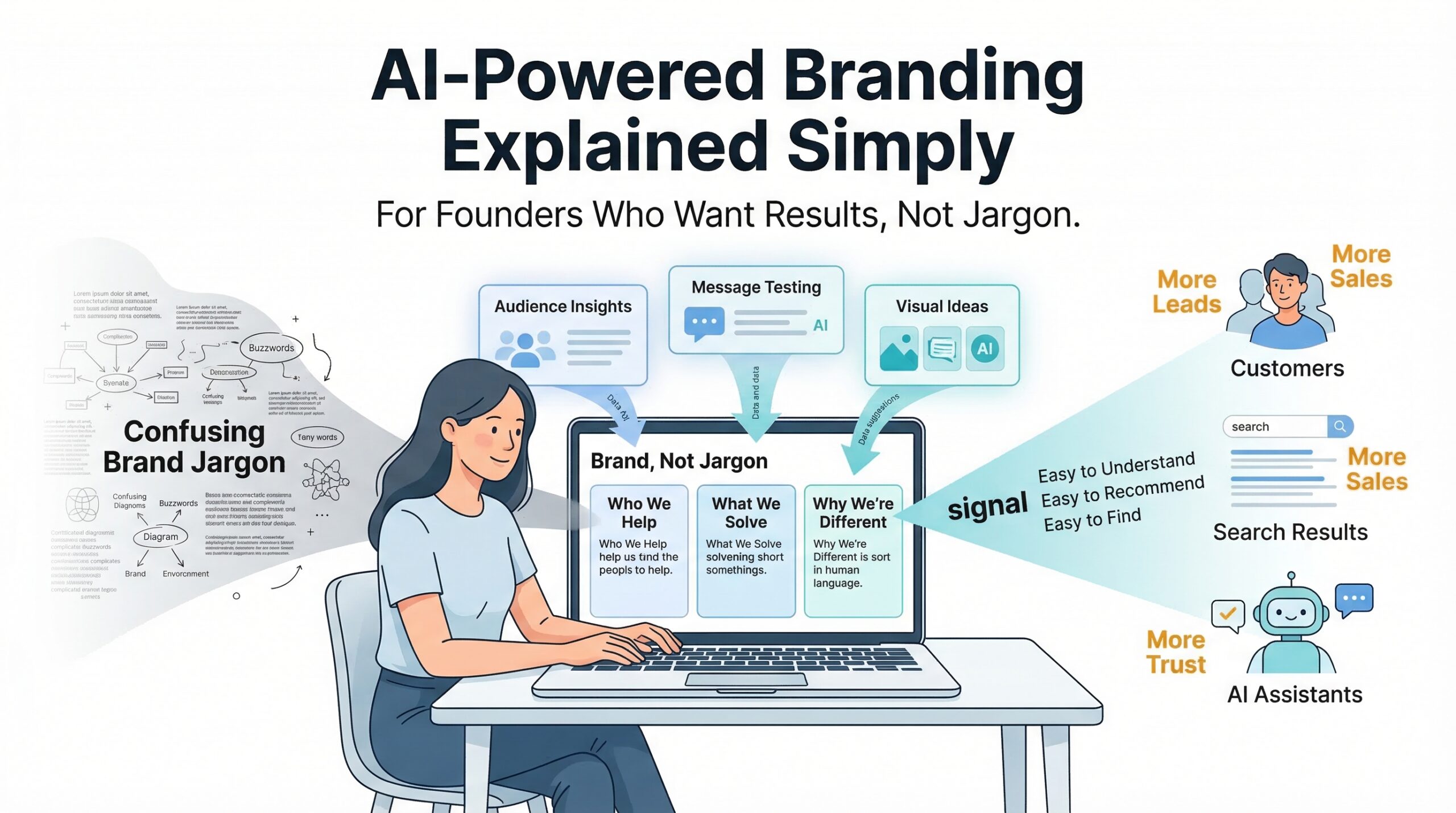
Direct Answer: AI-powered branding means using AI tools to make a brand discoverable in AI-generated search results, consistent across every publishing channel, and authoritative in the topic areas most commercially relevant to the business. It works through three mechanisms: AI content production (converting expertise into consistent multi-channel output), entity schema verification (making the brand citable by AI retrieval systems), and automated presence consistency (maintaining brand visibility without manual daily effort).
// Definition: AI-Powered Branding
The systematic use of AI tools to make a brand discoverable, credible, and consistent across every surface where buyers search, evaluate, and decide — without requiring a large team or agency budget.
01 // Content production — AI converts expertise into authority at scale
02 // Entity verification — schema makes the brand citable by AI systems
03 // Presence consistency — AI maintains multi-channel presence automatically
// In Brief
AI-powered branding is not a design trend. It is the application of AI to the three functions that determine whether your brand generates discovery, trust, and revenue: content production, entity verification, and presence consistency. Each is executable in weeks, not months.
// 01 · What It Actually Is
What Does "AI-Powered Branding" Actually Mean — and What Does It Not Mean?
The phrase "AI-powered branding" has been used to describe everything from AI-generated logo variations to chatbot customer service to algorithm-optimised ad copy. Most of those applications are real but peripheral. The core meaning — the one that determines whether your brand is growing or stagnating in 2026 — is narrower and more specific.
AI-powered branding, at its most commercially significant, means deploying AI tools to solve the three problems that have always limited SME branding: the inability to produce enough content to build genuine topical authority, the inability to make that content discoverable by AI retrieval systems that now mediate a growing proportion of buyer discovery, and the inability to maintain consistent brand presence across six channels without a full marketing team.
Content at Scale
// Problem 1
SMEs cannot produce enough content to build topical authority manually. AI solves this by multiplying one recording into seven published assets.
1 video → 7 assets in 90 min
AI Discoverability
// Problem 2 — Most Urgent
Brands without entity schema are invisible to AI Overview, Perplexity, and ChatGPT Search citations — regardless of content quality or keyword ranking.
68% of AI citations → schema pages
Channel Consistency
// Problem 3
Inconsistent presence across LinkedIn, YouTube, email, and search destroys the trust signal that converts discovery into pipeline.
Automated 30-day calendar
// What AI-Powered Branding Is Not
AI-powered branding is not using AI to generate a logo, produce generic social media captions, or write blog posts that say nothing specific. Those activities consume AI tool budget and produce no compounding commercial value. The defining characteristic of AI-powered branding that actually works is that every AI-produced asset adds permanently to a growing authority library — not to a feed that disappears in 48 hours.
The distinction is between AI as a replacement for creativity (which produces mediocre, forgettable output) and AI as a multiplier for genuine expertise (which produces authoritative, citable content that compounds with each new asset added). Every application of AI to branding should pass this test: does this asset add to a growing library that generates discovery next year, or does it fill a calendar slot and disappear?
// 02 · The Three Components
How Do the Three Components of AI-Powered Branding Work Together?
The three components are not independent — they form a sequential stack where each layer depends on the layer beneath it. Entity verification (the foundation) makes content citable. Content production (the amplification layer) provides the volume and depth that authority requires. Channel consistency (the distribution layer) ensures the content reaches every surface where buyers encounter brands. Missing any layer reduces the commercial effectiveness of the other two.
// Layer 1 — Entity Verification: Making Your Brand Citable
Entity verification is the technical process of establishing your business as a known, confirmed entity in Google's Knowledge Graph and in the retrieval layers of AI answer engines. Without it, your content is attributable to an anonymous website rather than to a named, verified organisation — which is the structural reason why 68% of Google AI Overview citations go to entity-schema pages rather than to unverified content of equivalent or higher quality, according to Semrush's 2025 research.
In practice, entity verification requires two schema nodes: an Organisation schema on your homepage with a sameAs array pointing to your LinkedIn company page, YouTube channel, and Twitter/X profile; and a Person schema on your About page for the founder or primary author with equivalent sameAs verification. These two installations take less than two hours to produce and deploy, and they retroactively change the citation eligibility status of every piece of content on your domain — making everything you have ever published potentially citable by AI retrieval systems from the day the Knowledge Graph entity confirmation processes (typically 30–45 days).
// Layer 2 — AI Content Production: Converting Expertise Into Authority at Scale
Content production at scale is where most SME branding programmes break down — not because founders lack expertise, but because converting expertise into published content manually is too time-intensive to sustain at the volume required for topical authority. AI-powered branding solves this with the content repurposing system: one recorded video per week, processed through five AI extraction prompts in 90 minutes, produces seven published content assets across six channels — the Authority Explainer transcript article, the FAQ video host pages, the email sequence, the social posts, and the newsletter brief.
The commercial distinction between AI content production done correctly and done incorrectly is the host page with VideoObject schema. A YouTube video without an owned host page attributes its ranking equity to YouTube rather than to your entity-verified domain. A YouTube video with a VideoObject schema host page on your owned domain attributes that ranking equity to your brand — generating organic search traffic and AI Overview citations to your website rather than depleting them into a third-party platform. This 25-minute infrastructure step is the difference between building a content asset and building a content expense.
// Layer 3 — Channel Consistency: Maintaining Presence Without Daily Manual Effort
Channel consistency — the same brand voice, the same visual identity, the same topical focus, the same publishing frequency — across LinkedIn, YouTube, email, Twitter/X, and your owned blog is the presence signal that builds the familiarity required for buyers to trust an unfamiliar brand. Building familiarity requires repetition. Repetition requires consistency. Consistency requires a system.
The AI channel consistency system is the 30-day distribution calendar: all seven content outputs from each recording session loaded into a scheduling platform on production day, publishing automatically on the correct day at the correct time on each channel, without daily manual posting. The system does not replace the human — the expertise in the recordings is irreplaceable. It replaces the daily manual posting effort that most founders abandon within six weeks of committing to a content programme, precisely because manual consistency is incompatible with the operational demands of running a business.
A brand is not what you say about yourself. It is the accumulated impression left by everything you publish, consistently, over time. AI's contribution to branding is making that accumulation possible at the speed and scale that builds genuine authority within 90 days rather than 24 months.
// The core commercial argument for AI-powered branding as an infrastructure investment rather than a content strategy
// 03 · Before vs After
What Does a Brand Look Like Before and After AI-Powered Branding Infrastructure?
The most practical way to understand AI-powered branding is through the before/after comparison of a specific SME — not a large enterprise with a marketing department, but a 10–50 person service business trying to build a recognisable brand in a competitive market with a founder who has genuine expertise and limited production capacity.
// Before AI-Powered Branding
- Posts 2–3 times per week when time allows
- No schema — brand is anonymous to AI systems
- Videos published to YouTube only, no host pages
- Content disappears in the 48-hour feed cycle
- No topical cluster — scattered individual posts
- Zero AI Overview or featured snippet appearances
- Discovery depends entirely on referrals and ads
- Content investment produces no compounding return
// After AI-Powered Branding Infrastructure
- 14 content assets per week from 2 recordings
- Entity-verified — citable by all AI retrieval systems
- VideoObject schema host pages on owned domain
- Authority library compounds with every asset added
- Topical cluster generates cluster authority signal
- AI Overview citations appear within 30–45 days
- Organic discovery from search and AI retrieval
- Every asset generates inbound in perpetuity
The most commercially significant change in this before/after comparison is not the volume of content — it is the longevity. Content published without schema infrastructure has a commercial life of 48 hours: it reaches the existing audience and disappears. Content published with entity schema, VideoObject host pages, and topical cluster architecture has a commercial life of 18 months or more — generating organic discovery, AI citations, and inbound leads continuously from the day of publication through the entire lifespan of the topical cluster.
68%
Of Google AI Overview citations go to entity-verified, schema-marked pages
// Semrush, 2025
4.3×
Higher AI Overview citation rate for VideoObject schema on owned domains vs YouTube-only
// Semrush, 2025
18mo
Average organic traffic lifespan for a well-structured schema-marked video host page
// HubSpot, 2025
// 04 · The Build
How Do You Implement AI-Powered Branding for an SME in 30 Days?
The 30-day AI-powered branding build is the minimum investment required to establish all three components of the infrastructure. The phases must be executed in order — entity verification first, because the Knowledge Graph confirmation takes 30–45 days from installation, and every day you delay entity verification is a day the content you are already producing remains uncitable by AI retrieval systems.
01 Week 1 — Install Entity Schema and Verify the Brand Foundation
Install Organisation schema on your homepage with a sameAs array pointing to your LinkedIn company page, YouTube channel, Twitter/X profile, and one additional verified platform. Install Person schema on your About page for the founder with equivalent sameAs verification. Submit both pages to Google Search Console for immediate crawling. This single week's work retroactively makes every piece of content on your domain entity-verified — the prerequisite for AI Overview citation eligibility across your entire existing content library. The installation takes two hours. The commercial impact operates indefinitely from the day the Knowledge Graph entity confirmation processes.
02 Week 2 — Record Your First Authority Explainer and Build the Content System
Record a 10–15 minute Authority Explainer video on the primary question in your most commercially relevant topic cluster. Build the five-prompt AI extraction library — transcript-to-article, LinkedIn post, Twitter/X thread, email nurture sequence, newsletter brief — using the five-part prompt architecture. Publish the full video on YouTube and publish the VideoObject schema host page on your owned domain with a 3,000-word transcript article, FAQPage schema, and Article schema with Person author attribution. Submit to Google Search Console. This week establishes the content production system and publishes the first asset in the authority library that will compound with every subsequent addition.
03 Weeks 3–4 — Build the FAQ Series and Load the Distribution Calendar
Record ten FAQ videos in a single batch session — each 90–180 seconds answering one specific question buyers ask before purchasing. Publish each with a VideoObject schema host page and FAQPage schema, targeting the exact natural-language query form the buyer uses. Build the 30-day distribution calendar template and load it into your social scheduling platform. Load the email sequence into your email platform with the correct three-day delay triggers between emails. By the end of week four, your content system is operational, your FAQ Series provides ten additional featured snippet targets, and your distribution calendar is running automatically — the three-component AI-powered branding infrastructure is complete and compounding.
// The 90-Day Measurement
At 90 days from the Authority Explainer's publication, test the ten most commercially relevant query variants in your primary topic cluster directly in Google AI Overviews and Perplexity. Count how many return citations to your entity-verified content. The 90-day citation count is your AI-powered branding ROI metric — the measurable evidence that the infrastructure investment is producing the compounding discovery return it was built to generate. From our experience working with SMEs, content programmes that complete the 30-day build and maintain weekly publishing typically achieve their first AI Overview citations within 45–60 days and measurable organic inbound within 90 days.
Frequently Asked Questions
What is AI-powered branding?
AI-powered branding is the systematic use of AI tools to make a brand discoverable by AI retrieval systems, consistent across multiple publishing channels, and authoritative in the topic areas most commercially relevant to the business — without requiring a large marketing team or agency budget. It works through three mechanisms: entity verification (Organisation and Person schema with sameAs arrays that establish the brand as a known entity in Google's Knowledge Graph and AI retrieval systems), AI content production (the repurposing system that converts one recorded video into seven published assets per week), and automated channel consistency (the 30-day distribution calendar that maintains multi-channel presence without daily manual posting). Semrush's 2025 research found that entity-verified, schema-marked content achieves a 4.3× higher AI Overview citation rate than unverified content — making entity verification the highest-leverage single action available to an SME building AI-powered branding infrastructure.
How is AI-powered branding different from traditional branding?
Traditional branding focuses primarily on visual identity, messaging consistency, and audience reach through paid or earned media. AI-powered branding extends beyond these dimensions to include technical discoverability in AI retrieval systems — the dimension that determines whether a brand appears in Google AI Overviews, Perplexity answers, and ChatGPT Search citations when buyers ask questions relevant to the business. The specific difference is the schema infrastructure layer: traditional branding does not include entity schema, VideoObject markup, or FAQPage structured data, because these technical elements did not affect discoverability in a non-AI search environment. In 2026, 68% of Google AI Overview citations go to schema-marked pages (Semrush, 2025), making structured data infrastructure a core component of brand discoverability rather than an optional technical enhancement. AI-powered branding combines the traditional elements (consistent voice, visual identity, topical focus) with the technical layer (entity verification, video host page infrastructure, direct answer architecture) that makes the brand discoverable in the AI-mediated discovery environment where buyers now encounter brands for the first time.
How long does AI-powered branding take to produce measurable results?
AI-powered branding produces results on three timelines. Immediate results (days 1–14): deploying the AI content repurposing system immediately reduces content production cost from £2,000–£4,000 per month (agency equivalent) to £40–£80 per month (AI tools), producing a direct margin improvement that begins on the first production day. Medium-term discovery results (days 30–60): entity schema installation produces Knowledge Graph entity confirmation and initial AI Overview citation eligibility within 30–45 days, and VideoObject schema host pages begin appearing in featured snippets and AI retrieval answers within 30–45 days of publication. Long-term authority compounding (months 3–12): the topical authority cluster — built from the Authority Explainer, FAQ Video Series, and supporting articles published at two per week — produces category-level AI citation authority within 90 days and measurable organic inbound from discovery-driven buyers within 90–120 days. The 12-month compounding effect — a growing library of 150+ entity-attributed, schema-marked assets generating citations across 30+ commercial query variants — is the wealth architecture component that makes AI-powered branding investment-grade rather than a marketing expense.
Do I need technical expertise to implement AI-powered branding?
No — the technical components of AI-powered branding require implementation knowledge rather than coding expertise. Organisation schema and Person schema are JSON-LD code blocks inserted into a page's head section using a CMS's custom code injection feature, which most modern CMS platforms (WordPress, Webflow, Squarespace) provide without developer involvement. The Schema.org Validator and Google Rich Results Test provide pre-deployment validation that confirms correct implementation without requiring a developer to review the code. VideoObject schema follows the same installation method and requires populating five fields from the video metadata. The total technical implementation time for the complete entity foundation (Organisation schema, Person schema, Google Business Profile NAP verification) is approximately two hours for a non-technical founder with a modern CMS. The only step that benefits from developer involvement is custom head code injection on legacy CMS platforms without native injection support — which accounts for a small minority of current SME website infrastructure.
What is the most important first step in AI-powered branding?
The most important first step in AI-powered branding is entity schema installation — specifically Organisation schema on the homepage and Person schema on the About page, both with populated sameAs arrays pointing to four or more actively maintained professional profiles. This step is highest priority because its commercial benefit is retroactive: installing entity schema today changes the citation eligibility status of every piece of content already published on the domain — not just new content published after the installation date. The Knowledge Graph entity confirmation process takes 30–45 days, meaning every day entity schema is not installed is a day the existing content library remains anonymous to AI retrieval systems. Semrush's 2025 research finding that 68% of AI Overview citations go to entity-schema pages establishes entity verification as a citation eligibility gate rather than a ranking enhancement — making its installation the prerequisite for accessing the majority of AI citation opportunities available to content on any domain, regardless of quality or existing organic ranking position.
→ The Compounding Summary
AI-Powered Branding Is Infrastructure — and Infrastructure Compounds
The simplest way to understand AI-powered branding is to understand what it is not: it is not a campaign, a trend, or a technology experiment. It is infrastructure — the technical and content foundation that makes a brand discoverable, citable, and authoritative in an AI-mediated world, built once and compounding indefinitely with every new asset added.
The entity schema takes two hours to install and runs indefinitely. The content system takes one week to build and produces seven assets per recording session forever. The FAQ Series takes one batch session to record and generates featured snippet targets permanently. The VideoObject host pages take 25 minutes each to publish and generate organic traffic for 18 months or more per video.
The founders who build this infrastructure in 2026 will have a brand discoverability advantage that widens automatically — every week, every new video, every new FAQ answer — while their non-infrastructure competitors are still posting to feeds that disappear in 48 hours and wondering why their content investment isn't compounding.