
Direct Answer: The secret to consistent content is replacing willpower with workflow: a four-tool AI stack (transcription, language model, video clip extraction, scheduling) connected by a documented production SOP that converts one recorded video into seven published assets in under four hours. Founders who deploy this system publish consistently across six channels every week for a total AI-tool cost of £30–£60 per month — regardless of creative energy, time pressure, or schedule disruption.
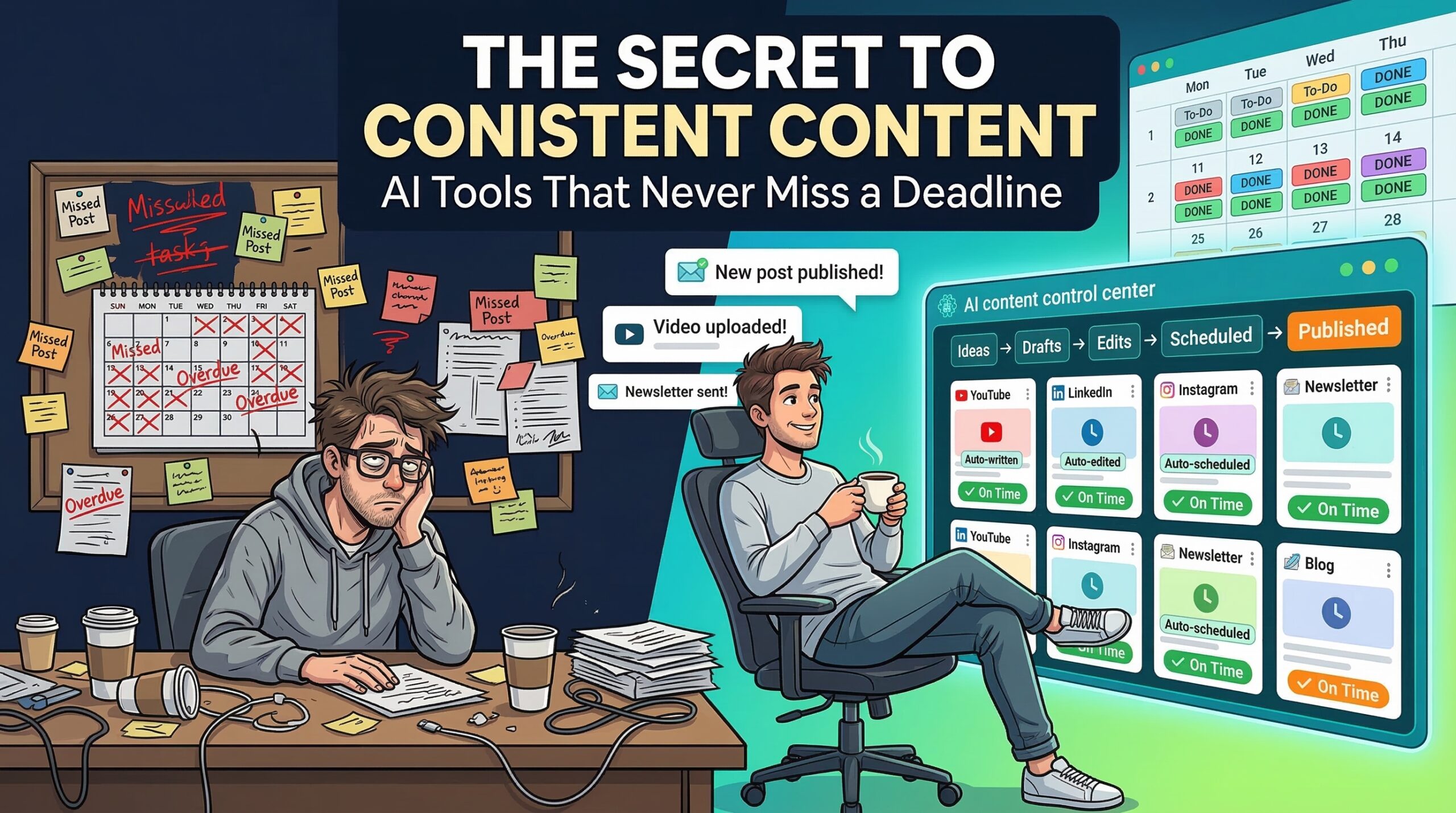
// Ops Brief
Inconsistent content is not a creativity problem — it is a systems problem. This article covers the exact AI tool stack, production SOPs, and deadline architecture that SME founders use to publish consistently across six channels every single week — without burnout, agency dependency, or missed publishing windows.
// 01 · The Root Cause
Why Do Founders Start Strong With Content Then Go Silent for Weeks?
The pattern is almost universal. A founder commits to content in January. Three weeks of daily posts. A video or two. Genuine momentum. Then a client crisis, a hiring round, or simply a bad week — and the entire content programme collapses. Three weeks later they restart, and the cycle repeats.
This is not a motivation problem. It is a system architecture problem. The content programme collapsed because it was built on available time and creative energy rather than on a production system that runs regardless of either. Manual content creation requires a specific kind of cognitive state — present, uninterrupted, creatively available — that a founder under operational pressure almost never has on demand.
AI tools solve this problem not by removing the need for human judgement but by compressing the time and cognitive load required for production to the point where it fits into the gaps that exist in even the most pressured week. A four-hour Sunday session with the right AI tool stack produces a full week's worth of content across six channels. It does not require inspiration. It requires a documented process and a reliable tool stack.
// The Systems Insight
Consistency is not a character trait. It is a system output. A founder with an unreliable content system who is highly motivated will always produce less consistent content than a founder with a reliable AI production system who is only moderately motivated. The variable that determines consistency is the system, not the person running it.
From our experience working with SMEs, the founders who produce the most consistent content output are almost never the most creative or the most prolific ideators — they are the ones who built a repeatable production system first and trusted the system to maintain output during weeks when motivation was low. The system is the consistency. The AI tools are what make the system executable in four hours rather than fourteen.
// 02 · The Stack
What Specific AI Tools Build a Consistent Content Production System for an SME?
The AI tool stack for consistent content production has four components. Each component addresses one production bottleneck. Together they form a pipeline from raw recording to published multi-channel content in under four hours.
Tool
Role in System
Time Saved
Role in System
Transcription Tool
Otter.ai / Descript / YouTube Auto-Caption
Converts raw video audio into editable transcript in under 5 minutes — the source asset for all downstream AI processing
45 min/video
Free–£10
AI Language Model
Claude / ChatGPT / Gemini
Runs 5 extraction prompts to generate article, LinkedIn posts, Twitter/X thread, email sequence, and newsletter brief from transcript
3h/video
£15–£25
Short-Form Clip Tool
Opus Clip / CapCut / Descript
AI detects and extracts 3–5 high-engagement moments from full video as 60–90 second clips with auto-captions
2h/video
£10–£20
Social Scheduling Platform
Buffer / Later / Publer
Loads all social posts from the 30-day distribution calendar on publication day — automatic delivery eliminates daily posting requirement
Daily logging
£10–£15
Email Platform
Mailchimp / Brevo / ConvertKit
Hosts and automates the 3-part nurture sequence with pre-set delay triggers — sends all three emails automatically from a single load event
Per-send prep
Free–£10
VideoObject Schema Generator
Clipkoi / Manual JSON-LD
Produces VideoObject schema and host page infrastructure that attributes video ranking equity to owned domain, not YouTube
25 min/video
Varies
The total monthly cost for the full stack is £30–£60 — less than the cost of one hour of copywriter time. The stack replaces what would otherwise require either a full-time content manager or a £1,500+/month agency retainer to produce at equivalent output volume and quality.
// The Tool Selection Principle
In practice, the specific tools matter less than the prompts and SOPs you attach to them. A founder using Claude with a well-crafted extraction prompt library will outproduce a founder using a more sophisticated platform with no documented process. Invest the first week in building your prompt library and production SOP. The tools are interchangeable. The documented process is the moat.
// 03 · The SOP
What Does the Exact Weekly Production SOP Look Like — Step by Step?
The production SOP is the document that converts the tool stack into a repeatable system. Without it, each production session requires decisions — which tool, which prompt, which format, which channel — that collectively consume as much time as the production itself. With a documented SOP, each session is execution-only. No decisions. No friction. Just process.
// Weekly Production SOP — Single Session Execution
Target: 4h total
01
30–60 min
Record Source Video
8–12 min structured argument · clear audio · 3-part format · single take preferred · no post-production
02
5 min
Generate Transcript
Upload to transcription tool · export clean text · light edit for filler words only · save as master source
03
90 min
Run 5 AI Prompts
Article → LinkedIn → Twitter/X → email sequence → newsletter · edit each output · 15 min max per output
04
25 min
Publish Host Page
VideoObject schema · article body from step 03 · YouTube embed · submit to Search Console
05
30 min
Load & Schedule
Social posts → scheduler · email sequence → platform with delay triggers · newsletter → queue · 30-day calendar locked
The five-step SOP runs in a single four-hour session scheduled on the same day each week. The session day does not matter — Sunday, Monday, or Friday — as long as it is the same day every week, which is what makes the system reliable rather than aspirational. A content system that depends on finding time whenever possible will always lose to operational pressure. A content system on a fixed weekly calendar appointment is a production commitment, not a hopeful intention.
What we consistently see in real-world deployments is that the founders who maintain the most consistent output are the ones who treat the production session as an immovable appointment — equal in calendar status to a client meeting or a board call. The production session is not discretionary. It is the business operation that generates the pipeline that funds everything else.
// The Editing Standard
The single most common SOP failure point is the editing step — founders who spend 45 minutes perfecting each AI output instead of the 15-minute maximum the SOP specifies. The editing standard is not perfection — it is publication quality. AI output that is 90% right and published consistently outperforms AI output that is 100% right and published monthly. Set a timer for each output and publish when the timer expires.
// 04 · The Architecture
How Do You Build a Deadline Architecture That Makes Missing a Publish Structurally Impossible?
A deadline architecture is the set of structural commitments that make publishing the default outcome rather than the aspirational one. Without a deadline architecture, every week is a new decision about whether to produce content. With one, the content system runs on rails — the only decision is whether to record the source video, which is the single irreducible human input the entire system requires.
87%
of SME content programme failures occur within the first 90 days due to system breakdown rather than topic exhaustion
// Content Marketing Institute, B2B Content Marketing Report, 2025
The failure mode is almost never running out of things to say. It is running out of system — the production infrastructure collapses under operational pressure before topical authority has time to compound into measurable results.
The deadline architecture has three structural elements that work together to make consistent publishing the default outcome rather than the effortful exception.
// Element 1 — The Fixed Recording Appointment
Block a recurring 60-minute recording appointment at the same time every week and treat it as a client-facing commitment. The recording appointment is the only session in the system that cannot be automated or AI-assisted — which is exactly why it requires the strongest structural protection. If the recording does not happen, nothing downstream happens. Everything in the deadline architecture flows from this one weekly appointment being kept.
// Element 2 — The 48-Hour Publication Window
Set a rule: all seven content outputs from a recording session must be published or scheduled within 48 hours of the recording. This rule prevents the most common consistency failure mode — the "I'll finish it later" backlog that causes one missed session to cascade into three. When the 48-hour window closes, any unfinished outputs are published in their current state or cut from that week's schedule. Imperfect and published beats perfect and unpublished every week without exception.
// Element 3 — The Pre-Built Contingency Library
Maintain a library of three to five evergreen content assets — articles, posts, and videos — that are fully produced but not yet published, reserved exclusively for weeks when the recording session cannot happen. The contingency library ensures that the distribution calendar never goes dark, even during travel, illness, or operational crisis. When a contingency asset is consumed, the next available production session adds one replacement asset back to the library before adding new current-cycle content. The library is the buffer that makes the system resilient rather than brittle.
3×
Higher organic ranking velocity for SMEs maintaining consistent weekly publishing versus monthly publishing on the same topic cluster
// Ahrefs, 2025
6×
More AI Overview appearances at 90 days for content programmes with weekly publishing cadence versus irregular publishing
// Semrush, 2025
48h
Maximum acceptable time from recording to scheduled publication — the deadline architecture's core constraint that prevents backlog cascades
// Clipkoi content ops data, 2026
Inconsistency doesn't announce itself. It creeps in as "just this once." The only defence is a system that makes publishing easier than not publishing — and that is exactly what the AI tool stack provides.// The core operational
insight behind the deadline architecture for SME content programmes
// 05 · The Prompt Library
What Are the Exact AI Prompts That Make Every Content Session Execution-Only?
The prompt library is the document that eliminates the cognitive load from every production session. Each prompt is a permanent, reusable template that requires only the transcript as the variable input. Once built, the prompt library converts your AI language model from a tool you have to think about into a production pipeline you execute.
01
The Transcript-to-Article Prompt
System: You are a senior content strategist converting a spoken-word video transcript into a high-authority written blog article. User prompt structure: five mandatory elements. (1) Goal: Transform the following transcript into a 1,400–1,800 word blog article on [topic cluster]. (2) Structure: Begin with a 40–60 word direct answer block that answers the article's primary question as a complete self-contained statement. Then use H2 headings written as natural-language questions matching how an expert in this field would search for information. Use short paragraphs of 2–4 lines. (3) Schema: Generate a FAQPage JSON-LD block with five Q&A pairs derived from the article's implied questions — each answer self-contained at minimum 50 words. (4) Constraint: Write in second person, authoritative tone, no marketing language, no filler. Assume the reader is an experienced founder or senior marketer. (5) Output: Semantic HTML with the FAQPage JSON-LD schema in a separate code block. Transcript: [PASTE TRANSCRIPT HERE]. Save this prompt permanently. Every future article uses the same prompt with the transcript as the only variable.
02
The LinkedIn Post Extraction Prompt
System: You are a LinkedIn content strategist extracting the single most commercially valuable insight from a transcript for a B2B founder audience. User prompt: Extract one long-form LinkedIn post from the following transcript. Requirements: 900–1,000 characters total. Three-paragraph structure — first paragraph is a scroll-stopping hook based on the transcript's most counterintuitive claim (do not start with "I"); second paragraph unpacks the mechanism behind the claim with one specific data point or framework; third paragraph states the one practical action the reader should take, ending with a non-salesy CTA. No more than two hashtags, placed at the end. Do not include a link in the post body. Transcript: [PASTE TRANSCRIPT HERE]. This prompt produces one post. Run it twice with the instruction "extract a different insight" to generate the second and third LinkedIn posts for the 30-day distribution calendar without additional thinking.
03
The Email Nurture Sequence Prompt
System: You are an email marketing strategist writing a three-part B2B nurture sequence for a founder's email list. User prompt: Generate a three-email nurture sequence from the following transcript. Email 1 — Insight (150–180 words): Extract the single most counterintuitive or surprising insight from the transcript. Subject line: the insight stated as a declaration, not a question. Body: the insight explained with one concrete example or data point. No CTA, ends with a teaser for Email 2. Email 2 — Proof (160–200 words): Extract the evidence, mechanism explanation, or before/after comparison that validates the Email 1 insight. Subject line: references Email 1 claim with "here's why." Body: the proof with specific detail. Ends with a teaser for Email 3. Email 3 — CTA (120–150 words): Connect the insight and proof to the reader's specific situation. One explicit next step — a link to the full article, a call booking, or a specific offer. Subject line: action-oriented. All three emails: second person, no marketing language, direct and conversational. Transcript: [PASTE TRANSCRIPT HERE].
04
04
The Twitter/X Thread Prompt
System: You are a Twitter/X content strategist creating high-engagement threads for a B2B founder audience. User prompt: Create an 8–10 tweet thread from the following transcript. Tweet 1: hook — the most provocative or surprising claim in the transcript, stated as a bold declaration. Under 240 characters including spaces. Tweets 2–4: mechanism — unpack the argument with one insight per tweet, each standing alone as a quotable statement. Tweet 5: data point or named research citation from the transcript. Tweets 6–7: application — the one or two most actionable takeaways for the reader. Tweet 8: pattern interrupt — a common misconception this content corrects. Final tweet: CTA with link to the full article. All tweets: under 280 characters, no emojis, no filler phrases. Number each tweet in format [1/9]. Transcript: [PASTE TRANSCRIPT HERE]. Add the instruction "produce a second thread on a different argument from the same transcript" to generate additional Twitter/X content for weeks 2–4 of the distribution calendar.
05
The Newsletter Brief Prompt
System: You are a newsletter editor writing a concise weekly brief for a B2B founder audience. User prompt: Write a 250-word newsletter brief from the following transcript. Structure: opener (one sentence, the most useful insight from the transcript stated directly — no preamble); three bullet points labelled "What it means," "Why it matters," and "What to do" — each 30–40 words, specific and actionable; a closer paragraph of two sentences connecting the insight to the reader's current situation; a closing line with links to the full article and the published video. Tone: direct, no fluff, assumes the reader is time-poor and has already seen hundreds of generic newsletters this week. Do not use the phrase "in today's newsletter" or any variant. Transcript: [PASTE TRANSCRIPT HERE]. This prompt produces a complete send-ready newsletter brief that requires only two minutes of personalisation before loading into your email platform.
Frequently Asked Questions
What is the secret to consistent content production for SMEs?
The secret to consistent content production for SMEs is replacing willpower-dependent manual creation with a four-tool AI system connected by a documented production SOP. The system converts one recorded video into seven published content assets across six channels in a four-hour weekly session — using a transcription tool (5 minutes), an AI language model running five extraction prompts (90 minutes), a short-form clip tool (15 minutes), and a scheduling platform (30 minutes). The consistency comes from the system's structural elements: a fixed weekly recording appointment, a 48-hour publication window rule, and a contingency library of three to five pre-produced evergreen assets that prevent the distribution calendar from going dark during weeks when the recording session cannot happen. According to Content Marketing Institute's 2025 B2B Content Marketing Report, 87% of SME content programme failures occur within 90 days due to system breakdown rather than topic exhaustion — confirming that the production system, not the content strategy, is the primary consistency variable.
What AI tools are best for consistent content production?
The four AI tools that form the most reliable consistent content production stack for SMEs are: a transcription tool (Otter.ai, Descript, or YouTube's built-in auto-captioning) for converting recorded video audio into an editable transcript in under five minutes; an AI language model (Claude, ChatGPT, or Gemini) for running five extraction prompts that generate an article, LinkedIn posts, Twitter/X thread, email sequence, and newsletter brief from the transcript in 90 minutes; a short-form clip tool (Opus Clip, CapCut, or Descript) for AI-detecting and extracting three to five high-engagement moments as 60–90 second clips with auto-captions in 15 minutes; and a social scheduling platform (Buffer, Later, or Publer) for loading all social posts from the 30-day distribution calendar on publication day and delivering them automatically without daily manual posting. Total monthly cost for the full stack is £30–£60 — less than one hour of copywriter time — producing the equivalent output of a full-time content manager at a fraction of the cost.
How do you prevent missing a content deadline when your week gets disrupted?
The three structural elements of a deadline architecture prevent missed content deadlines during disrupted weeks. First, a contingency library of three to five fully produced but unpublished evergreen content assets reserved exclusively for weeks when the recording session cannot happen — the library ensures the distribution calendar never goes dark regardless of operational pressure. Second, a 48-hour publication window rule that requires all outputs from a recording session to be published or scheduled within 48 hours of recording, preventing the "I'll finish it later" backlog that causes one missed session to cascade into three. Third, a fixed weekly recording appointment blocked in the calendar as a non-negotiable commitment equal in status to a client meeting — protecting the single irreducible human input that the AI production system requires to operate. When a contingency asset is consumed, the next production session adds one replacement asset to the library before adding new current-cycle content, keeping the buffer permanently full.
How much time does a consistent AI content system require each week?
A consistent AI content system requires a total of three to four hours per week for one video's worth of content across six channels. This breaks down as: 30–60 minutes for recording the source video (preparation plus filming); 5 minutes for generating the transcript; 90 minutes for running five AI extraction prompts and editing outputs to publication standard at a maximum of 15 minutes per output; 25 minutes for publishing the host page with VideoObject schema and submitting to Google Search Console; and 30 minutes for scheduling all social posts and loading the email sequence. The editing step is the most time-critical: founders who exceed 15 minutes per output extend the session beyond four hours and create the time pressure that causes them to skip the system in subsequent weeks. The 15-minute editing maximum is not a quality compromise — it is the operational standard that makes the system sustainable at weekly frequency without burnout.
Why does publishing consistently matter for SEO and AI citations?
Publishing consistently matters for SEO and AI citations because both Google's ranking systems and AI retrieval engines reward topical cluster density — the signal produced by multiple related articles published within a concentrated time window on the same topic cluster. Ahrefs' 2025 research found a 3× higher organic ranking velocity for SMEs maintaining consistent weekly publishing versus monthly publishing on the same cluster. Semrush's 2025 research found 6× more AI Overview appearances at 90 days for content programmes with weekly publishing cadence versus irregular publishing. The mechanism is cluster completion speed: a weekly publishing system completes the 12-article topical authority cluster in six weeks, triggering the citation eligibility threshold that produces AI Overview appearances. An irregular publishing system that produces the same 12 articles over six months produces the same total content but never triggers the density signal because the articles are published too far apart to register as a coordinated cluster build. Consistency is not a brand preference — it is a structural ranking requirement.
→ The Operational Truth
Six Months of Weekly Publishing Is Worth More Than Three Years of Irregular Posting
Six months from now, a founder who has run this system every week will have 24 schema-marked video host pages, 24 pillar and supporting articles in a topically authoritative cluster, 168 distributed social and email assets, and a content library that generates inbound traffic, AI Overview citations, and pipeline leads continuously — without requiring a new creative session to trigger each outcome.
Their competitor, who posts when inspired and goes silent when pressured, will have a fragmented presence that generates no cumulative authority and resets with every gap in their posting schedule.
The AI tool stack costs less than dinner. The SOP takes one afternoon to build. The prompt library is five documents. The only thing standing between you and consistent content is the decision to replace intention with infrastructure — this week, not next month.