
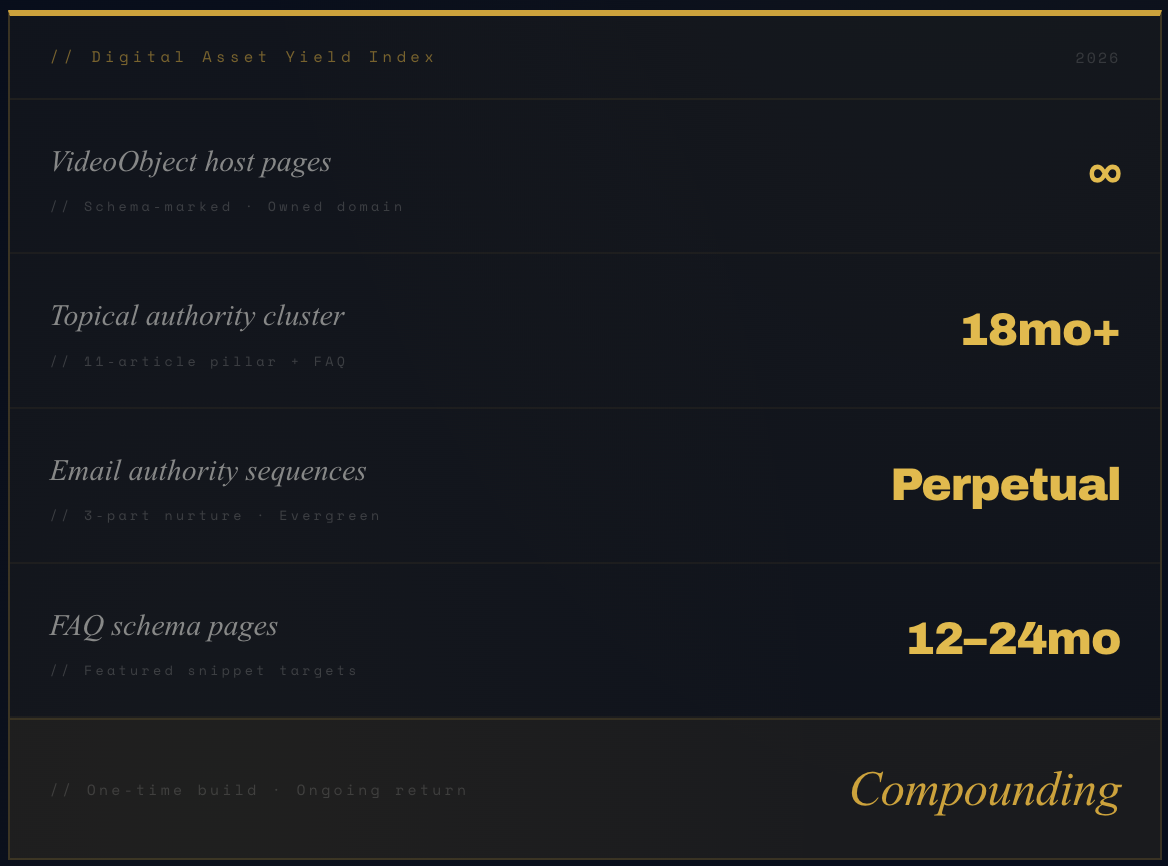
Direct Answer: Digital assets that pay you while you sleep are content infrastructure pieces — VideoObject schema host pages, topical authority article clusters, and evergreen email sequences — that generate organic discovery, AI citations, and inbound leads continuously without active time input after their initial build. HubSpot's 2025 research found that schema-marked video host pages on owned domains generate organic traffic for an average of 18 months post-publication — turning each 90-minute production session into 18 months of compounding commercial return.
// The Argument
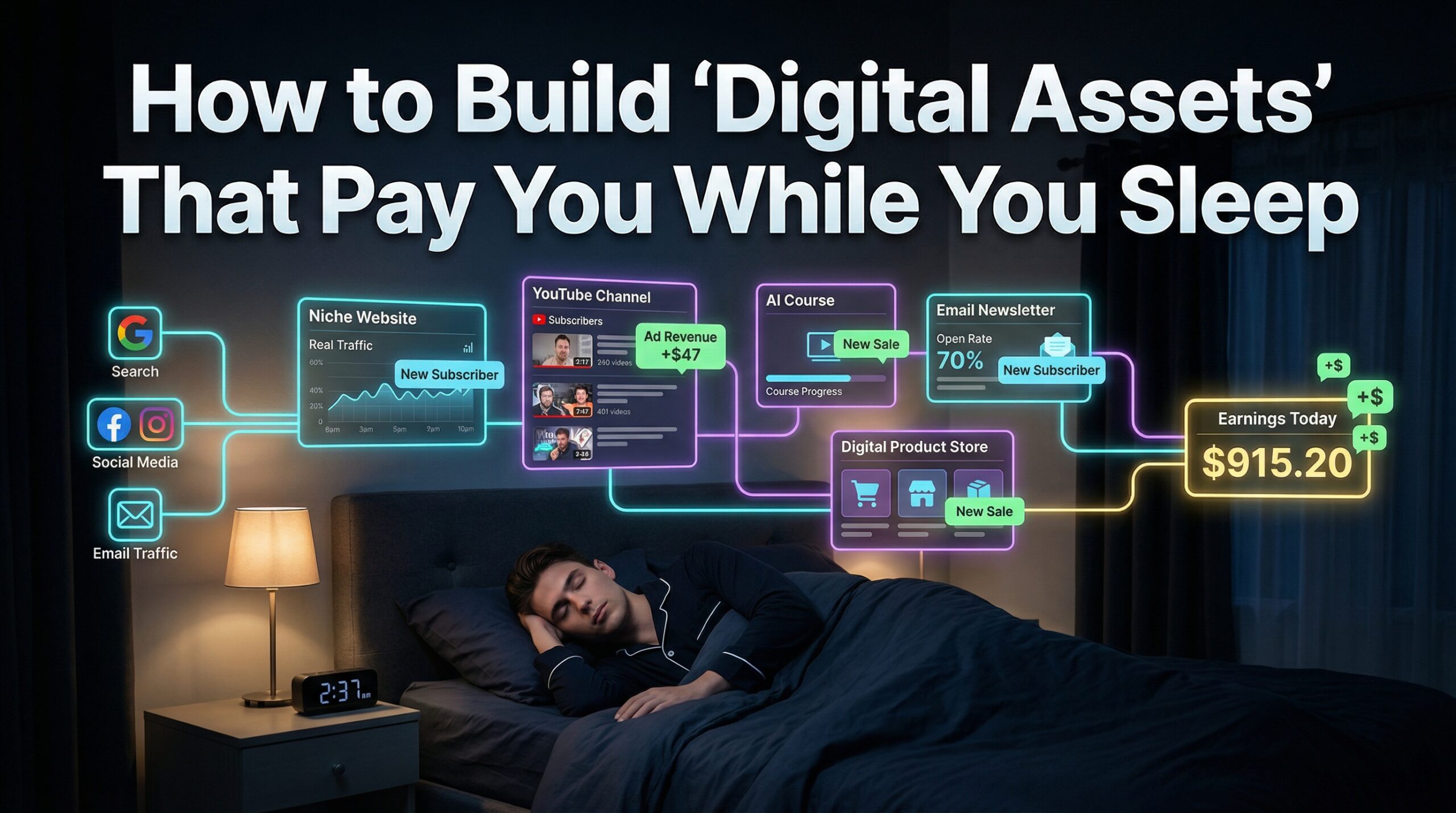
Most founders trade time for revenue. The New Rich trade one-time production sessions for permanent assets that generate discovery, inbound, and authority 24 hours a day — without any additional active effort after the build session ends.
// 01 · The Asset Definition
What Is a Digital Asset — and Why Does Most "Content" Fail to Qualify?
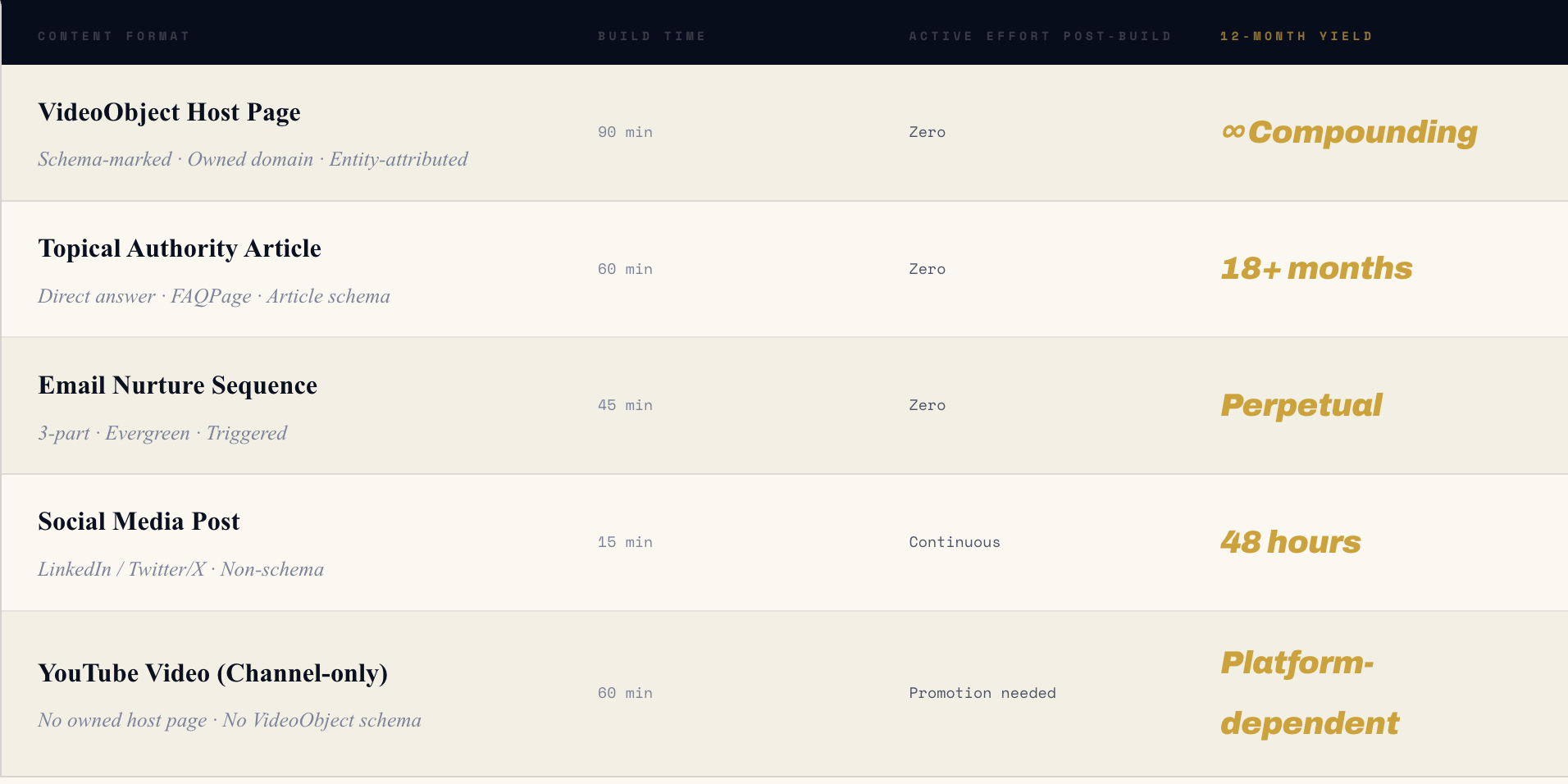
The phrase "digital asset" gets used loosely to mean anything a business publishes online. That definition is commercially useless. A social media post is not a digital asset — it has a 48-hour commercial lifespan and generates no compounding return after that window closes. A blog post with no schema, no direct answer block, and no entity attribution is barely a digital asset — it may rank for a brief window after publication, but it compounds nothing and generates nothing once Google's freshness signal decays.
A real digital asset, in the commercial sense that matters for SME founders, is any piece of content infrastructure that generates value without requiring your active time to deliver it — continuously, permanently, and at increasing yield as the asset library grows. The yield is measured in organic search traffic, AI Overview citations, inbound discovery calls, and email list subscribers — all arriving while you sleep, travel, or focus on client delivery.
The critical distinction is between content as activity (something you produce to fill a calendar or demonstrate effort) and content as infrastructure (something you build once and that compounds commercial value with every passing month). Activity produces engagement metrics. Infrastructure produces wealth. The difference between the two is schema, entity attribution, direct answer architecture, and owned domain hosting — the technical layer that converts publishing into asset-building.
// The Yield Test
Apply this test to every piece of content you are considering producing: will this asset generate commercial value in 12 months without any additional effort from me? If the answer is no — if it requires promotion, re-publishing, or active distribution to produce value — it is activity, not an asset. A VideoObject schema host page passes the yield test. A 48-hour Instagram story does not. Invest in infrastructure; distribute through channels.
// 02 · The Yield Data
What Do the Numbers Actually Show About Long-Term Digital Asset Returns?
The commercial case for digital asset building over active content creation is not philosophical — it is mathematical. The yield data from independent research organisations confirms that the gap between schema-marked owned domain content and all other content formats, measured by longevity, citation frequency, and organic discovery contribution, is large enough to change how founders should allocate their content production time.
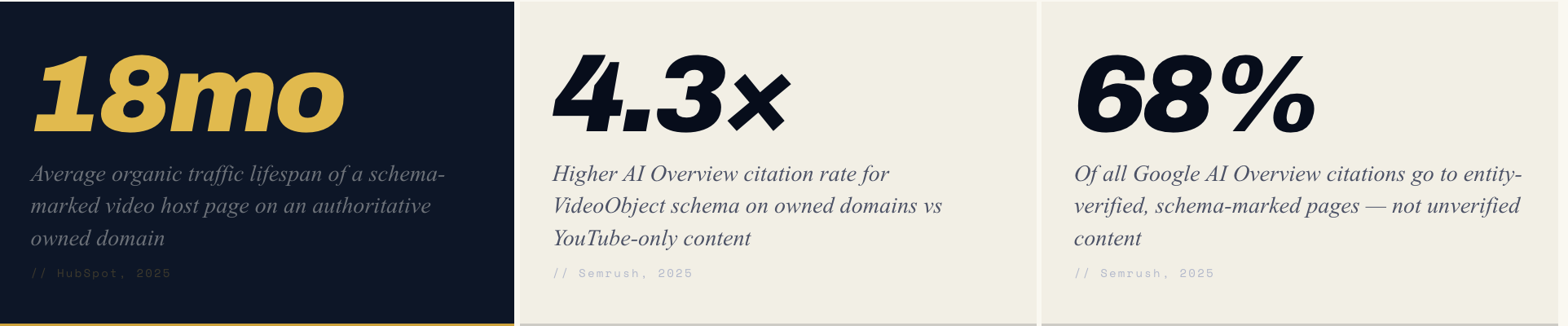
The 18-month average lifespan figure deserves closer examination. It means that a video host page produced in a 90-minute production session on Monday morning is still generating organic search traffic, AI citations, and inbound discovery in June of the following year — without any additional time investment. At one production session per week, 52 weeks of consistent operation produces 52 distinct assets each with an 18-month return window, collectively generating 52 concurrent organic discovery channels by the end of the year.
The compounding mechanism amplifies this further: each new asset added to an entity-verified authority library does not simply add one more discovery channel — it strengthens the entire library's topical authority signal, increasing the citation probability of every existing asset simultaneously. The 52nd video host page generates more total inbound than the first 51 combined because it completes the topical coverage that qualifies the library for AI Overview category authority.
// 03 · The Asset Portfolio
What Does a High-Yield Digital Asset Portfolio Look Like for an SME Founder?
A high-yield digital asset portfolio for an SME founder in 2026 is not a large content library — it is a small, precisely constructed infrastructure of schema-marked, entity-attributed assets covering the five commercial query types that generate the highest-value buyer discoveries. Quantity without infrastructure is activity. Infrastructure without quantity lacks the cluster density for authority. The optimal portfolio combines both.
// The Five Asset Categories in Priority Order
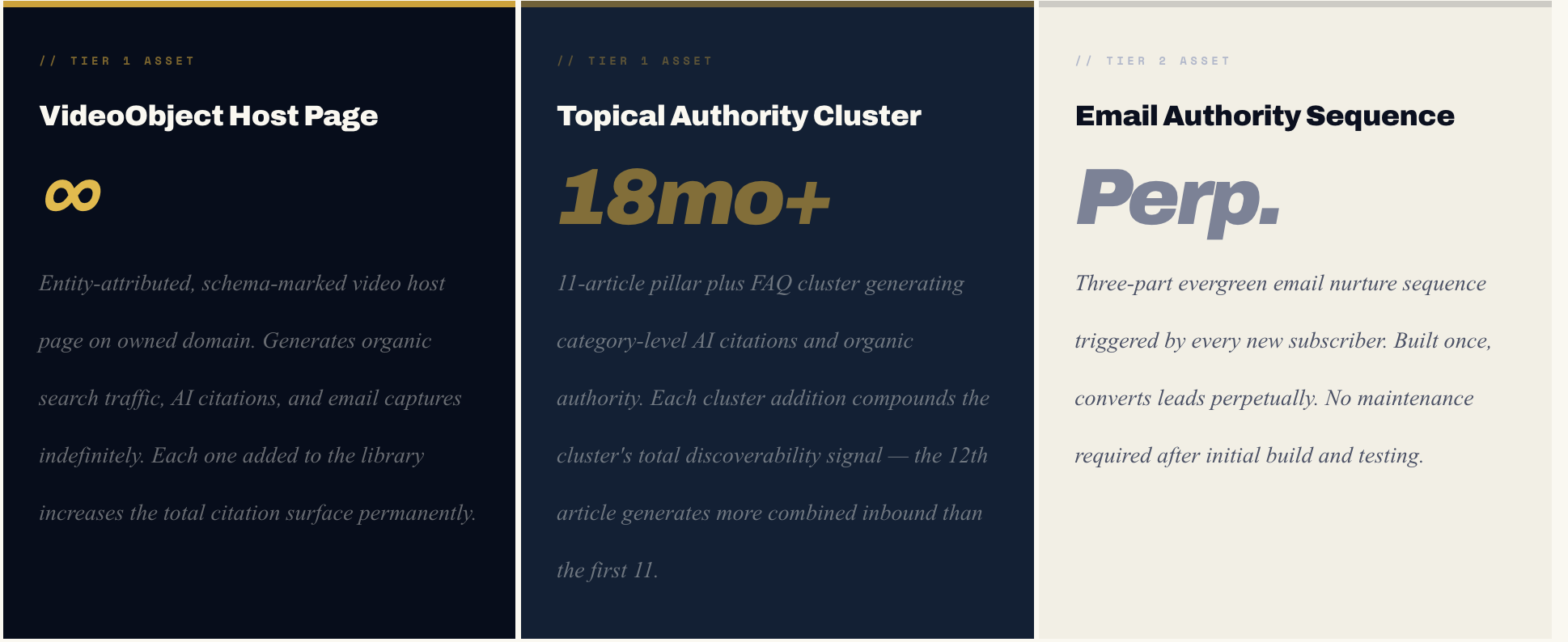
Category 1 — The Authority Explainer: The single most commercially valuable digital asset for any SME is the Authority Explainer video host page — a 10–15 minute recorded video answering the primary commercial question in your most revenue-relevant topic cluster, published on an owned domain host page with VideoObject schema, a 3,000-word transcript article, and FAQPage schema. This single asset, built correctly, generates AI Overview citations, organic search traffic from the cluster's primary commercial queries, and email captures from buyers at the point of highest research intent — all indefinitely from the publication date, with zero additional effort. Build this first, before any other asset.
Category 2 — The FAQ Series: Ten FAQ video host pages targeting the ten secondary questions buyers ask before purchasing in your category. Each takes 25 minutes to produce (90–180 second direct-answer video, VideoObject schema host page, 600-word transcript article, FAQPage schema). Together, they extend the citation surface to ten additional commercial query variants, each generating separate featured snippet and AI Overview citation eligibility permanently. Build after the Authority Explainer — the FAQ cluster requires the Authority Explainer's entity foundation to function at maximum yield.
Category 3 — The Topical Article Cluster: Eight to twelve long-form articles covering the secondary questions in the same topic cluster, each with direct answer blocks and FAQPage schema. These provide the text-content depth layer that AI systems require to confirm topical authority — the evidence that your expertise extends beyond five-minute video answers into comprehensive, genuinely expert knowledge. The cluster's yield is not in individual article performance but in the collective signal: twelve articles on a single topic cluster produce category-level AI citation authority that no individual article can achieve alone.
Category 4 — The Email Authority Sequences: Three to five evergreen email sequences triggered by list entry, video views, and direct inquiry — each converting a subscriber's initial interest moment into a six-touch nurture arc leading to a discovery call. Built once, these sequences run automatically for every subscriber who enters the trigger event, perpetually converting the inbound discovery generated by Categories 1–3 into qualified sales conversations without any active effort per conversion.
Category 5 — The Case Study Video Library: Three to five case study videos documenting client transformation outcomes with VideoObject schema host pages. These generate trust-intent traffic from buyers at the decision stage — buyers who have found your category through Categories 1–3, have been nurtured by Category 4, and need social proof to convert. The case study library completes the buyer journey from discovery to decision entirely through passive digital asset infrastructure.
The right question is not "how much content should I produce?" It is "how many assets do I need to cover every stage of my buyer's research journey, permanently, with zero active effort per buyer?"
// The strategic reframe that separates content strategy from asset portfolio management for SME founders in 2026
// 04 · The Build System
How Do You Build a Digital Asset Portfolio That Compounds While You Run the Business?
The build system is the production cadence that converts your existing expertise into a growing digital asset library — one 90-minute production session per week, producing one complete Tier 1 asset per session, compounding indefinitely. The session is not a writing session, a filming marathon, or a social media sprint. It is a precisely structured 90-minute protocol that produces seven distinct published assets from a single recording.
01 Record the Source Video — 10–15 Minutes, One Commercial Question
Record a 10–15 minute video structured as a complete expert answer to one commercial question your ideal buyers actively search for. The question should come from the ten-question topic cluster scope map you defined when installing your entity schema. The recording quality requirement is clear audio and adequate light — not professional studio production. The commercial value is in the expert answer, not the production value. Record on your phone, a mirrorless camera, or a webcam with adequate light — what matters is that the transcript is clear and the argument is well-structured. Upload to YouTube immediately after recording. The transcript will be the source material for all seven downstream assets.
02 Run the AI Extraction Protocol — 90 Minutes, Seven Assets
Open the AI language model with your five-prompt extraction library and process the video transcript through each prompt in sequence. Prompt 1: the transcript-to-article prompt producing a 3,000-word blog article with direct answer block, H2 natural-language questions, and FAQPage schema Q&A pairs. Prompt 2: the LinkedIn post extraction prompt producing three posts from the video's key insights. Prompt 3: the Twitter/X thread prompt. Prompt 4: the three-email nurture sequence prompt. Prompt 5: the newsletter brief prompt. Each prompt processes the same transcript input and produces a different-format output in approximately 15 minutes. The 90-minute session produces the transcript article, the social posts, the email sequence, the newsletter brief — and leaves 10 minutes for the VideoObject schema host page build in the next step.
03 Build the VideoObject Host Page — The Asset Creation Moment
This step is the specific action that converts a YouTube video from platform-dependent content into a permanent, entity-attributed, AI-citable digital asset on your owned domain. Create a new page on your CMS, embed the YouTube player at the top, and paste the 3,000-word transcript article below. Install the VideoObject JSON-LD schema in the head section with all required fields: name matching the video title exactly, description using 150–200 words of entity vocabulary from your topic cluster, thumbnailUrl as the YouTube maxresdefault image URL, uploadDate in ISO 8601 format, duration in ISO 8601 format, and embedUrl as the YouTube embed URL. Install the FAQPage JSON-LD schema with the five Q&A pairs from the article. Install Article schema with Person author attribution referencing your verified Person @id. Submit the page to Google Search Console via URL Inspection and select Request Indexing. This step takes 25 minutes and produces the Tier 1 asset that will generate commercial value for the next 18+ months without any additional effort from you.
04 Load the Distribution Calendar — The Passive Delivery System
Load all distribution assets from Step 2 into your scheduling platform and email system on production day. Schedule the three LinkedIn posts across the following two weeks. Schedule the Twitter/X thread for tomorrow morning. Load the three-email nurture sequence into your email platform with three-day automated delays. Schedule the newsletter brief for the next newsletter publish date. These actions take 20 minutes to execute and then run automatically — no further involvement required. The distribution calendar ensures that every subscriber, follower, and email contact encounters your expert insights across their preferred channels over the next 30 days, without any additional posting, checking, or management from you. The asset generates passive discovery; the distribution calendar generates passive audience engagement. Together, they complete the passive income architecture.
05 Measure and Compound — The 90-Day Portfolio Review
At 90 days from your first video host page publication, run a portfolio review to measure the combined yield of your growing asset library. Measure five metrics: total AI Overview appearances across your primary cluster query variants (test directly in Google); total organic impressions from all host pages in Google Search Console; new email subscribers from organic discovery (not referrals or paid); discovery calls booked from sources attributable to organic or AI-referred traffic; and total video host page count versus 90-day target (one per week = 12 assets). The 90-day review is the point at which most founders have their first experience of genuine passive return — a discovery call booked from a buyer who found a FAQ video host page in Google, watched the video, joined the email list through the CTA below the player, received the three-part nurture sequence automatically, and booked a call through the scheduling link in email three. You were not involved in any step of that buyer's journey after the initial 90-minute production session that built the asset.
Frequently Asked Questions
What are digital assets that pay you while you sleep?
Digital assets that pay you while you sleep are content infrastructure pieces that generate commercial value without requiring active time input after their initial build — specifically VideoObject schema host pages on owned domains, topical authority article clusters with entity schema, and evergreen email nurture sequences. Unlike social media posts or YouTube-channel-only videos, which have 48-hour commercial lifespans and generate no compounding return, schema-marked video host pages generate organic search traffic, AI Overview citations, and email captures continuously for 18 months or more per asset. HubSpot's 2025 research found an average 18-month organic traffic lifespan for schema-marked video host pages on authoritative owned domains. At one production session per week producing one host page, 52 sessions generate 52 concurrent organic discovery channels by end of year, each running permanently with zero additional maintenance effort.
How long does it take to build a digital asset that generates passive income?
A complete Tier 1 digital asset — a VideoObject schema host page with a transcript article, direct answer block, FAQPage schema, and Article schema — takes 90 minutes to build from a recorded video. The 90-minute production protocol breaks into five steps: recording the source video (10–15 minutes), running the AI content extraction protocol to produce the transcript article and seven supporting content assets (45 minutes), building the VideoObject schema host page and installing all JSON-LD schema nodes (25 minutes), loading the distribution calendar for the session's social posts and email sequences (20 minutes). The total build time investment produces an asset that generates commercial value for 18 months or more without any additional effort. The compounding begins immediately on publication: the VideoObject schema host page is discoverable by Google and AI crawlers from the day of Google Search Console submission, and typically produces its first organic search impressions within 14–21 days of publication for established domains with entity verification.
What is the difference between a digital asset and regular content?
A digital asset generates commercial value indefinitely without active effort after its initial build. Regular content requires active promotion, re-publishing, or continuous engagement to produce value — and produces no compounding return after its initial exposure window closes. The specific technical components that convert publishing into asset-building are: VideoObject schema on an owned domain host page (which attributes the video's ranking equity to your brand rather than YouTube), entity attribution through Organisation and Person schema with sameAs verification (which makes the content citable by AI retrieval systems), direct answer block architecture (which makes the content extractable for AI Overview and featured snippet responses), and FAQPage schema (which provides five additional extraction targets per page). Regular content without these components has a 48-hour to 30-day commercial lifespan. Content with these components has an 18-month-plus commercial lifespan and compounds with each addition to the authority library.
How many digital assets do you need to generate meaningful passive income from content?
A portfolio of twelve to fifteen Tier 1 digital assets — VideoObject schema host pages covering the primary and secondary commercial questions in your most revenue-relevant topic cluster — is sufficient to generate measurable passive inbound discovery for most SME service businesses. Twelve assets in a concentrated topic cluster produce the cluster density signal that qualifies for AI Overview category authority within 90 days of the final asset's publication, after which the entire cluster generates citations across ten to fifteen commercial query variants simultaneously. The passive income from this portfolio is measured in organic discovery calls — the discovery calls generated by buyers who found the content through AI Overviews, Perplexity citations, or Google search without any active outbound effort. From our experience working with SMEs, a twelve-asset authority cluster with complete entity verification and direct answer architecture generates between two and eight organic discovery calls per month within 90 days of cluster completion, growing by 20–30% per quarter as the cluster's authority compounds.
What tools do you need to build digital assets that generate passive income?
The tool stack for building passive digital assets costs £60–£80 per month total. You need five categories of tool. First, a recording setup — any smartphone or webcam with adequate light and clear audio; production quality is not a meaningful variable in the commercial yield of a VideoObject schema host page. Second, an AI language model (Claude, ChatGPT, or Gemini at £15–£25 per month) with a five-prompt extraction library for processing transcripts into articles, social posts, and email sequences. Third, a VideoObject schema generator — Clipkoi or a manual JSON-LD template — for building the host page infrastructure that converts each video into a permanent owned domain asset. Fourth, a social scheduling platform (Buffer or Later at £10–£15 per month) for loading the 30-day distribution calendar on production day. Fifth, an email marketing platform (ConvertKit or Beehiiv at £15–£20 per month) for the evergreen nurture sequences that convert organic discovery into discovery calls automatically. The entire stack replaces content production services that would otherwise cost £3,000–£6,000 per month, producing equivalent or higher output volume with significantly better asset longevity and compounding structure.
→ The Portfolio Argument
12 Months From Now, Your Asset Library Either Compounds or Doesn't Exist
The founders who start the digital asset build this week will have a portfolio of 52 VideoObject schema host pages in 12 months — each generating organic discovery, AI citations, and email captures independently, collectively producing a discovery volume that no outbound effort could match at equivalent cost.
The founders who start in 12 months will begin the same build against competitors whose portfolios have been compounding for a year. The compounding gap widens with every week of delay — not because the late starter builds worse assets, but because the early starter's assets are already compounding the collective authority signal that makes each new addition more valuable than the last.
The 90-minute production session is the minimum viable investment in the digital asset economy. The decision to start it this week — not next month, not after the next client project, not when the team is larger — is the decision that determines whether your brand compounds or stalls in the AI-mediated discovery landscape of 2026 and beyond.