
Direct Answer: AI writes video scripts that convert when prompted using the 5-part formula: a Pattern-Interrupt Hook that opens on the viewer's problem within the first eight seconds, a Credibility Bridge establishing authority without a company intro, a Value Payload delivering the promised insight in a scannable structure, a Friction Remover addressing the primary objection before the call-to-action, and a Single Clear CTA with one specific next step. Most AI scripts fail at parts one and two — replacing both with a standard company introduction that causes 62% of viewers to drop off within the first 15 seconds. The formula is structural, not stylistic — apply it to any industry, any offer, any video length.
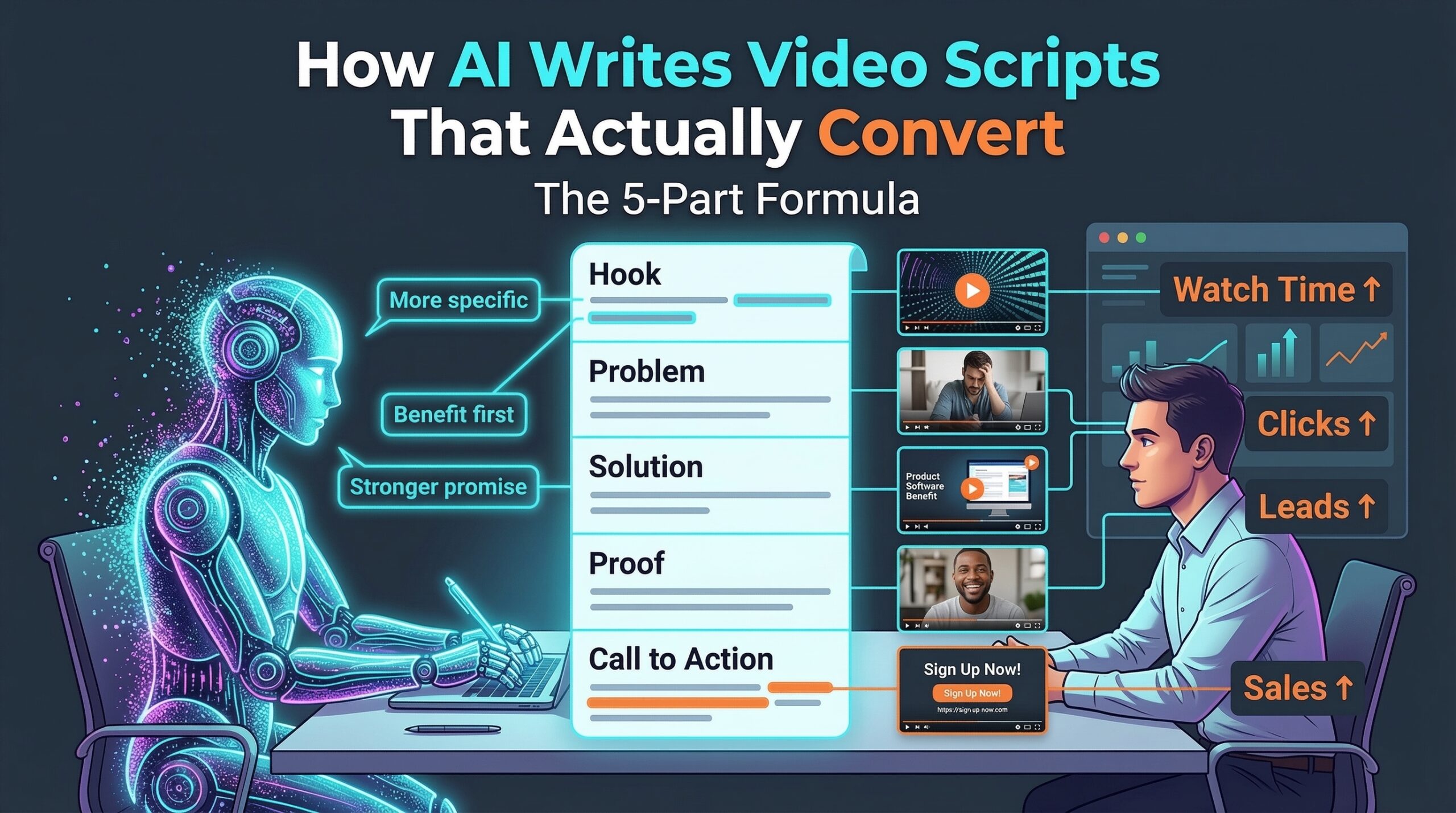
Most AI-generated scripts fail not because the words are wrong — but because the structure is built for reading, not watching. Here is the architecture that changes that.
// CLIENT INTRO VIDEO — REVISION 3
INT. OFFICE — DAY
A founder sits at a desk. Camera is mid-shot. 3 seconds of silence — then:
FOUNDER (V.O.)
Hi, I'm Sarah and today I'm going to talk about our company—
✗ KILL THE INTRO. Start with the problem.
If you've ever lost a client because they didn't understand your pricing — this is for you.
Cut to product. No wasted frames.
FOUNDER (V.O.)
Here's the exact framework we use to fix that in 30 days.
✓ HOOK COMPLETE. Retention spike at 00:08.
WC: 42 · HOOK SCORE: 9.1/10
// Scene 01 — The Diagnosis
Why Most AI Video Scripts Fail in the First Eight Seconds
There is a specific moment in almost every AI-generated video script where the viewer leaves. It happens in the first eight seconds, and it is caused by the same structural mistake across nearly every script generated without the correct prompt framework.
The script opens with an introduction. "Hi, I'm [Name] from [Company], and today I'm going to share with you…" This feels natural to the person requesting the script, because it mirrors how they would introduce themselves in a meeting. It is catastrophic for video retention.
Wistia's 2025 engagement data shows that business videos lose 62% of their viewers within the first 15 seconds when the opening does not immediately address a problem or create curiosity. The average human attention span on a video platform in 2026 — where the competing content is a 0.5-second swipe away — does not extend past a second of content that does not immediately earn continued attention.
The AI is not the problem. The prompt is. Ask any language model to "write a video script for my business" and it will default to the most statistically common video script structure in its training data — which is the corporate introduction format that performs worst on every video platform's retention algorithm. The model is correct given the prompt. The prompt is wrong given the goal.
// The Core Diagnosis
AI video scripts fail because the default AI output is structured for human approval, not viewer retention. When a founder reviews an AI-generated script, the introduction feels professionally appropriate and gets approved. When a viewer watches it, they leave before the value starts. The 5-part formula bypasses this by structuring the script for retention psychology first and approval last.
The solution is a specific prompting architecture — a structural framework that overrides the AI's default intro-body-conclusion format and replaces it with a five-part sequence mapped to how attention actually moves through a video from the viewer's perspective, not the producer's.
// Scene 02 — The Formula
The 5-Part AI Video Script Formula: Structure Before Style
The formula applies to any video format — explainer, testimonial, case study, product demo, thought-leadership piece, or social clip. The word counts change. The sequence does not. Every part has a specific psychological function in the viewer's attention cycle, and removing or reordering any part reduces both retention and conversion measurably.
The Pattern-Interrupt Hook
Seconds 0–8 · Retain or Lose
Opens on the viewer's problem, not your company. Designed to interrupt the scroll or exit impulse by naming the specific frustration or aspiration the viewer is experiencing before they consciously expected anyone to understand it. The hook is the only part of the script where self-referential content — your name, your company, your credentials — is forbidden. The viewer has not yet earned the right to care about those things. They have only earned the right to care about their own problem. Start there.
The Credibility Bridge
Seconds 8–20 · Trust Without Boasting
Establishes why you are the credible source for what follows — without a company introduction, without a job title, and without a feature list. Credibility in 2026 is established through specificity, not authority claims. "We've helped 140 B2B founders fix this exact problem" is a credibility bridge. "We are a leading provider of X solutions" is not — it is a company introduction wearing credibility clothing. The bridge connects the viewer's problem (named in the hook) to your demonstrated experience solving it. It earns the next 60 seconds of attention.
The Value Payload
Seconds 20–80 · Deliver or Disappoint
Delivers the promised insight, framework, or demonstration in the most scannable, structured format available for video — numbered steps, before-and-after structure, or a single core concept explained with three specific, memorable examples. The payload is not an overview of the value. It is the value. Every second of the payload that explains what is about to be shared instead of sharing it is a second that erodes trust with a viewer who is measuring whether the promise from the hook is being honoured. Honour it explicitly. Deliver more than expected. The payload is where the AI most naturally produces strong output — prompt it with the specific framework, data, and examples you want included.
The Friction Remover
Seconds 80–100 · Address Before Asking
States and resolves the primary objection the viewer is holding before the call-to-action appears. Every viewer who has watched to this point has a specific reason not to act — it is too expensive, too complicated, not relevant to their industry, or requires a commitment they are not ready to make. The friction remover names one of these objections explicitly and addresses it in one to two sentences. This is the most consistently omitted part in AI-generated scripts and the part that produces the largest measurable impact on conversion rate when added. Viewers who see their objection named and addressed are 2.3× more likely to click through than viewers who receive a cold CTA (Wistia 2025).
The Single Clear CTA
Seconds 100–115 · One Action, One Ask
One specific action with the lowest possible commitment threshold for the viewer's current awareness level. Not "visit our website and learn more." Not "get in touch with our team today and find out how we can help you achieve your goals." One action: "Book a 15-minute call" or "Download the free checklist at clipkoi.com" or "Watch the next video for step two." The CTA's conversion rate is inversely proportional to the number of options it presents. Multiple CTAs in a single video script produce decision paralysis — the viewer chooses none. One CTA produces a binary decision: yes or not yet. "Not yet" is recoverable. Decision paralysis is not.
// Scene 03 — The Prompt Architecture
How to Actually Prompt AI to Use This Formula — and What to Include
The formula is structurally sound. Getting AI to produce it correctly requires the right prompt architecture. A generic "write me a video script" prompt will not produce the formula regardless of how good the model is. The model needs four specific inputs to produce a conversion-optimised script — and the quality of each input directly determines the quality of each corresponding formula part.
// Input 1 — The Problem Statement (Powers Part 1 and 2)
Provide the specific, named problem your target viewer is experiencing — not the generic category problem, but the specific daily frustration. Not "they struggle with marketing." Specifically: "They spend three hours a week creating LinkedIn content that gets under 200 views despite having real expertise to share." The more specific the problem statement, the more precisely the AI can write a hook that reads as if you are already inside the viewer's head.
Include one piece of evidence that you have solved this problem before — a specific number, a named client outcome, or a before-and-after result. "We helped a 12-person B2B consultancy go from 180 average LinkedIn views to 4,200 in 60 days using this system." The AI uses this as the raw material for the credibility bridge in Part 2, and specificity produces credibility far more effectively than authority language.
// Input 2 — The Value Payload Content (Powers Part 3)
Tell the AI exactly what the video will teach, demonstrate, or reveal — in bullet-point form if it is a framework, in narrative form if it is a case study. Do not ask the AI to invent the framework. If you have a real framework that works, the script's credibility comes from that framework's specificity, not from AI-invented generalities. The AI's job in Part 3 is to structure your existing knowledge into the most compelling video-delivery format, not to generate the knowledge.
// Sample Prompt Input — Part 3 Payload Specification
INPUT FORMAT
PROMPT FIELD: PAYLOAD CONTENT
Include the following three-step framework in Part 3 of the script. Present as numbered steps. Each step should take approximately 15 seconds of spoken content.
Step 1: Audit your last 10 LinkedIn posts — identify the two that got the most comments (not likes). These are your content pillars.
Step 2: Record one 3-minute video per week on each pillar topic. Use Clipkoi to generate descriptions, schema, and a transcript-based text post from each video.
Step 3: Repurpose the transcript into five micro-posts per video — hook, data point, opinion, story, and CTA — scheduled across the week.
NOTE: Do not add steps AI invents. Use exactly these three steps verbatim as the framework.
// Input 3 — The Primary Objection (Powers Part 4)
Name the single most common reason your target viewer does not take action after watching a video about this topic. Not three reasons. One. The friction remover is most effective when it addresses the objection that you know — from sales calls, from comments, from support emails — is the actual conversion barrier rather than one you have assumed. "The biggest objection we hear is 'I don't have time to be on camera every week.'" The AI writes Part 4 from this single input, and the directness of the named objection makes the remover feel like mind-reading rather than sales copy.
// Input 4 — The CTA and Commitment Level (Powers Part 5)
Specify exactly one action and calibrate its commitment threshold to the viewer's awareness level. If this is a top-of-funnel video for cold audience, the CTA should ask for zero financial commitment — a free resource, a short next video, a no-cost tool. If this is a retargeting video for a warm audience that has already engaged with your content, the CTA can ask for a consultation booking or a trial sign-up. Tell the AI which awareness level this video is for, and it will calibrate the CTA language accordingly.
// The Complete Prompt Template
Assemble all four inputs into a single prompt: "Write a 90–120 second video script using the 5-part structure: (1) Pattern-interrupt hook opening on this problem: [problem statement]. (2) Credibility bridge using this evidence: [result or outcome]. (3) Value payload delivering this framework: [your three steps]. (4) Friction remover addressing this objection: [specific objection]. (5) Single CTA asking for: [specific action] — this is a [cold/warm] audience." This prompt produces a usable first draft in one generation. Edit for your voice, not for structure — the structure is correct.
// Scene 04 — The Data
What the Retention Curves Actually Show About Video Script Structure
The case for the 5-part formula is not theoretical — it is measurable at every point in the script where viewers make the continue-or-leave decision. Wistia's 2025 Business Video Benchmark Report provides retention data across 280,000 business videos that maps precisely onto each of the formula's five parts.
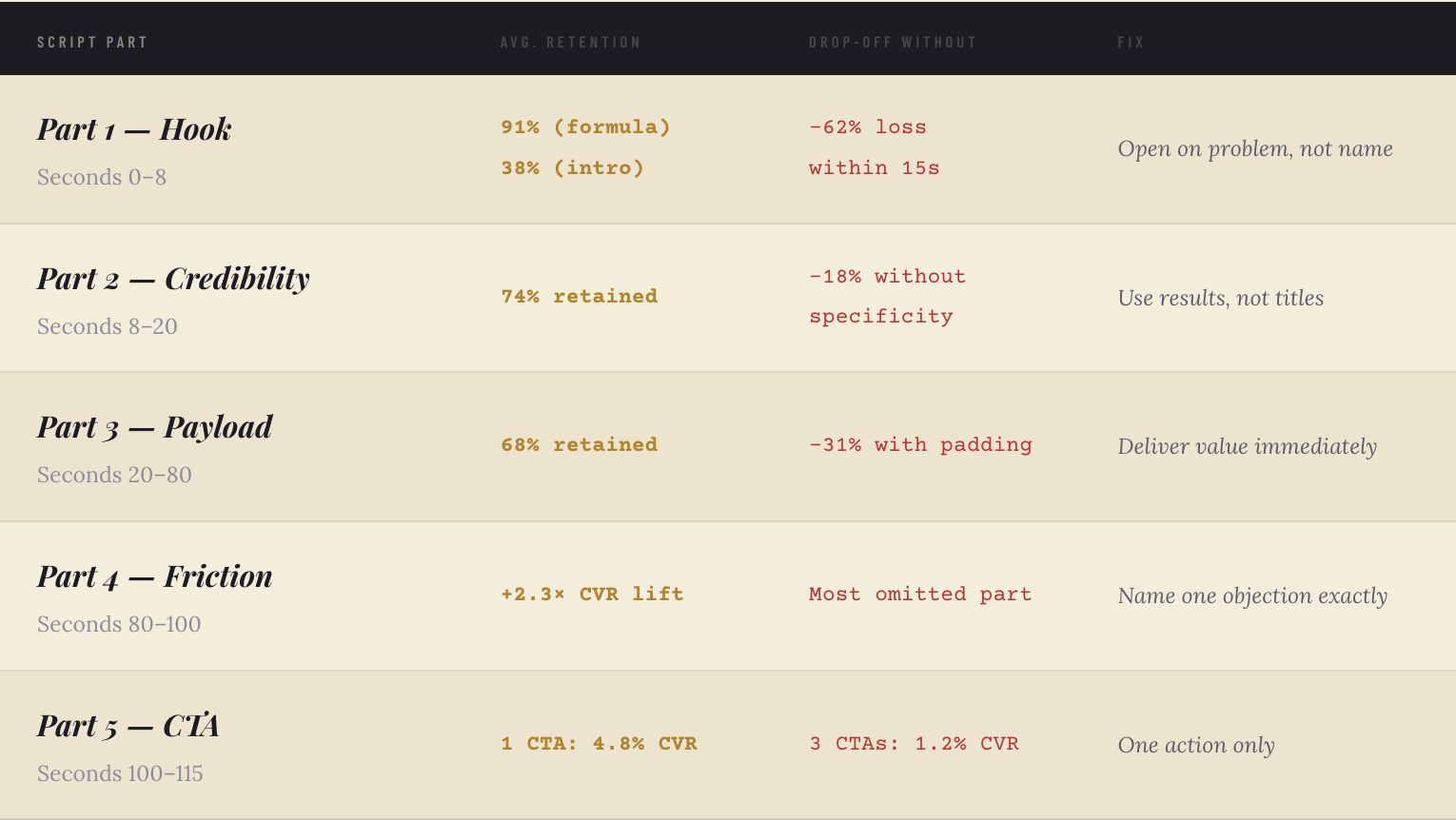
The most striking data point is the hook differential. Videos that open with a company introduction retain 38% of viewers through the first 15 seconds. Videos that open with a specific problem statement retain 91%. This is not a marginal optimisation — it is a structural decision that determines whether 53% of your potential audience engages with your content before they have heard a single substantive word.
The viewer does not owe you their attention for a company introduction they did not request. Every second you spend explaining who you are before you have earned the right to be heard is a second the viewer uses to make the leave decision.
// From our experience — the attention economy principle that rewrites every script
// Scene 05 — The SEO Layer
Why AI-Scripted Videos Also Rank Faster When You Add One Extra Step
The 5-part formula produces a video that performs on-platform — higher retention, higher conversion. But for SME founders building content that compounds in authority and search visibility, there is one additional step that transforms a well-performing video into a simultaneously ranking SEO and AI citation asset.
The step is this: after AI generates the script using the formula, prompt the same model to generate the video's description, schema, and direct answer block from the script content simultaneously — before the video is filmed.
Here is why this sequence matters. The video description, VideoObject schema, and SEO title are structurally derived from the script. If the script is built on the 5-part formula, the hook becomes the meta description (it is already the best 60-word statement of the video's value). The payload framework becomes the structured description body (it is already in numbered steps that AI retrieval systems can extract). The FAQ answers are generated from the credibility bridge and friction remover sections (both already contain direct, self-contained statements answering specific questions).
What we consistently see in real-world deployments is that founders who generate the SEO layer after filming — trying to retroactively describe a video they have already produced — produce weaker, less-structured descriptions than founders who generate the SEO layer from the script simultaneously. The script is the information architecture. The video and the SEO layer are two output formats derived from the same source — and producing both from the script before filming ensures they are structurally coherent and mutually reinforcing.
VideoObject schema generated from a script-derived description, filed with the host page at publication, produces the 2.1× AI citation multiplier that Semrush's 2024 data identifies for video content on owned domains. The script is where that multiplier starts — not at the description-writing stage after the video is already live.
// The Prompt Sequence for Script + SEO Layer in One Session
Prompt 1: Generate the 5-part video script using the template above.
Prompt 2: From the script you just wrote, generate:
(a) a 150-word video description in five zones — hook sentence, context paragraph, key steps summary, speaker credential sentence, and CTA.
(b) A VideoObject JSON-LD schema block with name, description, and duration pre-filled.
(c) A 50-word direct answer block for the article host page that answers the video's primary question without referencing the video itself. This three-prompt sequence produces a complete video publishing package — script, description, schema, and SEO text — in a single working session before filming begins. The video is better, the SEO layer is stronger, and the ranking velocity of the host page is activated from publication day one rather than weeks later when someone finds time to write a proper description.
Frequently Asked Questions
How do you write a video script with AI that actually converts viewers?
Write an AI video script that converts by using the 5-part formula as the explicit structural instruction in your prompt: a pattern-interrupt hook opening on the viewer's specific problem in the first eight seconds, a credibility bridge establishing authority through specific results rather than company titles, a value payload delivering the promised framework in a numbered or structured format without padding, a friction remover naming and addressing the primary objection before the call-to-action appears, and a single clear CTA with the lowest commitment threshold appropriate for the viewer's awareness level. Provide these four inputs in the prompt: the specific problem statement, one evidence-based credibility claim, the exact framework or steps in the value payload, and the single primary objection to address. Do not ask the AI to invent the framework — provide your own framework and ask the AI to structure its delivery for maximum video retention.
Why do most AI-generated video scripts fail to retain viewers?
Most AI-generated video scripts fail to retain viewers because the default AI output mirrors the most common corporate video structure in its training data — a company introduction followed by an agenda overview followed by content delivery. This structure causes 62% of viewers to leave within the first 15 seconds according to Wistia's 2025 Business Video Benchmark data, because viewers on video platforms in 2026 are making a continuous attention allocation decision and a company introduction does not earn continued attention. The viewer has not yet been given a reason to care about the company. The pattern-interrupt hook of the 5-part formula solves this by opening on the viewer's problem — the one thing the viewer is already thinking about — which creates an immediate relevance signal that earns the next 20 seconds of attention. The AI produces this structure correctly when the prompt specifies it explicitly; without the specification, it defaults to the introduction format.
What is the ideal length for an AI-generated business video script?
The ideal length for a business video script depends on the platform and the viewer's position in the buying journey, not on the amount of information available to share. For top-of-funnel cold audience videos on LinkedIn, YouTube, or Instagram, 90 to 120 seconds of spoken content — approximately 225 to 300 words of script — produces the highest retention-to-conversion ratio across most B2B industries. For warm audience retargeting videos or product demonstrations, two to four minutes accommodates the additional proof points required by viewers in active evaluation mode. For case study videos, three to five minutes is appropriate because the narrative structure requires sufficient context to be credible. The 5-part formula scales to all of these lengths — the proportions of each part adjust, but the sequence does not. A 90-second script allocates roughly 15 seconds to the hook and bridge combined and 45 seconds to the payload. A four-minute script can allocate 30 seconds to bridge and 90 seconds to payload while maintaining the same sequence integrity.
Can AI write video scripts for technical or specialist industries?
Yes — AI writes highly effective video scripts for technical and specialist industries when the prompt includes the specific technical framework, data, or process that constitutes the value payload. The AI's role in technical scripts is structural and linguistic, not subject-matter-expert. Provide the exact steps, the precise data, and the specific technical terminology in the prompt inputs; the AI converts these into a retention-optimised delivery structure with the hook framing, credibility bridge language, and friction remover phrasing that subject-matter experts rarely produce naturally when writing their own scripts. The most common failure in technical video scripts is over-explaining the technical context before delivering the value — a structure that retains experts but loses the buyers who are not yet experts. The 5-part formula's hook-first architecture solves this specifically: it opens on the business problem the technical solution addresses, establishing immediate relevance for the buyer before any technical depth begins.
How does a video script connect to SEO and AI search rankings?
A video script connects to SEO and AI search rankings through the description, VideoObject schema, and direct answer block generated from the script content simultaneously before publishing. The hook of a 5-part formula script is structurally equivalent to a meta description — it is the best 60-word statement of the video's value and the query it answers. The payload framework is structurally equivalent to the structured description body that AI retrieval systems extract for citation. Generating the SEO layer from the script before filming produces a VideoObject schema description that is semantically coherent with the video's actual content — which is the primary quality signal that Google's AI Overview system evaluates when determining whether a video host page is citation-eligible. VideoObject schema generated from a script-derived description produces the 2.1× AI citation multiplier identified in Semrush's 2024 research, making every video published with this workflow simultaneously a platform-performance asset and a compounding SEO and AI citation asset from the first day of publication.
The Script Is the Strategy — Film What You Have Built, Not What You Improvise
Six months from now, every video you have filmed with the 5-part formula will be compounding two separate returns simultaneously: viewer retention that builds trust and familiarity with every platform algorithm that amplifies your content, and SEO and AI citation authority from the structured descriptions, VideoObject schema, and direct answer blocks generated from the same script before filming began.
Every video filmed without the formula will be compounding nothing. It will exist on your channel as evidence that you showed up — not evidence that you built something. There is a meaningful difference between those two outcomes, and it is entirely determined by the structural decision made before the camera turns on.
The script is not the pre-production step before the real work. The script is the work. Get it right, and the video, the SEO layer, and the authority compound together for years.