
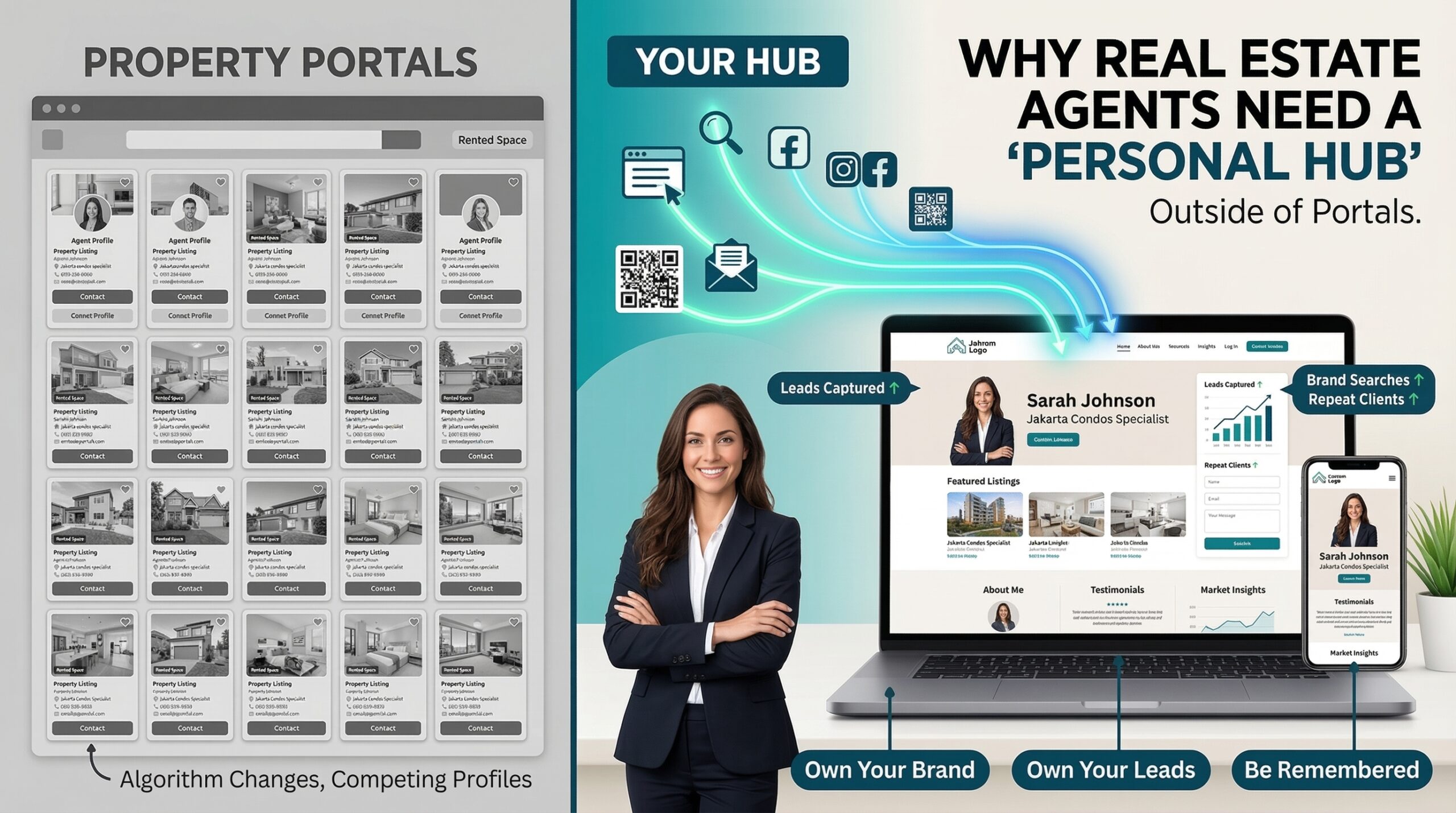
Direct Answer: Real estate agents need a personal hub outside of portals because portals own the authority agents build — retaining reviews, leads, and search visibility on their domain, not yours. A personal hub — a structured, entity-verified, schema-marked, video-integrated website — is the only digital asset that compounds your local market authority permanently, makes you citable by AI answer engines, and produces direct buyer contact that no platform can monetise, algorithm-penalise, or switch off.
// Portal vs Hub — The Numbers 2026 Data
68%
Semrush 2025 — portal profiles receive near-zero independent AI citations
// AI Overview citations → owned domain
2.1×
Semrush 2024 — video + owned domain vs static agent profiles
// VideoObject schema AI citation multiplier
42%
Hootsuite 2025 — social platform dependency risk for agents
// Platform organic reach decline 2023–25
The portals took your reviews, your leads, and your local authority. They monetised everything you built — and the moment you stop paying, you disappear. The agents who dominate in 2026 own a hub that Google, AI engines, and buyers all default to. Here is exactly how to build it.
What Are Portals Actually Selling — And Why Is the Product You?
Ask yourself a direct question: when a buyer submits a contact form on Zillow, who receives that lead? Not exclusively you. Zillow sells buyer enquiries to multiple competing agents simultaneously — including agents who have never met the buyer, never worked the suburb, and never earned the trust that your years of transactions and client results have built. You paid for the lead. You also paid for it to go to three other people.
This is the structural problem with portal dependency that most agents never fully articulate. The portal's business model requires you to remain dependent on their platform. Every listing you post, every five-star review a client leaves on Realtor.com, every market comparison you publish inside a portal's content ecosystem is feeding their domain authority — not yours. The entity that accumulates credibility from your decade of local expertise is not you. It is the platform you are renting.
In 2026, this has a direct consequence that goes beyond lead costs. When a buyer asks Perplexity or Google AI Overviews "who is the best agent in [suburb]", those systems retrieve answers from sources they can verify as authoritative entities. Zillow's domain is a verified authority entity. Your profile on Zillow's domain is not — it is a sub-page of their entity, contributing to their citation probability, not yours. You are invisible to the AI layer unless you own the source being cited.
Platform
Your Control
Zillow / Realtor.com
Leads, reviews, market visibility
None
Domain / REA Group
Australian portal duopoly
None
Google Business Profile
Local discovery, map pack
Partial
Social Platforms
LinkedIn, Instagram, Facebook
Low
Personal Hub — Owned Domain
Entity schema · video · content cluster
Full
What Exactly Is a "Personal Hub" — and Why Is It Not Just a Website?
Most real estate agent websites are digital business cards. A professional headshot, a biography, a listings carousel pulling from the MLS or portal feed, a contact form. They confirm you exist for buyers who already know your name. They generate no new discovery, no topical authority signals, and no reason for any AI system or search engine to cite them over a portal domain that has been accumulating entity signals for fifteen years.
A personal hub is architecturally different from a website in the same way a flagship store is architecturally different from a stall at a market. The website confirms presence. The hub commands territory. It is built around four compounding systems that, together, establish you as the cited local authority in your market — not just another agent with an online presence.
\Local Authority
Market Intelligence Content Cluster
Eight to twelve interlinked articles covering your specific suburb or market — buyer guides, quarterly price analyses, school catchment breakdowns, infrastructure pipeline updates, and agent comparison content. Each article answering one natural-language query that buyers and sellers ask AI engines. The cluster depth is the moat. One article is a page. Ten interlinked articles on the same local market is topical authority. AI systems treat them differently.
// AI citation probability increases non-linearly with topical cluster depth. Single pages: near zero. Eight+ interlinked articles: citation-eligible for local market queries.
Video Evidence
Market Video Library with VideoObject Schema
Monthly suburb market updates, property walkthrough videos, client case study videos, and buyer FAQ recordings — each published to YouTube and embedded on a dedicated host page on your hub with VideoObject JSON-LD schema and a five-zone SEO description. Video proves local expertise more credibly than written content because it is on-camera, first-person evidence. The 2.1× AI citation multiplier from VideoObject schema makes each video simultaneously a trust asset and a discovery asset.
// Semrush 2024: 2.1× AI citation multiplier for pages combining VideoObject schema with high-authority owned domain ownership vs portal listing pages.
Permanent Social Proof
Review Schema and Sold Results Archive
AggregateRating schema with individual Review nodes on your hub — sourced from client testimonials and mirrored from your Google Business Profile reviews. A sold results archive with suburb, price, and days-on-market data. This proof lives on your domain permanently. The same reviews on Zillow disappear when your subscription lapses. The star rating rich results that AggregateRating schema activates in Google's SERP are unavailable to portal profiles when viewed from the buyer's device — they appear only on your own domain.
// AggregateRating schema on personal hub produces star rating rich results — a conversion trust signal that zero portal profile pages can activate for individual agents independently.
Entity Verification
Person Schema and Knowledge Graph Anchor
Person JSON-LD with your name, jobTitle, worksFor organisation, address, and sameAs links to LinkedIn, Google Business Profile, and professional membership directories. This schema establishes you as a verified entity in Google's Knowledge Graph and AI retrieval systems. Without it, you are a name on a page with no verified professional identity. With it, every AI citation of your name links to a credible, verifiable human professional whose authority compounds with every mention.
// Google Search Central: Person schema with sameAs links is the prerequisite for Knowledge Panel formation and named-professional AI citation trust scoring.
// The Misconception We See Constantly
From our experience working with real estate professionals building authority infrastructure, the most common mistake is building a website with a property search widget and calling it a hub. A listings feed with a contact form has no topical authority signals, no entity schema, no video library, and no reason for Google or any AI system to cite it over Zillow's domain — which has been accumulating those signals for fifteen years while you were paying it subscription fees. Start with the content cluster and the schema. The listings widget is decoration.
How Do You Build the Content Cluster That Gets AI Engines to Cite You?
The content cluster is the engine of the personal hub. It is what differentiates your hub from every other agent website in your market — because most agent websites have no topical depth. They have individual pages. A content cluster has architecture: a pillar hub page surrounded by supporting articles that answer every specific question a buyer or seller in your market asks in a search engine or AI assistant, all interlinked, all structured with direct answer blocks and FAQPage schema for AI extraction.
Eight to twelve articles is enough to establish AI citation eligibility for your market segment. Each article follows a single rule: it must answer one natural-language question that your target buyer or seller is already asking, with a 40 to 60 word self-contained direct answer block at the top that AI systems can extract verbatim for Overview responses. Write that block first. Then write the full article to support it.
// Ten-Article Local Market Content Cluster — Path to AI Citation Eligibility
P
Pillar
The Complete Buyer's Guide to [Suburb / Area] — 2026 Edition
The hub page that all supporting articles link back to. Covers neighbourhoods, median price ranges, transport, schools, and infrastructure pipeline. Minimum 2,000 words with a direct answer block. This is the topical authority anchor — every other article in the cluster reinforces its authority through internal linking.
S
Support
What Is the Average House Price in [Suburb] Right Now? (Q2 2026)
A quarterly-updated price data article with median sale price, quarterly movement, and days on market from verifiable sources (CoreLogic, local council, ABS). Question-format headline matches how buyers ask AI assistants. Each quarterly update adds a freshness signal that static competitor pages cannot replicate.
S
Support
Is [Suburb] a Good Place to Buy in 2026? An Honest Assessment
A balanced, evidence-based pros-and-cons article citing named data sources — ABS, CoreLogic, local council infrastructure reports. AI systems preferentially cite balanced, evidence-backed assessments over promotional content for "is X a good place to buy" queries — the highest-volume decision-stage query type in residential real estate.
V
Video
[Suburb] Market Update — Monthly Video + Schema Host Page
Monthly market update filmed on location and published to YouTube with the video embedded on a schema-marked host page. VideoObject schema activates the 2.1× AI citation multiplier. Each monthly update's lastmod timestamp signals freshness to AI crawlers. The video creates trust. The schema creates discoverability. Together they compound.
S
Support
How Long Does Buying a House in [Suburb] Actually Take? (2026 Timeline)
Step-by-step process timeline from pre-approval to settlement with local-specific timeframes. Answers the exact question buyers ask AI assistants early in their research. FAQPage schema with five conversion-stage Q&As makes this article the most citable process-query asset in the cluster.
S
Support
What Fees Do Real Estate Agents Charge? (The Honest Breakdown)
A transparent, structured breakdown of commission structures, marketing budgets, and vendor-paid advertising. The most-searched agent comparison query in AI engines and the least honestly answered on agent websites. Publishing the specific, honest answer builds trust and pre-qualifies serious sellers simultaneously — and positions you as the agent who doesn't hide the numbers.
V
Video
Client Result Video — Case Study + Schema Host Page
A 2–3 minute video featuring a real client result — suburb, sale price relative to asking price, days on market — with the client on camera where possible. Embedded on a host page with VideoObject schema, Review schema for the client's testimonial, and the result data in structured text. Social proof in video format is the highest-trust evidence available to any agent online. One video per quarter is enough to build the social proof library systematically.
S
Support
What Schools Are in the [Suburb] Catchment? (2026 Full Guide)
School catchment data for primary, secondary, and private options with enrolment zone maps and ICSEA rankings. One of the highest-volume local queries from family buyers. Updated annually — the current-year lastmod date on a school catchment guide is a strong freshness signal for both Google and AI content indexers actively monitoring content recency.
S
Support
Local Agent vs Discount Agent in [Suburb] — What the Data Shows
The comparison article that wins the seller who is actively researching their options. Addresses the discount agent objection with specific local market data — comparative days on market, sale price variance vs asking price, negotiation outcome data — that only a genuinely local agent can provide credibly. AI systems cite this article for "local vs online agent" comparison queries because it contains verifiable, specific data rather than opinion.
S
Support
How to Choose the Right Real Estate Agent in [Suburb] — 7 Questions
The decision-stage article that converts researchers into contact enquiries by positioning you as the answer to every question you advise buyers to ask. Each of the seven questions must be one you answer better than any competing agent in your market — local transaction volume, average days on market, median sale-price-to-asking-price ratio, and local infrastructure knowledge. FAQPage schema with all seven questions as extractable Q&A schema pairs.
Why Does Video Compound Faster Than Any Other Content for Real Estate Agents?
Written content builds topical authority incrementally. Video builds trust immediately — and topical authority simultaneously. For a real estate agent, this distinction is structurally significant: a buyer choosing an agent is not only evaluating expertise. They are deciding whether to trust a specific human with the largest financial transaction of their life. Video is the fastest mechanism for establishing that trust with someone who has never met you in person.
The compounding argument for video is structural, not just intuitive. A suburb market update video published to YouTube and embedded on a host page with VideoObject schema opens three simultaneous discovery channels: YouTube search for the suburb name, Google video carousel results for local market queries, and AI Overview citation for conversational questions about local property conditions. A written article without VideoObject schema opens one channel — organic text search — at best. The same 15 minutes of filming creates three times the discovery surface area of a 1,500-word article when published correctly.
Every market update video on your hub is simultaneously a trust asset, a local SEO asset, and an AI citation candidate. The same video that converts a cold enquiry into a listing appraisal conversation is the video Perplexity retrieves when a buyer asks who the best agent in your suburb is.
// The three-channel return on every video published to a schema-marked hub
From our experience deploying this architecture with agents in competitive suburban markets, the pattern is consistent: the first monthly market update video generates modest views. The second builds on it. By the sixth or seventh video in the same suburb series, Google begins featuring the agent's content in the video carousel for suburb-specific queries — at zero marginal cost per view. The agents paying for portal premium placements are buying the same suburb visibility on a monthly recurring cost. The agents building the video hub are buying the same visibility once and owning it permanently.
Twelve months from now, the agent with seven market update videos on a schema-marked hub has a compounding authority asset. The agent with twelve months of portal premium listing fees has a receipt and a subscription renewal notice.
// How Clipkoi Fits Into This Architecture
Clipkoi generates the video host pages, VideoObject schema, and AI-structured five-zone descriptions from your video transcripts automatically — which means every market update video you film becomes a fully indexed, AI-citation-eligible authority asset on your hub without any additional technical work after the camera stops. You create the trust signal. Clipkoi creates the discovery infrastructure that makes it findable.
What Technical Infrastructure Does a Personal Hub Actually Require?
The technical foundation of a real estate personal hub is not complex — but it must be complete. The four missing schema types on most agent websites are precisely the ones that determine whether the hub qualifies as AI-citation-eligible from day one or spends months as an invisible website waiting for retroactive technical work to catch up with the content already published on it. Build the infrastructure correctly once and every piece of content you publish thereafter compounds from the moment it goes live.
Person Schema with Professional Credentials and sameAs Entity Links
Person JSON-LD on every page — name, jobTitle ("Real Estate Agent"), worksFor with your agency as an Organisation node, telephone, email, areaServed suburb arrays, and sameAs links to LinkedIn, Google Business Profile URL, and any verified professional membership directories (REIV, REIQ, REIWA, NAR, RICS). This schema is the entity verification anchor that establishes you as a credible named professional in Google's Knowledge Graph and AI retrieval systems. Without it, every page on your hub is anonymous content. With it, every citation of your name in an AI response links to a verifiable professional identity.
Real Estate Agent LocalBusiness Schema on the Homepage
Real Estate Agent schema — a LocalBusiness subtype — with your areaServed specified as an array of suburb names and postcodes, priceRange for commission bands, openingHoursSpecification, and AggregateRating pulled from your Google Business Profile review average. This schema activates Google's local pack eligibility and is the structural prerequisite for appearing in AI Overview responses to "best agent in [suburb]" queries — the single highest-intent query type for agent discovery in 2026.
Video Object Schema on Every Video Host Page
VideoObject JSON-LD on every page with an embedded video — name, description derived from the video transcript, thumbnailUrl, uploadDate, duration in ISO 8601 format (PT3M42S for a 3-minute 42-second video), embedUrl from YouTube, and contentUrl if self-hosted. Without VideoObject schema, every video on your hub is invisible to Google's video indexer — ineligible for video carousel placement, ineligible for AI Overview video citation, and generating none of the 2.1× citation multiplier benefit. This is the most commonly missing schema type on agent websites that contain video content.
FAQ Page Schema on All Market Guides and Buyer Decision Articles
FAQPage JSON-LD on every local market guide and buyer FAQ article — five or more Question and Answer schema pairs per page, each answer written as a self-contained statement readable without the question. FAQPage schema is the primary activation mechanism for appearing in AI Overview responses to suburb-specific queries that do not match any specific keyword. The answers must be written in conversational language — the same language buyers use when asking AI assistants, not formal marketing copy.
Aggregate Rating with Individual Review Nodes
AggregateRating schema combining the numerical review average and total count with an array of individual Review nodes — each with the reviewer name (with permission), reviewBody, reviewRating, and datePublished. This schema activates star rating rich results in Google SERP for your hub's pages — a trust signal unavailable to portal profiles when viewed from a buyer's device independently. Mirror every Google Business Profile review into this schema array on your hub: GBP reviews are Google's property, but hub reviews are yours, permanently portable regardless of GBP policy changes.
Dynamic XML Sitemap with Separate Video Sub-Sitemap
A dynamic sitemap that regenerates in real time on content publication — with accurate lastmod timestamps, a separate video sitemap listing all video host pages with their VideoObject metadata, and both sitemap URLs registered in Google Search Console. Quarterly market update articles must reach Google's index within hours to compete on content freshness signals. A static nightly-regenerating sitemap costs 12 to 24 hours of that freshness window per update — which for time-sensitive market data articles is the difference between being the first cited source and being the second.
Direct Answer Blocks on Every Article and Guide Page
A 40 to 60 word self-contained answer placed immediately after the H1 on every article and guide page — answering the page's primary question as a standalone statement requiring no additional context to be understood. This is the single highest-leverage structural change available to any existing real estate agent website: pages with a well-formed direct answer block are consistently cited in AI Overviews over structurally identical pages without one. Add this to your ten existing articles in a single afternoon and activate AI citation eligibility across your entire current content library simultaneously.
Frequently Asked Questions
Why do real estate agents need a personal hub outside of portals in 2026?
Real estate agents need a personal hub outside of portals because portals monetise the authority that agents build through years of transactions, reviews, and local market expertise — retaining it on the portal's domain rather than the agent's. In 2026, AI answer engines like Perplexity, ChatGPT Search, and Google AI Overviews preferentially cite structured, entity-verified content on owned domains. An agent with a personal hub containing Person schema, a local market content cluster with direct answer blocks, VideoObject-marked video content, and FAQPage-structured buyer guides is citation-eligible for the queries that bring the highest-intent buyers. A portal profile is not — it contributes to the portal's entity authority, not the agent's, regardless of how complete or well-reviewed it is.
What should a real estate agent personal hub include?
A real estate agent personal hub should include four compounding systems: a local market content cluster of eight to twelve articles covering buyer guides, price movement analysis, school catchment data, process timelines, and agent comparison content — all structured with direct answer blocks and FAQPage schema; a video library of market update videos and client case studies on schema-marked host pages with VideoObject JSON-LD; a social proof layer with AggregateRating schema and individual Review nodes from client testimonials; and a technical entity layer comprising Person schema with sameAs credential links, RealEstateAgent LocalBusiness schema with areaServed suburb arrays, and a dynamic XML sitemap with a video sub-sitemap registered in Google Search Console. Together these four systems create a hub that AI engines, Google, and buyers all verify and cite before making a discovery or contact decision.
Can a real estate agent appear in Google AI Overviews and Perplexity results?
Yes — a real estate agent with a properly structured personal hub can appear in Google AI Overviews and Perplexity citations for local market queries. The structural prerequisites are: Person schema with sameAs entity links establishing verified professional identity; FAQPage schema on local market articles providing self-contained answers to conversational buyer queries in natural language; VideoObject schema on market update video host pages activating the 2.1× AI citation multiplier identified by Semrush's 2024 research; direct answer blocks on every article for AI extraction; and sufficient topical cluster depth — eight or more interlinked articles on the same local market — to signal genuine subject-matter authority on the specific suburb or area. Portal profiles have no independent AI citation pathway because their content lives on the portal's domain and contributes to the portal's entity authority, not the individual agent's.
How long does it take for a real estate personal hub to produce measurable results?
A real estate personal hub typically produces the first AI citation signals within four to eight weeks of publishing the initial content cluster with full schema implementation, assuming the domain is not brand new and has at least some prior indexing history. Measurable organic search traffic from local market content typically begins between months two and four. Direct enquiry leads from buyers who found the agent through the hub — rather than through portal advertising — typically appear in analytics between months three and six. Video content specifically produces trust signals faster than written content because on-camera presentation compresses the buyer's decision timeline. The hub does not replace portal advertising in the short term for volume. It builds the compounding owned asset that reduces portal dependency incrementally — with most agents reporting portal advertising cost reduction between months nine and eighteen as hub-sourced organic enquiries reach sufficient volume.
What is the difference between a real estate agent website and a personal hub?
A real estate agent website confirms that an agent exists for buyers who already know their name. It typically contains a biography, a property search widget, and a contact form — with no topical authority signals, no entity verification schema, no video library, and no reason for any AI system or search engine to cite it over a portal domain. A personal hub establishes the agent as the cited local authority through four compounding systems: a topical content cluster signalling genuine market expertise, a schema-marked video library proving first-hand knowledge and building buyer trust at scale, structured social proof with machine-readable AggregateRating and Review schema, and Person and RealEstateAgent entity schema verifying the agent as a named professional in Google's Knowledge Graph. The website confirms presence. The personal hub commands discovery.
The Agent Who Owns the Hub Owns the Market
Twelve months from now, every buyer starting a property search in your suburb is going to ask an AI assistant who the leading agent in the area is. That system will retrieve its answer from sources it can verify — sources with Person schema, topical depth, video evidence of local expertise, and structured content that directly answers the buyer's specific question.
The portal profile gives you visibility while you pay. The personal hub makes you the answer before the buyer even thinks to search. Every article you publish, every video you add, every schema block you implement is a compounding asset that your competitors are not building while they are busy paying for the next portal tier upgrade.
Build the hub this quarter. Start with three articles and one video. The first publish activates the schema. The fifth article establishes topical authority. The twelfth locks in the market position.