
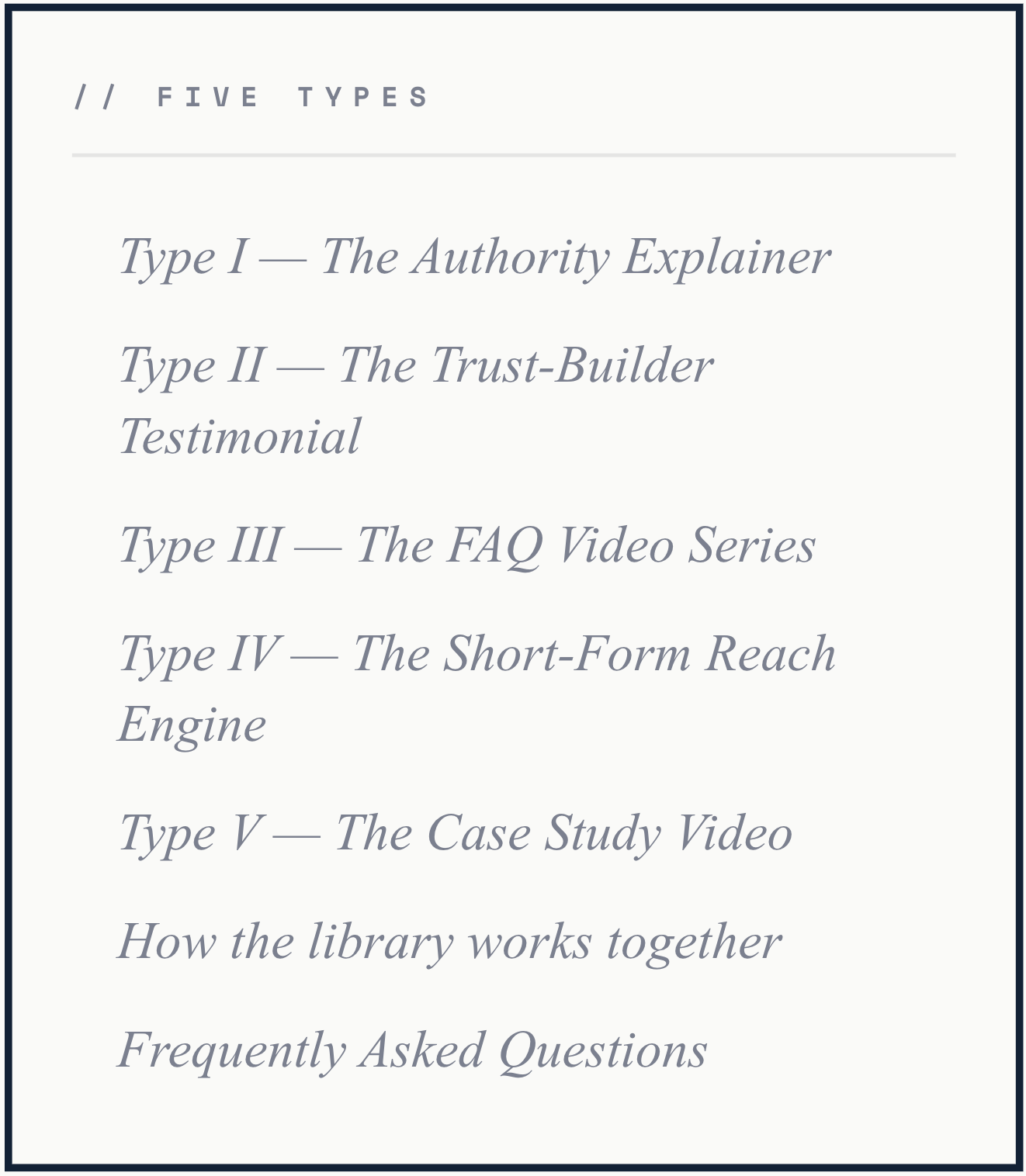
Direct Answer: The five types of AI video every business must have in 2026 are: the Authority Explainer (topical cluster pillar and AI Overview citation magnet), the Trust-Builder Testimonial (social proof with AggregateRating schema), the FAQ Video Series (featured snippet and voice search capture), the Short-Form Reach Engine (algorithm-driven new audience discovery), and the Case Study Video (high-intent buyer conversion). Each type serves a distinct funnel position, generates a specific AI citation type, and requires a dedicated Video Object schema configuration to attribute ranking equity to the business's owned domain rather than to YouTube.
// The Taxonomy Problem
Why Is Publishing More Video the Wrong Strategy — and What Is the Right Framework?
Most SME video strategies fail not because founders lack content ideas or production budget — they fail because every video is treated as the same type of asset, deployed to the same channel, optimised with the same approach. A founder's product demo and a founder's thought leadership piece are fundamentally different assets serving different buyer stages, different search intents, and different AI citation categories. Treating them identically wastes both.
The five-type taxonomy exists to solve this. Each type occupies a specific position in the buyer journey, generates a specific category of AI citation, and requires a specific schema configuration to produce its intended commercial outcome. When all five types are in place and producing consistently, the result is a video asset library that covers every stage from first discovery through conversion — without overlap, redundancy, or wasted production budget.
// The AI Citation Dimension
In 2026, every video type has a corresponding AI retrieval function beyond its organic reach. The Authority Explainer generates AI Overview citations for informational queries. The FAQ Series captures voice search and featured snippets. The Case Study generates high-intent buyer citations in Perplexity and ChatGPT Search. Without Video Object schema and owned host pages, none of these citation functions activate — the video's AI discoverability remains at zero regardless of view count.
From our experience working with SMEs across industries, the businesses generating the highest compound return from video are those that produce all five types systematically and publish every one with a schema-marked host page on their own domain. The five-type library is not aspirational — it is the minimum infrastructure for video to function as a durable business asset rather than a temporary reach vehicle.
The Authority Explainer
AI Overview Magnet
Cluster Pillar 10–15 min
The Authority Explainer is the video equivalent of your pillar article — the comprehensive, long-form video on the primary question in your most commercially relevant topic cluster. It is the video that establishes your business as a subject-matter authority, generates AI Overview citations for the cluster's primary commercial queries, and serves as the internal link anchor for every other video and article in the cluster.
The Authority Explainer is 10–15 minutes long, structured in three clear parts: a direct answer to the cluster's primary question in the first two minutes, a comprehensive mechanism explanation in the middle section, and a specific application framework in the final section. This structure is not aesthetic preference — it is what enables AI retrieval systems to extract the direct answer block, the supporting evidence, and the actionable takeaway as three separate citation types from a single video asset.
From our experience working with SMEs, the Authority Explainer is the video type most consistently skipped — replaced with shorter, less demanding content — and the one whose absence is most commercially costly. Without an Authority Explainer on your primary cluster, every AI Overview query on your most important commercial topic sends buyers to a competitor who made the investment you did not.
Every Authority Explainer requires four infrastructure elements to activate its AI citation function: a VideoObject schema host page on your owned domain, a transcript article with a direct answer block and FAQ Page schema, an Article schema node with Person author attribution, and internal links to all supporting cluster content. Without all four, the video ranks for your existing audience on YouTube but generates zero AI citation appearances for the new-audience discovery queries it was designed to capture.
4.3×
Higher AI Overview citation rate for Authority Explainers with VideoObject schema vs YouTube-only
// Semrush, 2025
18mo
Average organic search traffic lifespan for a well-structured Authority Explainer host page
// HubSpot, 2025
3,000+
Word minimum for the
accompanying transcript article to qualify as a topical cluster pillar
// Internal benchmark
// How to produce it
Record once in a single session. Structure the argument as: direct answer (90 seconds) → mechanism (7 minutes) → application framework (4 minutes). Publish on YouTube, publish the transcript article with full schema on your domain, embed YouTube player on the host page between the direct answer block and H2 section one. Submit to Google Search Console. This single video, produced correctly, generates AI Overview citations for your primary cluster for 18+ months.
The Trust-Builder Testimonial
Social Proof Asset
AggregateRating Schema 2–4 min
The Trust-Builder Testimonial is the highest-converting video type in the SME library — not because it reaches the largest audience, but because it reaches buyers at the highest-intent moment of their decision cycle, with the specific evidence format (peer validation) that moves consideration to commitment more reliably than any other content type.
A testimonial video that works in 2026 has four structural components. The client must be identified by name, role, and company — anonymous testimonials carry zero credibility weight in the AI retrieval environment because they cannot be attributed to a verified entity. The testimonial must include a specific quantified outcome ("reduced our onboarding time by 40%") rather than a general approval statement ("highly recommend"). It must address the specific objection the buyer in the same industry has before purchasing. And it must be 2–4 minutes — long enough to be credible, short enough to be watched to completion.
The schema dimension transforms the Trust-Builder Testimonial from a social proof asset into a structured data asset. The host page requires AggregateRating schema referencing the testimonial as a Review, with the reviewer's name (matching their LinkedIn profile for entity verification), their rating, and the reviewed product or service as named entities. This schema configuration makes the testimonial eligible for Rich Result star rating displays in Google search — the structured data signal that increases click-through rate by an average of 35% in B2B service categories per Google's Search Console data, 2025.
In practice, this breaks down when founders treat testimonial collection as opportunistic rather than systematic. The highest-performing SME video libraries have three to five testimonials per service line, collected at 30, 60, and 90 days post-delivery and structured with the four components above — not one testimonial per year recorded when a happy client happens to be available.
35%
Average CTR increase from AggregateRating Rich Results in B2B service categories
// Google Search Console, 2025
92%
Of B2B buyers consult peer testimonials before contacting a vendor (Gartner 2025)
// Gartner, 2025
2–4
Optimal video length in minutes — beyond 4 minutes, testimonial completion rates fall below 55%
// Wistia, 2025
// How to produce it
Interview the client on video at their 30-day post-delivery point. Ask four questions: What was the situation before working with us? What specific result did you achieve? What would you say to someone considering us? What surprised you most? Edit to 2–4 minutes. Publish with VideoObject schema and AggregateRating Review schema on a dedicated testimonial host page. Collect three per service line before considering the library complete.
The FAQ Video Series
Featured Snippet Engine
Voice Search 90–180 sec each
The FAQ Video Series is the video type most directly optimised for AI retrieval. Each video answers exactly one question — the natural-language question that a buyer in your target market types into Google, asks Perplexity, or speaks to a voice assistant — in 90 to 180 seconds. The format is not short because short is fashionable; it is short because the featured snippet and AI Overview systems require a self-contained, directly stated answer within the first 60 seconds of a video to classify it as a direct answer source.
The FAQ Video Series functions as the supporting cluster layer beneath the Authority Explainer. Where the Authority Explainer covers the cluster's primary question at depth, the FAQ Series covers the eight to twelve secondary questions that buyers ask as they research the same topic. Each FAQ video has a corresponding written article on an owned host page — the two together create an entity-verified, schema-marked answer to a specific query that AI retrieval systems can cite with high confidence.
The production standard for an FAQ Video Series is deliberately minimal. The video does not require professional equipment, multiple camera angles, or post-production. It requires a direct, confident answer in the first 30 seconds, one supporting explanation, and one clear application instruction — delivered in exactly the format that buyers are asking the question in their own conversations. The authenticity of a direct answer is the production value. Over-producing FAQ videos introduces polish that makes them feel less like answers and more like advertisements.
What we consistently see in real-world deployments is that the FAQ Video Series generates the fastest AI citation results of any video type — typically appearing in featured snippets and voice search answers within 30–45 days of publication with VideoObject schema, because the direct answer format is exactly what AI retrieval extraction algorithms are designed to surface. Ten FAQ videos, each answering a specific cluster question, can produce AI citation appearances across ten different query variants simultaneously — a coverage breadth that no single Authority Explainer or testimonial video can achieve.
30d
Typical time to first featured snippet appearance for an FAQ video with direct answer block and VideoObject schema
// Clipkoi data, 2026
10×
Query variant coverage from a ten-video FAQ series vs a single Authority Explainer on the same cluster
// Internal benchmark
41%
Of voice search results come from a featured snippet source — making FAQ schema the voice search ranking mechanism
// Backlinko, 2025
// How to produce it
Identify the ten most common questions buyers ask before purchasing from you. Record one 90–180 second video per question: state the question as the first sentence, answer it directly in the next 30 seconds, explain the mechanism in 60 seconds, give one specific application in 30 seconds. Publish each with a VideoObject schema host page and FAQPage schema containing the question and a written answer. Batch all ten in a single recording session to minimise production overhead.
The Short-Form Reach Engine
New Audience Discovery
60–90 sec Reels · Shorts · TikTok
The Short-Form Reach Engine is the only video type in the five-type library that is not primarily designed for AI citation or organic search — it is designed for algorithm-driven discovery of new audiences who have never encountered your brand before. Reels, YouTube Shorts, and TikTok's recommendation algorithms surface content to non-followers based on engagement signals, making short-form the only video format that can reach buyers before they have a specific search intent.
The most efficient way to produce Short-Form Reach Engine content is through the AI repurposing system described in this article series — extracting three to five 60–90 second clips from each long-form Authority Explainer or FAQ video using an AI clip tool, rather than recording dedicated short-form content. This approach produces short-form content as a by-product of long-form production, adding 15 minutes of AI tool time per source video without requiring additional recording sessions or additional scripting.
The short-form hook is the single most commercially important element of this video type. If the first three seconds do not create cognitive dissonance — challenge a commonly held assumption, state a surprising number, or begin mid-argument as if the viewer missed the setup — the algorithm will not distribute the video beyond its initial test cohort. The hook must be extracted from the most counterintuitive moment in the source video, not from the introduction. AI clip tools identify these moments automatically, but the final hook selection requires a human judgement call: which of the candidate clips would cause a buyer scrolling at 11pm to stop and watch?
The schema caveat for short-form content is important: the Short-Form Reach Engine does not require VideoObject schema on owned host pages the way the other four types do, because short-form clips are not the video asset you want buyers to find through search. They are the awareness asset that drives buyers to search for your brand, your long-form content, or your primary commercial query — at which point the schema-marked library of the other four video types captures them. Short-form is the top-of-funnel reach engine; the other four types are the discoverability and conversion infrastructure it feeds.
53%
Of B2B buyers discover new vendors through short-form social video before any search behaviour (LinkedIn B2B Report 2025)
// LinkedIn, 2025
3s
Window to hook a short-form viewer before algorithm counts the view as a skip — the only metric that determines initial distribution
// Meta, 2025
15min
Additional AI production time to extract 3–5 short-form clips from each long-form video using AI clip detection
// Clipkoi data, 2026
// How to produce it
Run each Authority Explainer and FAQ video through Opus Clip or CapCut's AI scene detection. Select three to five candidate clips based on the AI's engagement score. From those candidates, select the one where your most counterintuitive claim lands earliest in the clip — this is your hook test. Publish the top clip to Reels and Shorts within 48 hours of publishing the long-form source video. Publish the remaining clips on Days 5, 10, and 20 of the 30-day distribution calendar.
The Case Study Video
Conversion Asset
High-Intent Buyer 5–8 min
The Case Study Video is the highest-commercial-value video type in the library — not because it reaches the most buyers, but because it reaches buyers at the precise moment when the decision between you and a competitor is being made. A buyer who searches "how [Your Company] helped [Industry] company achieve [Outcome]" is within one conversation of becoming a client. The Case Study Video is the asset that captures that search intent and converts it.
The Case Study Video differs from the Trust-Builder Testimonial in three critical ways. It is longer (5–8 minutes versus 2–4 minutes) because the high-intent buyer wants comprehensive proof, not a brief endorsement. It follows a structured narrative (situation, challenge, approach, result, and what's possible for you) rather than an interview format. And it targets a specific industry vertical or company size rather than being a general approval statement — which is what makes it findable by the specific buyer profile who most closely resembles the case study subject.
The keyword targeting for a Case Study Video is the reverse of the Authority Explainer's. The Authority Explainer targets informational queries ("how to [solve problem]"). The Case Study Video targets commercial investigation queries ("[company type] + [outcome] + [service category]") — the query form that indicates a buyer comparing specific vendors, not gathering general information. The VideoObject schema for a Case Study Video should include the industry vertical, the outcome metric, and the service category as named entities in the description field, because these are the semantic signals AI retrieval systems use to match the video to commercial investigation queries.
Six months from now, a business with three Case Study Videos targeting its primary buyer profiles will have a permanently active conversion layer in its video library — assets that capture high-intent buyers regardless of how they discovered the business, on every platform and search engine that indexes the host pages. A business without Case Study Videos loses those buyers at the final stage of consideration to a competitor whose proof of concept is more accessible.
78%
Of B2B buyers watch a vendor's case study or success story video before making a final purchasing decision (Demand Gen Report 2025)
// Demand Gen Report, 2025
5–8
Optimal Case Study Video length in minutes — shorter lacks credibility; longer loses completion rate below 45%
// Wistia, 2025
3×
Higher close rate for SMEs using video case studies in final-stage sales conversations vs text-only case study PDFs
// HubSpot, 2025
// How to produce it
Select a client who achieved a specific quantified outcome in your primary buyer industry. Film a structured 20-minute interview covering five questions: situation before (3 min), specific challenge (3 min), your approach (5 min), the quantified result (3 min), recommendation to similar businesses (3 min). Edit to 5–8 minutes with the result stated in the first 45 seconds. Publish with VideoObject schema, the client's industry and outcome in the description, and a transcript article targeting "[industry] + [outcome] + [your service]" as the primary keyword cluster.
// The Complete Library
How Do All Five Types Work Together as a Unified Video Asset Library?
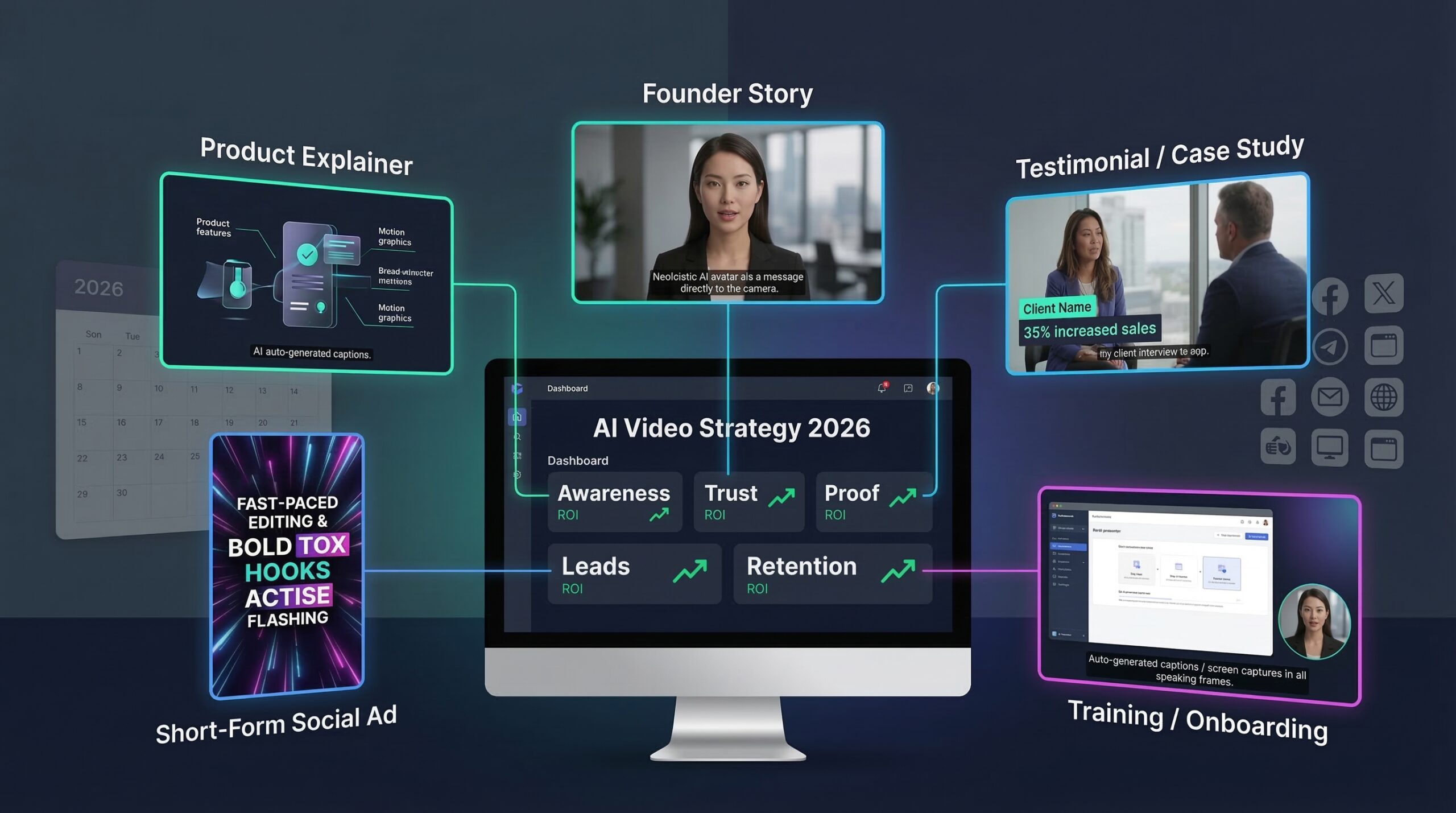
The five video types are not standalone assets — they function as an interconnected library where each type serves a specific buyer stage and feeds the next. Understanding how they connect is what allows you to plan production strategically rather than reactively.
The Short-Form Reach Engine (Type IV) creates first awareness — buyers who had never heard of you encounter your most counterintuitive insight. Those who are intrigued search for your brand or your primary commercial query and arrive at the Authority Explainer (Type I) through organic search or AI Overview citation. Buyers who engage deeply with the Authority Explainer encounter the FAQ Video Series (Type III) through internal links, deepening their understanding and your authority. Buyers who are evaluating you specifically seek out the Trust-Builder Testimonials (Type II) for peer validation. And buyers who are in final-stage decision-making find the Case Study Videos (Type V) through commercial investigation queries that match their specific industry and desired outcome.
// The Library Completion Priority
In practice, the production priority order is not the buyer journey order. Build the Authority Explainer first (establishes topical authority and AI citation eligibility for everything else), then the FAQ Series (fastest AI citation results, lowest production cost), then Case Study Videos (highest conversion value), then Testimonials (collected systematically at delivery milestones), then Short-Form (extracted from all existing long-form content). This order maximises commercial return per production hour at every stage of the library build.
A video library that contains all five types is not just content — it is infrastructure. It captures buyers at every stage of consideration, on every platform where they search, and converts them regardless of how they discovered you or when.
// The strategic case for the five-type video library as business infrastructure rather than content marketing
Frequently Asked Questions
What are the 5 types of AI video every business must have in 2026?
The five types of AI video every business must have in 2026 are: the Authority Explainer (a 10–15 minute comprehensive video on the primary question in your most commercially relevant topic cluster, designed to generate AI Overview citations and establish topical authority); the Trust-Builder Testimonial (a 2–4 minute client testimonial with a specific quantified outcome and AggregateRating schema for Rich Result star ratings); the FAQ Video Series (90–180 second videos each answering one specific buyer question, designed for featured snippet and voice search capture); the Short-Form Reach Engine (60–90 second clips extracted from long-form content for algorithm-driven new audience discovery on Reels, Shorts, and TikTok); and the Case Study Video (a 5–8 minute narrative case study targeting commercial investigation queries from high-intent buyers in final-stage decision-making). Each type requires a dedicated VideoObject schema configuration on an owned host page to attribute ranking equity to the business's domain rather than to YouTube.
Which type of AI video should a business produce first?
A business should produce the Authority Explainer first, followed by the FAQ Video Series, Case Study Videos, Trust-Builder Testimonials, and Short-Form Reach Engine clips. The Authority Explainer is the priority because it establishes the topical cluster authority signal that makes all subsequent content in the cluster more easily discoverable by AI retrieval systems — the foundational asset without which supporting video types produce lower citation rates. The FAQ Video Series is second because it generates the fastest AI citation results (typically within 30–45 days of publication with VideoObject schema) and requires the lowest production investment per video. Case Study Videos are third because they represent the highest conversion value per view. Testimonials are fourth because they should be collected systematically at client delivery milestones rather than produced on a fixed schedule. Short-Form clips are last because they are most efficiently produced as AI-extracted derivatives of existing long-form content, requiring no additional recording once the Authority Explainer and FAQ Series are in place.
Why does every video need a VideoObject schema host page?
Every video needs a VideoObject schema host page because without one, the video's ranking equity — the organic search traffic, AI Overview citation eligibility, and featured snippet appearances it generates — is attributed to YouTube's domain rather than to the business's own domain. When a video is published only on YouTube, Google indexes it as YouTube's content, and any AI Overview citation or featured snippet appearance credits YouTube as the publisher. When the same video has an owned host page with VideoObject schema (containing name, description, thumbnailUrl, uploadDate, duration, and embedUrl fields), Google attributes the video to the entity-verified business domain — meaning the video contributes to the business's topical authority, generates organic search traffic to the business's website, and appears in AI Overviews under the business's brand name. Semrush's 2025 research found that video content with VideoObject schema on owned entity-verified domains is 4.3× more likely to appear in AI Overviews than equivalent content published on YouTube without an owned host page.
How many videos of each type does an SME need?
An SME needs the following minimum library counts to produce measurable commercial outcomes from each video type: one to three Authority Explainers per topic cluster (one covering the cluster's primary question, with additional explainers for the cluster's highest-traffic secondary questions as the library matures); eight to twelve FAQ Videos per topic cluster matching the cluster's full semantic scope; three Case Study Videos per primary buyer industry or company size (one per major buyer profile you serve); three to five Trust-Builder Testimonials per service line (collected systematically at the 30, 60, and 90-day post-delivery milestones); and short-form clips produced automatically from all long-form content at a ratio of three to five clips per source video. A library at minimum counts across all five types represents approximately 25–35 total videos, producible in six to eight months at the two-videos-per-week production cadence described in the AI content repurposing system. Once the minimum library is in place, every additional video adds compound authority rather than filling a structural gap.
What is the most important AI video type for generating AI Overview citations?
The Authority Explainer generates the highest individual-video AI Overview citation rate because it covers a primary commercial query at the depth that AI retrieval systems require to classify a source as authoritative — typically 10–15 minutes of structured expert content accompanied by a 3,000-word transcript article, direct answer block, and FAQPage schema on an owned entity-verified host page. However, the FAQ Video Series generates the broadest citation coverage across the most query variants — ten FAQ videos with direct answer blocks and VideoObject schema can produce AI Overview citations on ten different buyer questions simultaneously, producing greater total citation surface area than a single Authority Explainer at any individual AI Overview citation rate. The most effective strategy combines both: one Authority Explainer establishing cluster authority and triggering the topical expertise signal, supported by eight to twelve FAQ Videos that capture specific query variants the Authority Explainer's broader scope cannot target precisely enough for featured snippet or voice search extraction.
→ The Library Argument
Six Months of Systematic Video Production Produces a Moat That Willpower Cannot Build
The five-type taxonomy is not a content calendar — it is an infrastructure plan. Every video produced within it adds to a library that generates discovery, authority, and conversion outcomes that compound with each addition rather than depreciating with time.
Six months of producing two videos per week using this taxonomy — with full VideoObject schema infrastructure on every host page — produces a library of 48+ videos covering every buyer stage, every AI citation category, and every funnel position in your primary commercial cluster. Your competitor who is posting to YouTube and LinkedIn without schema infrastructure will have 48+ videos and zero accumulated domain authority from them.
The investment is not talent or budget. It is the decision to treat video as infrastructure rather than content — to produce each video type with the schema, host page, and cluster architecture that makes it a durable asset rather than a temporary view. That decision is available to you today.