
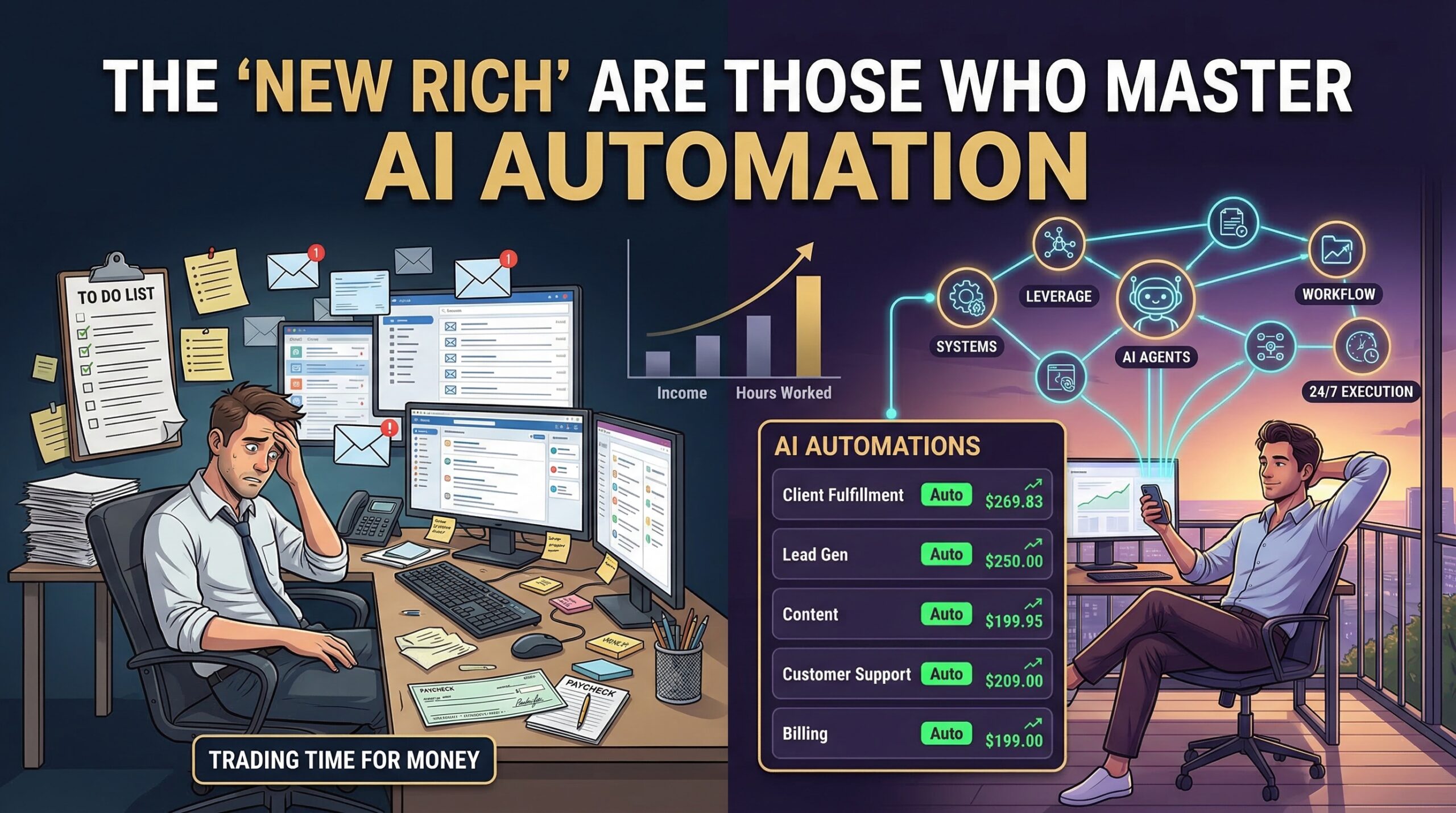
Direct Answer: The "New Rich" are founders and business owners who master AI automation because AI converts their expertise into leveraged output at a scale no human team can match at equivalent cost — generating 14× more revenue per employee than traditional SMEs, according to McKinsey 2025. Mastering AI automation means replacing time-for-money exchange with systems that compound authority, revenue, and freedom simultaneously — producing wealth that scales with intellectual capital, not headcount.
// Leverage Multiplier Data
14×
Revenue per employee for AI-first SMEs versus traditional SMEs at equivalent headcount
// McKinsey, 2025
$240K
Average annual income of solo AI automation founders with £100K–£500K ARR businesses in 2025
// MBO Partners, 2025
72%
Of tasks in a typical SME knowledge business can be fully or partially automated with current AI tools
// McKinsey, 2025
Compounding
// The Argument
Wealth in 2026 is not accumulated through capital, connections, or credential. It is accumulated through leverage — and AI automation is the most accessible leverage multiplier in the history of business. The founders who master it first are building a compounding advantage that will be structurally irreversible within 18 months.
// 01 · The Wealth Mechanism
Why Is AI Automation the Primary Wealth Accumulation Vehicle of 2026?
Every major wealth accumulation era in modern history has been defined by a specific leverage mechanism — the tool, technology, or system that allowed a small number of people to create disproportionate value relative to the time and capital they invested. The printing press created information leverage for publishers. The factory created production leverage for industrialists. The internet created distribution leverage for software founders. AI automation is creating cognitive leverage — the ability to multiply the commercial output of a single expert mind across unlimited simultaneous tasks, channels, and delivery formats without proportional increases in time or labour cost.
The defining characteristic of cognitive leverage is that it compounds differently from the previous leverage types. Distribution leverage (the internet) made it cheap to reach many people with a single message — but the message still required a human to create it. Cognitive leverage makes it cheap to create, distribute, optimise, and iterate the message continuously, at the pace of machine execution rather than human execution. A founder who deploys AI automation is not just working more efficiently — they are operating at a fundamentally different point on the output curve.
// The Leverage Definition
Tim Ferriss popularised the concept of the "New Rich" as those who optimise for freedom rather than net worth. In 2026, the definition requires updating: the New Rich are those who have deployed AI automation to such a degree that their revenue, authority, and discovery systems operate independently of their time — producing wealth that compounds while they sleep, travel, or focus exclusively on the highest-leverage human work only they can do.
McKinsey's 2025 State of AI Report found that AI-first SMEs generate 14× more revenue per employee than traditional SMEs at equivalent headcount — not because AI-first founders work harder, but because their leverage ratio is structurally different. A five-person AI-first business does not produce five times the output of a one-person operation. It produces fifty times the output, because each person's time is multiplied by the AI systems they have deployed rather than constrained by the tasks they can complete manually.
// 02 · The Automation Stack
What Are the Specific AI Automation Functions That Create the Highest Wealth Leverage?
Not all AI automation creates equal leverage. The highest-return automation targets are the functions that simultaneously: (a) consume the most founder time per week, (b) are most repeatable and therefore most reliably automatable, and (c) produce the most compounding commercial value when done consistently at scale. Most founders automate for convenience. The New Rich automate for compounding.
Business Function
Manual Cost
AI Cost
Leverage
Content Production
Blog, video, social, email — seven outputs per source asset
£2,000/mo agency
£40/mo tools
50×
Search and AI Discovery
Entity schema, VideoObject, FAQPage, host pages
£1,500/mo SEO
£0–30/mo
∞
Email Marketing Sequences
Lead nurture, client onboarding, re-engagement
£800/mo writer
£15/mo model
53×
Client Delivery Automation
Async onboarding, progress tracking, resource delivery
£1,200/mo ops
£30/mo tools
40×
Sales Infrastructure
VSL, proposal generation, discovery prep, CRM
£600/mo SDR
£20/mo tools
30×
Financial Administration
Invoicing, bookkeeping, expense categorisation
£400/mo admin
£25/mo tools
16×
The most strategically important row in this table is Search and AI Discovery — where the leverage ratio is effectively infinite because the manual cost (an SEO agency doing this correctly) is approximately £1,500 per month, and the AI-enabled cost is near zero with the right infrastructure knowledge. Entity schema, VideoObject host pages, and FAQPage structured data are not technically difficult to produce — they are knowledge-intensive. Once you know how to build them, the marginal cost approaches zero and the compounding return runs indefinitely.
// The Compounding Distinction
Automation that saves time creates efficiency. Automation that builds authority, discovery, and trust compounds. The New Rich focus their AI automation investment on the second category — the systems that generate inbound clients, AI Overview citations, and topical authority whether they are working or not. Every piece of content infrastructure deployed today is still working in 2027, 2028, and beyond.
// 03 · The Wealth Stack
What Are the Four Layers of the New Rich AI Wealth Stack — and How Do They Compound?
The New Rich do not build businesses — they build leverage stacks. Each layer of the stack multiplies the layer beneath it, producing a compounding wealth architecture that generates more from each additional unit of input than the last. This is what makes the AI automation era fundamentally different from every previous era of business building.
// Layer 1 · Foundation
Expert Identity — The Knowledge Asset That Everything Else Amplifies
1×
// Layer 2 · Amplification
AI Content System — The Machine That Converts Expertise Into Authority at Scale
7×
// Layer 3 · Discovery
Schema Infrastructure — The Entity Verification That Makes Everything Citable
4×
// Layer 4 · Compounding
Authority Library — The Growing Asset That Generates Inbound Without Effort
∞
The compounding mechanism is what separates the New Rich from efficient operators. An efficient operator automates tasks — they save time on individual actions. A wealth architect builds a compounding stack — each new content asset added to the authority library increases the total citation surface area, the topical authority signal, and the discovery probability. The 50th video added to a schema-marked authority library generates more combined inbound than the first 49 because it completes the topical coverage that AI retrieval systems require for category authority.
The old rich worked hard for their money. The new rich built systems that work harder than they do — and every AI content asset published is another system running indefinitely without salary, sick leave, or turnover.
// 04 · The Evidence
What Does the Data Show About Income and Wealth Outcomes for AI Automation Masters?
The New Rich thesis is not aspirational philosophy — it is supported by a converging set of income, revenue, and business performance data that together describe a measurable and growing divergence between AI-first founders and their non-AI-equipped peers operating in the same markets.
14×
Revenue per employee for AI-first SMEs versus traditional SMEs at equivalent headcount
// McKinsey, 2025
$240K
Average annual income of solo AI automation founders with £100K–£500K ARR businesses in 2025
// MBO Partners, 2025
72%
Of tasks in a typical SME knowledge business can be fully or partially automated with current AI tools
// McKinsey, 2025
The $240,000 average income figure for solo AI automation founders is particularly significant because it represents a category of wealth generation that did not exist five years ago. A founder operating a consulting or coaching business at £100,000–£500,000 ARR without AI automation required a team of two to five people to support the content production, scheduling, client management, and business development functions — reducing net income to £60,000–£120,000 after team costs. With AI automation replacing those functions at a combined tool cost of £100–£200 per month, the same revenue generates take-home income approaching £200,000–£240,000. Same revenue, 4× the personal wealth outcome, zero additional employees.
What we consistently see in real-world deployments is that the wealth divergence accelerates over time. At month one, an AI-automated founder is 20–30% more profitable than their non-automated peer. At month twelve, they have a content library generating inbound citations the non-automated peer cannot match, a client acquisition cost approaching zero from organic discovery, and an authority position that takes 12–18 months to build — which means the non-automated peer's catch-up time is always running behind the automated founder's advance.
// 05 · The Mastery Framework
Mastery of AI automation is not the same as using AI tools. Using AI tools produces efficiency. Mastering AI automation produces leverage architecture — the interconnected system of automations that compound authority, reduce cost, and generate inbound wealth continuously. The distinction is between using a hammer and building a house.
Week 1–2: Audit Your Revenue-to-Time Ratio and Identify Every Leverage Gap
Calculate your current revenue per hour of active work — dividing your monthly revenue by the hours per month you spend on billable client work only, excluding all administrative, marketing, content, and operational hours. This is your leverage ratio baseline. Now calculate your total work hours including every non-billable hour — content, admin, scheduling, sales, reporting. The gap between your billable-only rate and your total-hours rate is your leverage gap: the income being destroyed by time spent on tasks that AI automation can handle. A founder earning £10,000 per month and working 180 total hours but billing for only 60 of them has a leverage ratio of £55/hour, not the £167/hour their billable rate implies. The 120 hours of non-billable work at £167/hour represents £20,000 of destroyed leverage potential every month — the exact opportunity that AI automation recovers. Map every recurring non-billable task category (content, admin, sales support, scheduling, reporting) against its AI automation potential and estimated tool cost. This audit becomes the ROI case for your automation investment and the priority list for your build sequence.
Week 3–4: Deploy the Compounding Layer First — Content and Discovery Infrastructure
Deploy the highest-leverage automation layer first — not the most urgent one. The most urgent automation is usually administrative (invoicing, scheduling) because these create immediate pain. The highest-leverage automation is content and discovery infrastructure because this is the layer that compounds. The content automation system (AI repurposing five prompts, 30-day distribution calendar, VideoObject schema host pages) deployed in week three will still be generating inbound clients, AI Overview citations, and authority signals in week 156. The invoicing automation deployed in the same week will still be automating invoices in week 156 — a useful efficiency, but not a compounding wealth mechanism. The New Rich invest their automation build time in the compounding layer first: entity schema and host pages for all existing content (making everything citable immediately), the five-prompt AI content system (multiplying every future recording by seven), and the VideoObject schema template (attributing every future video to the owned domain rather than YouTube). This layer, once built, runs permanently with near-zero marginal maintenance.
Month 2: Deploy the Efficiency Layer — Operations, Delivery, and Administration
Once the compounding layer is operational and producing its first inbound signals (typically within 30–45 days of entity schema installation), deploy the efficiency layer: async client delivery infrastructure (Calendly, Loom, Notion client portal), automated email sequences for lead nurture and client onboarding, financial administration automation (Xero, Dext), and CRM automation for sales pipeline management. The efficiency layer recovers 15–30 hours per week of non-billable time — time that can be redirected to client delivery (increasing revenue at the same hourly rate), strategic business development (increasing the future revenue trajectory), or genuine personal freedom (the New Rich definition). The sequencing matters: efficiency layer first produces an operationally smooth but commercially invisible business — improved margins but no compounding discovery. Compounding layer first, efficiency layer second produces a business that generates inbound simultaneously with improving its margins — the wealth architecture of the New Rich.
Month 3–6: Scale the Compounding Layer by Adding Volume to the Authority Library
Once both layers are operational, the wealth building phase begins: systematically growing the authority library that generates compounding inbound. Two videos per week through the AI repurposing system produces 14 content assets per week — 56 per month, 672 per year. Each asset is entity-attributed, schema-marked, and AI-citable. Each FAQ video adds an additional featured snippet target. Each Authority Explainer deepens the topical authority signal. Each case study video captures commercial investigation queries from new buyer profiles. Six months of consistent operation at this volume produces an authority library that generates AI Overview citations, organic search traffic, and email list growth at a pace that is essentially impossible for a manually operating competitor to match at equivalent total cost. At month six, the weekly content system is running automatically, the inbound from organic discovery is measurable, and the founder's personal income — net of tool costs — is approaching the New Rich income trajectory: high revenue, near-zero marginal cost per additional client, and authority-based pricing power that increases with every addition to the library.
Month 6+: Protect the Human Layer — Reserve Your Irreplaceable Time for the Work Only You Can Do
The final and most strategically important phase of AI automation mastery is the decision about what not to automate. The New Rich are not the founders who have automated everything — they are the founders who have automated everything that can be automated and fiercely protected the time for everything that cannot: the client relationships that justify premium pricing, the coaching conversations that create transformational outcomes, the sales negotiations where emotional intelligence converts high-ticket buyers, the strategic decisions where human judgement applied to specific context is worth more than any AI-generated analysis. The wealth architecture compounds precisely because the human layer is protected by the automation of everything beneath it. A founder whose AI systems handle content, discovery, scheduling, administration, and sales support — and whose human time is reserved exclusively for client delivery, key relationships, and strategic decisions — is not working smarter. They are operating at a fundamentally different productivity-to-freedom ratio than any non-automated competitor, at any price point, in any market. That ratio is the definition of the New Rich in 2026.
Frequently Asked Questions
Who are the "New Rich" in the AI era?
The New Rich in the AI era are founders, business owners, and knowledge professionals who have deployed AI automation to such a degree that their revenue, authority, and client discovery systems operate independently of their time — producing wealth that compounds while they work on only the highest-leverage human activities. The term builds on Tim Ferriss's concept from The 4-Hour Work Week (2007) but updates it for the AI era: where Ferriss defined the New Rich as those who optimise for freedom over net worth, the 2026 definition is those who use AI automation to achieve both simultaneously — high income and high freedom — by replacing time-for-money exchange with systems that scale with intellectual capital rather than headcount. McKinsey's 2025 State of AI Report found that AI-first SMEs generate 14× more revenue per employee than traditional SMEs at equivalent headcount, and MBO Partners' 2025 data shows that solo AI automation founders with £100,000–£500,000 ARR businesses earn an average of $240,000 annually — demonstrating that the New Rich income profile is achievable without a large team, large capital, or large overhead.
What is the most important AI automation for building wealth as a founder?
The most important AI automation for building wealth as a founder is the content and discovery infrastructure layer — specifically the AI content repurposing system (converting one recorded video into seven content assets in 90 minutes) combined with entity schema and VideoObject schema host pages (making every published asset citable by AI retrieval systems and rankable in organic search). This layer is highest-priority because it is the only automation category that compounds: each new content asset added to an entity-verified, schema-marked authority library increases the total citation surface, organic discovery probability, and inbound lead generation capacity permanently. Administrative automation (invoicing, scheduling) saves time but produces no compounding commercial value — the 500th automated invoice is worth the same as the first. The 500th schema-marked authority video is worth dramatically more than the first, because it completes topical coverage, reinforces entity authority, and generates AI citation appearances across a wider range of commercial query variants. Deploy the compounding layer first, the efficiency layer second.
How long does it take to see wealth results from AI automation mastery?
Wealth results from AI automation mastery appear on three timelines. Immediate cost reduction (weeks 1–4): deploying the AI content system reduces content production costs from £2,000–£4,000 per month to £40–£80 per month — an immediate margin improvement of £1,960–£3,920 per month that begins on the day the system is deployed. Medium-term discovery results (days 30–90): entity schema installation and VideoObject schema host pages begin generating AI Overview citations and featured snippet appearances within 30–45 days of schema deployment, producing inbound leads from organic discovery that were not previously available. Long-term wealth compounding (months 3–18): the authority library grows with each new video and article published, increasing the total citation surface area, the topical authority signal strength, and the inbound lead volume continuously. At month 6 with consistent weekly production, the authority library is typically generating measurable organic discovery-driven inbound. At month 18, the library has produced enough topical authority to generate category-level recognition — the compounding point at which authority converts into pricing power and inbound volume that makes outbound sales effort largely unnecessary.
What is the leverage ratio of AI automation for an SME founder?
The leverage ratio of AI automation for an SME founder varies by function but averages between 16× and 50× when comparing the monthly cost of AI tools to the equivalent outsourced or employed alternative. The highest-leverage ratio is in the search and discovery category, where entity schema and VideoObject host pages replace an SEO agency retainer of £1,500–£3,000 per month at near-zero marginal cost once the implementation knowledge is acquired. Content production automation achieves a 50× leverage ratio (£40/month AI tools versus £2,000/month agency). Email marketing sequence automation achieves 53× (£15/month versus £800/month writer). Client delivery automation achieves 40× (£30/month versus £1,200/month operations coordinator). Financial administration achieves 16× (£25/month versus £400/month admin). At full deployment across all six automation categories, an SME founder spending £150–£200 per month on AI tools is replacing £6,500–£11,000 per month of outsourced or employed support functions — a total leverage ratio of approximately 43–55× on the tool investment, producing monthly profit improvement of £6,300–£10,800 per month in recovered margins.
How does AI automation create compounding wealth rather than just efficiency gains?
AI automation creates compounding wealth rather than just efficiency gains when it is directed at the content and discovery infrastructure layer — the category where each automation output adds permanent commercial value to a growing asset library rather than simply completing a repeatable task. Administrative automation (invoicing, scheduling, bookkeeping) produces efficiency gains: time saved is proportional to volume processed, but the 500th automated invoice produces no more lasting commercial value than the first. Discovery automation (entity schema, VideoObject host pages, FAQPage structured data, AI content repurposing) produces compounding wealth: the 500th schema-marked video host page is worth dramatically more than the first because it deepens topical authority, increases AI citation frequency, extends organic search coverage, and adds inbound discovery capacity that was not previously available — all permanently, with zero additional maintenance cost. The compounding mechanism is the authority library: a growing collection of entity-attributed, schema-marked, AI-citable content assets that generate citations, search traffic, and inbound leads independently of the founder's active working time, increasing in total commercial value with every new asset added.
→ The Compounding Argument
18 Months From Now, The Gap Between Automators and Non-Automators Will Be a Moat
The wealth gap between AI automation masters and their non-automated peers is not currently visible to most people because the compounding is still early. In 18 months — with authority libraries at 150+ assets, AI Overview citations across thirty commercial queries, and inbound client pipelines running at near-zero acquisition cost — the gap will be structural and irreversible.
The non-automated founder will need 18 months to build the same library from zero. But by the time they start, the automated founder will have added another 18 months of compounding authority. The lead never closes. The moat widens automatically, every week, with every new content asset published.
The New Rich are not building the biggest team, spending the most on advertising, or working the longest hours. They are building the systems that work hardest — and they started building them before their competitors understood that the wealth architecture had changed. That window is still open. The question is whether you enter it now or after your competitors have already compounded past you.