
Direct Answer: The world I found after a 6-year hiatus from digital marketing had structurally changed: AI tools now convert one recorded video into seven published content assets in 90 minutes, entity schema makes brand content citable by AI retrieval systems that didn't exist in 2018, and VideoObject schema host pages generate organic discovery for 18 months per asset without ongoing effort. The asymmetry between what was possible manually in 2018 and what is automatable in 2026 is not an incremental improvement — it is a structural change in who wins the visibility game and why.
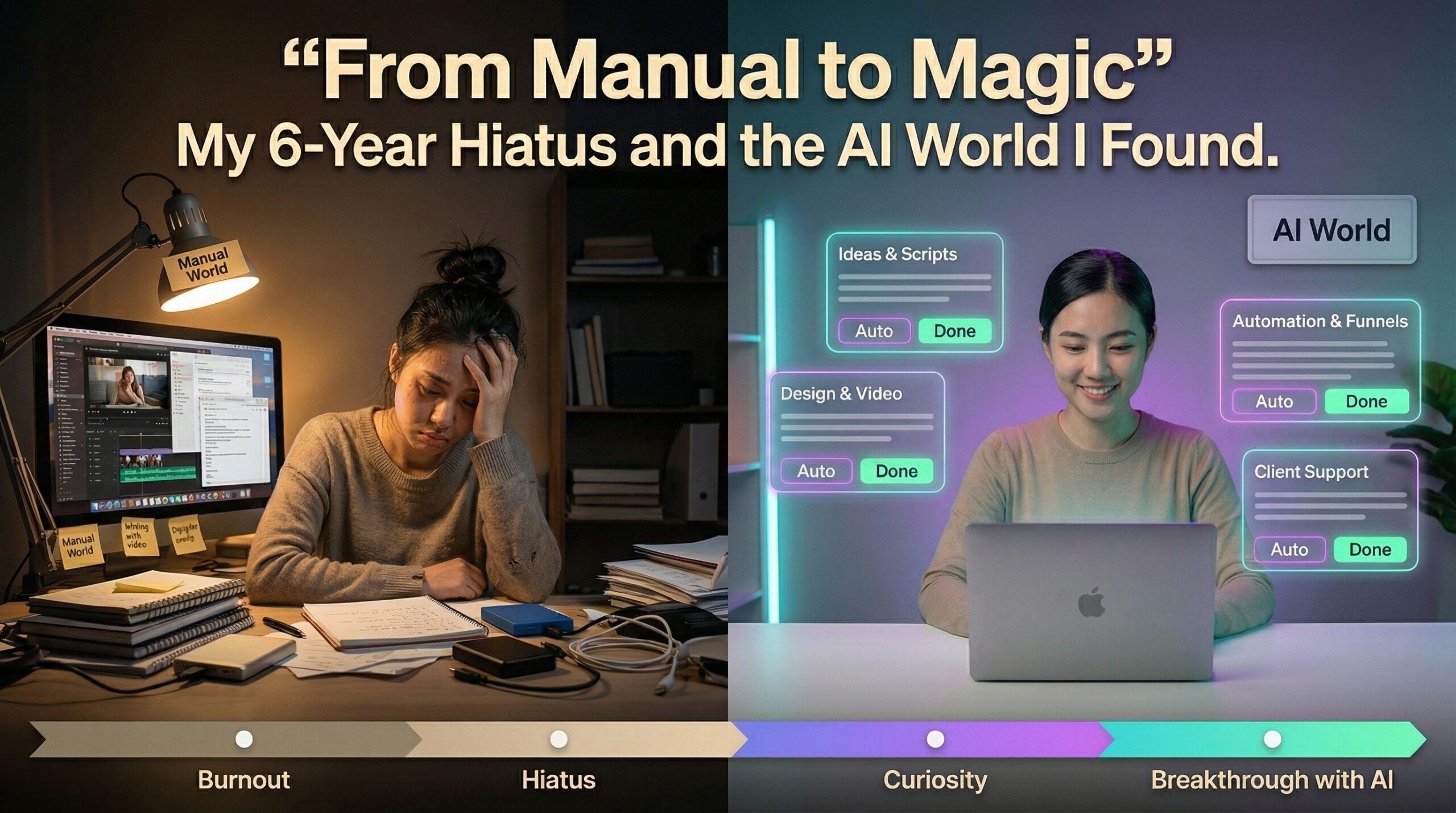
// The Honest Account
Six years ago I was writing blog posts manually, scheduling social media one post at a time, and hoping Google would find me. What I found when I came back is a world where one 90-minute production session replaces what used to take a team a month. This is what I actually discovered — not the hype, the reality.
// Personal Timeline 2018–2026
2018 - Left digital marketing. Manual everything. Content calendar on a whiteboard.
2019–23 - Six years offline. Family. A small offline business. Paper receipts.
2024 - First week back. Opened a browser. Nothing looked the same. Everything had changed.
2026 - Fully deployed. One 90-min session per week. Brand discoverable across every AI surface.
// Time to full deployment = 90 days
// 01 · The Return
What Did I Actually Find When I Came Back After Six Years Away?
I stepped away from digital marketing in early 2018. Not dramatically — there was no burnout, no grand exit. A family situation changed, an opportunity in offline business presented itself, and I took it. The plan was eighteen months. It became six years.
When I came back in late 2024, I expected to catch up on some tool updates. New social platforms, perhaps. Maybe a different SEO framework. I did not expect to find that the entire operating model had been restructured at the infrastructure level — that the tools I'd be learning were not improvements on the ones I'd used, but replacements for an entirely different approach to how expert knowledge becomes commercial visibility.
My first week back, I opened a browser and searched for "content marketing for a service business." The results were different in a way that was immediately disorienting — not in the pages that appeared, but in how Google presented them.
There was an AI-generated summary at the top. It cited specific sources. It answered the question without requiring me to click anything. I remember the exact feeling: not frustration, but a very specific cognitive recalibration, like arriving at a city you lived in for years and finding the street layout had changed while the buildings remained.
That week, I started mapping what had actually changed versus what was surface-level different. The surface differences — new tools, new platforms, new terminology — were manageable. The structural changes were something else entirely.
// The Five Structural Changes I Found on Return — In Order of Impact
01 AI retrieval systems now mediate how buyers first encounter brands — and they only cite verified, schema-marked sources. My 2018 blog posts: anonymous to these systems. Invisible.
02 One recorded video now produces seven published assets in 90 minutes via AI extraction. The content production equation I'd known — one piece per day of writing — was obsolete.
03 Entity schema changes the citation eligibility of every piece of content retroactively. Two hours of installation work I'd never heard of in 2018 unlocked everything I'd published before.
04 Video Object schema on an owned host page converts a YouTube video into a permanent brand asset generating organic traffic for 18+ months. I'd been uploading to YouTube and losing the equity to their platform for years.
05 The operational cost of content production had dropped 95%. What required a content team, an SEO agency, and a social media manager in 2018 was being handled by £60/month of AI tools in 2024.
// 02 · The Before
What Did Marketing a Service Business Actually Look Like in 2018 — From Someone Who Lived It?
I want to be specific about what I mean by "manual everything," because the contrast is the point. In 2018, the standard approach for an SME founder trying to build content authority looked like this: write one blog post per week (two to three hours including research and editing), manually schedule two to three social posts per day across three platforms (thirty to forty minutes per day), maintain one email newsletter per fortnight (three hours including design and copywriting), and hope that Google's algorithms would reward consistency with rankings over a six to twelve month horizon.
That approach cost approximately twelve to fifteen hours per week of the founder's personal time, or £1,500 to £4,000 per month of agency budget — for output that had a commercial lifespan of thirty to ninety days per piece before the freshness signal decayed and the content became invisible.
// 2018 — Manual Everything
— One blog post per week — 2–3 hours writing, researching, editing
— Social posts scheduled manually — 30–40 min per day across platforms
— SEO agency retainer — £1,500–£3,000/month for keyword research and backlinks
— YouTube videos — uploaded and forgotten. Equity went to YouTube.
— Content lifespan: 30–90 days. Then invisible.
— AI search didn't exist. Google ranked pages. No entity schema required.
— 12–15 hrs/week founder time on content. Non-negotiable.
// 2026 — AI Infrastructure
✓ One recording session produces 7 assets in 90 minutes via AI extraction prompts
✓ 30-day calendar pre-loaded on production day. Publishes automatically.
✓ Entity schema + VideoObject host pages replace SEO retainer at £60/month total
✓ VideoObject schema host page — equity stays on owned domain. 18-month lifespan.
✓ Content lifespan: 18+ months per schema-marked asset. Compounding.
✓ AI search cites brands with entity verification. Schema is the entry requirement.
✓ 90 min/week founder time on content. The rest is automated.
What I'm describing is not an efficiency improvement. A 95% reduction in time cost, a 1,800% increase in asset lifespan, and the addition of entirely new discovery surfaces that didn't exist in 2018 — this is a structural change in what it costs to become visible and stay visible as a small business. The competitive advantage available to the founder who understands and deploys this infrastructure is qualitatively different from any competitive advantage I knew in 2018.
// 03 · The Discovery
What Were the Specific AI Tools and Infrastructure Changes That Changed Everything?
I am going to name specific things here, because the strategy content I consumed on return was frustratingly abstract. Everyone was talking about "leveraging AI" — almost no one was saying which specific tools, in which specific order, for which specific output.
// The AI Retrieval System Shift — The One I Hadn't Expected
The change I found most commercially significant was not in content production tools — it was in how discovery happens. In 2018, a buyer searching for "how to improve my B2B content strategy" got a list of ten blue links. In 2026, they get an AI-generated summary that cites three to five specific brands by name, with their claims attributed and their content quoted. The brands cited in that summary are not the ones with the most backlinks or the highest domain authority — they are the ones with entity-verified, schema-marked, direct-answer-formatted content that AI retrieval systems can confidently attribute to a verified source.
I had no entity schema. My six years of content was published to a domain with no Organisation schema, no Person schema, no sameAs verification. From the perspective of every AI retrieval system operating in 2026, my entire content library was anonymous — published by an unknown, unverifiable source that could not be safely cited in an AI-generated recommendation. Two hours of schema installation changed this retroactively for every piece of content on my domain.
68%
Of Google AI Overview citations go to entity-verified, schema-marked pages. My pre-schema content: invisible to all of it.
18mo
Average organic traffic lifespan of a VideoObject schema host page versus 30–90 days for standard blog posts
14×
Revenue per employee at AI-first SMEs versus traditional SMEs. The leverage ratio I was leaving on the table.
// The Content Production Shift — What I'd Been Doing the Hard Way
I had been writing approximately one piece of quality content per week when I left in 2018. Good writing, well-researched, published consistently. I was proud of the discipline. What I found on return was that a founder with equivalent expertise was now producing seven distinct published assets from one 90-minute production session — a transcript article, five social posts across platforms, an email sequence, and a newsletter brief — using AI extraction prompts applied to a single recorded video transcript.
The quality difference between my hand-written 2018 output and the AI-extracted 2026 output was not in the ideas — both came from genuine expert knowledge. The difference was in the velocity of amplification, the consistency of distribution, and the cumulative compounding effect of a system that produces seven assets per session versus one asset per three hours of manual effort.
// The Specific Moment It Clicked
I ran my first AI extraction session in January 2025. I recorded a 12-minute video on a question clients consistently asked me. I ran the five-prompt extraction sequence I'd learned that week. In 90 minutes, I had a 2,800-word article with a direct answer block and FAQPage schema, three LinkedIn posts, a Twitter/X thread, a three-part email nurture sequence, and a newsletter brief. That same content, produced manually in 2018, would have taken me a full working week across multiple writing sessions and separate distribution tasks. The week's output was now 90 minutes. I sat with that for a while.
// 04 · The Rebuild
How Did I Actually Rebuild From Zero in a World I Didn't Recognise?
Here is what the first ninety days looked like — specifically and practically, not as a framework but as the actual sequence of what I did, what order I did it in, and what I'd do differently.
Week one, I installed entity schema. Not because I fully understood the long-term significance at the time — I understood it enough to know it was the foundational step that everything else depended on. Organisation schema on the homepage, Person schema on the About page, sameAs arrays pointing to my LinkedIn, YouTube channel, and Twitter profile. Two hours. Validated in Schema.org Validator. Submitted to Google Search Console. The investment that retroactively changed the citation status of everything I'd previously published. I didn't see the results for six weeks — the Knowledge Graph confirmation process is thirty to forty-five days. But the clock was running.
Weeks two through four, I recorded my first Authority Explainer video and built the VideoObject schema host page. This step — the specific action of hosting the video on my own domain rather than simply uploading to YouTube — was the one I most wish I'd understood in 2018. Six years of YouTube videos, all building YouTube's authority rather than mine. The VideoObject host page takes twenty-five minutes to build. It attributes the ranking equity to your domain. It generates organic traffic for eighteen months per video rather than the forty-eight hours a social share produces. I felt the specific frustration of retroactive clarity — the recognition of a better path that was not available then but is available now.
By day sixty, three things had happened that I had not fully predicted from a rational analysis of the strategy. My first AI Overview citation appeared — a FAQ video host page appearing in a Google AI-generated response to a query I had not specifically targeted. A buyer from a country I had no audience in emailed asking about working together, having found me through a Perplexity search. And the weekly 90-minute production session had become genuinely automatic — not easy, but habitual, like exercise after the first month's resistance passes.
By day ninety, the infrastructure was running. Not producing dramatic revenue — that takes longer, and anyone who tells you otherwise is selling something. But running: generating organic impressions daily, accumulating authority assets that compound with each addition, and requiring no active maintenance beyond the weekly production session that had by then become the most commercially productive ninety minutes of my week.
What I found on return was not a harder game. It was a different game — one where the builder of infrastructure wins over the producer of activity, and where the compounding happens in the background while you sleep.
// The reframe that changed how I thought about the six years I'd been away — and the eighteen months ahead
// 05 · The Honest Advice
What Would I Tell Someone Returning to Digital Marketing After Years Away — or Starting From Zero Today?
The most useful thing I can offer is the sequenced advice I wish I'd had on day one of my return — not the strategic overview, but the specific actions in the specific order that produce the highest return on the first ninety days of time investment.
First: install entity schema before producing a single new piece of content. Every piece of content you publish before entity schema is installed is published by an anonymous source that AI retrieval systems cannot safely cite. Entity schema takes two hours. Its commercial benefit is retroactive. Starting it before anything else means the first piece of new content you publish is already entity-attributed from day one — and it means everything you have already published becomes citation-eligible from the installation date, not from some future date after you have built content on top of it.
Second: build a VideoObject schema host page for every video you record — not a YouTube upload. This was the single most expensive error of my 2018–2024 period. I uploaded dozens of videos to YouTube. They generated views, some subscribers, some peripheral awareness. None of them generated organic traffic to my domain, AI citations attributed to my brand, or lasting authority equity on my owned web properties. A VideoObject host page takes twenty-five minutes to build. It changes where the ranking equity goes. Build it for every video from the first recording session onwards.
Third: the content production system takes one week to build and then runs for years. Five AI extraction prompts, one recording session per week, one 90-minute production session per week. The prompts are permanent. The session is habitual within four weeks. The assets compound indefinitely. The initial system build — writing and testing each prompt against a real transcript — takes one week of evenings or one focused day. It is the highest-leverage single investment in the entire rebuild.
// The Honest Assessment — 18 Months After Return
The AI infrastructure world I found on return is not magic in the sense of easy or guaranteed. It is magic in the sense of asymmetric — where a small, correctly deployed time investment produces a compounding return that grows independently of continued active effort. The founders who understand this and build it correctly in 2026 are building a brand visibility advantage that their competitors, who are still doing it the 2018 way, will not be able to close in 2027, 2028, or 2029 — because the compound is already running.
Frequently Asked Questions
Is it too late to start building AI-powered brand infrastructure in 2026?
It is not too late in 2026 — but the window of asymmetric advantage is narrowing as adoption increases. The founders who started entity schema and VideoObject infrastructure in 2024 and 2025 have a compounding head start that grows every week they continue producing schema-marked content. The founders who start in 2026 begin against competitors with 12–24 months of compounding authority — which means their initial assets need to be higher quality and their cluster build needs to be concentrated and systematic to close the gap within 12 months. The specific opportunity that remains wide open in 2026 is topical authority clusters: most SMEs, even those who have begun AI-assisted content production, have not built the systematic cluster depth that qualifies for AI Overview category authority. A founder who builds a complete twelve-article cluster with VideoObject schema host pages on a specific topic in concentrated 90-day windows can achieve AI Overview citation authority for that cluster regardless of when competitors started — because the cluster density signal is measured relative to the content on the specific topic, not relative to the domain's total age or authority.
What changed most significantly in digital marketing between 2018 and 2026?
The three most significant structural changes in digital marketing between 2018 and 2026 are: first, the emergence of AI retrieval systems as primary discovery surfaces — Google AI Overviews, Perplexity, and ChatGPT Search now mediate a growing proportion of buyer discovery, and they only cite entity-verified, schema-marked content, making the technical infrastructure layer a prerequisite for visibility rather than an enhancement; second, the collapse of content production cost and time — AI extraction systems convert one recorded video into seven published assets in 90 minutes, reducing the founder time cost of consistent content authority from 12–15 hours per week to 90 minutes per week at equivalent or higher output volume; third, the VideoObject schema host page model — the specific infrastructure that converts video content from platform-dependent YouTube assets into owned-domain ranking assets with 18-month organic traffic lifespans, fundamentally changing the economic equation of video content investment. All three changes together produce a world where a solo founder with £60 per month in AI tools can outperform a 2018-era content team of three people on every measurable discovery metric, given the correct infrastructure deployment.
What should someone coming back to digital marketing after years away do first?
Someone returning to digital marketing after years away should do three things in strict order before producing any new content. First, install entity schema — Organisation schema on the homepage and Person schema on the About page, both with sameAs arrays pointing to four or more actively maintained professional profiles. This two-hour installation retroactively changes the AI citation eligibility of every piece of content already on the domain, meaning everything published before the return immediately becomes AI-citable from the installation date. Second, build the five-prompt AI content extraction library — the standard prompt templates for transcript-to-article, LinkedIn post, Twitter/X thread, email nurture sequence, and newsletter brief that convert each recording session into seven assets. Building and testing these prompts takes one week and then functions permanently. Third, record the first Authority Explainer video and publish its VideoObject schema host page on the owned domain rather than uploading only to YouTube. This single action establishes the first compounding brand asset — an 18-month-lifespan organic traffic and AI citation source — and begins the topical authority cluster that qualifies for AI Overview category citation within 90 days.
How long did it take to rebuild brand visibility after a 6-year absence?
The first AI Overview citation appeared at day 60 from entity schema installation — 30 days after the Knowledge Graph entity confirmation processed and 45 days after the first VideoObject schema host page was published. Measurable organic inbound from new sources appeared at day 90. The specific timeline reflects the standard sequence: entity schema installation in week one, first VideoObject host page published in week two, Knowledge Graph confirmation processing over 30–45 days, first AI citation appearances beginning 2–3 weeks after confirmation. The rebuild took 90 days to generate first measurable evidence of the infrastructure working — and then began compounding from that point, with each new video host page and FAQ article adding to the citation surface and organic discovery probability. By month six, the authority library had accumulated sufficient assets to generate consistent weekly organic discovery calls from buyers who had found the brand through AI Overviews or Perplexity without any active outbound effort. The 6-year absence did not significantly disadvantage the rebuild — the entity schema installation retroactively attributed the existing content library, and the new assets built on top of a domain with existing topical history compound faster than they would on a brand new domain.
What is the most important single insight from returning to digital marketing in the AI era?
The most important single insight from returning to digital marketing in the AI era is the distinction between content as activity and content as infrastructure. In 2018, the dominant approach was content as activity — producing pieces of content on a schedule, distributing them through available channels, and measuring success by engagement metrics and incremental ranking improvements. In 2026, the most commercially valuable approach is content as infrastructure — producing assets that are entity-attributed, schema-marked, and direct-answer-formatted, placed on owned domains with VideoObject schema host pages, structured to generate AI citations and organic search traffic for 18 months or more per asset without any additional effort. The infrastructure approach requires a higher upfront investment in technical setup (entity schema, VideoObject schema, FAQPage schema) but produces a fundamentally different return profile: compounding rather than linear, permanent rather than ephemeral, and passive rather than requiring continuous active distribution effort. Every hour invested in content infrastructure produces a return that grows with time. Every hour invested in content activity produces a return that decays within 48 hours to 90 days. The 2026 digital marketing opportunity is almost entirely in the infrastructure category — and it is available to any founder willing to invest 90 days in building it correctly.
→ The Return Summary
Six Years Away Made One Thing Clearer Than Staying Would Have
People who stayed in digital marketing through 2018 to 2024 adapted gradually. Each new tool arrived incrementally. The shift from manual to AI-assisted happened in small steps that each felt manageable. The cumulative effect — the structural change in what the game now is — was easier to miss when you were inside it, adapting week by week.
Coming back after six years, I saw the full distance in one view. What used to require a team and a significant budget now requires one recording session and £60 of AI tools. What used to generate 90 days of traffic lifespan now generates 18 months. What used to be invisible to discovery systems now appears in AI-generated summaries that reach buyers at the exact moment of research. The gap between the 2018 approach and the 2026 approach is not a technology upgrade — it is a structural change in the economics of brand visibility.
The founders building this infrastructure now — entity schema, VideoObject host pages, topical authority clusters — are building something that compounds indefinitely and costs their competitors more to replicate every month they delay. Six years away made me see that window clearly. I hope this account helps you see it too, without needing the six-year hiatus to gain the perspective.