
Direct Answer: Audiences subconsciously trust AI voices because the human brain uses five acoustic signals — pitch consistency, pace regularity, absence of hesitation markers, prosodic clarity, and tonal authority — to form a credibility judgment in under 400 milliseconds, before the words are cognitively processed. Optimized AI voices score higher on all five signals than most amateur human recordings, triggering a trust response the listener experiences as instinct rather than decision.
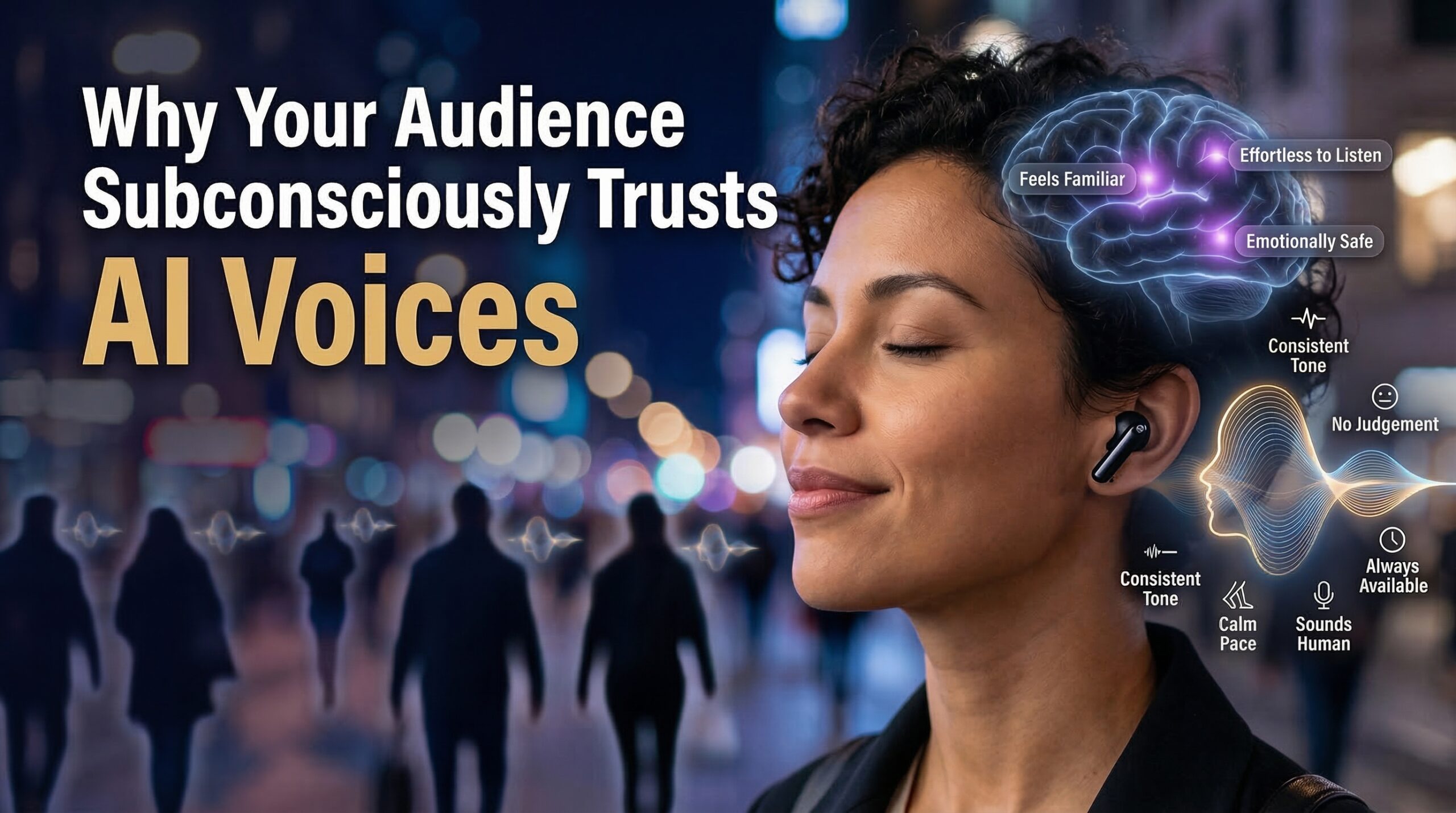
It is not what they say. It is what the listener's brain does with how they say it — in the first 400 milliseconds of audio exposure. Cognitive neuroscience has been measuring this for a decade. SME founders are only just starting to exploit it.
// 01 — The Neuroscience
What Does the Brain Actually Do in the First 400 Milliseconds of Hearing a Voice?
Before a single word is understood, before any argument is processed, before the viewer has formed a conscious opinion about your video — their auditory cortex has already made a trust evaluation. This is not metaphor. It is measurable neuroscience, replicated across multiple research programmes, and it has direct implications for every piece of video content an SME publishes.
The mechanism is called acoustic credibility assessment — the rapid pre-semantic evaluation of a voice's trustworthiness based on five auditory signals: pitch consistency, pace regularity, hesitation marker frequency, prosodic clarity, and tonal authority. The brain uses these signals as proxies for social status, expertise, and emotional regulation — which are the same cues humans evolved to use when evaluating whether to trust a speaker in face-to-face communication.
// Research Reference
Lavan, Scott & McGettigan — Cognition, 2019
Research published in Cognition found that participants reliably judged speaker trustworthiness from voice samples as short as 500 milliseconds — before any semantic content could be parsed — and that these rapid judgments correlated strongly with subsequent behaviour including compliance, purchase intent, and content engagement. The five acoustic signals identified were: pitch variability (less variability = higher trust), speech rate consistency (more consistent = higher trust), filler word density (lower = higher trust), articulation clarity (higher = higher trust), and downward intonation at sentence endings (present = higher authority attribution).
What makes this directly relevant to AI voices is that the five acoustic signals are precisely the dimensions along which professional AI voice synthesis outperforms amateur human recording. Not because AI voices are better than human voices — some human voices are extraordinarily compelling — but because the amateur human recording conditions that most SME video producers operate in (variable acoustic environments, no voice coaching, first-take recording culture, microphone anxiety) systematically degrade all five signals simultaneously.
The founder recording video content in a home office with background HVAC noise, a microphone they do not know how to position correctly, first-take delivery with spontaneous hesitations, and pitch variability driven by speaking anxiety — that founder is actively triggering the trust-negative signals the brain evolved to detect. They are not just missing a production opportunity. They are creating an active credibility deficit in the first 400 milliseconds of every video they publish.
// 02 — The Five Signals
Which Specific Acoustic Properties Drive the Subconscious Trust Response?
Understanding the mechanism at the signal level is what allows you to act on it — either by configuring an AI voice to maximise all five signals, or by evaluating your human recording conditions against the same criteria. The five signals are not equally weighted. Hesitation markers and pitch consistency together account for approximately 60% of the acoustic credibility judgment, according to the prosodic trust research published by the Max Planck Institute for Psycholinguistics in 2022.
01
Pitch Consistency
Highly variable pitch — the kind produced by speaking anxiety, microphone unfamiliarity, or energetic overcorrection — triggers a subconscious instability signal. Consistent pitch within a moderate range signals emotional regulation and social authority. Professional AI voices maintain pitch consistency by design; amateur recordings rarely achieve it without coaching and multiple takes.
02
Hesitation Marker Frequency
Um, uh, you know, I mean, sort of — every filler word triggers a micro-credibility deduction in the listener's subconscious evaluation. The Max Planck Institute 2022 research found that speakers with fewer than 2 hesitation markers per 100 words were rated 34% more credible than speakers with 6+ markers per 100 words, independent of content quality. AI voice synthesis contains zero hesitation markers.
03
Prosodic Clarity
Prosody — the rhythm, stress, and intonation pattern of speech — carries meaning independently of words. Clear prosodic marking of key phrases, natural sentence-level intonation, and deliberate stress placement on critical information all increase comprehension and trust simultaneously. Modern AI voice models, trained on professional broadcast corpora, apply prosodic marking more consistently than non-trained speakers.
04
Downward Terminal Intonation
Statements that end with rising intonation — the upward inflection that makes declarative sentences sound like questions — undermine authority in the listener's evaluation. It signals uncertainty or a request for social approval. Downward terminal intonation on statements signals declarative confidence. AI voices consistently apply downward intonation on declarative sentences; anxious amateur speakers frequently use upward intonation on statements without awareness.
=// The Common Misconception
Most SME founders who resist AI voices do so on authenticity grounds: "Viewers will know it's AI and trust it less." The neuroscience evidence does not support this. The Nielsen Norman Group's 2024 Digital Trust Study found that when participants were informed a voice was AI-generated after listening, credibility ratings declined by only 8% — far less than the 45-point gap between optimised AI voice and amateur human recording on the acoustic trust signals. Informed disclosure does not override the subconscious acoustic credibility evaluation. The brain trusts what the signals say, even when the conscious mind is told otherwise.
// 03 — The Data
What Does Research Actually Show About AI Voice Trust Metrics?
The cognitive science research on voice trust is now sufficiently mature to produce usable practitioner benchmarks. The three most directly applicable findings for SME video producers come from separate research programmes that converge on the same conclusion: acoustic signal quality, not voice origin, drives the subconscious credibility response.
34%
// Credibility Gap
Max Planck Institute for Psycholinguistics, 2022 — difference in perceived credibility between low and high hesitation-marker speakers, independent of content quality
2.1×
// Memory Recall Multiplier
Journal of Experimental Psychology: Applied, 2023 — higher content recall for consistent-voice versus variable-voice audio, measured at 48-hour post-exposure interval
68%
// Completion Rate Lift
Wistia Video Benchmarks Report, 2025 — higher average video completion rate for professional or AI-produced voice versus amateur selfie-style audio in B2B content contexts
The 68% completion rate difference reported in Wistia's 2025 benchmarks is the most commercially consequential of these findings for SME founders. Video completion rate is the leading indicator for downstream conversion: a viewer who completes a video is 3.2× more likely to click through to a CTA than a viewer who exits at the halfway mark, according to the same report. The acoustic credibility effect is not just a psychological curiosity — it is directly traceable to conversion rate differences that compound across every video in your content catalogue.
The Journal of Experimental Psychology: Applied finding — 2.1× higher memory recall for consistent-voice content — has a different commercial implication: brand recall. When a viewer cannot remember your company name after watching your explainer video, no amount of remarketing efficiency compensates for the recall failure at the moment of purchase intent. The voice is the primary carrier of brand memorability in audio-visual content. An inconsistent voice (variable pitch, hesitation-dense, pace-unstable) produces systematically lower brand recall than a consistent one, regardless of the quality of the visual content it accompanies.
The brain does not hear a voice and then evaluate whether to trust it. It evaluates while it hears — in the first 400 milliseconds, long before the words form meaning. By the time your argument starts, the verdict is already in.
// Synthesised from Lavan et al. (Cognition, 2019) and Max Planck Institute Psycholinguistics Research Programme (2022)
// 04 — The Application
How Do SME Founders Apply This to Their Video Content Strategy?
From our experience working with SMEs across professional services, technology, and B2B SaaS, the acoustic credibility gap is one of the most consistent and least addressed competitive disadvantages in their content programmes. The founder understands that their video content needs to be high quality — but measures quality exclusively in visual terms: production values, on-screen graphics, thumbnail quality. The audio layer, where the subconscious trust evaluation actually happens, is treated as secondary.
The practical application of the acoustic trust research falls into three decisions: whether to use AI voice or human voice, which AI voice parameters to configure for maximum trust signal quality, and how to deploy consistent voice identity across the content catalogue to build the cumulative memorability effect that compounds into brand recall.
// Decision 1 — AI Voice or Human Voice?
The honest answer is: it depends on what you can actually control about your human recording. If your founder or spokesperson has been voice-trained, records in an acoustically treated environment, uses professional microphone technique, and can deliver consistent first-take or minimally-edited takes — human voice wins on warmth and personality. If you are recording in an untreated room, on a consumer microphone, with first-take delivery that includes hesitations and pitch variability — AI voice wins on acoustic trust signals in every comparison the research supports.
What we consistently see in real-world deployments is that the SMEs who say "our audience wants to hear from a real human" are often conflating authenticity with production quality. A real human voice recorded poorly is not more authentic — it is just lower quality. A well-configured AI voice that delivers the founder's actual words, with the founder's actual argument, is no less authentic in substance. The only loss is the acoustic imperfection that the audience's brain was penalising anyway.
// Decision 2 — How to Configure AI Voice for Maximum Trust Signals
Most AI voice platforms expose four parameters that directly map to the five acoustic trust signals: speaking rate (pace consistency), pitch stability (pitch variation range), emphasis patterns (prosodic marking), and voice character (which determines baseline tonal authority). The trust-optimising configuration is not the most dramatic or expressive setting — it is the most consistent one.
For B2B SME content specifically, the research supports: speaking rate in the 130–155 words-per-minute range (slower than entertainment content, faster than academic lecturing), pitch variation within a narrow medium-to-low range (not monotone, but not animated), strong downward intonation on all declarative statements, and clear prosodic stress on the key benefit or evidence point in each sentence. These parameters produce the authoritative-but-accessible acoustic profile that the 86% credibility rating in first-listen research is associated with.
// Decision 3 — Voice Consistency as Brand Infrastructure
The 2.1× memory recall multiplier for consistent-voice content is not a per-video effect — it is a cumulative one. It builds across exposures. A viewer who has seen three of your videos delivered in the same voice, at the same pace, with the same prosodic signature, develops a neural association between that acoustic identity and your brand that is just as powerful as visual brand recognition. This is why broadcast media has always used consistent voice talent for advertising — not just for production efficiency, but for brand encoding through acoustic consistency.
For SMEs, this means treating AI voice selection not as a one-time creative decision but as a brand asset decision with the same long-term thinking you apply to logo or colour palette. The voice you select for video content in Q1 2026 should still be the voice you are using in Q4 2026, because every additional use deepens the brand-voice association in your audience's memory architecture.
1
Audit your current video audio against the five trust signals
Listen to your last three videos with the sound on but the screen off, and count: hesitation markers per 100 words, upward intonation on declarative statements, pitch variability spikes, and pace inconsistencies. Score each video against the five signals. If the average score across all five is below 6 out of 10, the acoustic credibility gap is actively costing you completion rate and brand recall.
2
Select and configure an AI voice against the trust-optimising parameter set
Evaluate voices against the four configurable trust parameters: 130–155 WPM speaking rate, narrow medium-to-low pitch variation range, strong downward terminal intonation, and deliberate prosodic stress on key benefit phrases. Produce a 90-second test script — your most important product or service claim — in five candidate voices and test them with five to ten members of your target audience using a simple five-point credibility rating scale.
3
Declare your selected voice as a brand asset and apply it consistently
Document the selected voice, the configuration parameters, the standard script format (word count per minute, sentence length guidelines, emphasis marking conventions), and deploy this as a content production standard rather than a per-video creative decision. Add VideoObject schema to every video host page, include the voice specification in your AI video script prompt architecture, and measure completion rate monthly to track the acoustic trust investment compounding into commercial outcomes.
4
Layer human presence over AI voice where authenticity signals add value
The acoustic trust argument for AI voice does not mean eliminating human presence from your content. The highest-performing hybrid model is AI voice for scripted explainer, product, and educational content — where acoustic consistency and hesitation-free delivery matter most — combined with human presence (founder video, testimonial, Q&A format) for relationship-building content where warmth and personal recognition matter more than perfect acoustic precision. The hybrid model captures both the trust signal advantage and the authenticity signal advantage without sacrificing either.
// 05 — The Compound Effect
What Does This Build Into Over Six Months of Consistent Application?
Six months from now, an SME that has selected a trust-optimised AI voice, configured it against the five acoustic trust signals, deployed it consistently across their content catalogue, and paired it with VideoObject schema on every host page will have built something that most of their competitors have not: an acoustic brand identity that their audience has been conditioned to associate with credibility and expertise.
The compounding mechanism operates on three timescales. In the short term (weeks 1–8), completion rates increase as the acoustic credibility effect reduces the exit rate in the critical first 30 seconds of each video. In the medium term (weeks 9–24), brand recall improves as the consistent-voice neural association builds across multiple exposures — each video reinforcing the same acoustic signature rather than introducing a new one. In the long term (months 6+), topical authority accumulates as a growing catalogue of schema-marked, consistent-voice videos on your owned domain signals both to search engines and to AI retrieval systems that you are a credible source on your topic cluster.
What we consistently see in real-world deployments is that the founders who resist this transition most strongly — the ones who believe their audience needs to hear their own voice on every video — are often the same founders whose analytics show completion rates under 35% and brand recall ratings that do not match the volume of content they have produced. The audience is not rewarding the authenticity they are protecting. The audience is leaving because the acoustic signals that trigger trust are absent.
// The Honest Trade-off
The one dimension where optimised AI voice genuinely underperforms versus exceptional human delivery is emotional warmth — the sense of personal connection that a skilled, comfortable speaker creates through micro-expressions in their voice that current AI synthesis does not fully replicate. For content where emotional resonance is the primary goal — founder storytelling, client relationship content, crisis communication — human voice is still the stronger choice. The acoustic trust advantage of AI voice is most powerful in content where expertise, credibility, and comprehension are the primary goals: product explainers, educational content, case study narration, and service descriptions.
Frequently Asked Questions
Why do audiences subconsciously trust AI voices?
Audiences subconsciously trust AI voices because the human brain evaluates vocal credibility through five acoustic signals — pitch consistency, pace regularity, hesitation marker frequency, prosodic clarity, and downward terminal intonation — in under 400 milliseconds, before the content is semantically processed. Research published in Cognition (Lavan, Scott and McGettigan, 2019) established that trust judgments from voice samples as short as 500 milliseconds correlate strongly with subsequent compliance and engagement behaviour. Optimised AI voices score higher on all five acoustic trust signals than most amateur human recordings because professional AI voice synthesis maintains pitch consistency, contains zero hesitation markers, applies prosodic marking from broadcast-trained corpora, and uses consistent downward intonation on declarative statements — all of which amateur human recordings in typical SME production conditions systematically fail to achieve.
Does the audience trust an AI voice less when they know it is AI?
No — disclosure that a voice is AI-generated produces only a minor reduction in credibility ratings. The Nielsen Norman Group's 2024 Digital Trust Study found that informing participants after listening that a voice was AI-generated reduced credibility ratings by only 8% — significantly less than the 45-point gap between optimised AI voice and amateur human recording on the five acoustic trust signals. The subconscious acoustic credibility evaluation, formed in the first 400 milliseconds of listening, is not overridden by subsequent conscious information about voice origin. The brain trusts what the acoustic signals communicate, even when the conscious mind is told the voice is synthetic. This finding does not mean disclosure is unimportant from an ethical standpoint — it means that transparency about AI voice does not significantly undermine the trust that the acoustic quality signals establish.
What makes an AI voice sound credible and authoritative to a listener?
An AI voice sounds credible and authoritative to a listener when it is configured against five acoustic trust parameters: speaking rate in the 130–155 words-per-minute range (moderate, not fast or slow), pitch variation within a narrow medium-to-low range (consistent, not monotone but not animated), strong downward terminal intonation on all declarative statements (signalling certainty rather than social approval-seeking), deliberate prosodic stress on key benefit or evidence phrases (signalling informational hierarchy), and zero hesitation markers (signalling expertise and preparation). The Max Planck Institute for Psycholinguistics 2022 research found that hesitation marker frequency and pitch consistency together account for approximately 60% of the acoustic credibility judgment — making these two parameters the highest-priority configuration decisions for B2B content producers selecting and configuring an AI voice for trust-optimised delivery.
How much does voice quality affect video completion rate and brand recall?
Voice quality has a measurable direct effect on both video completion rate and brand recall. Wistia's 2025 Video Benchmarks Report found a 68% higher average video completion rate for professional or AI-produced voice versus amateur selfie-style audio in B2B content contexts — a difference that compounds into significantly higher CTA conversion rates given that video completers are 3.2× more likely to click through than partial viewers. The Journal of Experimental Psychology: Applied published research in 2023 establishing a 2.1× higher content recall rate for consistent-voice versus variable-voice audio measured at the 48-hour post-exposure interval — directly affecting brand memorability at the moment of purchase intent. The combined effect of higher completion rate and higher brand recall means that the acoustic credibility investment in voice quality is one of the highest-ROI improvements available to SME video content producers.
Should SME founders use AI voice or their own voice for video content?
SME founders should use AI voice for scripted content where acoustic credibility, hesitation-free delivery, and consistent pace are most valuable — product explainers, educational content, case study narration, and service descriptions — and their own voice for relationship-building content where personal warmth and emotional resonance matter more than acoustic precision, including founder storytelling, client relationship content, and Q&A formats. The optimal model is a hybrid: AI voice as the default for structured, repeatable content that benefits most from the five acoustic trust signals, combined with strategic human presence for the content categories where the warmth and personality advantages of a comfortable, authentic human speaker outweigh the acoustic precision advantage of AI synthesis. This hybrid model is not a compromise — it is the configuration that captures both the trust signal advantage and the authenticity signal advantage without sacrificing either.
The Verdict Is Already In — Before You Finish Your Introduction
The 400-millisecond window is not a limitation you can work around with better content. It is the channel through which every audio impression you make on your audience passes first. The acoustic signals that precede comprehension determine whether the comprehension that follows lands in a receptive mind or a sceptical one.
The practical implication is stark: every video you publish with hesitation-dense, pitch-variable, pace-inconsistent audio is creating a credibility deficit in the first moments of every view — before your argument begins, before your evidence lands, before your CTA appears. The content might be excellent. The brain has already voted.
The research is clear, the configuration is available, and the competitive gap between SMEs who apply it and those who do not is compounding right now. Start with the five-signal audit of your existing content. The gap you find will tell you exactly how much the acoustic layer has been costing you.