
Direct Answer: In 2026, authority beats keywords because Google's ranking systems and AI retrieval engines both use topical authority, entity verification, and demonstrated expertise to determine citation eligibility — signals that keyword optimisation cannot produce. Pages that establish entity-verified, schema-marked, cluster-supported topical authority are 4.3× more likely to appear in AI Overviews than keyword-optimised pages without entity infrastructure — regardless of backlink volume or keyword density.
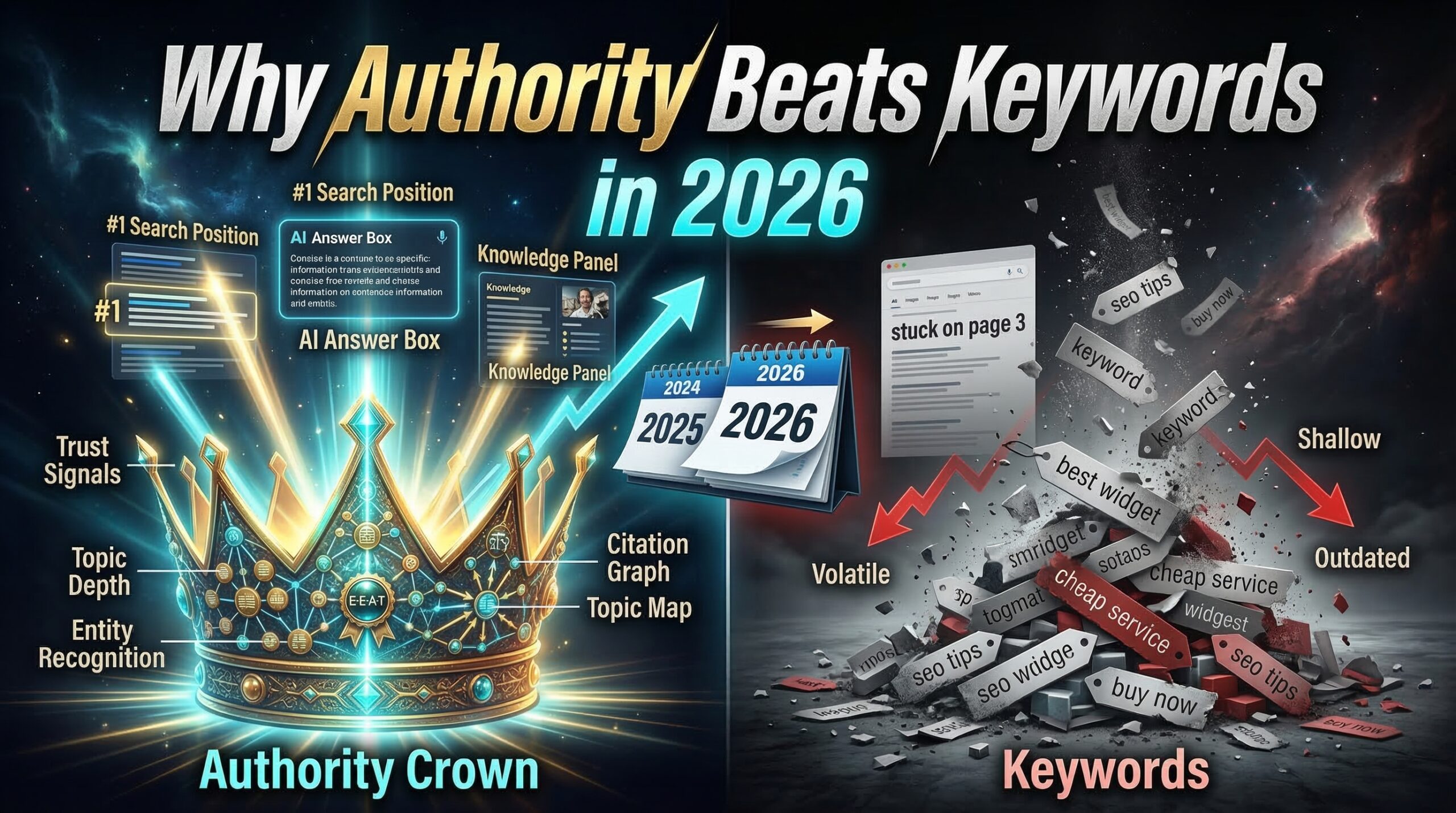
The era of keyword optimisation as the primary ranking lever is over. In 2026, both Google's ranking systems and every major AI retrieval engine prioritise topical authority, entity verification, and trust signals — which cannot be manufactured with keyword density and cannot be bought with backlinks at the rates that worked in 2021.
// 01 — The Mechanism
Why Did Keyword Optimisation Stop Being the Primary Ranking Lever?
Keyword optimisation worked because search engines once used keyword frequency as the primary proxy for topic relevance. If a page mentioned "accounting software for small businesses" more often — in the title, in headers, in the body — it ranked higher for that phrase than a page that mentioned it less. The entire SEO industry that grew up between 2005 and 2018 was built on exploiting this proxy relationship.
The proxy broke in two stages. The first stage was semantic search. Google's BERT update in 2019 and the subsequent MUM architecture shift moved the ranking system away from keyword matching toward semantic understanding — evaluating the meaning of a query and matching it to the meaning of content, not the surface-level word overlap. Keyword stuffing stopped working because the engine was no longer counting words; it was evaluating concepts.
The second stage was the authority infrastructure shift accelerated by the Helpful Content system in 2022 and the explosion of AI-generated content in 2023. When AI tools made it trivially easy to produce keyword-dense content at industrial scale, Google responded by accelerating its shift toward signals that cannot be manufactured at scale: topical authority, demonstrated expertise, entity verification, and trust architecture. These signals require time, genuine knowledge, and structural investment — exactly the properties that distinguish human expertise from mass-produced AI content farms.
// The Irony of 2026
The same AI tools that destroyed the value of keyword-dense content at scale are now the primary reason authority signals matter more than ever. Google's defensive response to AI content farming was to weight the signals that AI cannot fake: entity verification, topical depth, and cross-platform trust architecture. SMEs who build genuine authority now are benefiting directly from the standards that AI content farms forced Google to raise.
// 02 — The Signal Map
What Specific Signals Define Authority in 2026 — and How Are They Measured?
Authority in 2026 is not a single signal — it is a cluster of correlated signals that together tell both Google and AI retrieval engines that a specific entity (a person, a business, a publication) has genuine expertise on a specific topic cluster. Understanding the signal cluster is what allows you to build it systematically rather than accidentally.
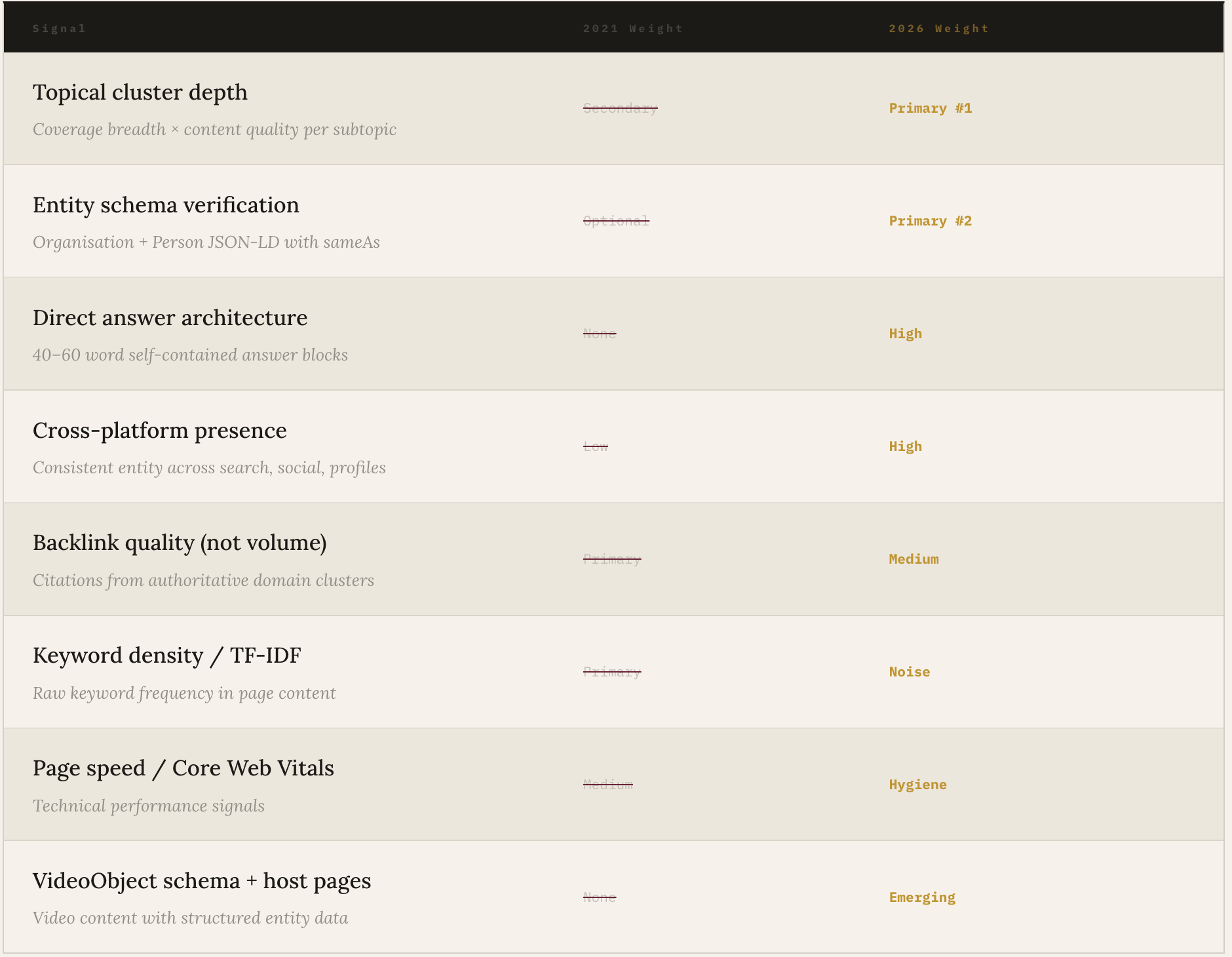
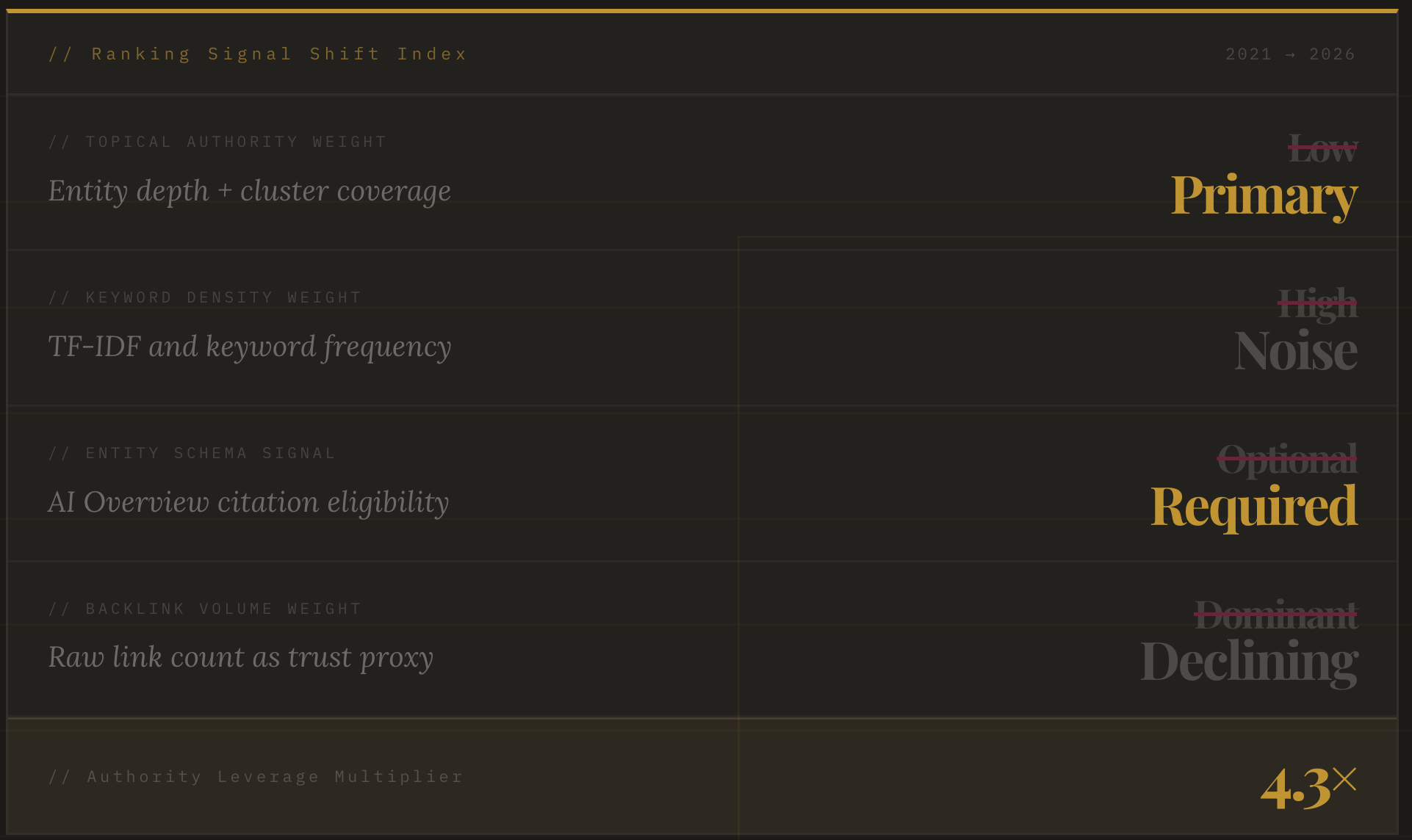
The most consequential shift in this table is the reclassification of keyword density from "Primary" to "Noise." This does not mean keywords are irrelevant — semantic coverage of your topic cluster's vocabulary is still essential. It means that the frequency with which you repeat specific keyword phrases is no longer a meaningful ranking lever, and optimising for it at the expense of genuine topical depth actively reduces the authority signals that now matter most.
// The Backlink Clarification
Backlinks have not become irrelevant — their character has changed. Raw link volume from low-authority domains carries almost no weight in the 2026 signal environment. What carries weight is citation from authority clusters: being mentioned by domain-relevant, entity-verified publications within your topic cluster. For most SMEs, three citations from genuinely authoritative sources in their industry are worth more than forty directory-style backlinks. The acquisition strategy is publishing content authoritative enough to deserve citation — not link-building at volume.
// 03 — The AI Retrieval Dimension
How Does Topical Authority Affect AI Overview Citations and Answer Engine Visibility?
The authority signal shift is not only a Google ranking story. It is simultaneously an AI retrieval story — and the two are now more closely aligned than at any previous point in the history of search. Perplexity, ChatGPT Search, Google AI Overviews, and Gemini all use authority signals as the primary filter for which sources they cite in AI-generated answers.
68%
of Google AI Overview citations go to entity-verified, schema-marked pages
// Semrush, 2025
Pages without entity schema — Organisation or Person nodes with populated sameAs arrays — are structurally ineligible for the majority of AI Overview citations regardless of content quality or keyword optimisation. The entity verification signal is not a ranking booster; it is a citation gate.
The mechanism behind this finding is not algorithmic preference for schema markup per se — it is that entity-verified pages are more parseable by AI retrieval systems. When an AI model's retrieval layer needs to determine whether a specific page is a credible source on a specific topic, it uses entity verification as a confirmation signal. A page with an Organisation schema node linked to a verified LinkedIn profile, YouTube channel, and Twitter/X account tells the retrieval system unambiguously who produced this content and whether they are a consistent entity with a verifiable track record on this topic cluster.
A keyword-optimised page without entity schema is, from the AI retrieval system's perspective, an anonymous assertion — content that could have been produced by anyone, verified by no external signal, with no confirmed relationship to a real entity with a real track record. The content might be excellent. The retrieval system has no reliable way to know, so it defaults to citing the entity-verified competitor instead.
From our experience working with SMEs across multiple content clusters, the single highest-leverage action available to a founder who wants AI Overview and answer engine citations is not publishing more content — it is installing entity schema on existing content and verifying the Organisation entity across four or more external platforms. This changes the retrieval eligibility of the entire existing content catalogue, not just new pages.
Keywords tell a search engine what your page is about. Authority tells it whether to trust you. In 2026, trust is the gating signal — and trust cannot be manufactured with density or volume.
// The central distinction between keyword strategy and authority strategy for SME search visibility in 2026
// 04 — The Authority Stack
What Does the Complete Authority-Building Infrastructure Look Like for an SME?
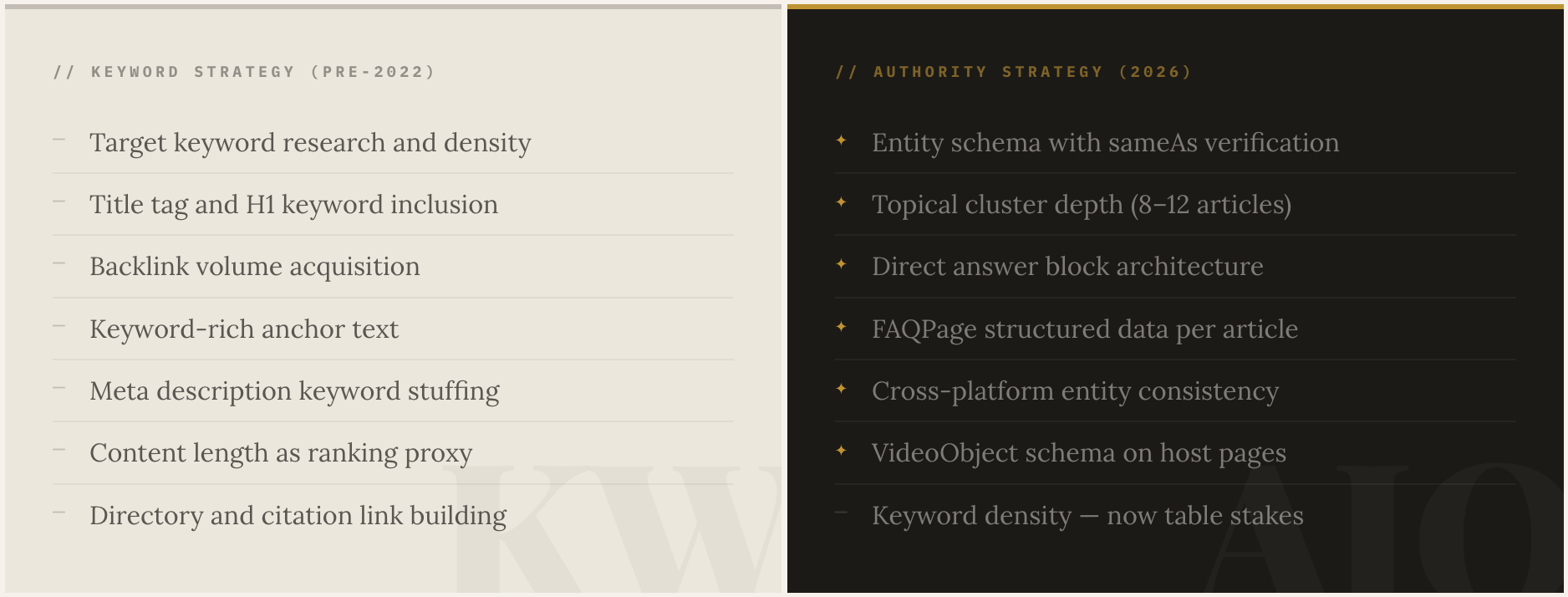
Authority is not a single tactic — it is a stack of reinforcing signals that together produce what both Google and AI retrieval systems recognise as genuine expertise on a specific topic cluster. The stack has four layers, and they must be built in order. Skipping the foundational layers to focus on the visible outputs produces content that looks authoritative but ranks like an anonymous assertion.
// Layer 1 — Entity Foundation
The first layer is entity verification: establishing your business as a known, confirmed entity in Google's Knowledge Graph and in the retrieval layers of major AI systems. This requires four actions executed in a specific order: publishing an Organisation schema node with a populated sameAs array pointing to your LinkedIn company page, YouTube channel, Twitter/X account, and one additional platform profile; verifying your Google Business Profile with consistent NAP (Name, Address, Phone) data matching the Organisation schema; publishing an About page with Person schema for the founder or primary author with equivalent sameAs verification; and ensuring all four external profiles are fully populated and actively maintained rather than abandoned shells.
The entity foundation does not rank your content directly. It makes your content citable — by establishing that a verified, real entity with a consistent cross-platform presence is the source of every piece of content on your domain.
// Layer 2 — Topical Cluster Architecture
The second layer is cluster architecture: structuring your content to systematically cover a topic cluster at sufficient depth that both Google and AI retrieval systems recognise your domain as a subject-matter authority rather than a general content publisher. A topic cluster consists of one pillar article — comprehensive, long-form, internally linkable — and eight to twelve supporting articles covering the specific subtopics, questions, and related entities that together constitute the cluster's full semantic scope.
What we consistently see in real-world deployments is that SMEs who publish individual articles on unrelated topics for years accumulate no topical authority, while SMEs who publish ten focused articles on a single cluster within 90 days begin receiving AI Overview citations and featured snippet appearances within 30–60 days of the cluster's completion. The authority signal is not per-article — it is per-cluster. Ten articles on ten different topics produce zero cluster authority. Ten articles on one topic produce cluster authority that compounds with each additional article added.
// Layer 3 — Direct Answer Infrastructure
The third layer is direct answer architecture within every piece of content: structuring each article to include a 40–60 word self-contained answer block immediately after the introduction, FAQPage structured data with five or more self-contained Q&A pairs, and H2 headings written as natural-language questions that match the semantic form of AI retrieval queries. This layer determines whether your authority-verified, cluster-supported content is extractable by AI systems — whether it can be cited in a 200-word AI Overview answer or a Perplexity summary without the surrounding context.
// Layer 4 — Video Entity Layer
The fourth and increasingly important layer is video entity infrastructure: publishing video content with VideoObject schema on owned host pages, with AI-generated descriptions that include the same entity vocabulary as your cluster's written content. Video content with VideoObject schema on entity-verified domains is 2.1× more likely to be cited in AI Overviews for visual-intent queries than equivalent video content hosted only on YouTube without owned domain attribution, according to Semrush's 2025 video citation research. The video layer extends your authority cluster into the visual search and video-intent query categories that written content alone cannot address.
// 05 — The Execution Framework
How Do You Build Topical Authority in 90 Days Without an Agency?
The 90-day authority build is the most reliable timeline for an SME to move from zero topical authority on a specific cluster to measurable AI Overview citations and featured snippet appearances — based on the cluster-completion data we observe across content programme deployments. The framework has five sequential steps. None can be skipped without undermining the steps that follow.
01
Choose One Topic Cluster and Define Its Full Semantic Scope
Identify the single topic cluster most commercially relevant to your primary offer — the subject where being recognised as an authority most directly generates pipeline. Map its full semantic scope: the primary question it answers, the eight to twelve supporting questions that must be answered to constitute genuine coverage, and the related entities (organisations, tools, concepts, processes) that belong in the cluster's vocabulary. This map becomes your 90-day content brief. Resist the temptation to build two clusters simultaneously — the authority signal requires density within a single cluster, not breadth across multiple clusters. One cluster at genuine depth produces more measurable authority than three clusters at surface coverage.
02
Install the Entity Foundation Before Publishing a Single Article
Before publishing any content in the cluster, install the entity foundation: Organisation schema with sameAs array on your homepage; Person schema for the primary author on the About page; fully populated and actively maintained profiles on LinkedIn, YouTube, Twitter/X, and one additional relevant platform; and Google Business Profile verification with NAP data matching the Organisation schema exactly. Every article published after the entity foundation is installed is entity-verified from publication day one. Every article published before the entity foundation is retroactively unverified until you add the schema — which means delayed citation eligibility for the content that should be driving authority fastest.
03
Publish the Pillar Article with Full Schema Infrastructure First
Publish the cluster's pillar article — the comprehensive, 3,000+ word definitive guide on the cluster's primary topic — before any supporting articles. The pillar article establishes the topical authority foundation that supporting articles link back to; without the pillar published first, supporting articles have no internal link destination and contribute no cluster authority. The pillar must include: a 40–60 word direct answer block immediately after the introduction, five or more FAQPage Q&A pairs in JSON-LD schema, an Article schema node with the Organisation publisher entity, H2 headings written as natural-language questions, and internal links to placeholder URLs for the supporting articles that will follow. The placeholder internal links can be updated to live URLs as supporting articles are published.
04
Publish Two Supporting Articles Per Week for Six Weeks
Publish two cluster-supporting articles per week for six weeks — twelve supporting articles completing the cluster's full semantic scope. Each supporting article must: link to the pillar article in the first or second body paragraph with a descriptively anchored link (not "click here" — the anchor text should be the keyword phrase the pillar article targets); include its own FAQPage schema and direct answer block; cover exactly one subtopic from the cluster map with a depth of 1,000–1,800 words; and be internally linked from the pillar article on publication. The publication rhythm is more important than the individual article quality up to a minimum threshold. Twelve well-structured supporting articles published within six weeks produce cluster authority. Twelve excellent articles published over twelve months produce no measurable cluster authority because the publication density signal is absent.
05
Add the Video Layer and Measure Cluster Authority at Day 90
At week eight, add the video layer: produce two to four short-form videos (60–120 seconds each) on the cluster's highest-traffic subtopics, publish them on YouTube with full VideoObject schema on owned host pages, and include the same entity vocabulary in the video descriptions as appears in the corresponding written articles. Submit all cluster URLs to Google Search Console for crawling. At day 90, measure: AI Overview appearances for cluster query variants; featured snippet appearances; organic ranking positions for the cluster's primary and secondary questions; and video citation appearances in AI retrieval responses. The 90-day measurement establishes your baseline authority for the cluster and determines which supporting articles need updating, which subtopics need additional depth, and which query variants need dedicated pages to complete the cluster's semantic coverage.
Frequently Asked Questions
Why does authority beat keywords in 2026?
Authority beats keywords in 2026 because Google's ranking systems and AI retrieval engines both use topical authority, entity verification, and demonstrated expertise as primary ranking and citation signals — signals that keyword density and volume cannot produce. Google's BERT and MUM architecture shifts moved ranking away from keyword matching toward semantic understanding, and the Helpful Content system update accelerated the shift toward trust signals that cannot be manufactured at scale. Semrush's 2025 research found that entity-verified, schema-marked pages are 4.3× more likely to appear in AI Overviews than keyword-optimised pages without entity infrastructure. The practical implication is that an SME with genuine topical authority, entity schema, and cluster architecture will consistently outrank a competitor with a higher keyword density and more backlinks — because authority signals operate at the citation eligibility level, not at the ranking position level within eligible content.
What is topical authority and how is it measured by Google?
Topical authority is a domain's demonstrated expertise on a specific subject cluster, measured by Google through three correlated signals: topical cluster depth (the breadth and quality of content covering a topic cluster's full semantic scope — typically eight to twelve articles addressing the cluster's primary and secondary questions), entity verification (Organisation and Person schema with populated sameAs arrays confirming the content source is a verifiable real entity with a consistent cross-platform presence), and direct answer architecture (the presence of 40–60 word self-contained answer blocks and FAQPage structured data that make content extractable by AI Overview and featured snippet systems). A domain that covers a topic cluster at genuine depth with entity-verified content and direct answer infrastructure is assigned topical authority by Google's systems — which means its content is evaluated as credible for queries within that cluster regardless of keyword density, while an unverified competitor must rely on keyword and backlink signals alone.
Are keywords still important for SEO in 2026?
Keywords are still important for SEO in 2026 — but their role has changed from ranking lever to semantic coverage requirement. The distinction is critical: keyword density (repeating specific phrases frequently in content) no longer functions as a meaningful ranking signal and was reclassified as noise in Google's 2022–2024 algorithm updates. Semantic keyword coverage (ensuring that all the vocabulary, entity names, related concepts, and question forms that belong to a topic cluster appear naturally in the content) remains essential because it is how Google's semantic search systems confirm that a piece of content genuinely covers its claimed topic. The practical difference is that optimising for keyword density — inserting phrases artificially or repetitively — now produces no benefit and can trigger the Helpful Content system quality penalty. Writing content that comprehensively addresses a topic at genuine depth naturally produces the semantic coverage that modern ranking systems require, without deliberate keyword frequency management.
How long does it take to build topical authority for an SME?
Building measurable topical authority for an SME takes approximately 90 days when executed using the five-step cluster framework: one week for entity foundation installation and cluster scope mapping, one week for pillar article publication with full schema infrastructure, six weeks for two supporting articles per week completing the cluster's twelve-article semantic coverage, and two weeks for video layer addition and cluster authority measurement. The 90-day timeline assumes that all content is published with entity schema, direct answer blocks, FAQPage structured data, and internal link architecture from the start. Without entity schema, the timeline extends because entity verification lag — the time between schema installation and Knowledge Graph entity confirmation — adds 30–45 days to citation eligibility. With entity foundation installed before the first article is published, cluster authority measurements typically begin showing AI Overview appearances and featured snippet eligibility within 30–45 days of cluster completion.
How does entity schema affect AI Overview citations and answer engine visibility?
Entity schema — specifically Organisation and Person JSON-LD nodes with populated sameAs arrays pointing to verified external profiles — directly determines whether content is eligible for AI Overview citations, Perplexity source citations, and ChatGPT Search attributions, because AI retrieval systems use entity verification as a citation gate rather than a ranking booster. Semrush's 2025 research found that 68% of Google AI Overview citations go to entity-verified, schema-marked pages — meaning that pages without entity schema are structurally ineligible for the majority of AI citation opportunities regardless of content quality or organic ranking position. The sameAs array must point to actively maintained profiles on LinkedIn, YouTube, Twitter/X, and at least one additional relevant platform to complete the cross-platform entity verification that AI retrieval systems use to confirm source credibility. Installing entity schema on an existing content catalogue retroactively improves AI citation eligibility for all existing articles within the 30–45 day Knowledge Graph confirmation window.
→ Conclusion
The Ranking System Has Already Changed — The Only Question Is When You Adapt
The shift from keyword optimisation to authority infrastructure is not a future trend. It is the present reality of how both search engines and AI retrieval systems evaluate and cite content in 2026. The SMEs who are currently receiving AI Overview citations, featured snippet positions, and Perplexity source attributions are not the ones with the highest keyword density — they are the ones who installed entity schema, built topic clusters at genuine depth, and structured their content for direct answer extraction.
Six months from now, the authority gap between SMEs who have built cluster infrastructure and those who are still managing keyword density will be measured in AI citation frequency, organic visibility, and pipeline generation — not in rankings for individual keyword phrases that fewer and fewer users are typing into traditional search interfaces.
The entity foundation takes one day to install. The topic cluster takes 90 days to build. The authority compounding that follows runs indefinitely. The only variable is when you start.