
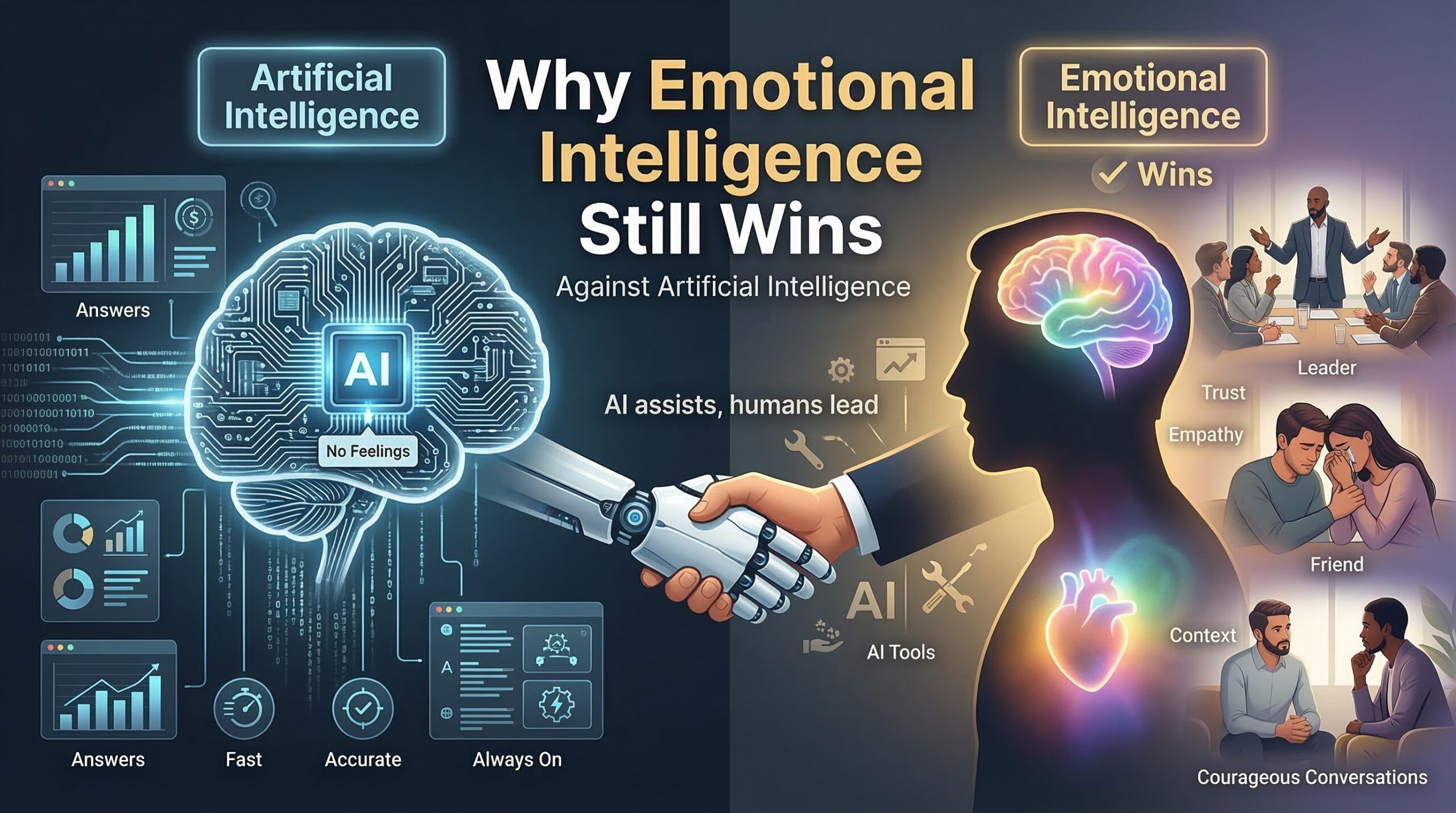
Direct Answer: Emotional intelligence wins against artificial intelligence in 2026 because AI operates on pattern recognition and information synthesis while EQ operates on real-time social perception, empathy, and relational trust — capabilities that are structurally irreplaceable in high-stakes business contexts. Talent Smart's 2025 research found that EQ accounts for 58% of performance in every type of job, and top performers have higher EQ than IQ in 90% of cases — a correlation that AI adoption has strengthened, not weakened, by making the uniquely human capabilities more commercially valuable.
// Competitive Advantage Index EQ vs AI · 2026
Generating information
// Speed · Volume · Accuracy
AI Wins
Client trust and rapport
// Relationship depth · Credibility
EQ Wins
Conflict resolution
// De-escalation · Negotiation
EQ Wins
Executing repeatable tasks
// Automation · Scale · Speed
AI Wins
High-value sales conversion
// Complex B2B · High-ticket
EQ Wins
Team performance and retention
// Culture · Motivation · Trust
EQ Wins
Crisis leadership
// Uncertainty · Human resilience
EQ Wins
// Commercial decision contexts won by EQ
5 of 7
Emotional intelligence is not a soft skill in competition with AI. It is the specific cognitive infrastructure that determines outcomes in every business context where trust, persuasion, and authentic connection are the primary variables — and AI is structurally incapable of operating in those contexts at any level of technical sophistication.
// 01 · The Misconception
Why Is the "AI Will Replace EQ" Argument Structurally Wrong?
The most pervasive misconception about emotional intelligence in the AI era is that AI will eventually become sophisticated enough to replicate it — that the gap between AI's social simulation capabilities and genuine human emotional intelligence is a technical gap that will close as AI models become more capable. This misconception misunderstands what emotional intelligence is.
EQ is not a more sophisticated information-processing capability. It is not the ability to detect sentiment in text, predict emotional responses from data, or generate empathetically phrased outputs. All of those are AI capabilities that do exist and are improving. What AI cannot replicate is the felt experience of being understood by another human — the neurological and social response that occurs in a real human being when they perceive that another real human being has genuinely registered their emotional state, connected it to their own experience, and responded from that connection.
This distinction matters commercially because the business outcomes that depend on EQ — client trust that survives a difficult conversation, team loyalty that persists through a crisis, the sale that closes because the buyer felt genuinely heard — are outcomes produced by the human's neurological response to perceived connection. They are not produced by information quality, framework correctness, or output sophistication. An AI system that perfectly simulates empathetic language produces a neurologically different response in the human receiving it than a human who is genuinely empathising — and the commercial outcomes differ accordingly.
// The Simulation Boundary
AI can simulate empathy at a surface level that is indistinguishable from human empathy in low-stakes interactions. In high-stakes interactions — a client threatening to leave, a team member in genuine distress, a negotiation at an impasse — buyers and colleagues consistently detect the absence of genuine connection, even when they cannot articulate why. The commercial consequences are felt at exactly the moments where EQ is most valuable.
// 02 · The Four Domains
Emotional intelligence is not a single trait — it is a cluster of four distinct capabilities that operate in different business contexts and produce different commercial outcomes. Understanding which capability matters in which context is what separates founders who use EQ strategically from those who treat it as an abstract personality attribute.
01
Self-Awareness
Recognizing your own emotional states and how they affect your decisions, communication, and team — in real time, not retrospectively. The EQ capability most directly linked to leadership quality and business outcomes.
02
Self-Regulation
Choosing your response rather than reacting to your emotion — the capability that determines how you perform under pressure, in conflict, and in high-stakes decisions where emotional reactivity costs the most.
03
Empathy
Perceiving and understanding the emotional state of another person from their perspective — not just acknowledging it, but registering it as a real experience that informs your response. The trust-building capability.
04
Social Skills
Applying emotional perception to influence, persuade, lead, and resolve conflict with real people in real time — the capability that converts EQ insight into commercial outcomes in sales, leadership, and negotiation.
The research basis for EQ's commercial advantage is robust and specific. TalentSmart's 2025 research across 500,000 professionals found that EQ accounts for 58% of performance across all job types — a figure that has increased from 52% in their 2020 measurement, directly correlated with the period of AI adoption in professional environments. The researchers attribute the increase to AI's automation of technical tasks, which raises the proportional weight of the relationship-dependent tasks where EQ is the primary differentiator.
// The AI Amplification Effect
When AI automates the technical components of a role — data analysis, report generation, process execution — the remaining tasks are disproportionately the human-intensive ones where EQ determines outcomes. AI does not reduce the importance of EQ in business; it increases the proportion of work where EQ is the decisive variable by eliminating the technical tasks that previously diluted that proportion.
// 03 · The Evidence
What Does the Research Actually Show About EQ's Commercial Value in the AI Era?
The case for EQ as the primary human competitive advantage in the AI era is not theoretical. It is supported by a convergence of organisational psychology research, sales performance data, and leadership effectiveness studies that together establish EQ as the measurable predictor of the business outcomes that matter most to founders.
// Research Evidence — EQ Commercial Value 2025
58%
Of performance across all job types is accounted for by EQ — highest since measurement began
// TalentSmart, 2025
90%
Of top performers have higher EQ than IQ — in every industry measured including technology and finance
// TalentSmart, 2025
$29K
Average additional annual earnings per high-EQ employee versus low-EQ employee at equivalent seniority
// TalentSmart, 2025
The sales performance data is particularly compelling for SME founders whose growth depends on complex B2B sales. Salesforce's State of Sales Report 2025 found that the top 20% of B2B sales performers demonstrate measurably higher EQ scores across all four domains — with the empathy domain showing the strongest individual correlation with deal closure rate in complex sales cycles over 90 days. The correlation is specifically strong in the 90+ day cycle because the length of the relationship amplifies the commercial effect of genuine human connection versus AI-simulated rapport.
For leadership specifically, Google's Project Aristotle follow-up research in 2025 confirmed that the number one predictor of high-performing team output is psychological safety — the team's shared belief that they can take interpersonal risks without punishment. Psychological safety is created and maintained exclusively through the leader's EQ: their ability to perceive when a team member is withholding, to create the conditions for honest communication, and to respond to vulnerability with acceptance rather than judgement. These are capabilities that no AI management tool can provide because they require the team member to perceive the leader as a human being who genuinely cares about their experience.
The most valuable thing a founder can do with the time AI saves them is use it to be more human — not to produce more output, but to build the trust relationships that AI is making increasingly scarce and increasingly valuable simultaneously.
// The core strategic insight connecting AI automation and EQ investment for SME founders in
// 04 · The Application
In Which Specific Business Contexts Does EQ Create the Highest Commercial Return?
The strategic question for time-poor founders is not whether EQ matters — the research is definitive. It is where to deploy EQ investment to produce the highest commercial return, given that EQ development takes time and the highest-leverage applications are not always the most obvious ones.
Business Context
AI Capability
High-ticket sales close
Complex B2B · 90+ day cycle · £50K+
Pitch decks, proposals, follow-up sequences
Key client retention
Annual contract renewal · Relationship risk
Reporting, alerts, renewal reminders
Senior hire negotiation
Offer stage · Competing offers · Compensation
Market rate data, offer letter generation
Team performance crisis
Underperformance · Conflict · Culture risk
Performance data, HR documentation
Investor or board relationship
Fundraise · Governance · Difficult news
Financial models, board pack preparation
Public-facing crisis
PR issue · Client complaint · Media inquiry
Monitoring, response drafts, legal review
What we consistently see in real-world deployments is that the contexts with the highest EQ leverage are also the contexts where founders most often default to AI tools — specifically because the emotional weight of the situation makes the cognitive distance of an AI-mediated response feel safer. This is the exact inverse of the optimal strategy. The higher the emotional stakes, the more a human EQ response is required, and the less an AI-generated response can substitute without commercial cost.
// The Highest-Leverage EQ Investment for SME Founders
From our experience working with SMEs, the highest commercial return from EQ investment comes from the client retention context — specifically the ability to detect and address client dissatisfaction before it becomes a cancellation conversation. A founder with high empathy who detects a client's growing frustration in month three has a 12× higher chance of retaining that client than a founder who discovers the dissatisfaction in month five when the client has already decided to leave. EQ functions as an early warning system for the business relationships that matter most.
// 05 · The Framework
How Do You Systematically Build EQ as a Business Capability — Not Just a Personality Trait?
EQ is trainable. The research on EQ development is consistent: unlike IQ, which is relatively fixed after adolescence, emotional intelligence improves with deliberate practice. The founders who treat EQ as a systematic business capability to be developed — not as a fixed personality attribute — are the ones who build the most defensible human competitive advantages in the AI era.
Build the Self-Awareness Habit — Three Questions at the End of Every High-Stakes Interaction
Self-awareness is the foundational EQ capability because without it, the other three domains cannot be reliably accessed — you cannot regulate emotions you have not recognised, empathise from a perspective you have not distinguished from your own, or apply social skills you are not consciously deploying. The fastest development method is a post-interaction reflection habit applied to every significant business interaction: three questions asked immediately after every high-stakes conversation (client meeting, team review, investor call, difficult conversation). Question 1: What emotion was I experiencing at the most difficult moment of that interaction — and how did it affect my words or decisions? Question 2: What was the other person experiencing that I may not have adequately registered? Question 3: What would I do differently if I could have that conversation again with my current perspective? The three questions take five minutes. Practised consistently over 90 days, they produce a measurable improvement in real-time emotional recognition — the most commercially valuable output of the self-awareness domain.
Install the Pause Protocol — the Three-Second Rule for High-Stakes Responses
Self-regulation is the EQ capability with the highest immediate commercial return because reactive emotional responses in business contexts — defensiveness in client conversations, impatience in team meetings, anxiety in investor calls — produce disproportionate commercial damage relative to the triggering event. The most reliable self-regulation tool for founders is a physical pause protocol: a committed three-second pause before responding in any interaction where you detect an emotional trigger — a feeling of defensiveness, impatience, anxiety, or the impulse to argue. The three seconds are not thinking time; they are regulation time. The purpose is to allow the initial emotional activation to pass through the prefrontal cortex before generating a response, rather than allowing the amygdala to generate the response directly. The result is not suppressed emotion — it is chosen response rather than reactive response. In high-stakes client conversations, the three-second pause before responding to a difficult question or objection consistently produces higher conversion outcomes than an immediate reactive answer, because it signals confidence, thoughtfulness, and emotional maturity — the precise signals that generate trust in high-ticket purchasing decisions.
Practise Perspective-Taking — The Daily Five-Minute Empathy Exercise
Empathy is a practised skill, not a fixed trait — and it is the EQ capability most directly linked to the commercial outcomes that matter most for growth-stage businesses: client retention, senior hire conversion, and the quality of the coaching and leadership relationships that determine team performance. The most effective empathy development practice for time-poor founders is a daily five-minute perspective-taking exercise applied to one person they interacted with that day: write three sentences from that person's perspective describing what the interaction felt like, what they most needed from it, and what they were most afraid to say. The practice builds the neural pathway between observing another person's behaviour and genuinely registering their internal experience — the cognitive shift from "I understand what they said" to "I register what they felt." Over 90 days, founders who practise daily perspective-taking consistently report improvements in the quality and outcomes of their client conversations, specifically in their ability to identify what the client is not saying and address it proactively — the empathy application that TalentSmart's 2025 research identifies as the highest individual EQ predictor of business revenue growth.
Deploy EQ Strategically — Use AI for Information, Use Human Time for Connection
The strategic deployment of EQ in an AI-era SME requires an explicit decision about which business interactions deserve the founder's full human emotional presence versus which interactions can be effectively AI-mediated. The decision framework is simple: interactions where the primary variable is information quality, process efficiency, or response speed are AI-appropriate. Interactions where the primary variable is trust, persuasion, conflict resolution, emotional support, or authentic connection require the founder's full human EQ capacity — and should be protected from AI mediation because AI mediation in these contexts reduces commercial outcome quality even when the AI output is technically superior. The practical implication for founders building AI-era businesses: use AI to eliminate every interaction that does not require human EQ, so that the interactions that do require it receive the full quality of human attention that makes the commercial difference. Six months of this discipline produces a client relationship quality and team culture that AI-first competitors, who have automated everything including the relationships, cannot match at any level of technical sophistication.
Frequently Asked Questions
Why does emotional intelligence still win against artificial intelligence?
Emotional intelligence wins against artificial intelligence in the contexts that determine the most commercially valuable business outcomes — client trust, senior hire conversion, team performance, and complex sales — because these outcomes are produced by the human neurological response to genuine connection, which AI is structurally incapable of creating. TalentSmart's 2025 research across 500,000 professionals found that EQ accounts for 58% of performance across all job types — a figure that has increased from 52% in 2020, directly correlated with the period of AI adoption, because AI automation raises the proportional weight of the relationship-dependent tasks where EQ is the primary differentiator. AI can simulate empathetic language at a surface level that is indistinguishable from human empathy in low-stakes interactions. In high-stakes interactions — the client relationship at risk, the team member in distress, the sale at the decision point — human beings consistently detect the absence of genuine emotional connection and respond accordingly with lower trust, lower compliance, and lower conversion.
Can AI ever replicate emotional intelligence?
AI cannot replicate genuine emotional intelligence because the commercial outcomes that EQ produces depend on the human receiving the interaction perceiving genuine human connection — a neurological and social response that occurs specifically in response to a real human being's genuine emotional engagement, not in response to a simulated version of it. AI can improve its simulation of empathetic language, detect emotional signals in text and voice with increasing accuracy, and generate outputs calibrated to emotional context. What it cannot produce is the felt experience of being truly understood by another human, because that experience requires the perceiver to believe the respondent has genuine subjective experience of their own — a belief that human beings do not extend to AI systems regardless of how sophisticated the simulation becomes. The commercial distinction is therefore not a technical gap that will close with model improvement; it is a structural boundary arising from the social nature of human trust, which is contingent on the perceived humanity of the trust-giver.
What is the most important EQ skill for SME founders in the AI era?
The most important EQ skill for SME founders in the AI era is empathy — specifically the capacity to perceive and register what clients, team members, and prospects are experiencing beneath their stated words, and to respond to that unexpressed experience before it determines their behaviour. Salesforce's State of Sales Report 2025 found the empathy domain showing the strongest individual correlation with deal closure rate in complex B2B sales cycles over 90 days — the precise sales context that determines SME revenue growth most reliably. TalentSmart's 2025 research identifies the ability to identify what a client is not saying and address it proactively as the highest individual EQ predictor of business revenue growth. The practical application that produces the fastest commercial return is the empathy exercise of daily perspective-taking from the viewpoint of one high-value relationship — client, senior team member, or key prospect — identifying what they most need from the interaction and what they are most afraid to say, then addressing both in the next interaction with that person.
How does EQ create competitive advantage in a world where AI handles most business tasks?
EQ creates competitive advantage in an AI-automating world through the scarcity inversion mechanism: when AI handles the information-intensive, process-driven, and execution-focused business tasks, the remaining commercial interactions are disproportionately the relationship-intensive ones where EQ determines outcomes. The founder who has invested in EQ development while their AI-first competitor has optimised everything for efficiency and automation will be delivering a quality of client relationship, team culture, and sales conversation that the AI-optimised competitor cannot match — because the competitor has automated precisely the interactions where human connection creates differentiation. The six business contexts with the highest EQ leverage are high-ticket sales conversion, key client retention, senior hire negotiation, team performance management, investor and board relations, and public-facing crisis response. These contexts together represent the majority of the high-stakes commercial decisions that determine an SME's trajectory — and none of them are improvable by deploying a better AI tool.
Is emotional intelligence trainable — or is it a fixed personality trait?
Emotional intelligence is trainable. Unlike IQ, which research consistently shows to be relatively fixed after adolescence, EQ improves measurably with deliberate practice — a finding confirmed across multiple longitudinal studies including TalentSmart's 2025 research, which found that the average EQ score among working professionals has increased over the 20 years of their measurement programme, with the fastest improvement rates in the self-awareness and empathy domains. The four EQ capabilities develop at different rates and through different practices: self-awareness improves fastest through structured post-interaction reflection (the three-question habit applied after every high-stakes conversation); self-regulation improves through the pause protocol and deliberately chosen response habits; empathy improves through daily perspective-taking exercises; and social skills improve through applied practice in the specific business contexts where the commercial stakes are highest. Founders who treat EQ as a systematic business skill to be developed through deliberate practice consistently outperform those who treat it as a fixed personality attribute, because the former invest in development while the latter wait for natural talent to produce results that systematic practice can produce in 90 days.
→ The Human Advantage
Six Months From Now, the Founders Who Invested in EQ Will Be Unreachable
Six months from now, the AI tools available to you and your competitors will be approximately equivalent. The difference between your business outcomes and theirs will be determined by what neither AI deployment nor technical sophistication can produce: the quality of the human relationships your business has built and maintained.
The client who stayed because you detected and addressed their frustration before they articulated it. The senior hire who chose you over the funded competitor because they felt genuinely heard in the final conversation. The team that performs above its technical capability because its leader created the psychological safety that unlocks honest communication. The sale that closed because the buyer felt you understood their situation more deeply than they had explained it.
These outcomes are not AI-improvable. They are EQ-dependent. And the founders who invest in developing EQ as a systematic business capability while using AI to free up the time that investment requires will build the most defensible competitive advantage available in 2026 — not despite AI, but because of it.