
Direct Answer: AIO tools worth paying for in 2026 are those that generate or validate entity schema, Video Object schema, FAQ Page structured data, and direct answer architecture — the specific infrastructure that determines AI citation eligibility. SEO tools worth keeping are those measuring backlink authority and content gap analysis. Rank tracking subscriptions, generic AI writing tools, and keyword volume dashboards are the categories most commonly over-purchased while schema infrastructure — the actual AI visibility lever — remains Underplayed.
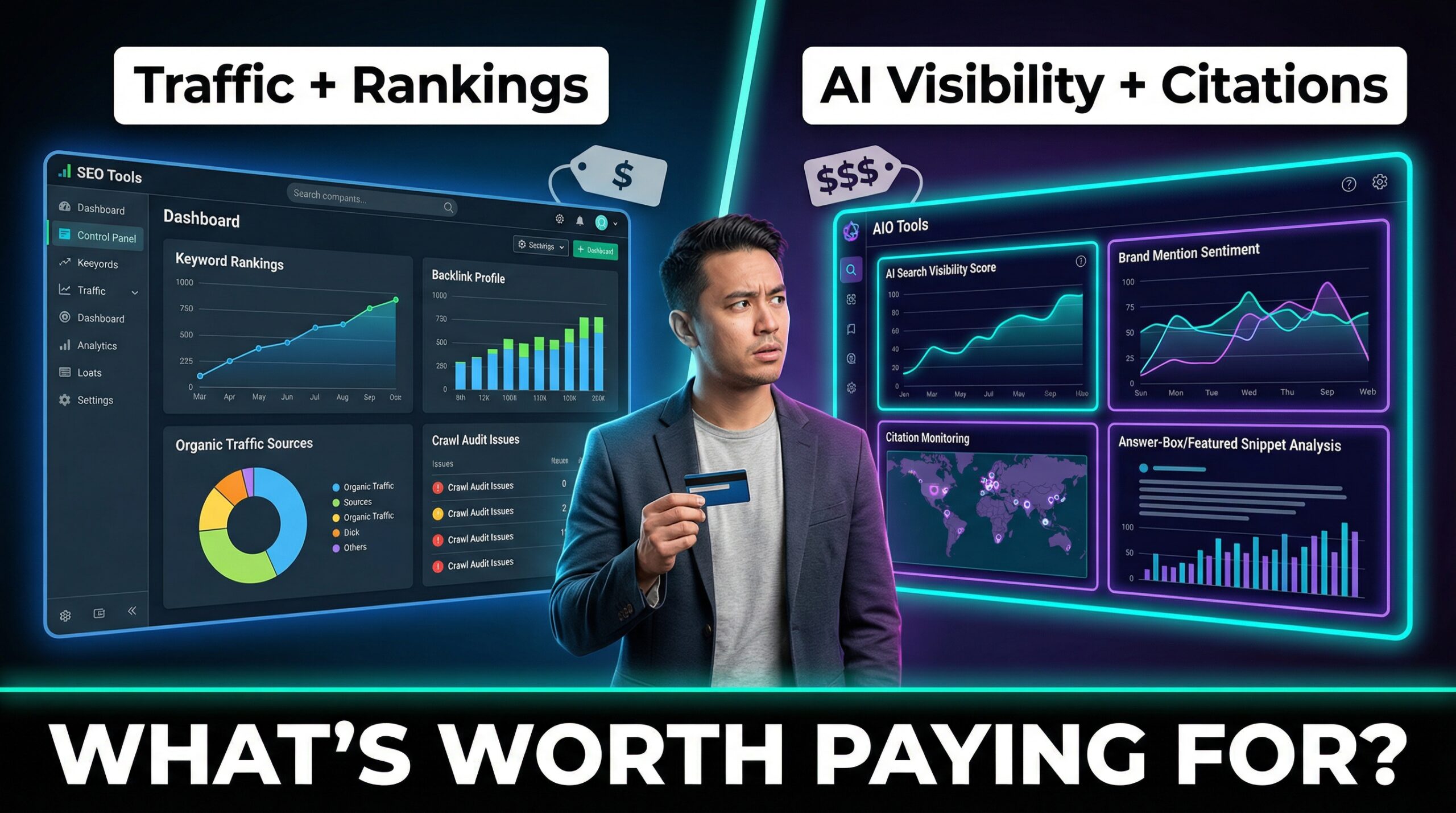
Most SEO tools were built for a world where Google rankings were the only discovery metric that mattered. In 2026, AI retrieval systems generate a growing proportion of brand discovery — and most SEO tools are structurally blind to everything that determines AI citation eligibility.
// Verdict Index — 2026
£/month
Semrush / Ahrefs
// SEO · Backlinks · Keyword rank
Conditional
Clipkoi
// VideoObject schema · Host pages · AI citations
Keep
Rank tracking tools
// Position monitoring · SERP tools
Cut
AI writing assistants
// Jasper, Copy.ai, generic AI writers
Cut
Claude / ChatGPT / Gemini
// Expert extraction · Content production
Keep
Schema validators
// Schema.org · Google Rich Results Test
Keep (free)
// Optimal monthly stack
£60–80/mo
// 01 · The Framework
Why Do Most SEO Tools Fail to Address AI Visibility — and What Is the Right Evaluation Framework?
The SEO tool market was built between 2005 and 2020 to solve a specific problem: understanding and improving Google search rankings. The tools that dominated that era — Semrush, Ahrefs, Moz, and their successors — are excellent at measuring the variables that determine traditional organic rankings: backlink profiles, keyword positions, domain authority signals, and content gap analysis.
The problem is not that these tools are bad. The problem is that they measure a subset of the variables that determine brand discovery in 2026 — and specifically exclude the variables that determine AI citation eligibility. They cannot tell you whether your entity schema is correctly installed. They cannot audit your VideoObject schema. They cannot measure whether your content contains extractable direct answer blocks. They cannot show you which of your pages appear in Google AI Overviews, Perplexity answers, or ChatGPT Search citations.
// The Right Evaluation Framework
Evaluate every tool in your current stack against one question: does this tool measure or improve the variables that determine whether my brand appears in AI-generated recommendations? If the answer is no — if the tool only measures traditional organic ranking signals — you are paying for insights about a discovery mechanism that is declining in relative importance while the discovery mechanism that is growing goes unmeasured. The highest-ROI tool investment in 2026 is the one that closes the AI citation gap, not the one that refines the keyword ranking gap.
// 02 · The Verdict Table
Which Specific Tools Are Worth Keeping, Which Should Be Cut, and Why?
The following verdict table is based on one evaluation criterion: does this tool generate measurable commercial return in the 2026 discovery environment, which requires performance across both traditional organic search and AI retrieval systems? Tools that only optimise for traditional organic without contributing to AI visibility are being evaluated against the full discovery landscape, not the 2018 discovery landscape they were designed for.
Tool / Category
SEO Value
AIO Value
Verdict
Semrush / Ahrefs
Backlink analysis · Content gap · Keyword research
High
Low — no AI metrics
Conditional
Clipkoi
VideoObject schema · Host pages · AI citation infrastructure
High — video SEO
High — AI citations
Keep
Claude / ChatGPT / Gemini
Expert content extraction · AI repurposing
Medium
High — content quality
Keep
Rank tracking tools
Position monitoring · SERP feature tracking
Medium — declining signal
Zero — blind to AI
Cut
Generic AI writers
Jasper, Copy.ai, Writesonic
Low
Low — no entity context
Cut
Google Search Console
Index coverage · Impression data · AI Overview signals
High
High — AI impression data
Keep (free)
Schema.org Validator
JSON-LD validation · Rich result eligibility
Critical
Critical — AI citation gate
Keep (free)
Social scheduling (Buffer/Later)
30-day calendar automation
Low direct
Low direct — distribution
Keep (ops)
Keyword volume tools
Search volume · CPC · Trend data only
Medium — decreasing
Zero
Cut / Downgrade
Email platform (ConvertKit/Beehiiv)
Automated nurture · Sequence delivery
Low direct
Low direct — conversion
Keep (conversion)
Perplexity / ChatGPT Search
Manual AI citation testing — free
Low
High — citation measurement
Keep (free)
Backlink outreach tools
Pitchbox, Hunter.io — citation density
High
Medium — Gate 4
Conditional
// 03 · The Detailed Verdicts
What Is the Specific Case for Each Major Tool Category — Keep, Cut, or Conditional?
// Keep — AI Language Models (Claude, ChatGPT, Gemini)
The three major AI language models are the highest-ROI tool investment in the 2026 content stack — not because they generate content autonomously, but because they function as expert knowledge amplifiers when deployed with the five-prompt extraction library. The value is not AI-generated content; it is the conversion of genuine expert insight (the recorded video transcript) into seven distinct published assets in 90 minutes at a combined cost of £40–£60 per month across the three platforms. No content agency, copywriter, or social media manager operating at £40–£60 per month produces equivalent volume, quality, or distribution breadth. Keep all three — deploying each according to its specific strength (Claude for long-form, ChatGPT for structured output, Gemini for real-time research).
// Keep — Clipkoi (VideoObject Schema and Host Pages)
Clipkoi occupies the specific tool category that the entire traditional SEO tool market has not built for: the infrastructure that converts recorded video into entity-attributed, AI-citable, owned-domain ranking assets. The VideoObject schema generation, entity-verified host page production, and AI-citation-ready description creation that Clipkoi provides are the specific technical functions that determine whether a video generates AI Overview citations and 18-month organic traffic, or simply accumulates YouTube views with no lasting brand equity. There is no SEO tool equivalent. The commercial case is not tool preference; it is tool category: Clipkoi solves a problem that Semrush, Ahrefs, and Moz structurally cannot address.
// Keep (Free) — Google Search Console
Google Search Console is the only tool that provides direct impression data for AI Overview appearances — the specific metric that measures whether your content is appearing in AI-generated responses to commercial queries. The Search Console Coverage report identifies schema errors. The Performance report segments Discover and Search traffic types. The URL Inspection tool confirms entity schema processing and Knowledge Graph confirmation status. It costs nothing and provides the measurement infrastructure that most paid SEO tools cannot match for AI visibility tracking. Using a paid rank tracking tool while ignoring Google Search Console's free AI visibility data is one of the most common tool budget misallocations we see.
// Cut — Rank Tracking Tools
Standalone rank tracking tools — position monitoring dashboards that show daily keyword ranking fluctuations — have declining commercial justification for SME founders in 2026. The specific problem is that they measure the wrong metric: traditional organic position for a keyword, rather than AI citation frequency for the commercial queries that determine whether buyers encounter your brand during research. A brand can rank position 1 for a keyword and receive zero AI Overview citations for that same query — because traditional ranking and AI citation eligibility are different signals determined by different technical factors. The time spent monitoring rank positions is time not spent building the schema infrastructure and authority clusters that determine AI citation frequency, which now determines a growing proportion of buyer discovery.
// Cut — Generic AI Writing Tools
Generic AI writing tools — Jasper, Copy.ai, Writesonic, and their equivalents — were solving a specific problem in 2021–2023: the cost and time of producing written content. In 2026, that problem is solved more cheaply and with better output quality by Claude or ChatGPT deployed with expert-specific prompt libraries. The additional cost of a generic AI writer subscription on top of a Claude or ChatGPT subscription produces no measurable additional output value — and generic AI writers specifically lack the entity vocabulary, direct answer architecture, and schema awareness that determine whether content is AI-citable. They produce content for the 2018 discovery environment: indexed by Google, found through traditional keyword searches, generating ephemeral traffic. That is the wrong target for the 2026 content investment.
// Conditional — Semrush and Ahrefs
The flagship SEO platforms are not tools to cut — they are tools to use correctly. The specific Semrush and Ahrefs features that retain high value in 2026 are: competitor backlink analysis (identifying the citation density gap for Gate 4 of the AI trust build), content gap analysis (finding the commercial query variants your authority cluster is not yet covering), and site audit features that identify technical errors preventing schema processing. The features that should be deprioritised: keyword position tracking dashboards, rank history charts, and traffic estimation tools that describe traditional organic performance without any AI citation visibility data. The conditional verdict is: keep a subscription if you are actively using the backlink and content gap features for strategic cluster planning; downgrade or cancel if your primary use case is monitoring keyword positions that AI citation frequency has made a secondary discovery metric.
The most expensive tool decision is not the subscription you cut. It is the infrastructure category you never subscribed to — because you were spending the budget on tools that measured the old game while the new game went unplayed.
// The budget reallocation insight that changes SME tool stack decisions in 2026
// 04 · The Optimal Stack
What Does the Optimal £60–80/Month Tool Stack Look Like for an SME Focused on AI Visibility?
The optimal 2026 tool stack for an SME founder focused on AI-first brand visibility costs £60–80 per month and covers five functional categories: AI content production, entity schema and VideoObject infrastructure, email sequence delivery, social scheduling, and financial administration. Everything else is either free or unnecessary.
// Keep — Core Stack
£55–65
The AI production and schema infrastructure that generates all content, discovery, and AI citations
Claude Pro £20 · ChatGPT Plus £20 · Clipkoi · Scheduling £10–15
// Conditional
£80–120
SEO platform for backlink and content gap analysis — justified only if actively used for cluster planning
Semrush or Ahrefs · Backlink outreach tools if building citation density
// Cut
£150–400
Tools solving the wrong problem — rank tracking, generic AI writers, keyword volume dashboards
Rank trackers · Jasper/Copy.ai · Standalone keyword tools
The zero-cost measurement stack — Google Search Console, Schema.org Validator, Google Rich Results Test, and direct AI citation testing in Perplexity and ChatGPT Search — provides all the measurement data needed to confirm whether the core stack is generating the AI citation appearances and organic search impressions that indicate the infrastructure is working. None of this measurement infrastructure costs anything.
// The Budget Reallocation Case
The average SME founder we work with is spending £200–£500 per month on tool subscriptions that are primarily monitoring traditional SEO metrics. Reallocating that budget to the £60–80 core stack — Claude, ChatGPT, Clipkoi, and a scheduling platform — while using Google Search Console and free schema validators for measurement produces a 3–5× improvement in AI citation frequency within 90 days. The reallocation is not a cost reduction; it is a redeployment of existing budget from measuring the old discovery model to building the new one.
Frequently Asked Questions
Do I still need Semrush or Ahrefs in 2026?
Yes — conditionally. Semrush and Ahrefs retain high value for the specific use cases they were designed for: backlink profile analysis (identifying citation density gaps for AI trust Gate 4), content gap analysis (finding commercial query variants your authority cluster is not covering), and site audit features that identify technical errors preventing schema processing and indexing. The features that have declining ROI in 2026 are rank tracking dashboards, keyword position history charts, and traffic estimation tools that describe traditional organic performance without any AI citation visibility data. The conditional verdict is: maintain a subscription if you are actively using the backlink and content gap features for strategic cluster planning at least monthly; consider downgrading to a lower tier or cancelling if your primary use is monitoring keyword positions that no longer fully describe your brand's discovery landscape. Most SMEs using Semrush primarily for rank tracking are paying for a metric that is declining in commercial relevance — they would get more actionable data from a well-configured Google Search Console review of the same domain at zero additional cost.
What is an AIO tool and how is it different from an SEO tool?
An AIO (AI Optimisation) tool is any tool that specifically improves a brand's visibility and citation frequency in AI retrieval systems — Google AI Overviews, Perplexity, ChatGPT Search, and similar AI-mediated discovery surfaces. AIO tools generate or validate entity schema (Organisation and Person JSON-LD with sameAs verification), VideoObject schema (structured data that makes video content AI-citable on owned domains), FAQPage schema (extractable Q&A pairs that AI systems use for direct answer responses), and direct answer architecture (the 40–60 word self-contained answer blocks that AI systems extract for featured responses). SEO tools, by contrast, primarily measure and improve traditional organic search ranking signals: keyword positions, backlink profiles, domain authority, and technical crawl issues. The critical difference in 2026 is that SEO tools measure signals that determine Google ranking but are largely blind to the signals that determine AI citation eligibility — and these two signal sets are different enough that a brand can rank position 1 for a keyword while receiving zero AI Overview citations for the same query.
Are generic AI writing tools like Jasper worth paying for?
No — not for SMEs that already have Claude or ChatGPT subscriptions. Generic AI writing tools were solving a meaningful problem in 2021–2023: the cost and time of producing written content without a human writer. In 2026, Claude and ChatGPT with expert-specific prompt libraries produce better-quality content at higher volume than any generic AI writer, because they combine the language model's capability with the founder's genuine expert knowledge rather than generating generic content from training data alone. The additional monthly cost of a Jasper or Copy.ai subscription on top of Claude and ChatGPT produces no measurable additional content value, and generic AI writers specifically lack entity vocabulary awareness, schema-formatted output capability, and direct answer architecture — the specific content characteristics that make content AI-citable. The budget is better allocated to Clipkoi's VideoObject schema infrastructure, which solves a problem that no generic AI writer addresses at any price point.
How do you measure AI citation performance without a paid AIO monitoring tool?
AI citation performance can be measured accurately without any paid tool through a combination of four free resources. First, Google Search Console Performance report segmented by Search type — Discover impressions and AI Overview appearances are captured in the Search Console data and show the organic impression growth from AI-cited content. Second, direct manual testing — searching your top ten commercial query variants directly in Google and recording whether an AI Overview appears that cites your content; this takes 15 minutes per week and provides exact citation data. Third, direct Perplexity testing — entering the same queries in Perplexity and checking whether your brand appears as a cited source in the AI-generated answer. Fourth, Google Search Console Coverage report — identifying any schema errors that prevent AI citation eligibility, which is more commercially actionable than any paid rank tracking data. Together, these four free measurement approaches provide all the AI citation performance data needed to confirm whether your entity schema, VideoObject infrastructure, and direct answer architecture are generating the citations your budget is intended to produce.
What is the minimum tool budget for an SME to achieve AI visibility in 2026?
The minimum effective tool budget for achieving meaningful AI visibility in 2026 is £55–80 per month, covering: Claude Pro at approximately £18–22 per month for long-form content production and transcript-to-article extraction; ChatGPT Plus at £20 per month for structured output, schema markup generation, and social post formatting; Clipkoi for VideoObject schema generation and entity-verified host page production; and a social scheduling platform such as Buffer at £10–15 per month for 30-day automated distribution calendar loading. The measurement infrastructure — Google Search Console, Schema.org Validator, Google Rich Results Test, and direct Perplexity and ChatGPT Search citation testing — costs nothing. The zero-cost entity schema installation (Organisation schema and Person schema with sameAs arrays) is a two-hour one-time setup that retroactively changes the citation eligibility of all existing content on the domain. At £55–80 per month with this stack, an SME produces consistent weekly content at seven assets per session, maintains permanent AI citation infrastructure, and generates the topical authority cluster depth that qualifies for AI Overview category citations within 90 days — achieving more measurable AI discovery impact than the majority of SMEs spending £300–500 per month on traditional SEO tooling.
→ The Budget Decision
The Most Expensive Tool Is the One Solving the Wrong Problem With This Month's Budget
The tool market has not yet caught up with the discovery landscape change. The platforms that dominate the SEO tool category were built in the era when Google rankings were the only metric that mattered for brand visibility — and they are excellent at measuring that metric. The problem is that metric is no longer the complete picture of brand discovery, and the tools designed to improve it are largely blind to the growing proportion of discovery happening through AI retrieval systems.
The highest-ROI tool allocation in 2026 puts entity schema infrastructure, VideoObject schema generation, and AI content extraction capability at the centre of the stack — and uses Google Search Console's free AI visibility data for measurement. The tools that remain in the stack after that allocation are the ones that improve the other half of the discovery landscape: the backlink profile and content gap analysis that Semrush and Ahrefs provide for traditional organic performance.
The tool audit takes 30 minutes. Open your bank statement, list every tool subscription, and apply the single evaluation question: does this tool improve or measure my brand's visibility in AI-generated recommendations? The subscriptions that fail that test are paying for insights about a discovery mechanism that is declining in relative importance while the mechanism that is growing goes unmeasured and unaddressed.