
Direct Answer: A B2B video funnel converts viewers into qualified leads by mapping specific video content types to each stage of the buyer journey — awareness, education, evaluation, and decision. The funnel works when each video contains a stage-appropriate CTA that moves the viewer one step forward, and when content is distributed across the channels where buyers at that specific journey stage are actually searching. Most B2B video fails because it targets every stage simultaneously, converting no stage effectively.
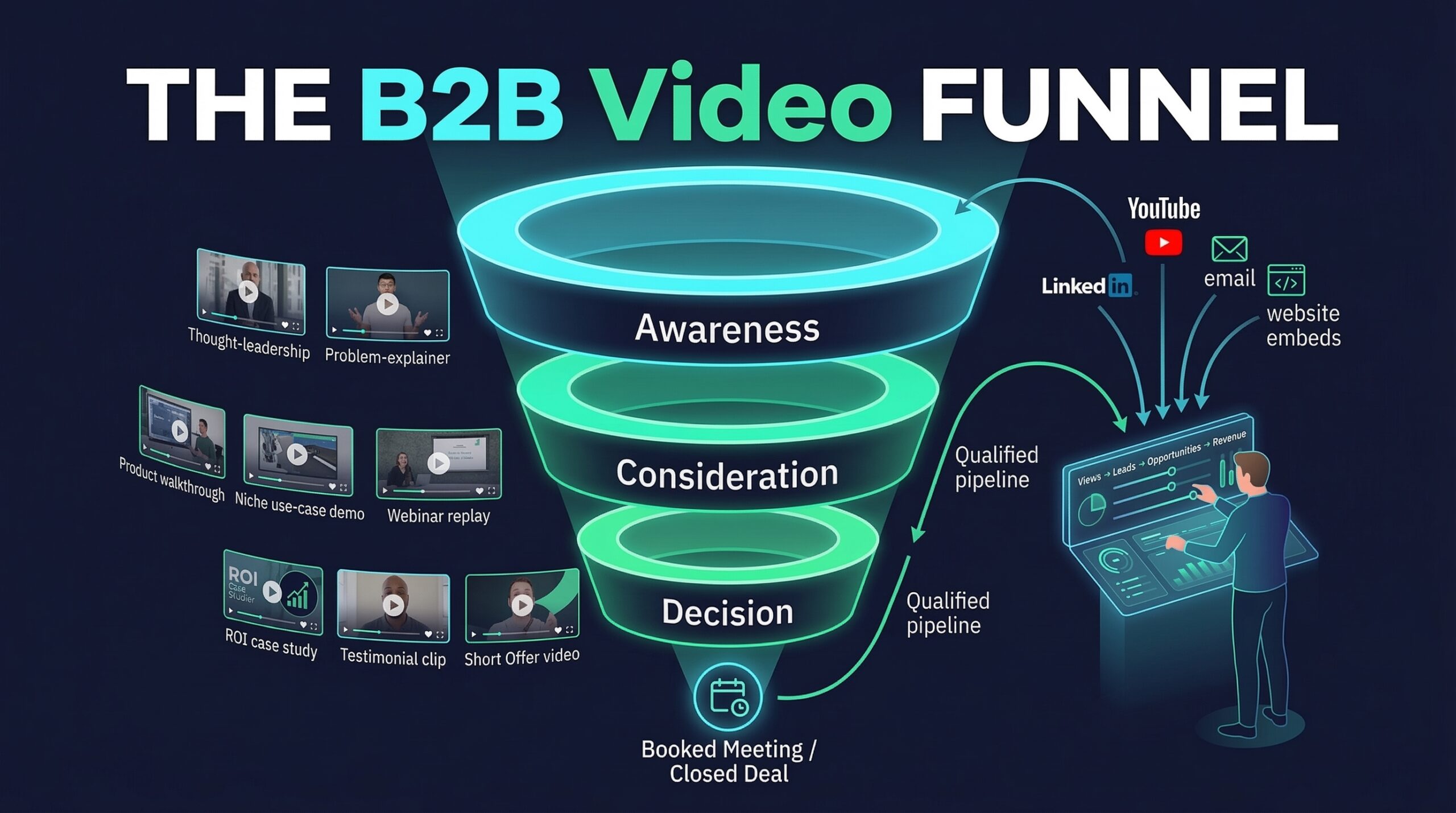
Most B2B video content generates views and zero pipeline. This is the framework that changes that — four stages, the exact content types, and the CTAs that convert viewers into qualified sales conversations.
80%
of B2B buyers watch video before contacting a vendor — yet only 24% of video content includes a conversion-optimised CTA
Wyzowl · State of Video Marketing, 2025
4.8×
higher qualified lead rate for B2B companies with a structured multi-stage video funnel vs single video type
Aberdeen Group · Video Marketing ROI, 2024
53%
of B2B decision-makers say video has directly influenced a purchase decision in the past 12 months
LinkedIn · B2B Benchmark Report, 2025
Why Is Most B2B Video Generating Views but No Pipeline?
The failure pattern is consistent. A business invests in video — product demos, explainer content, thought leadership clips — distributes them across LinkedIn and YouTube, watches the view count accumulate, and then asks the question that exposes the structural problem: where are the leads?
The answer is almost always the same. The content was not designed for conversion. It was designed for awareness — and awareness without a structured next step is a dead end. Views are not pipeline. Engagement is not intent. The gap between a buyer who watched your video and a buyer who booked a call is bridged by one thing: a video funnel that knows which stage the buyer is at and asks for the right next action at the right moment.
Wyzowl's 2025 State of Video Marketing report found that 80% of B2B buyers watch video before contacting a vendor. The pipeline opportunity is real and large. But the same report found that only 24% of B2B video content includes a conversion-optimised CTA. The majority of B2B video is built entirely for stage one — awareness — regardless of where the viewer actually sits in their buying journey.
// The Structural Problem
From our experience working with SMEs, the most common B2B video mistake is not poor production quality or wrong platform — it is publishing awareness content to buyers who are already in the evaluation stage. A CFO who has already identified a problem and is comparing three vendors does not need a video explaining why the problem exists. She needs a case study, a comparison, or a specific ROI calculation. The funnel fails because the content stage and the buyer stage are misaligned.
What Are the Four Stages of a B2B Video Funnel — and What Content Belongs at Each One?
A B2B video funnel maps four distinct stages of buyer awareness to four distinct categories of video content — each with a different job to do, a different optimal length, and a different CTA mechanism. The architecture only converts when each stage is treated as a separate programme, not as variations on the same video brief.
// Four-Stage B2B Video Funnel Architecture
Stage 1 ·
WidestAwareness — Problem Framing
The buyer knows they have a problem but has not yet framed it or identified solution categories. Your video names the problem precisely, validates that it matters, and introduces the category of solution — without selling anything.
Content Type
Thought leadership clips
Trend videos
Problem POV posts
60–90 sec shorts
Stage 2 · Narrowing
Education — Solution Architecture
The buyer understands their problem and is actively learning how different approaches solve it. Your video explains how your category works, what the implementation looks like, and what outcomes are realistic — positioning your methodology before they evaluate vendors.
Content Type
How-to guides
Framework explainers
Tutorial series
8–15 min videos
Stage 3 · Qualifying
Evaluation — Proof and Specificity
The buyer is comparing vendors and needs evidence. Your video provides customer results, implementation specifics, and objection resolution — at sufficient depth that a qualified buyer can self-select. This is where unqualified viewers self-exclude and your best prospects lean in.
Content Type
Case study videos
ROI breakdowns
Customer interviews
Comparison contents
Stage 4 · Narrowest
Decision — Conversion Catalyst
The buyer has a short vendor list and needs to reduce perceived risk before committing to a conversation. Your video removes the final objections — implementation risk, time investment, commitment level — and makes the next step feel obviously low-risk. The CTA here is direct: book a call, start a trial, see a live demo.
Content Type
Founder intro videos
Process walkthroughs
Risk-reversal demos
Personalised loom
// Critical Distinction
The funnel architecture above is not about video length or production quality — it is about the job the video is hired to do. A 90-second clip can be Stage 3 content if it leads with a specific customer result. A 20-minute guide can be Stage 1 content if it explains why a problem matters without positioning a solution. Stage is defined by buyer intent and content job, not format.
Which Video Content Types Convert Best at Each Stage — and What Do the Numbers Say?
Not all video formats perform equally across funnel stages. Aberdeen Group's 2024 Video Marketing ROI study found a 4.8× difference in qualified lead rate between B2B companies with a structured multi-stage video funnel and those publishing only one content type. The performance variation by content type and stage is significant enough to be prescriptive.
Video Format
Primary Funnel Stage
Thought Leadership Clips
Founder POV, industry takes, trend commentary
AWARENESS
How-To Guides
Framework tutorials, implementation walkthroughs
EDUCATION
Customer Case Studies
Named results, before/after, implementation story
EVALUATION
Product Demos
Live walkthrough, specific use case demonstration
AWARENESS
Founder / Team Introduction
Who we are, how we work, why we do this
DECISION
Risk-Reversal Videos
Objection handling, guarantee explanation, onboarding preview
DECISION
Personalised Loom / Video DM
Bespoke outbound video addressed to a specific prospect
DECISION
The highest-completing video format in the entire B2B funnel is the personalised one-to-one video — 88% completion rate, 3× the reply rate of text email. Most B2B teams spend zero minutes producing this format and all of their video budget on brand content that rarely reaches the right person at the right moment.
// From our experience working with SMEs
What Are the CTAs That Actually Move B2B Buyers Through the Funnel?
The CTA is the mechanism that converts a video view into a funnel progression event. Most B2B video CTAs are either absent, generic ("visit our website"), or misaligned to stage — a Stage 1 awareness video asking for a demo booking from a buyer who just learned the problem exists. Stage-matched CTAs are the single highest-leverage optimisation available to any B2B video programme.
Stage 1 / Awareness
~8%
The Depth CTA
Ask the viewer to go deeper into the topic — not to buy, not to book, not to visit a sales page. The awareness CTA converts curiosity into a deeper relationship. The appropriate conversion event is a follow, a subscribe, or a longer-form content consumption.
→ "Follow for the full framework next week"
→ "Read the full guide — link in bio"
→ "Subscribe for the weekly breakdown"
Stage 2 / Education
~14%
The Asset CTA
Exchange depth for contact information. The education stage buyer is willing to trade an email address for a genuinely useful resource — a template, a checklist, a framework document — because they are actively trying to solve the problem your video just explained.
→ "Download the free template — link below"
→ "Get the full checklist — no charge"
→ "The complete framework is at clipkoi.com"
Stage 3 / Evaluation
~22%
The Evidence CTA
Drive the viewer to your highest-converting proof content — a detailed case study, an ROI calculator, or a comparison page. The evaluation buyer is deciding between vendors and needs more evidence. Your CTA gives them the most compelling evidence immediately.
→ "See the full case study — link in description"
→ "Calculate your ROI — free tool below"
→ "Watch: how [Company] achieved [result]"
Stage 4 / Decision
~31%
The Friction-Removal CTA
Remove the perceived risk of the next step explicitly before asking for it. The decision buyer has a cost-of-action calculation in their head — how long will this take, what am I committing to, what happens next. Answer all three before the ask. The booking rate jumps when the call feels predictable and low-commitment.
→ "15-minute call — no pitch, just strategy"
→ "Start free — no card, cancel anytime"
→ "Book: I'll show you exactly how this works for your situation"
How Do You Build the Video Funnel Systematically Without a Large Content Team?
The funnel architecture above sounds like it requires four separate content programmes running simultaneously. In practice, with the right production system, one founder or one content person can maintain all four stages from a single weekly recording session.
The key is the anchor-and-extract model: one primary long-form video per week serves as the source material for every other stage. The long-form becomes a how-to guide for Stage 2. A specific insight from it becomes a Stage 1 short clip. A customer result mentioned in passing becomes a Stage 3 case study excerpt. The founder's closing summary becomes a Stage 4 conversion video. Four funnel assets from one session.
Record the Anchor — One Specific Problem, One Specific Solution
Record a 20 to 30 minute video addressing one specific buyer problem with one specific solution framework. Keep it as a conversation or walkthrough — no script, just structured. The transcript becomes all subsequent content. The more specific the problem, the more precisely it qualifies viewers at the right funnel stage automatically.
Extract Stage 1 — The 60-Second Problem Statement Clip
Identify the 60 to 90 seconds in the anchor where you state the problem most sharply — usually in the first three minutes. Extract this as a standalone clip with captions. This is your awareness content: it names the problem without solving it, creating curiosity that drives viewers to the full video. Distribute to LinkedIn, TikTok, and Instagram Reels with a depth CTA.
Publish the Anchor as Stage 2 — YouTube With Full SEO Description
Publish the full anchor video to YouTube with a five-zone SEO description generated from the transcript — direct answer block, keyword-rich body, chapter markers, and CTA. This becomes your education content: the buyer who wants to go deep can spend 20 minutes learning your framework in full. The YouTube description CTA points to a downloadable template or checklist as the asset CTA conversion point.
Build Stage 3 — Reference a Customer Result or Case Proof
Within the anchor video, there is almost always a moment where you reference how a client applied the framework or what results they achieved. Extract or re-record this as a 3 to 5 minute case study video. If you do not yet have a named case study, use anonymised data or a walk-through of what a client's before-and-after looks like. The CTA drives to your pricing page, ROI tool, or comparison content.
Record Stage 4 — The 90-Second Conversion Video
After recording the anchor, spend 90 seconds on camera answering three questions: what does our process look like in the first 30 days, what does the buyer need to invest in terms of time, and what is the first step. This video lives on your contact, pricing, and services pages. It removes the primary objections that cause qualified buyers to delay booking a call — and it is recorded in the same session as the anchor at zero incremental time cost.
How Do You Measure Whether the Video Funnel Is Actually Converting?
Most B2B video measurement stops at views, watch time, and engagement rate — metrics that measure content performance, not funnel performance. A functioning B2B video funnel requires measurement of progression events: did the viewer advance from the current stage to the next stage as a result of consuming this video?
Measurement Layer
Tool
Benchmark
Stage 1 → Stage 2 Progression
Awareness to Education conversion
UTM Links + GA4
3–8% of clip viewers visit long-form or asset page
Asset Download Rate
Education to lead data conversion
CRM / Landing page
12–20% of video page visitors complete asset download
Case Study Completion Rate
Evaluation content consumption depth
YouTube Analytics / Wistia
>60% average view duration for case study videos
Conversion Page Video Watch
→ CTA Click
Decision stage activation
Hotjar / Clarity + GA4
18–35% of video viewers on conversion page click primary CTA
Video-Attributed Pipeline Value
Monthly revenue contribution
CRM UTM attribution
Video touchpoint in 40%+ of closed deals after 6 months
// The Measurement Reality
What we consistently see in real-world deployments: the first 90 days of a B2B video funnel show video attribution in CRM of under 10%. By month six, that figure typically reaches 35 to 50% of closed pipeline having a video touchpoint — because the compound effect of search-indexed videos, AI-cited content, and dark social sharing takes three to six months to reach steady state. Cutting the programme at 60 days because attribution is low is the most common reason B2B video funnels fail to deliver the results they were designed to produce.
Frequently Asked Questions
What is a B2B video funnel and how does it generate leads?
A B2B video funnel is a structured system that maps specific video content types to each stage of the buyer journey — awareness, education, evaluation, and decision — with each stage containing a CTA that advances the viewer to the next stage. It generates leads by meeting buyers where they are in their decision process: awareness content attracts buyers who have just identified a problem, education content converts curious viewers into known contacts, evaluation content qualifies and filters for ideal buyers, and decision content removes the final risk barriers before a call or trial. The funnel produces qualified leads rather than raw view counts because each stage is designed to self-select buyers at the right intent level for that content type.
What types of video work best for B2B lead generation?
The highest-converting B2B video formats for lead generation are, in descending order by conversion event rate: personalised one-to-one video for outbound and late-stage prospects (88% completion, 3× reply rate vs text email); founder or team introduction videos on conversion pages (82% completion, highest direct booking signal); customer case study videos (71% completion, drives pricing page visits and demo requests); risk-reversal and objection-handling videos on sales pages (76% completion); and thought leadership short clips (64% completion, highest volume distribution reach). The format that works best depends on which funnel stage you are optimising for — the highest-completion formats are not the highest-distribution formats, and conflating the two is the primary reason B2B video budgets are misallocated.
How long should B2B video content be for each funnel stage?
Optimal B2B video length varies significantly by funnel stage and mirrors the buyer's investment willingness at each stage. Stage 1 awareness clips should be 60 to 90 seconds — the buyer is not yet ready to invest more time than this in an unknown brand. Stage 2 education content performs well at 8 to 15 minutes — the buyer is actively trying to learn and will invest time in a structured framework. Stage 3 evaluation content — case studies and product demos — performs best at 3 to 8 minutes: long enough to be credible, short enough to respect a decision-stage buyer's limited time for vendor research. Stage 4 decision videos should be under 2 minutes — by this point, the buyer has decided they are interested and just needs risk reduced, not more education. Founder introduction videos and risk-reversal content should be the shortest videos in the entire funnel.
What CTA should you use at the end of a B2B video?
The CTA at the end of any B2B video should match the funnel stage of that specific content — not default to "book a call" regardless of stage. Awareness content should use a depth CTA: follow, subscribe, or read the longer article. Education content should use an asset CTA: download the template, get the checklist, access the full framework. Evaluation content should use an evidence CTA: read the case study, calculate your ROI, visit the comparison page. Only decision-stage content should use a direct booking or trial CTA — and it should be preceded by explicit risk reduction: state the time investment, the commitment level, and exactly what happens next before making the ask. Aberdeen Group's 2024 research found that stage-matched CTAs produce a 4.8× higher qualified lead rate compared with uniform "book a demo" CTAs applied to all video content.
How long does a B2B video funnel take to produce measurable pipeline results?
A B2B video funnel typically shows initial conversion signals within 30 to 60 days — stage one to stage two progression events, asset downloads, and increased branded search volume. Measurable pipeline attribution — closed deals or active opportunities with a video touchpoint in the buyer journey — typically reaches 20 to 30 percent of new pipeline between months three and four. By months six to nine, a consistently operated funnel with content indexed on YouTube and in AI answer engines typically shows video attribution in 35 to 50 percent of closed pipeline, because search-indexed and AI-cited video content compounds in discovery reach across all four channels over time. The critical operational point: the funnel must be operated consistently for the first 90 days before attribution data is sufficient to make investment decisions.
The View Counter Is Not the Business Result
Views are evidence that someone watched. Leads are evidence that someone decided to take the next step. The B2B video funnel is the architecture that bridges the two — by ensuring that every piece of video content has a precise job, a stage-matched CTA, and a measurement system that tracks progression rather than consumption.
Six months of consistent funnel operation compounds into something competitors cannot quickly replicate: a library of indexed, AI-cited, search-ranked video content at every stage of the buyer journey, working as a 24-hour sales development asset on every platform where your buyers are looking.
The production system to build this at SME scale exists. The only missing element, in almost every case, is the decision to treat video as a funnel — not a broadcast.