
Direct Answer: Backlinks remain essential in 2026 but now serve two distinct functions: traditional PageRank signals for Google ranking, and entity authority signals for AI citation selection. The future of backlinks requires building both — high-authority contextual links for search ranking, and citation mentions with structured entity data for AI answer engine visibility. The businesses that treat these as one strategy will be left behind by those building both simultaneously.
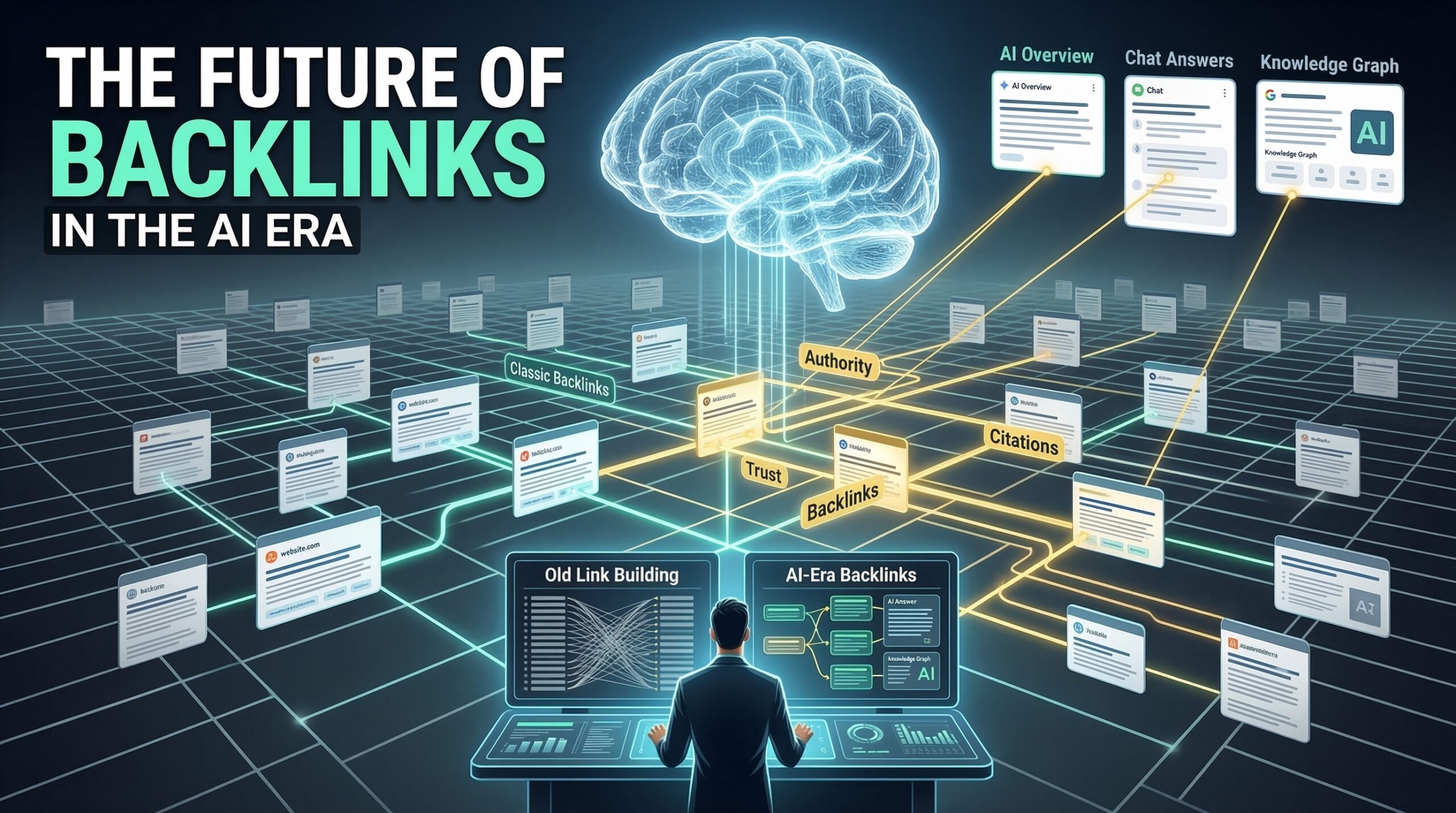
Backlinks aren't dying. They're splitting into two parallel authority systems — one that Google's algorithm still needs, and one that AI answer engines use to decide whose content gets cited. Most SEO teams are building only one of them.
Are Backlinks Still Worth Building in 2026?
The question surfaces in every SEO conversation right now — and the anxious version of the answer ("backlinks are dead") is wrong in a way that will cost you search visibility if you act on it. The accurate version is more nuanced and more operationally demanding.
Backlinks are not dead. Google's Gary Illyes confirmed at Brighton SEO 2024 that links remain one of the top three ranking signals in Google's algorithm — alongside content quality and user experience. For competitive commercial queries, domain authority built through link acquisition is still the primary differentiator between page-one results and everyone else.
What is changing is that backlinks now need to do two jobs simultaneously. The first job — influencing PageRank — is largely unchanged. The second job — establishing entity authority recognisable to AI citation systems — is entirely new, and requires a different type of link acquisition strategy than the one most SEO teams are running.
The risk is not that backlinks stop mattering. The risk is that you spend your link-building budget entirely on the first job while neglecting the second — and your content disappears from AI answer surfaces that your buyers are already using as their primary research tool.
⚑ The Misconception Costing Rankings
Most SEO commentary framing backlinks as "dying" is confusing two separate trends: the decline of low-quality mass link schemes (which Google has penalised since 2012) with a structural change to how authority is recognised. High-authority, contextually relevant links from credible sources are worth more in 2026 than at any point in the last decade — not less. The strategy changes. The signal does not disappear.
How Has the Role of Backlinks Changed Since AI Search Became Mainstream?
To understand the shift, it helps to see the evolution not as a replacement of one system by another, but as a layering of a second authority system on top of the first. Each era added requirements — it did not subtract the previous ones.
// Era 1 · Pre-2012
Volume-Based Link Authority
More links from more domains equalled higher PageRank. Quality was secondary to volume. Mass link schemes, directory submissions, and private blog networks were the dominant acquisition strategy.
// Era 2 · 2012–2020
Quality and Contextual Relevance
Penguin and subsequent updates penalised low-quality links and rewarded contextually relevant, editorially given links from authoritative sources. Domain authority and topical relevance became the primary quality signals.
// Era 3 · 2020–2023
E-E-A-T and Author Entity Signals
Google's Helpful Content updates and E-E-A-T framework elevated author and publisher entity signals alongside link authority. Who linked to you mattered as much as how many did. Brand mentions without links began accumulating measurable weight.
// Era 4 · 2024–Present
Dual-Channel Authority — PageRank + AI Citation
AI Overviews, Perplexity, and ChatGPT Search select sources based on semantic relevance, entity clarity, and structural extractability — not PageRank alone. The highest-authority link profile no longer guarantees AI citation if the content lacks structured entity signals. Both tracks now require explicit optimisation.
The transition from Era 3 to Era 4 is where most SEO strategies have not caught up. Link authority still matters for Era 4 — but it is now a necessary condition rather than a sufficient one. AI citation requires link authority plus entity clarity plus content structure. Missing any one of the three eliminates your content from AI surfaces regardless of domain authority.
What Is the Difference Between PageRank Link Signals and AI Citation Authority Signals?
The two authority systems are not fully separate — there is meaningful overlap — but they are selected for by different mechanisms and require different optimisation inputs. Understanding the signal-level differences determines where your link acquisition and content investment should go.
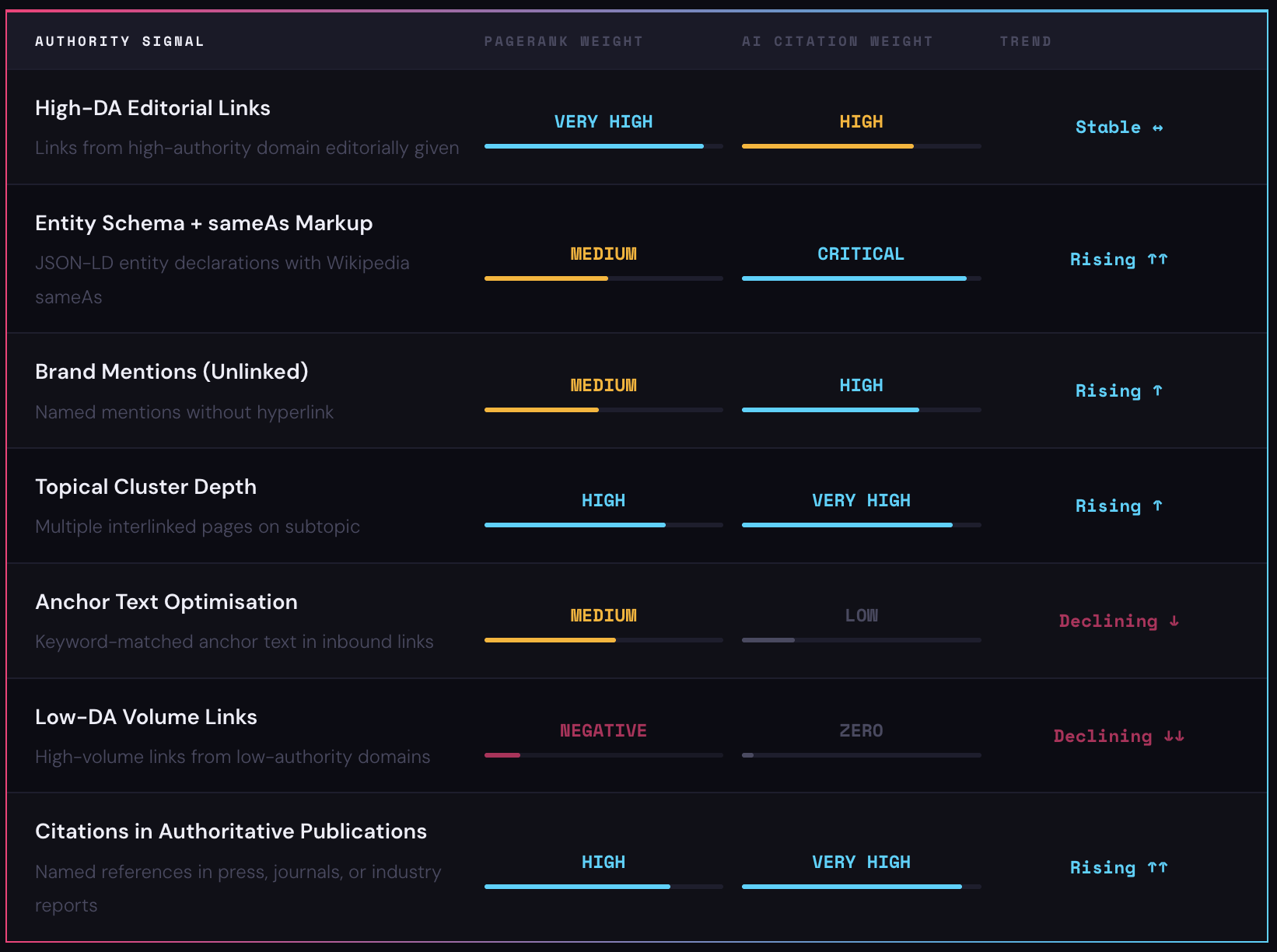
The most operationally significant finding in this matrix: entity schema and unlinked brand mentions now carry higher AI citation weight than anchor-text-optimised links — a complete reversal of the traditional link acquisition priority stack. If your SEO team is still optimising link campaigns primarily for anchor text distribution, they are building for a 2018 algorithm.
// From Our Experience
What we consistently see in real-world SME deployments: businesses with moderate domain authority (DA 30–50) but strong entity schema and topical cluster depth are appearing in Google AI Overviews for competitive queries — while competitors with DA 60–80 and no entity structure are absent from the AI surface entirely. Domain authority is a necessary baseline, not a sufficient one for AI citation.
What Link-Building Strategies Actually Work in the AI Era — and Which Ones Are Wasting Budget?
The 2026 link acquisition landscape rewards a narrower set of strategies at higher quality, while penalising or simply ignoring the volume-based approaches that formed the backbone of most agency link-building programmes through 2022. Here is the frank assessment.
Strategies Losing ROI Fast
Guest Post Mills
High-volume guest posting on mid-tier blogs for anchor text links. Google's SpamBrain now identifies and discounts link farms at scale. The links accumulate but the authority does not.
Directory Submissions
Generic business directories outside your specific industry vertical. Zero AI citation value. Minimal PageRank value since 2019 Penguin integration into core algorithm.
Anchor Text Engineering
Manually engineering exact-match anchor text distribution across link campaigns. AI citation systems ignore anchor text entirely — and Google's spam filters flag unnatural anchor text patterns above 15-20% exact match concentration.
Paid Links Without Disclosure
Still a manual penalty risk. Increasingly detectable by Google's link graph analysis. Carries zero AI citation value — AI systems weight editorial independence as a trust signal.
Infographic Syndication at Scale
Mass infographic distribution for embedded attribution links. The links that return are typically no-follow, low-authority, and provide zero semantic context to AI retrieval systems about your expertise.
Strategies Losing ROI Fast
Original Data and Research
Proprietary research, surveys, and datasets your industry will cite. Each citation is a link with maximum topical relevance, maximum AI citation weight (named data source), and zero manual outreach required.
Expert Contributor Placements
Bylined articles in tier-one industry publications — Forbes, Harvard Business Review, specialist trade press. One link from a DA 80+ publication with full author entity attribution outperforms fifty guest post links on aggregate authority and AI citation weight.
HARO / Journalist Source Relationships
Being the expert source journalists quote in major publications. Creates high-authority links plus named entity mentions that AI systems specifically weight as evidence of real-world expertise beyond the link itself.
Podcast Appearances with Show Notes Links
Expert appearances on high-authority podcasts in your category. Show notes links carry full editorial context — your expertise, your topic, your entity. AI systems read podcast show notes as high-credibility contextual signals.
Broken Link Reclamation with Entity Context
Identifying broken outbound links from high-authority relevant pages and offering your content as the replacement. The highest ROI per-hour link acquisition method — and the resulting link carries full topical context for AI citation.
What Is Entity Authority — and Why Does It Now Matter As Much As Domain Authority?
Entity authority is the degree to which AI systems — Google's Knowledge Graph, Perplexity's retrieval model, and ChatGPT Search's citation engine — recognise your brand as a credible, clearly-defined source of expertise on a specific topic cluster.
Unlike domain authority, which is built primarily through link acquisition over time, entity authority is built through the combination of structured data declarations, consistent named mentions across authoritative sources, topical content depth, and author entity signals. It is faster to build than domain authority and, critically, more directly correlated with AI citation frequency.
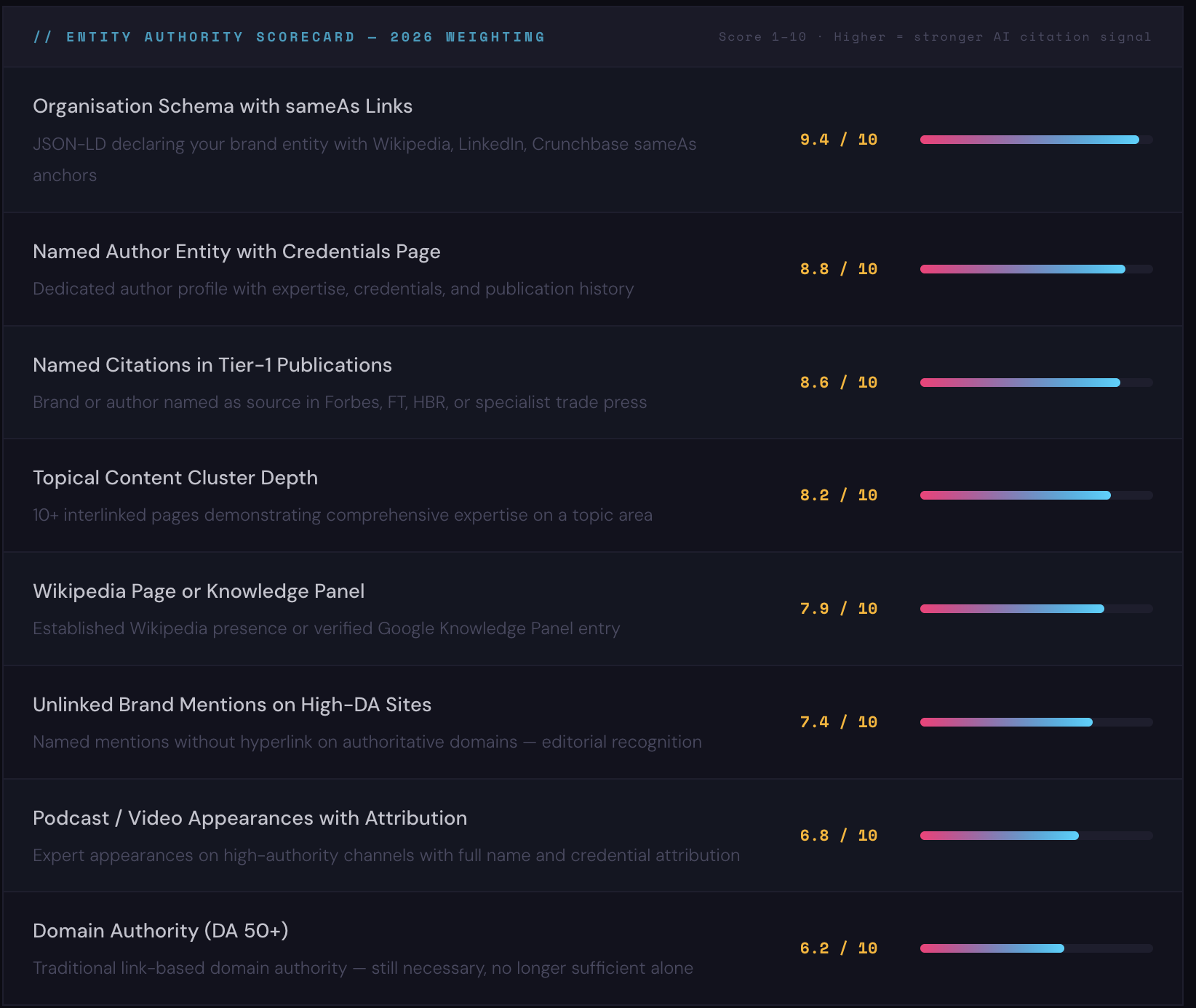
The most striking element of this scorecard for experienced SEOs: Organisation Schema with sameAs links — a technical implementation that costs one hour of developer time — scores higher than domain authority built over years of link acquisition. This does not mean domain authority is irrelevant. It means that for SMEs with moderate DA scores, entity schema delivers proportionally more AI citation impact per hour invested than continued link building alone.
What Is the Actionable Dual-Track Link and Entity Authority Strategy for SMEs?
The dual-track strategy combines traditional link acquisition for Google ranking with entity authority building for AI citation — running both tracks from the same content and PR investment, with minimum additional overhead per piece of work done.
The Monthly Authority Building Stack
// Monthly Dual-Track Authority Checklist
Implement Organisation and Person Schema on All Core Pages
JSON-LD Organisation node with sameAs links to Wikipedia (if available), LinkedIn, Crunchbase, and your industry association profiles. Person schema for each named author with credentials and publication links. One-time technical implementation — permanent entity authority signal.
Publish One Original Data Point Monthly
Survey your client base, analyse your platform data, or compile an industry dataset that journalists and bloggers in your space will cite. Each citation creates a link with maximum contextual authority and a named data source mention — the highest-value AI citation trigger in content marketing.
Respond to Two HARO or Journalist Queries Per Week
Help A Reporter Out and similar journalist source platforms surface daily opportunities to be quoted as an expert source in major publications. The resulting links carry full editorial authority. The named mentions accumulate into a recognisable entity signal that AI systems can verify across multiple sources.
Monitor and Claim Unlinked Brand Mentions Monthly
Use Ahrefs Content Explorer or Google Alerts to identify publications that mention your brand without linking. For high-DA sites, request a link addition. For all sites, the unlinked mention itself adds to your AI citation entity signal — do not discard these as "wasted" mentions.
Build One Deep Topical Cluster Per Quarter
A minimum of five interlinked pages covering a topic cluster from multiple angles: pillar page, definition page, comparison page, use-case page, FAQ page. Topical cluster depth is the highest-weight AI citation signal that scales with content investment — and simultaneously builds the internal link architecture Google uses to assign topic authority.
Pursue Two Tier-1 Contributor Placements Per Quarter
Target one industry-specific trade publication and one broad-reach business publication per quarter for bylined expert articles. One annual investment of six tier-1 placements outperforms fifty low-DA guest posts on every measurable authority signal. Prioritise publications where your ideal buyers already read.
Add Direct Answer Blocks to All Existing High-Traffic Pages
Retrofitting your current top-traffic pages with 40–60 word direct answer blocks costs one hour per page and immediately increases AI citation eligibility for those pages' existing link authority. This is the fastest way to make your current backlink profile work harder for AI search surfaces without new link acquisition.
Track AI Citation Frequency Alongside Traditional Ranking KPIs
Use Semrush's AI Overview tracker or Authoritas to monitor which of your pages are being cited in Google AI Overviews and Perplexity. Run this report monthly alongside your standard rank tracking. Without this measurement layer, you will not know whether your entity authority investment is compounding or stagnating.
Frequently Asked Questions
Are backlinks still important for SEO in 2026?
Yes. Backlinks remain one of the top three Google ranking signals according to Google's Gary Illyes at Brighton SEO 2024. For competitive commercial queries, domain authority built through high-quality link acquisition is still the primary differentiator between page-one and lower rankings. What has changed is that backlinks now serve two parallel functions: traditional PageRank signals for Google ranking, and entity authority signals for AI citation selection by Google AI Overviews, Perplexity, and ChatGPT Search. The businesses that recognise both functions and build for both simultaneously have a measurable advantage over those optimising for only one.
How do AI systems like Google AI Overviews use backlinks differently from traditional search?
Google AI Overviews and other AI answer engines use backlink signals as one input among several, weighted differently than traditional PageRank. Semrush's AI Overview Citation Study 2024 found that 71 percent of AI citations came from pages outside the top three Google rankings for the same query — meaning content quality, structural extractability, and entity clarity consistently override pure link authority in AI source selection. AI systems specifically weight named citations in authoritative publications, entity schema declarations, and unlinked brand mentions on high-DA sites — signals that traditional link building campaigns do not directly address.
What is entity authority and how does it differ from domain authority?
Domain authority is a link-based score reflecting the quantity and quality of inbound links to a domain. Entity authority is the degree to which AI retrieval systems recognise a brand or author as a credible, clearly-defined source of expertise on a specific topic — built through Organisation and Person schema declarations, named mentions in authoritative publications, topical content cluster depth, and verified Knowledge Panel presence. Entity authority is faster to build than domain authority, more directly correlated with AI citation frequency, and specifically actionable through technical implementation (JSON-LD schema) within days rather than the months required to accumulate meaningful domain authority through link acquisition.
What link-building strategies work best in 2026?
The highest-ROI link-building strategies in 2026 are: original proprietary data and research that journalists and bloggers cite independently; expert contributor placements in tier-one industry and business publications; HARO and journalist source relationships that produce named expert quotes in major publications; podcast appearances with full attribution in show notes; and broken link reclamation targeting high-authority relevant pages. These strategies produce high-authority, contextually relevant links that serve both PageRank and AI citation functions. Low-DA volume link schemes, generic guest post networks, and anchor-text-engineered link campaigns are producing negative or zero net returns across both signals.
How do I make my existing backlink profile work harder for AI citation?
The fastest method for leveraging existing link authority for AI citation is retrofitting top-traffic pages with AIO structural elements: add a 40 to 60 word direct answer block immediately after the H1, implement Organisation and Person JSON-LD schema with Wikipedia and LinkedIn sameAs anchors, add an FAQ section with five self-contained Q&As, and verify or add HowTo schema for any process-oriented pages. These additions do not require new link acquisition — they activate the entity authority potential of the link profile you have already built, making your existing domain authority visible to AI retrieval systems that currently cannot extract usable citation signals from unstructured content.
The Parallel Investment Compounds — or the Gap Opens
Twelve months from now, there will be two types of B2B businesses. Those that recognised the dual-track authority shift in 2025 and began building both PageRank and entity authority simultaneously. And those that continued running their 2022 link-building programme, ranked for their target keywords, and gradually disappeared from the AI answer surfaces where their buyers were conducting the first stage of every purchase decision.
The mechanics are clear. The signal weights are documented. The execution checklist is above. What remains is whether you treat this as a future problem or a current one — because the businesses doing this now are compounding an authority advantage that will be structurally difficult to close once the AI citation landscape solidifies around established sources.
The backlink is not obsolete. It is half of the answer. Build both halves.