
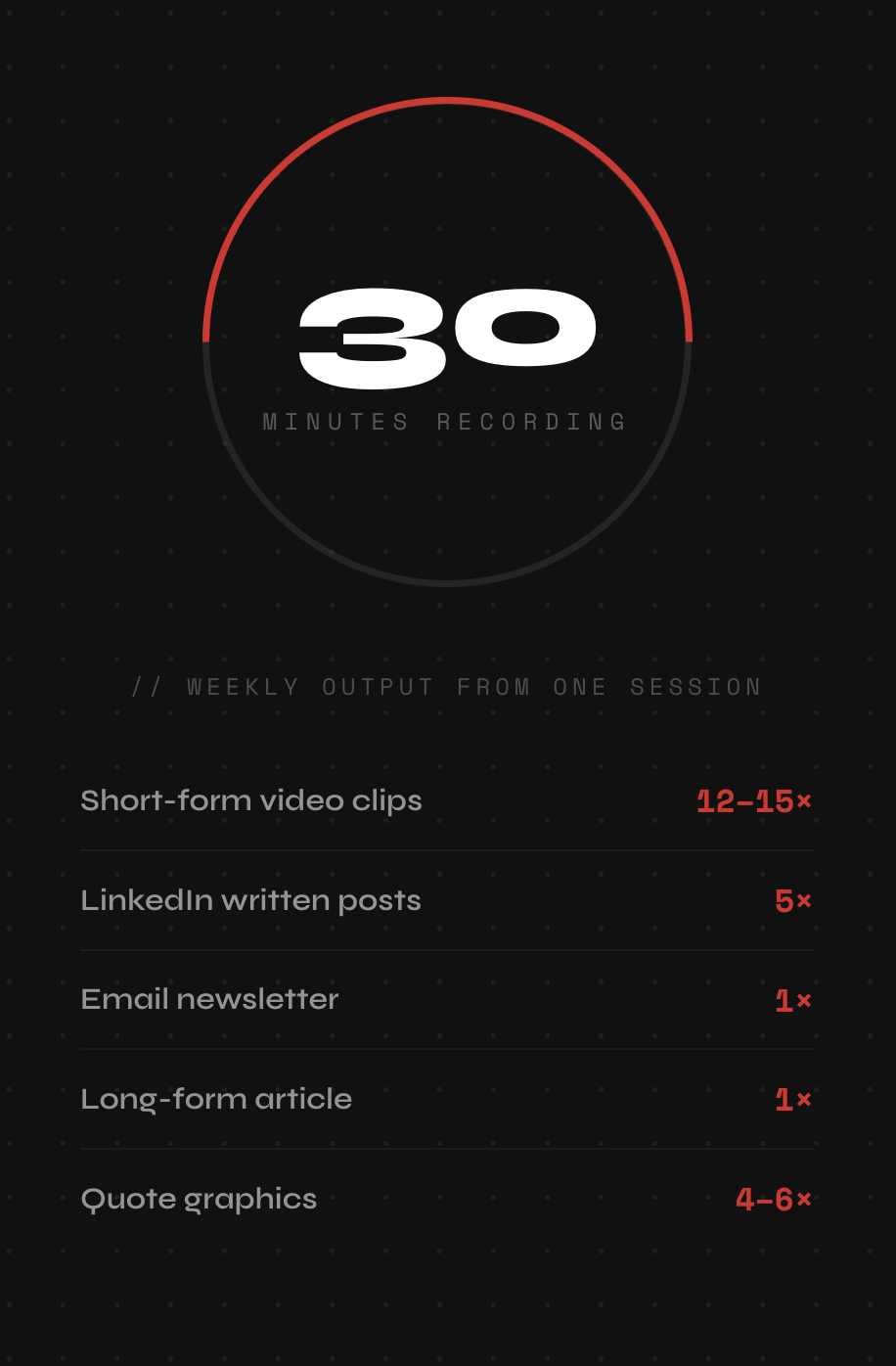
Direct Answer: The 30-Minute Content Machine works by recording one structured anchor video session weekly, then using AI to extract, repurpose, and distribute 25–30 individual content assets across every relevant platform. A founder spending 30 minutes recording produces enough content to publish something every day for a week — without writing a single post from scratch, without a content team, and without a production agency. The AI handles everything after the record button stops.
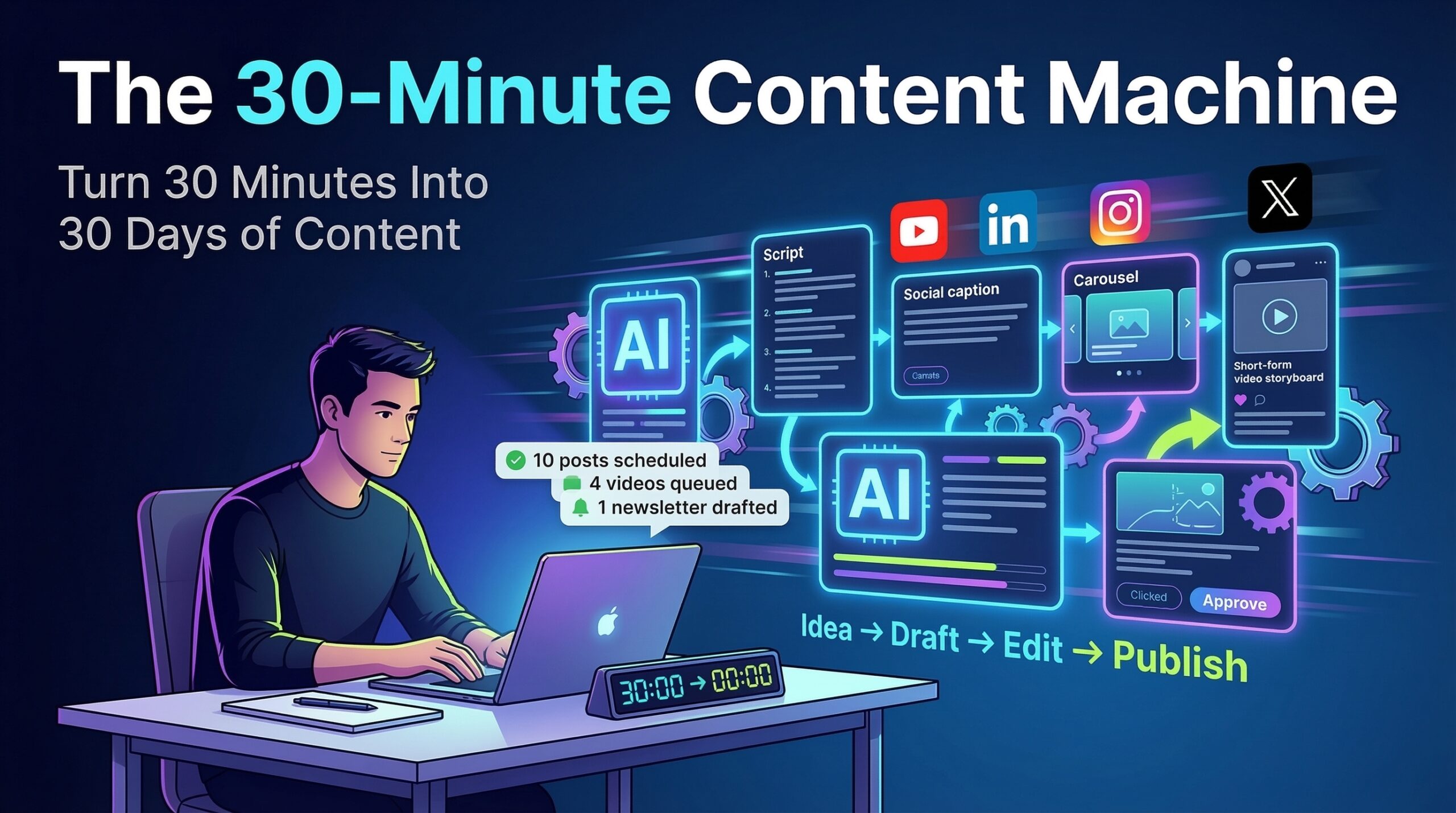
One focused recording session. Processed by AI. Enough content to fill your entire week across every platform your buyers are watching.
Why Does "Creating Content Every Day" Fail Every Busy Founder Who Tries It?
The standard content advice has not changed in a decade: post every day, stay consistent, show up for your audience. The problem is that advice was written for professional creators — people whose entire job is content production. It was not written for the founder running a 40-person company who has four hours of meetings before lunch.
The daily posting model fails founders for a structural reason, not a discipline reason. It demands you treat content as a primary production activity when it is, at best, a secondary one. Every post written from scratch during a busy week is a post written under time pressure, producing output that reflects that pressure.
What we consistently see when working with SME founders: the ones with the most engaging content are almost never the ones posting daily under grind conditions. They are the ones who batch — who record once, think clearly, and let a system distribute the output across the week.
The 30-Minute Content Machine is that system. And it works not because it is clever, but because it aligns with how founders actually think and what AI can now actually do.
92%
of marketers report that video produces better ROI than any other content format
Wyzowl · State of Video Marketing Report, 2024
54%
of executives say they share video content with colleagues weekly — more than any other content format in B2B contexts
Forbes Insights · B2B Video Report, 2023
3.7×
more leads generated by companies publishing 16+ pieces of content per month versus those publishing 4 or fewer
HubSpot · Marketing Benchmarks Report, 2024
5×
LinkedIn engagement advantage for native video over text posts in algorithmic distribution since Q3 2024 algorithm update
LinkedIn Internal Data, Q3 2024
The data is not ambiguous: more content, distributed consistently, across the platforms your buyers use, produces compounding lead generation. The machine exists. The question is whether you operate it efficiently or exhaustingly.
What Exactly Is the 30-Minute Anchor Session — and How Does It Work?
The anchor session is a single, structured 25–35 minute recording you make once per week. It does not need to be polished. It does not need a studio. It needs three things: a clear topic, an on-camera presence, and a microphone that captures your voice cleanly.
The session is recorded in a specific format designed for maximum AI extraction value. Not as a lecture. Not as a tutorial. As a structured thinking session on a topic your buyers are actively searching, debating, or confused about. The format matters because it determines how richly AI can extract standalone clips, quotes, and insights from the raw material.
The 30-Minute Session Structure
The Hook — The pattern interrupt opening (Min 0–3)
Start with the counter-intuitive statement, the surprising statistic, or the wrong assumption your audience holds. Do not ease in. State the most provocative version of your point immediately. This opening becomes the strongest short-form clip AI extracts — and the one that generates the most platform-level distribution.
// 3 minutes · Produces: 1–2 standalone clips
The Framework — Your named system or process (Min 3–15)
Walk through the 3–5 step framework, principle, or process that addresses the topic. Give each step a specific name. This section is the most extractable — each named step becomes a standalone clip, a LinkedIn post, and a newsletter section. The naming convention is not cosmetic; it is structural for AI extraction.
// 12 minutes · Produces: 3–5 clips, 3–5 posts, newsletter body
The Evidence — Proof from your direct experience (Min 15–22)
A specific client example, a before/after scenario, or a result you have seen directly. Keep it concrete and named where possible. AI treats evidence sections as trust-building content best suited for LinkedIn carousels, article sections, and email case study blocks. Abstract claims produce weak assets; specific examples produce strong ones.
// 7 minutes · Produces: 2–3 clips, article evidence section
The Call to Think — The reframe close (Min 22–30)
End with the single most important conceptual reframe your session has built toward. Not a sales pitch — a perspective shift. "The question is not whether to do this. The question is how long you want to wait before starting." This close produces the most saved and shared clips across every platform because it gives the viewer something worth keeping.
// 8 minutes · Produces: 2–4 clips, closing article paragraph, email sign-off
From Our Experiences: The single most common founder mistake in anchor session recording is over-preparing. We consistently see founders write full scripts, rehearse them, and produce stilted, low-engagement content — then wonder why their unscripted competitor is outperforming them. The AI extracts natural authority better than rehearsed performance. Prepare a bullet-point outline. Speak to it freely. The rough edges are what make it trustworthy.
How Does AI Turn 30 Minutes of Recording Into a Week of Content?
This is where the mechanical advantage of the model becomes visible. The AI repurposing layer does not create content from nothing — it extracts, reformats, recontextualises, and distributes content that already exists in your recording. Your thinking is already done. AI packages it for each platform's native format and audience behaviour.
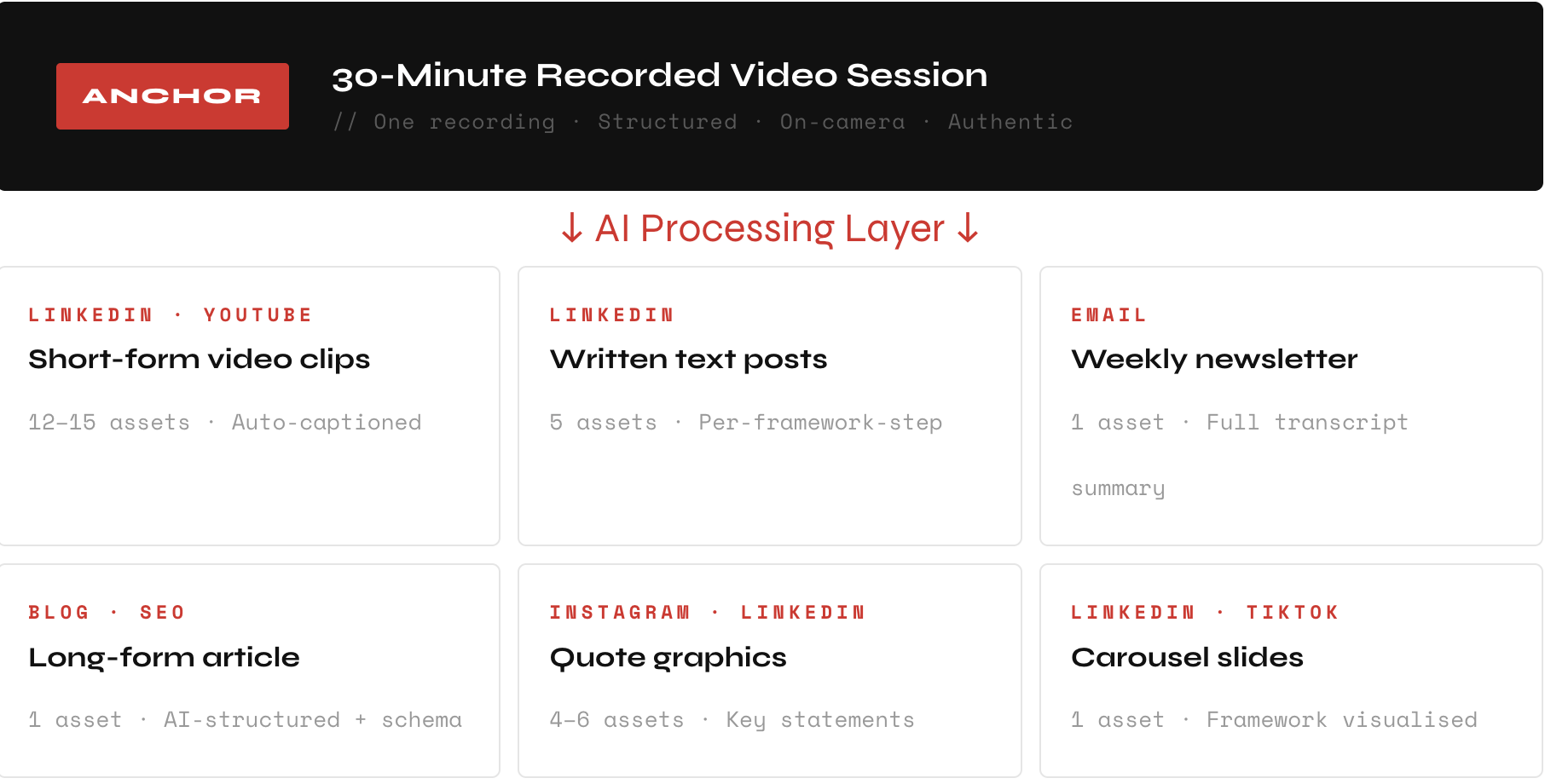
The total output from one 30-minute session: 24–29 individual content assets ready for scheduled distribution across the week. That is more content than most SMEs publish in an entire month — produced in the time it takes to record a single Zoom call.
The distribution system then schedules each asset to publish at the optimal time for its platform — LinkedIn posts at 7:30am Tuesday and Thursday, short-form video at 12pm daily, newsletter on Wednesday morning. The founder records on Monday morning and the content machine runs itself for seven days without a single additional decision required.
What Does the Weekly Content Calendar Actually Look Like?
The weekly calendar is the operating document that makes the machine feel real. Every asset from the anchor session is slotted into a specific platform at a specific time — not randomly distributed, but sequenced to create a narrative arc across the week that a buyer following you experiences as a coherent, deepening conversation.
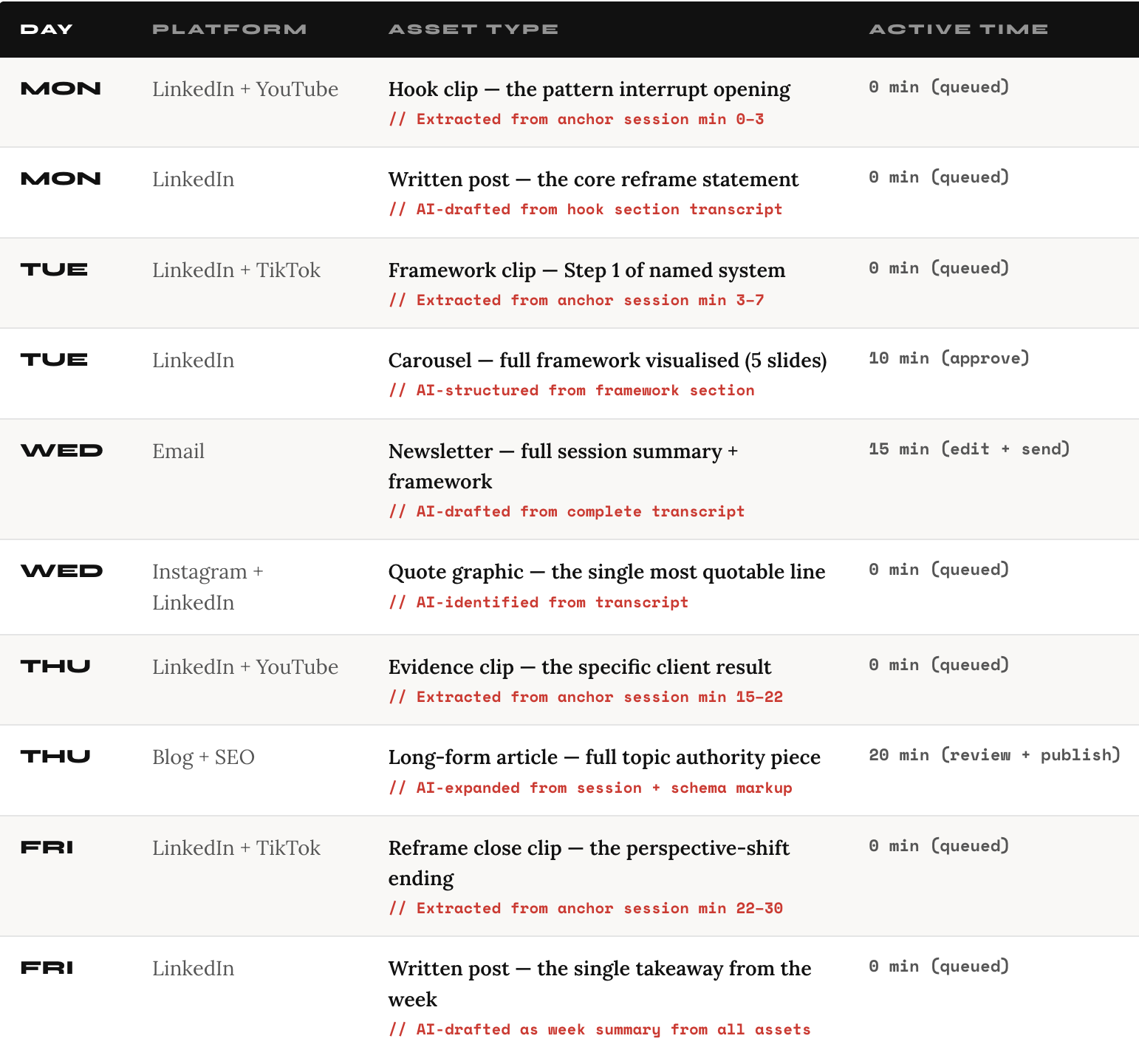
Total active time after the Monday anchor session: 45 minutes spread across Wednesday and Thursday for newsletter editing and article review. The rest is AI-automated. You recorded once. The machine published daily. Your buyers experienced you as a consistent, high-volume presence — because from their side of the feed, you were.
What Are the Three Topic Frameworks That Produce the Highest-Performing Anchor Sessions?
The topic of your anchor session determines the ceiling of every asset it produces. A session on a narrow, niche-specific problem generates clips that speak directly to your ideal buyer. A session on a generic, broadly-applicable topic generates clips that speak to everyone and convert no one.
From our experience working with founders across B2B services, professional services, and technology: three topic frameworks consistently produce the highest-performing content across all platform types.
Framework 1 — The Costly Mistake
"The [industry] mistake that costs [specific business type] [quantified consequence]." Topics built around mistakes your ideal buyers are actively making right now. The psychological driver is loss aversion — content about what not to do consistently outperforms content about what to do at 2.3 to 1 in LinkedIn engagement data (LinkedIn Creator Analytics, 2024). Pick the mistake you see repeatedly. Name it specifically. Explain the mechanism that makes it costly.
Framework 2 — The Misunderstood Process
"Why [widely believed process] does not work — and what does." The reframe topic. You take the conventional approach your industry promotes and challenge it with evidence from your direct experience. This format generates the most shares because it gives viewers something socially valuable to pass to their network — a counter-intuitive insight that makes them look well-informed.
Framework 3 — The Specific Result Breakdown
"How [client type] achieved [specific result] in [specific timeframe]." The case study format. Specific enough to feel real, anonymised where needed, structured with the before state, the intervention, and the measurable after state. This topic consistently produces the strongest direct conversion from viewer to inbound enquiry because it answers the exact question every prospect is silently asking: "has this worked for someone like me?"
Topic Selection Rule: Before recording any anchor session, ask: "If my single best potential client saw only this one video, would they know exactly what problem I solve and whether it applies to them?" If the answer is no, the topic is too broad. Narrow it by one level before recording. "How AI content works" is too broad. "How B2B consulting firms use AI video to generate leads without a content team" is a topic that converts.
Enter your text here...
Enter your text here...
Enter your text here...
Enter your text here...
Enter your text here...
Enter your text here...
Enter your text here...
Enter your text here...