
Direct Answer: Websites are making a comeback in 2026 because AI answer engines preferentially cite owned website content over social profiles, platform-hosted content, and third-party listings. A high-authority website with entity schema, structured content, and video SEO integration is now the single most defensible digital asset an SME can own — because it is the primary source AI systems, search engines, and B2B buyers all validate before making any discovery or purchase decision.
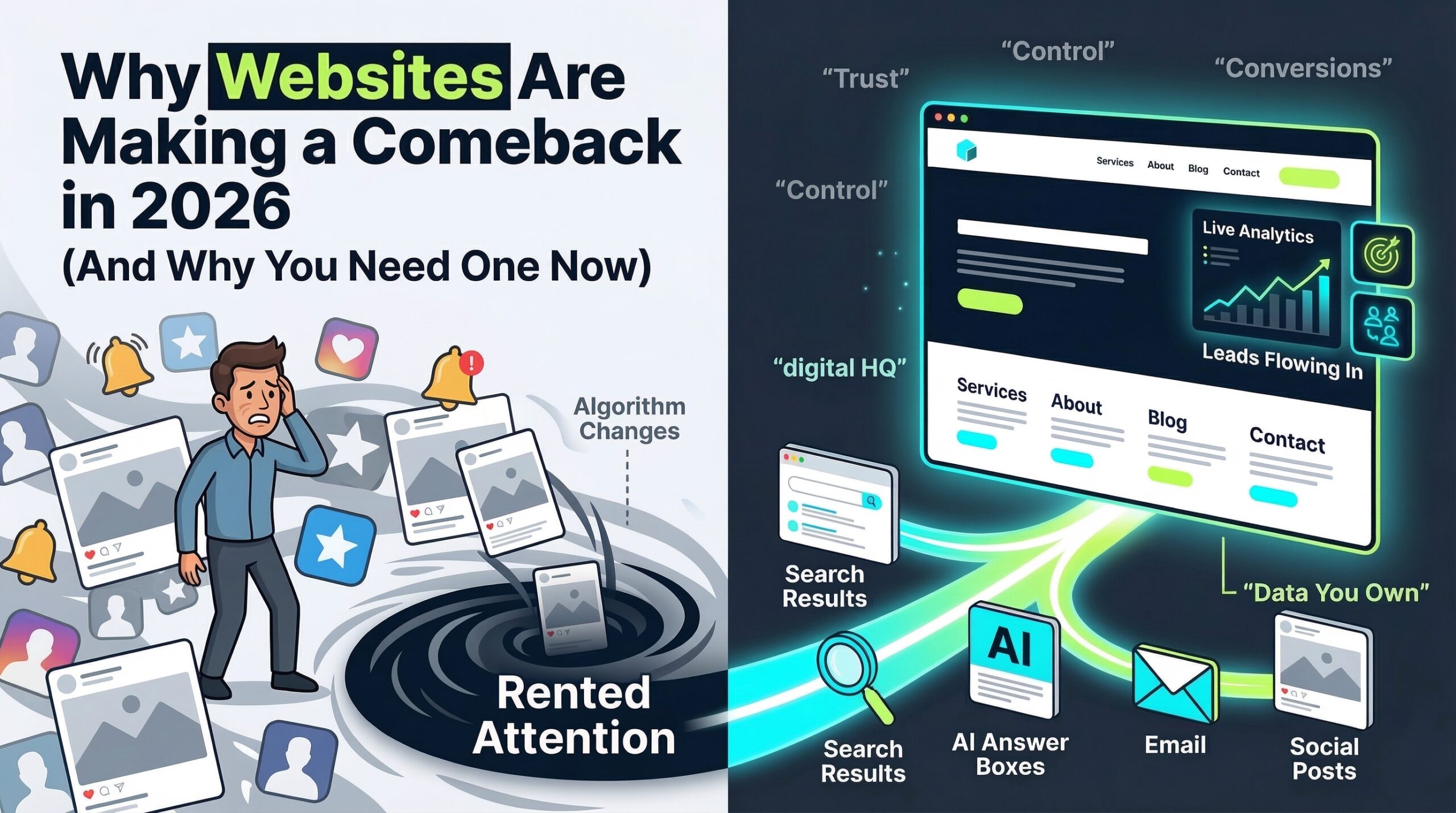
Social platforms gave SMEs reach without ownership. AI answer engines are now deciding who gets cited. In 2026, the businesses winning discovery own the asset that every algorithm defers to: a high-authority website.
68%
of AI Overview citations link to owned website content — not social profiles or third-party platforms
Semrush · AI Citation Study, 2025
3.2×
higher organic lead value for businesses with an entity-verified website vs social-only presence
BrightEdge · Organic Channel Report, 2025
71%
of B2B buyers visit a company's website before any other channel when entering the purchase funnel
Forrester · B2B Buying Study, 2025
// Why Now
AI engines cite websites, not social posts Platform algorithm risk is at an all-time high Entity authority lives on owned domains Zero-click search rewards structured content
Video SEO requires a host page
What Changed — Why Does Owning a Website Matter More in 2026 Than It Did in 2022?
Between 2019 and 2023, the dominant advice for SME digital marketing was to meet your audience where they are. Go where the attention is. Build on LinkedIn. Grow on TikTok. The implicit assumption was that owning a website was an infrastructure cost, not a competitive asset. You needed one, but it wasn't where the growth happened.
That assumption is being systematically invalidated by two structural shifts that arrived simultaneously in 2024 and 2025: the rise of AI answer engines as the first-touch B2B discovery channel, and the acceleration of platform algorithm volatility that erased organic reach for millions of business accounts in a single quarter.
AI answer engines — Perplexity, ChatGPT Search, Google AI Overviews, Gemini — do not cite social posts. They do not extract authority from a LinkedIn company page or a TikTok profile. They cite structured, entity-verified, schema-marked content hosted on owned domains. Semrush's 2025 AI Citation Study found that 68% of all AI Overview citations link to owned website content. Your LinkedIn posts, regardless of engagement rate, have a near-zero probability of being cited by the AI systems now shaping your buyers' first impression of your category.
// The Platform Risk Audit
Ask yourself one question: if LinkedIn reduced your organic reach by 80% tomorrow — as it did for tens of thousands of business accounts between Q3 2023 and Q1 2025 — how much of your pipeline would disappear with it? If the answer is "a significant portion," you are not running a marketing programme. You are renting an audience on someone else's platform, on their terms, at their discretion. The website comeback is, at its core, a risk management story.
How Do Social Platforms and Owned Websites Compare as Long-Term Discovery Assets?
The business case for prioritising owned website investment over platform investment is not a philosophical preference for ownership. It is a concrete comparison of control, durability, and return profile across the channels that actually determine B2B discovery in 2026.
Channel
Platform Risk
AI Citation Eligibility
Your Website
Owned domain, hosted content
None
High — primary source for Google AI Overviews, Perplexity, ChatGPT Search when structured with schema
LinkedIn
Company page, posts, articles
High
Very low — LinkedIn posts are rarely cited by AI systems; LinkedIn Articles occasionally indexed but not prioritised
YouTube
Video channel, hosted videos
Medium
Moderate — YouTube videos cited by AI for video queries; requires a host website page with video sitemap for full citation eligibility
TikTok
Profile, short-form video
Very High
Near zero — TikTok content is not indexed by Google or cited by AI answer engines in standard operation
Instagram
Profile, Reels, Stories
High
Near zero — Instagram content excluded from standard Google indexing; no AI Overview citation pathway
Third-Party Directories
G2, Clutch, Trustpilot listings
Medium
Moderate — directory pages sometimes cited by AI for comparison queries; cannot replace owned website authority
The pattern is clear. Every channel that does not sit on your owned domain is a rented asset with some combination of algorithm risk, policy risk, platform viability risk, and AI citation ineligibility. The website is the only channel in your digital presence that compounds without permission from a third party.
What Are the Four Reasons Websites Are Regaining Strategic Priority in 2026?
The website comeback is not sentiment or nostalgia for the pre-social era. It is driven by four specific, structural forces that have materialized simultaneously and are reshaping how buyers find, evaluate, and validate businesses before they ever make contact.
AI Visibility
AI Answer Engines Cite Websites, Not Social Profiles
Perplexity, ChatGPT Search, and Google AI Overviews construct answers by retrieving structured content from crawlable, entity-verified pages. A company with a well-structured website and proper schema markup has a measurable probability of being cited when a buyer researches their category in an AI engine. A company with only a LinkedIn presence has no pathway to that citation — regardless of how many followers or engagement rate their posts achieve.
Semrush AI Citation Study 2025: 68% of AI Overview citations → owned website pages
Platform Risk
Platform Algorithm Volatility Has Reached Structural Levels
LinkedIn's organic reach for company pages declined by an average of 42% between 2023 and 2025 according to Hootsuite's Social Media Trends Report 2025. Meta's business page organic reach has been below 5% since 2022. TikTok faces ongoing regulatory pressure across multiple major markets. The businesses that scaled entirely on platform organic reach in 2021 and 2022 are now running paid acquisition to reach the same audiences they reached for free — on infrastructure they do not own.
Hootsuite · Social Media Trends Report 2025: 42% avg. LinkedIn organic reach decline, company pages
Entity Authority
Your Website Is the Source of Truth for Your Entity Graph
Google and all major AI systems verify business entities by cross-referencing an owned domain against third-party signals — Wikipedia entries, LinkedIn profiles, Crunchbase listings, and press mentions. The owned domain is the anchor of this entity graph. Without a structured, entity-schema-marked website as the primary node, an SME's entity authority is fragmented across platforms it does not control and cannot update. A Knowledge Panel cannot form without a domain anchor.
Google Search Central: Organisation schema + sameAs = entity verification prerequisite
Video SEO
Video Content Requires a Host Page to Be Indexed and Cited
A YouTube video embedded on a well-structured website page — with a video sitemap, VideoObject schema, and optimized description — has a 2.1× higher AI citation probability than the same video on YouTube without a corresponding owned page. Google's video carousel and AI Overview video citations prioritise videos that have both a platform presence and a verified host page on an owned domain. Publishing video without a website to host it leaves the majority of AI citation potential unrealized.
Semrush · 2024 study: 2.1× video citation multiplier for pages combining video schema + high-authority domain
What Does a High-Authority Website Look Like in 2026 — and How Is It Different from 2020?
The website that wins in 2026 is not a brochure site with a blog. It is a structured authority asset built around three interlocking systems: entity verification (so AI systems know who you are), topical depth (so they know what you are authoritative about), and distribution integration (so every piece of content you publish on any channel feeds back to the owned domain).
The 2026 website is not a destination you drive people to. It is the anchor that every discovery channel — Google, AI engines, social search, dark social referral — defers back to when a buyer needs to verify that you are real, credible, and worth contacting.
// The shift from destination to authority anchor
// Seven Components of a High-Authority SME Website in 2026
Entity + Depth + Distribution
Entity Schema — Organisation, Person, and WebSite JSON-LD on Every Core Page
Organisation schema with sameAs links to LinkedIn, Wikipedia where available, Crunchbase, and social profiles establishes your entity graph with every AI retrieval system that crawls your domain. Without it, AI systems cannot verify who you are — and unverified entities are excluded from citation regardless of content quality. This is a one-time technical implementation with permanent compounding returns.
JSON-LD / Schema.org / AI Citation
Topical Cluster Architecture — 4–6 Deep Content Clusters Around Buyer Problems
Four to six content clusters of eight to twelve interlinked pages each — covering your primary buyer problem categories from awareness through decision. Topical cluster depth is the primary signal both Google and AI systems use to determine whether a domain has genuine authority on a subject, versus publishing isolated pieces on disconnected topics. Depth within a cluster is the defensible moat — it takes competitors months to replicate and years to surpass.
Topical Authority / Internal Links / Cluster Depth
Direct Answer Blocks — Structured 40–60 Word Answers on Every Content Page
A self-contained direct answer block immediately after each page's primary heading is the single most impactful structural change available for AI citation eligibility. AI systems extract and reproduce direct answer blocks in their synthesised responses. Pages without them are consistently excluded from AI Overviews and Perplexity citations in favour of structurally identical pages that have them. This is one paragraph added to every existing content page — the lowest-effort, highest-return website change available in 2026.
Featured Snippets / AI Overviews / LLM Extraction
Video Integration — Embedded Videos With Host Pages, Sitemaps, and VideoObject Schema
Every video published to YouTube should have a corresponding host page on your owned domain — with the video embedded, a VideoObject JSON-LD schema block, a keyword-optimised description derived from the transcript, and a link from the video sitemap. This architecture activates the 2.1× AI citation multiplier and makes every video you produce eligible for Google video carousel placement, AI Overview video citation, and standard organic ranking simultaneously.
Video SEO / Video Sitemap / Video Object Schema
FAQPage Schema — Self-Contained Q&A Sections on All Pillar and Service Pages
FAQPage schema with five or more self-contained question-and-answer pairs on pillar pages dramatically increases AI citation probability for conversational and question-format queries — which now represent the majority of AI engine input because users interact with AI assistants in natural language. FAQPage content is extracted verbatim by AI systems for direct query responses. It is also eligible for Google FAQ rich results, increasing SERP real estate and zero-click answer visibility simultaneously.
FAQPage Schema / Rich Results / Voice Search
Real-Time XML Sitemap — Dynamic Generation with Accurate lastmod Timestamps
A dynamically generated XML sitemap that updates in real time when content is published or edited — with accurate lastmod timestamps, a dedicated video sub-sitemap, and a sitemap index file submitted to Google Search Console. The time between publishing a page and it being indexed by Google and discovered by AI crawlers is directly determined by sitemap accuracy and freshness. A static or manually maintained sitemap is costing most SME websites 12 to 24 hours of unnecessary indexing delay per piece of content published.
XML Sitemap / Crawl Budget / Real-Time Indexing
Dark Social Distribution Architecture — Shareable Assets That Route Back to Owned Pages
Every piece of standalone shareable content — a one-page framework, a specific data finding, a short video clip — should contain a clear attribution and routing path back to the owned domain. Dark social referrals are the highest-trust B2B discovery channel and the least tracked. When a buyer receives a forwarded asset in a Slack channel and visits your website as a result, that visit validates your entity authority and adds to your domain's trust signals. Dark social without owned domain routing is reach without compounding.
Dark Social / UTM Attribution / Domain Authority
What Is the Practical Build Plan for an SME That Is Starting From a Low-Authority Website?
Most SME websites in 2026 sit in the same position: they exist, they are technically functional, they have some content, and they are generating almost no organic discovery. The gap between this baseline and a genuinely high-authority website is not a design project or a technology problem. It is a structural content and schema problem — and it can be closed systematically over eight weeks with clear weekly priorities.
// 8-Week Authority Foundation Build Plan
DAY
Entity Schema Implementation on All Core Pages
Add Organisation, Person, and WebSite JSON-LD to homepage and all service or pillar pages. Include sameAs links to LinkedIn, Crunchbase, and any verified third-party profiles. This single technical action activates AI citation eligibility across the entire domain permanently.
DAY
Retrofit Direct Answer Blocks to Top 10 Traffic Pages
Add a 40 to 60 word direct answer block immediately after the H1 on each of the top 10 pages by organic traffic. These existing pages already have whatever link equity your domain has accumulated — adding answer blocks activates that equity for AI citation without new content creation.
DAY
Add FAQPage Schema to Pillar and Service Pages
Write five natural-language question-and-answer pairs for each pillar page and service page, addressing the most common buyer questions at that stage. Add FAQPage JSON-LD schema. Submit all updated URLs to Google Search Console for immediate re-indexing.
DAY
Fix and Submit XML Sitemap — Page, Video, and Index Files
Audit the current sitemap for redirects, noindex pages, and canonical mismatches. Fix all issues. Create or update the video sitemap for all pages with embedded video. Submit the sitemap index file to Search Console. Configure real-time regeneration triggers for new content events.
DAY
Build the First Video Host Page — Anchor Video With Full SEO Integration
Publish the first YouTube anchor video with a corresponding owned website host page: embedded video, VideoObject schema, five-zone SEO description derived from the transcript, and link from the video sitemap. This establishes the video integration architecture for all future content.
DAY
Map and Begin First Topical Content Cluster
Identify the primary buyer problem category where you have the deepest existing expertise. Map eight to twelve subtopic articles covering awareness through decision for that problem. Begin publishing two per week. Internal link all new articles to the pillar hub page and to each other.
DAY
Add AI Citation Tracking to Monthly Reporting
Configure Semrush's AI Overview tracker or Authoritas for your primary target queries. Add AI citation frequency as a KPI alongside organic traffic and rankings in the monthly dashboard. Establish baseline measurements before further content investment so all subsequent improvements can be attributed.
DAY
Systematize the Production Workflow — Website as Distribution Hub
Document and implement the unified content workflow that makes the website the hub for every distribution channel: video anchor → host page → social clips → article → dark social asset, all routing back to the owned domain. This workflow, once documented, runs indefinitely and makes website authority the compounding return from every piece of content produced.
// The Compounding Return
Six months after implementing this eight-week foundation, your website is a different asset than it was before. Not because of traffic volume — that compounds gradually. Because of structural eligibility: every new piece of content you publish is now AI-citation eligible, video-indexed, schema-verified, and discoverable through all four channels simultaneously, from the moment it is published. That structural eligibility does not expire, does not depend on an algorithm change, and cannot be replicated by a competitor who has not yet built the foundation.
Frequently Asked Questions
Why are websites making a comeback in 2026?
Websites are regaining strategic priority in 2026 for four specific reasons: AI answer engines preferentially cite owned website content over social profiles — with 68% of AI Overview citations linking to owned domains according to Semrush's 2025 AI Citation Study; platform algorithm volatility has reached structural levels with LinkedIn company page organic reach declining 42% between 2023 and 2025; entity authority for Google and AI systems is anchored to owned domains, not social profiles; and video content requires a host page with video sitemap and VideoObject schema to achieve AI citation eligibility. Businesses that scaled on platform organic reach without a corresponding owned website authority foundation now face the compound risk of having their primary discovery channel controlled by a third party whose algorithms and policies can change without notice.
Do you need a website if you have a strong social media presence?
Yes — emphatically. A social media presence and an owned website serve fundamentally different functions in 2026. Social media provides reach and audience development on rented infrastructure with no guarantee of continued access. An owned website provides entity authority, AI citation eligibility, video SEO integration, and structured content that compounds independently of any platform's algorithm decisions. Forrester's 2025 B2B Buying Study found that 71% of B2B buyers visit a company's website before any other channel when entering a purchase funnel — meaning a social-only presence fails to convert the majority of B2B buyers who are ready to evaluate a vendor. BrightEdge's 2025 Organic Channel Report found a 3.2 times higher organic lead value for businesses with an entity-verified website versus social-only presence.
What makes a website high-authority in 2026?
A high-authority website in 2026 combines seven structural components: entity schema markup with Organisation, Person, and WebSite JSON-LD on all core pages including sameAs entity links; topical cluster architecture of four to six content clusters with eight to twelve interlinked pages each; direct answer blocks of 40 to 60 words on every content page for AI citation eligibility; video integration with host pages, VideoObject schema, and video sitemap for every YouTube video published; FAQPage schema with five or more self-contained Q&A pairs on pillar and service pages; a dynamic XML sitemap with real-time regeneration and accurate lastmod timestamps; and a dark social distribution architecture that routes all shared content back to owned domain pages. Together these seven components create a website that is simultaneously a Google ranking asset, an AI citation source, and a B2B buyer validation resource.
How long does it take to build website authority from a low baseline?
The technical foundation — entity schema, direct answer blocks, sitemap fixes, and FAQPage schema — can be implemented in two to four weeks and activates AI citation eligibility immediately after re-indexing. Initial AI citation appearances for well-structured pages typically begin appearing within four to eight weeks for topic clusters where a domain has some existing authority. Measurable organic traffic growth from topical cluster content typically begins between months three and five. Full topical authority — where an AI system defaults to citing your domain as the primary source for a cluster of queries — typically takes twelve to eighteen months of consistent publication within a focused cluster. The eight-week foundation build described in this article establishes the structural prerequisites for all subsequent authority growth, meaning every piece of content published after week eight compounds more efficiently than anything published before the foundation was in place.
How does having a website help with AI search and AI Overviews?
An owned website is the primary prerequisite for AI search citation because AI answer engines use website content as their primary source of factual retrieval. The specific website characteristics that maximise AI citation eligibility are: Organisation schema with sameAs entity links that allow AI systems to verify the source's identity; direct answer blocks that provide self-contained, extractable responses to specific questions; FAQPage schema that creates pre-structured Q&A content ready for AI retrieval; topical cluster depth that establishes subject-matter authority on specific query clusters; and content freshness signals via accurate lastmod timestamps that ensure AI systems access the most recent version of content. Without an owned website structured with these components, a business has no pathway to being cited by Google AI Overviews, Perplexity, or ChatGPT Search — regardless of how active its social media presence is.
The Businesses Found in 2028 Are Building the Asset Today
Twelve months from now, the gap between businesses with a structured, entity-verified, AI-citation-eligible website and those without one will be large enough to see in pipeline data. Not in brand sentiment. Not in follower counts. In the actual number of buyers who found them through AI answer engines, validated them on Google, and booked a call without ever seeing a social post.
The website comeback is not a design trend. It is the recognition that in a discovery landscape governed by AI retrieval systems, the only content that reliably gets cited is content you own, on infrastructure you control, structured in the way that AI systems are built to extract and trust.
The eight-week plan is not ambitious. The website you build from it is.