
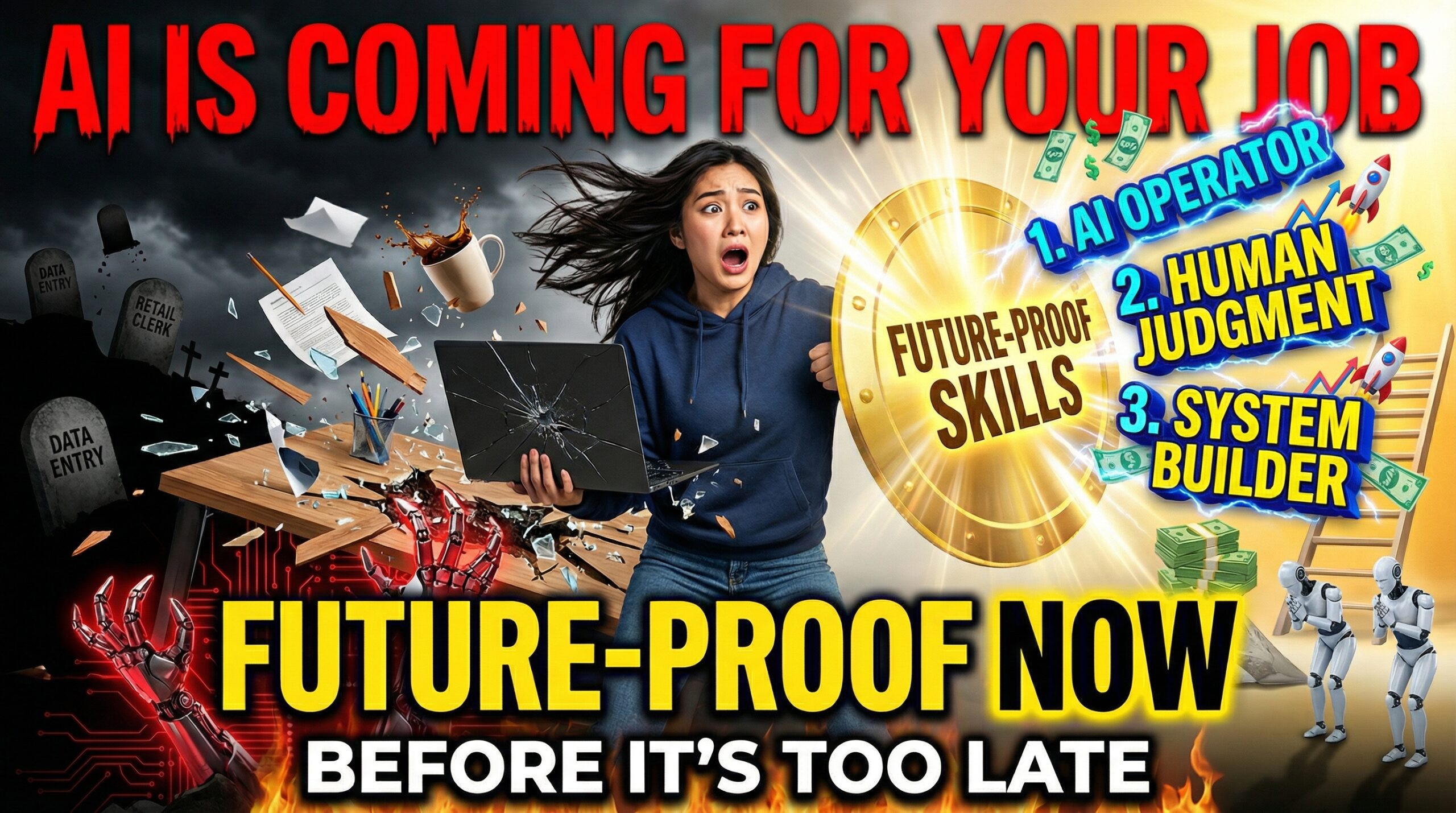
Direct Answer: To future-proof your career before AI makes it obsolete, build four irreplaceable assets: a verified personal entity (Person schema with Knowledge Graph confirmation), a topical authority library of AI-citable content on your specific expertise, a VideoObject host page portfolio that generates perpetual AI citations, and an email authority sequence that converts AI-referred discovery into relationship. McKinsey's 2025 research found that 72% of knowledge worker tasks are automatable — but workers with verified subject-matter authority and AI-native skills face dramatically lower displacement risk than generalist role equivalents.
// The Reframe
AI isn't replacing jobs. It's replacing the way jobs generate value. The professionals who thrive are building an irreplaceable personal authority layer that AI systems can discover, verify, and amplify — while everyone else waits to see what happens.
// Role Displacement Risk
McKinsey 2025
Generic content writer
// No niche authority · No entity schema
High
SEO specialist (keyword-only)
// No AI visibility expertise
High
General marketing manager
// Generalist without AI-native skills
Medium
AI-native content strategist
// Schema · VideoObject · Entity · AIO
Defensible
Verified authority expert
// AI-citable · Schema-marked · Entity-confirmed
Irreplaceable
// Only one category grows under AI
Build toward it
// 01 · The Real Threat
What Is AI Actually Replacing — and What Does That Mean for How You Need to Position Yourself?
The most dangerous misconception about AI's impact on careers is the binary framing: either AI replaces your job or it doesn't. Reality is more surgical and more urgent than that. AI is not replacing entire job categories — it is replacing the specific tasks within jobs that generate generic, reproducible, non-expert outputs. And for the majority of knowledge workers, those tasks represent 40–70% of their current working week.
A content writer who produces generic blog posts from keyword briefs is not at risk because AI is coming for "content writers" — they are at risk because AI can produce generic blog posts from keyword briefs at 1,000× their speed and a fraction of their cost. A content strategist who builds entity-verified authority infrastructure, produces VideoObject schema host pages, and understands how AI retrieval systems select citations is not replaceable at any price, because that work requires genuine expertise, contextual judgment, and a continuously updated understanding of technical systems that AI cannot recursively apply to itself.
72%
Of knowledge worker tasks are fully or partially automatable with current AI tools, per McKinsey Global Institute research
// McKinsey Global Institute, 2025
3.4×
Higher income premium for professionals with verified subject-matter authority versus generalist equivalents in the same field in 2026
// LinkedIn Economic Graph, 2025
89%
Of hiring managers in 2026 report prioritising candidates who demonstrate AI-native skills and demonstrated domain expertise over general qualifications
// LinkedIn Report, 2025
The 3.4× income premium for verified subject-matter authority versus generalist equivalents tells you exactly where to direct your career investment in 2026. The professional who spends the next 90 days building a verifiable, AI-citable, entity-confirmed expertise platform will be standing on the high ground of that 3.4× premium when the displacement cycle that is already underway reaches their specific role. The professional who does nothing will be competing with AI for the 72% of tasks that have already become commoditised.
// The Specificity Principle
AI cannot replace a specific person who is known, verified, and cited as an expert in a specific domain by AI retrieval systems themselves. It can replace a generic content producer, a keyword-brief article writer, or a general marketing coordinator. The career survival question is not whether you can do something better than AI — it is whether AI systems themselves recognise you as a credible expert source that they need to cite in order to give accurate, authoritative answers about your domain.
// 02 · The Moat Architecture
What Are the Four Career Moats That AI Cannot Cross — and How Do You Build Them?
A career moat is any asset or capability that creates a structural advantage that is difficult or impossible for AI to replicate — not because the underlying task is complex, but because the authority, relationships, or verified identity that give the task its value are human in origin and AI-verifiable by definition. The four moats below represent the specific career architecture that produces irreplaceability in the 2026 labour market.
01 Verified Personal Entity — Your Knowledge Graph Identity (Gate 1)
// Person schema · sameAs arrays · Knowledge Graph confirmation
A Person schema with Knowledge Graph confirmation makes you a verified entity in the system that every major AI retrieval surface uses to attribute expertise. When AI systems can verify your identity through Organisation and Person schema, they can safely cite you by name in expert recommendations. This is the foundational career moat because it retroactively makes all your existing content AI-citable and all future content AI-attribution-ready from publication day.
02 Topical Authority Library — Your AI-Citable Expertise Record (Gate2)
// 11-article authority cluster · FAQPage schema · Direct answers
A concentrated cluster of entity-attributed, schema-marked articles covering the primary and secondary questions in your specific domain creates topical authority that AI systems use to classify you as a subject-matter expert rather than an occasional content publisher. This library is your expertise credential in the AI era — the documented evidence that your knowledge depth qualifies you for AI citation in your domain's commercial queries.
03 Video Authority Portfolio — Your Parasocial Trust Asset (Gate 3)
// VideoObject schema · Owned host pages · 18-month lifespan
VideoObject schema host pages convert your recorded expertise into permanent AI-citable assets that generate parasocial trust — the specific neurological mechanism that makes buyers and employers trust a person they have never met. A growing video authority portfolio does what a CV cannot: it shows your thinking, communicates your personality, and generates AI citations that bring new opportunities to you without active outreach on your part.
04 Email Authority Sequence — Your Relationship Conversion System (Gate 4)
// Evergreen nurture · Triggered sequences · Zero active effort
An evergreen email authority sequence converts the passive inbound discovery generated by your AI citation infrastructure into active professional relationships — with potential clients, employers, collaborators, and referral partners. Built once, it operates permanently for every new subscriber who discovers you through organic search or AI recommendations, multiplying the commercial return of your authority assets without any additional active effort per relationship.
// The Compound Effect of All Four Moats
Each moat amplifies the others. Entity verification makes your authority library AI-citable. The authority library earns topical expert status that increases your AI citation frequency. The video portfolio builds parasocial trust in every new buyer who finds you through those citations. The email sequence converts that trust into professional relationships that generate income, opportunities, and new content for the library. The compound begins the day you install entity schema and build your first VideoObject host page — and it runs indefinitely from that point without requiring proportional active effort to maintain.
// 03 · The Risk Matrix
Which Career Roles Are Most Vulnerable — and Which Become More Valuable Under AI?
The displacement risk is not evenly distributed across knowledge worker roles. The specific variable that determines vulnerability is the ratio of generic, reproducible task output to genuine expert judgment in a role's daily function. Roles where the majority of output is generic and reproducible face high displacement risk. Roles where the majority of output requires genuine contextual expertise, verified identity, or human relationship depth face low displacement risk — and in many cases, growing value as AI handles more of the generic work.
Role / Position
AI Automation Risk
Moat Potential
Career Verdict
Generic content writer
Keyword-brief to article, no niche expertise
Very High
Low without niche pivot
Pivot Now
SEO specialist (traditional)
Keyword research, rank tracking, backlinks
High
Medium with AIO skills
Upskill
Social media manager
Content scheduling, engagement tracking
High
Low without strategy layer
Specialise
Marketing generalist
Campaign management, reporting, coordination
Medium
Medium with AI-native skills
Evolve
AIO / AI visibility strategist
Entity schema, VideoObject, AI citation strategy
Low
Very High
Build Now
Verified expert with AI-citable authority
Knowledge Graph confirmed, schema-marked, cited
Very Low
Maximum
Compound
The most commercially significant finding in the displacement risk data is not about which roles disappear — it is about which roles become more valuable precisely becase AI handles more of the surrounding generic work. A verified authority expert in 2026 commands a 3.4× income premium over a generalist equivalent (LinkedIn Economic Graph, 2025) in part because AI has concentrated demand for genuine expert judgment rather than diluting it. When anyone can produce a generic article, a verified expert's AI-cited original analysis becomes more commercially valuable than it has ever been — not less.
The professionals most at risk from AI are those producing outputs that AI can replicate. The professionals most protected are those producing authority that AI needs to cite.
// The distinction that separates career survival strategy from career hedging in the AI displacement era
// 04 · The Build Plan
How Do You Build the Career Moat Infrastructure in 90 Days While Still Working Full-Time?
The career moat build is achievable in 90 days alongside full-time employment because the technical components are one-time installations rather than ongoing activities, and the content production system operates on one 90-minute session per week rather than continuous active effort. The sequence matters — entity verification first, because its retroactive benefit means every hour of content production before it is installed is producing assets that are anonymous to AI systems.
Week 1 — Install Your Personal Entity Schema (2 Hours, One-Time)
Create a personal website or professional page on an owned domain (not a third-party platform) and install Person schema with your full name, professional title using domain-specific expertise vocabulary, your employer or business entity in a worksFor field referencing a linked Organisation schema node, and a sameAs array with your LinkedIn personal profile, Twitter/X profile, and one additional verified platform — a podcast guest page, a publication contributor page, or a professional association profile. This two-hour installation retroactively changes the AI citation eligibility of everything you have published on that domain from the installation date, and triggers the Knowledge Graph entity confirmation process that makes AI systems able to safely cite you by name. Submit the page to Google Search Console via URL Inspection. The clock starts running toward your first AI-attributed expert citation from the moment this is submitted.
Weeks 2–8 — Build Your Topical Authority Cluster (One 90-Minute Session Per Week)
Record one 10–15 minute expert video per week on the primary and secondary questions in your most valuable professional domain — the questions your ideal clients or employers would ask when evaluating expertise in your area. For each recording, build a VideoObject schema host page on your owned domain with the YouTube embed, a transcript article with a direct answer block and FAQPage schema, and Article schema with your Person @id as author. The weekly session produces seven published assets from one recording: the VideoObject host page, the transcript article, three LinkedIn posts, a Twitter/X thread, and an email sequence addition. By week eight, you have eight VideoObject host pages and eight topical articles covering your primary expertise area — sufficient cluster depth for AI Overview topical authority classification in your domain, and sufficient parasocial trust asset volume for meaningful professional inbound from buyers and employers who find you through AI citations and organic search.
Weeks 4–12 — Build Citation Density Through Strategic Professional Contribution
Pitch two guest article contributions to publications in your professional domain with Domain Authority above 40 — industry journals, vertical-specific media, or professional association publications — with links back to your VideoObject host pages as depth resources. Appear on two podcasts in your professional niche whose episode host pages generate their own organic search traffic. Submit to two professional association directories or expert registers relevant to your field. These six citation actions produce the external validation signals that AI systems require to confirm your expertise claim is independently corroborated. Ahrefs' 2025 research found that 91% of Perplexity citations reference sources with at least one Domain Authority 40-plus external link — making these editorial and directory citations the Gate 4 requirement for Perplexity citation eligibility specifically and the general third-party corroboration signal that all AI retrieval systems weight when selecting expert citations.
Month 3 — Build Your Email Authority Sequence and Measure First Results
Build the three-part evergreen email authority sequence triggered by any new subscriber to your professional email list: Email 1 (Day 3) — the insight email sharing the most counterintuitive finding from your primary expertise area without the video; Email 2 (Day 7) — the video thumbnail email linking to your best VideoObject host page; Email 3 (Day 12) — the relationship email offering one specific high-value action (discovery call, consulting inquiry, collaboration discussion). Load into your email platform with automated triggers. At Day 90, run the AI citation measurement test: search your top five professional expertise queries in Google AI Overviews, Perplexity, and ChatGPT Search and record whether your name appears as a cited expert. The 90-day target for professionals who complete all four build steps is one to three expert citation appearances in AI-generated responses — the beginning of the compound that grows with every additional VideoObject host page and authority article added after the initial build.
Frequently Asked Questions
How do you future-proof your career before AI makes it obsolete?
To future-proof your career before AI makes it obsolete, build four career moats that AI systems cannot replicate but actively amplify: a verified personal entity (Person schema with Knowledge Graph confirmation making you AI-citable by name), a topical authority library (eleven or more entity-attributed, schema-marked articles covering your primary expertise domain at expert depth), a VideoObject host page portfolio (video expertise recordings hosted on an owned domain with VideoObject schema, generating AI Overview citations and parasocial trust simultaneously), and an email authority sequence (an evergreen three-part nurture sequence converting AI-referred discovery into professional relationships automatically). McKinsey's 2025 research found that 72% of knowledge worker tasks are automatable — but professionals with verified subject-matter authority and AI-native skills face dramatically lower displacement risk and command a 3.4× income premium over generalist equivalents (LinkedIn Economic Graph, 2025).
Which jobs are most at risk from AI automation in 2026?
The jobs at greatest risk from AI automation in 2026 are those where the majority of daily output is generic, reproducible, and non-expert — specifically: generic content writers producing keyword-brief articles without niche authority, traditional SEO specialists focused exclusively on keyword research and rank tracking without AI visibility expertise, social media managers focused on content scheduling without strategic specialisation, and general marketing coordinators without AI-native skills. The common thread is the absence of verified, subject-matter-specific expertise that AI systems can confirm and cite — without this verification, these roles are producing outputs that AI can replicate at 1,000× the speed and a fraction of the cost. The roles with the lowest displacement risk and highest value growth are AIO and AI visibility strategists who understand entity schema, VideoObject infrastructure, and AI citation optimisation, and verified authority experts in specific professional domains whose expertise is confirmed in the Knowledge Graph and citable by AI retrieval systems.
What is a career moat and how does it protect against AI displacement?
A career moat is any asset or capability that creates a structural advantage that is difficult or impossible for AI to replicate — not because the underlying task is complex, but because the authority, verified identity, or human relationship depth that give the task its commercial value are human in origin and AI-verifiable by definition. The four career moats that provide maximum AI displacement protection are: verified personal entity (Person schema with Knowledge Graph confirmation making your expertise attributable by AI systems), topical authority library (concentrated expert content that qualifies you for AI expert citation in your domain), video authority portfolio (VideoObject schema host pages generating parasocial trust and permanent AI citations), and email authority sequence (automated relationship conversion from AI-referred discovery). These four moats compound together — each amplifying the others — and require a one-time build investment of 90 days followed by one 90-minute production session per week to maintain and expand.
How long does it take to build career moat infrastructure while working full-time?
The career moat infrastructure build takes 90 days working alongside full-time employment, structured as: two hours in Week 1 for Person schema entity installation (one-time), one 90-minute production session per week in Weeks 2–8 for VideoObject host pages and topical authority articles, targeted citation outreach actions in Weeks 4–12 requiring approximately one hour per action across six total actions, and email sequence building in Month 3 requiring approximately three hours one-time. The total active time investment across 90 days is approximately 20–25 hours — less than a single working week spread across three months — producing entity verification, an eight-asset authority cluster, eight VideoObject host pages, six external citations, and an active email authority sequence. After the initial build, the maintenance requirement is one 90-minute production session per week that produces seven published assets, maintains publishing freshness signal, and expands the citation surface indefinitely without proportional additional time investment.
Can a Video Object schema host page genuinely generate career opportunities without active outreach?
Yes — a VideoObject schema host page generates career opportunities passively through two mechanisms that require no active outreach after the initial build. First, organic search traffic: the owned-domain host page generates organic search impressions for the queries related to your expertise area for an average of 18 months per page (HubSpot 2025), bringing potential clients, collaborators, and employers who are actively researching expertise in your domain directly to a page showcasing your specific expertise in video format. Second, AI citations: the VideoObject schema and entity verification make the page eligible for AI Overview citations when AI systems respond to professional service queries in your domain — bringing buyers who have received an AI recommendation of your expertise before they have visited any page. Both mechanisms activate the parasocial trust effect of the video content, meaning opportunities that arrive through these channels come from buyers and employers who have already developed a genuine sense of your professional credibility before making first contact. The practical result is inbound professional opportunities arriving without active outbound effort — the specific passive income architecture of a correctly built career moat.
→ The Urgency Argument
The Window for First-Mover Career Moat Advantage Is Measured in Months, Not Years
The displacement cycle that McKinsey's research describes is not a future scenario — it is a current process. The 72% automation potential of knowledge worker tasks exists in tools that are available right now, adopted by organisations right now, and producing measurable changes in hiring and compensation patterns right now. The professionals who begin building career moats today are entering the AI citation landscape as early adopters in a pool that is still small enough for individual expert authority to stand out clearly.
In twelve months, that pool will be larger. In twenty-four months, building a topical authority library and VideoObject portfolio will be standard professional practice rather than a differentiation strategy — and the first-mover advantage will belong to the professionals who built it now rather than when the practice became conventional. The compound that starts in 90 days of disciplined build will be producing AI citations, professional inbound, and income premium for years after the initial investment. The compound that starts in eighteen months will be starting against competitors with eighteen months of lead time.
The career moat build takes 90 days and one 90-minute weekly session after that. The entity schema installation takes two hours and costs nothing. The VideoObject host page takes 25 minutes per video. These are not significant investments relative to the career security and income premium they produce. The decision to start this week — before the displacement cycle reaches your specific role — is the most commercially rational career decision available to any knowledge worker in 2026.