
Direct Answer: Artificial intelligence is reshaping every industry by simultaneously acting on four universal force vectors: cost compression (reducing the unit cost of cognitive work by 60–90% across most knowledge-work domains), capability democratisation (making enterprise-grade analytical and creative tools available at SME price points), competitive timeline compression (shrinking the window between innovation and mainstream adoption from years to months), and discovery reinvention (replacing traditional search-and-referral buyer journeys with AI-generated expert recommendations). McKinsey's 2025 Global AI State Report found that AI adoption is occurring simultaneously across all major industry verticals at rates significantly faster than any prior technology transition — including the internet — with the average sector reporting material AI-driven disruption to core processes within 18 months of first adoption by category leaders.
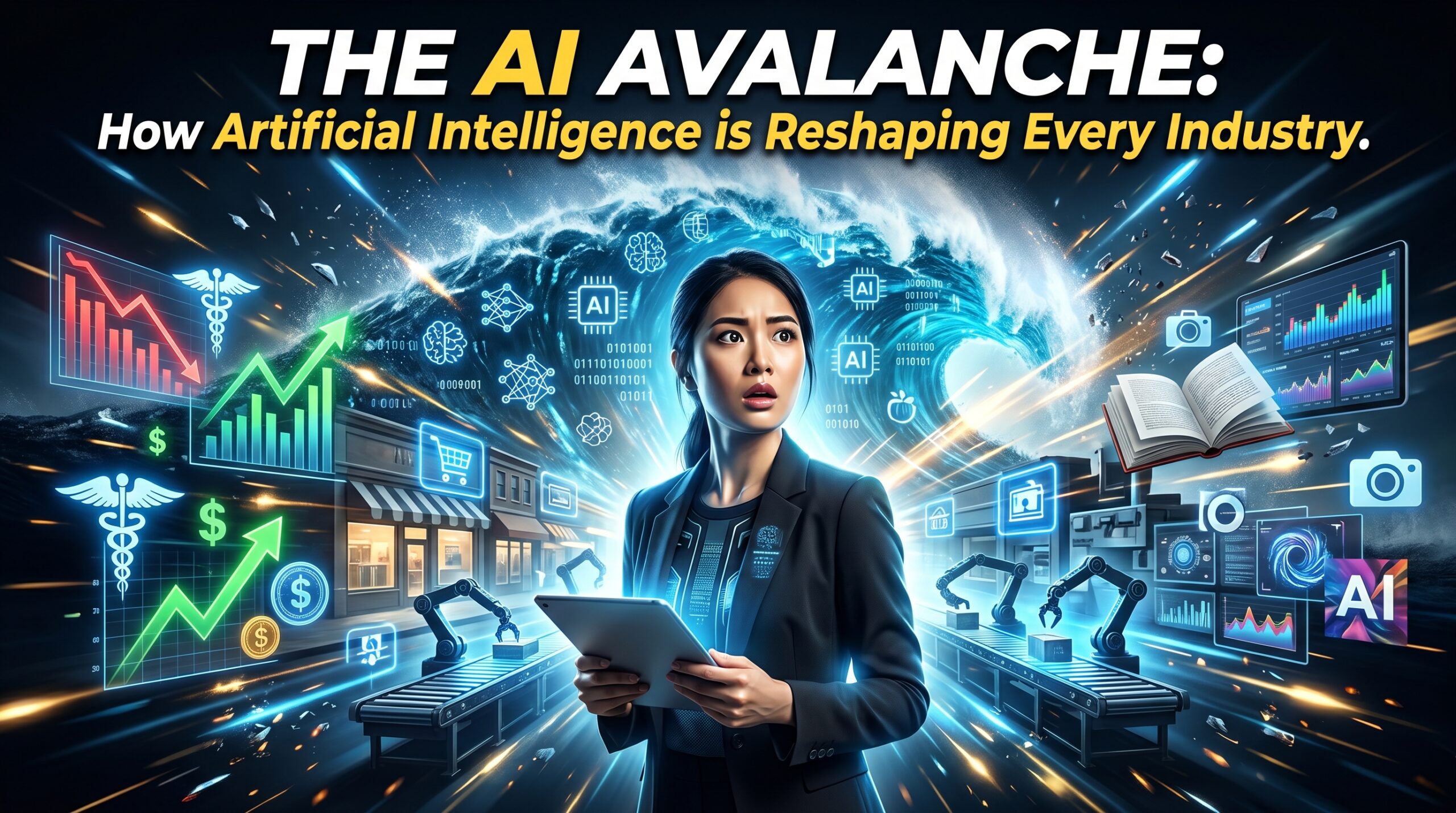
— How artificial intelligence is transforming every industry simultaneously. What SME founders must understand now.
// The Core Argument
AI is not disrupting individual industries one at a time — it is simultaneously compressing timelines, rewriting cost structures, and redefining competitive advantage across every sector. The founders who understand the force patterns driving the avalanche will be able to navigate it. Those who wait for their specific sector to be disrupted will be buried by it.
// 01 · The Avalanche Mechanics
What Makes AI's Industry Transformation Different From Every Prior Technology Wave?
Every major technology wave produces disruption, and every wave produces a cohort of business leaders who predict it will be different this time — either more catastrophic or more manageable than the data suggests. The internet, the mobile revolution, and cloud computing all disrupted industries, all created new competitive hierarchies, and all left businesses that failed to adapt structurally weaker than those that did. AI is doing the same thing, with one measurably different characteristic that makes the comparison to prior waves systematically misleading.
Prior technology waves targeted specific functions — the internet primarily disrupted information distribution, mobile disrupted location-dependent services, cloud disrupted capital expenditure models for software infrastructure. AI targets cognitive work itself — the specific human activity that knowledge workers perform, across every industry where knowledge workers operate. That means the disruption vector is not channel-specific or function-specific. It is the fundamental unit of economic value in knowledge-economy businesses: human cognitive labour applied to problems.
// The Structural Difference That Changes Every Comparison
The internet created new distribution channels. Mobile created new user interfaces. Cloud reduced capital costs for software. AI reduces the cost of thinking — the analytical, creative, and communicative cognitive work that knowledge workers charge for and that knowledge businesses compete on. Every sector that competes on cognitive output is experiencing simultaneous cost structure pressure from AI, not because AI is being applied in each industry sequentially, but because the underlying cognitive work is the same across all of them. The avalanche is not hitting one slope at a time. It is the whole mountain, all at once.
// 02 · The Four Force Vectors
What Are the Universal Mechanisms Through Which AI Is Reshaping Every Industry Simultaneously?
The AI avalanche operates through four specific force vectors, each of which applies across every sector regardless of vertical, size, or geography. Understanding these force vectors allows SME founders to identify the specific mechanisms through which AI will affect their competitive landscape — rather than waiting for their industry press to announce it when it is already affecting their clients and competitors.
01 Cost Compression — The Margin Restructuring Force
// Unit cost of cognitive work falling 60–90% across knowledge-work domains
AI reduces the unit cost of producing analytical output, written content, code, legal drafts, financial models, and creative work by 60–90% in the domains where these tasks represent a significant production cost. For any business that competes by charging for cognitive output — consulting, legal, accounting, marketing, content, software development — this force is simultaneously a cost advantage opportunity and an existential competitive threat: competitors who deploy AI cost compression before you do can offer equivalent quality at lower prices while maintaining margins, while you absorb unchanged production costs.
60–90% cost drop
02 Capability Democratisation — The Competitive Equaliser
// Enterprise-grade AI tools available at SME price points since 2024
AI has made capabilities previously requiring enterprise-scale investment available to SMEs for under $200 per month. A five-person consultancy now has access to the same quality of market research synthesis, competitive analysis, strategic framework generation, content production, and data interpretation that a 500-person firm's analyst team previously provided. This equalises the capability gap between SMEs and large competitors in knowledge-work domains — and in some cases reverses it, because SMEs can adopt new AI tools faster than enterprises encumbered by legacy processes and governance requirements.
SME parity now
03 Timeline Compression — The Speed Advantage Erasure
// 18-month average from innovation to SME-accessible standard in AI (vs 5+ years prior)
AI capabilities that achieve commercial viability in enterprise deployments are becoming accessible to SMEs within 18 months rather than the 3–5 year diffusion timeline of previous technology transitions. This timeline compression means that the first-mover advantages available in AI are measured in months rather than years — and that the penalty for waiting to see whether an AI capability proves durable before adopting it has increased sharply, because the adoption window during which early movers build defensible advantages is now much shorter than the wait-and-see period most traditional business risk frameworks would recommend.
18mo window
04 Discovery Reinvention — The Buyer Journey Transformation
// 38% of commercial queries now resolved by AI Overviews before any organic click
AI search has fundamentally changed how buyers find businesses, experts, and service providers. Google's Q1 2026 data shows that 38% of commercial queries are now resolved by Gemini AI Overviews that name specific brands without displaying a ranked link list — meaning that businesses without entity schema and VideoObject AI citation infrastructure are structurally invisible to 38% of the commercial buyer research that matters to their growth. This discovery reinvention applies across every industry where buyers use search to find providers — which is every industry in the knowledge economy.
38% invisible
// 03 · The Industry Map
How Is AI Specifically Reshaping the Industries Most Relevant to SME Founders in 2026?
38%
Of commercial Google queries now resolved by Gemini AI Overview before any organic click — structural visibility gap for businesses without AI citation infrastructure
// Google, Q1 2026
14×
Revenue per employee at AI-first businesses versus non-adopter equivalents — the compounding competitive gap opening between adopters and non-adopters
// McKinsey Global Institute, 2025
18mo
Average time from AI capability enterprise adoption to SME-accessible availability — the first-mover window that determines category authority in each sector
// MIT Technology Review, 2025

Professional Services — Legal, Consulting, Accounting
AI is compressing the unit cost of document review, contract drafting, financial modelling, and strategic analysis by 60–80%. Firms adopting AI maintain margins while reducing delivery time; non-adopters face pricing pressure from AI-enabled competitors charging equivalently for faster output. The human premium in these sectors is shifting from analytical production to judgment, client relationship, and ethical guidance — the capacities AI cannot replicate at equivalent quality.
// McKinsey 2025: 60% faster delivery in AI-augmented legal workflows

Marketing, Media & Content
The most directly and rapidly affected sector. AI has commoditised generic content production, making volume content available to any budget. The premium has shifted to entity-verified expert authority content — VideoObject schema host pages, AI-citable topical clusters — that generates AI citation appearances rather than only organic link clicks. Agencies and marketers who have not pivoted from production to authority infrastructure are facing existential margin compression from AI-enabled competitors and from clients who can produce generic content internally.
// Google Q1 2026: 38% of commercial queries resolved at AI layer

Healthcare
AI is primarily affecting administrative burden (clinical documentation, coding, scheduling — consuming up to 30% of clinician time, now 60–70% automatable), diagnostic support (AI reading imaging and pathology at specialist-equivalent accuracy in specific domains), and patient communication (AI-generated personalised patient education materials). For health-adjacent SMEs — wellness, allied health, medtech — the competitive implications of AI citation discovery are particularly acute because health information queries are among the highest-volume commercial search categories resolving at the AI layer.
// AMA 2025: 68% of admin documentation now AI-assistable

Finance, FinTech & Insurance
AI is reshaping credit risk assessment (AI models outperforming traditional scoring for non-standard credit profiles), fraud detection (real-time pattern recognition at scale impossible for human analysts), compliance monitoring (AI reading regulatory documents and flagging non-compliance faster than compliance teams), and personalised financial guidance (AI delivering personalised product recommendations at scale previously only available through private banking). FinTech SMEs competing with incumbents have the adoption speed advantage — the capability equalisation force is most powerful where regulatory burden has historically protected larger players.

Retail, E-commerce & Consumer Brands
AI is affecting three primary value chain stages: demand forecasting (AI reducing inventory waste 30–50% in early adopters), personalisation at scale (product recommendations, dynamic pricing, and personalised content delivery at the individual level), and customer service automation (AI handling 70–80% of tier-1 support interactions at equivalent or superior CSAT to human agents). The discovery reinvention force is particularly acute for direct-to-consumer brands, where AI shopping assistants are increasingly influencing product discovery and purchase decisions before any brand website is visited.
// Shopify 2025: 43% of purchase research interactions now include AI assistant

Education, Training & Professional Development
AI is enabling personalised learning at scale — adaptive curricula that adjust to individual learner pace, comprehension, and learning style in real time. For SMEs in education and training, the competitive implication is a content quality bar reset: AI can generate adequate generic training content at near-zero marginal cost, shifting the premium entirely to expert-authored, authority-verified content with AI citation infrastructure. Expert practitioners who build VideoObject host page content estates are establishing the category authority that AI learning systems will cite as primary sources — capturing first-mover discovery advantage in professional development topics.
// Gates Foundation 2025: AI tutoring closing achievement gap in 18-week pilots
The question is not whether AI is reshaping your industry. It already is. The question is whether you are the one riding the avalanche or standing in its path. // The reframe that converts the AI avalanche from a threat narrative into a first-mover opportunity for SME founders who act before their competitors do
// 04 · The SME Response
What Is the Specific Strategic Response That SME Founders Should Execute Now — Regardless of Which Industry They Are In?
Across every industry being reshaped by the AI avalanche, one strategic response consistently produces the highest first-mover advantage for SME founders: making their expertise AI-discoverable before their competitors do. The four force vectors described above all converge on a single practical action: build the entity-verified, VideoObject-schema-marked, topical-authority-cluster content infrastructure that makes your business and expertise citable in AI-generated recommendations across the 38% of commercial queries now resolved at the AI layer.
This response is industry-agnostic because the discovery reinvention force applies identically regardless of sector. Whether you are a legal consultant, a marketing agency, a healthcare practitioner, a fintech founder, or an e-commerce operator, the 38% of your buyers whose research is now resolved by AI-generated expert recommendations will only find you if your entity schema is verified, your VideoObject host pages are schema-marked on an owned domain, and your topical authority cluster provides the depth signal that AI retrieval systems use to classify category experts for citation.
// The Four-Action AI-Era Competitive Response — Universal Across All Industries
Action 1: Entity verification this week. Install Organisation schema on your homepage and Person schema on your About page with complete sameAs arrays. This two-hour installation starts the Knowledge Graph confirmation clock that determines whether you are citable in AI-generated responses — for any commercial query in your industry. No entity schema means no AI citation eligibility, regardless of content quality, backlink profile, or brand reputation.
Action 2: First VideoObject host page this week. Record a ten-minute Authority Explainer on the primary commercial question your buyers ask when evaluating expertise in your industry. Build the VideoObject schema host page using Clipkoi. This 90-minute session produces the first permanent AI citation asset in your industry estate — generating AI Overview citation eligibility at 4.3× the rate of text-only pages (Semrush 2025) and organic search impressions for 18 months (HubSpot 2025) simultaneously.
Action 3: Topical authority cluster — one session per week. One recording per week, building the ten-topic expertise cluster that earns category expert classification in AI retrieval systems. By Week 10, the ten-host-page cluster is generating AI citations across the full range of your primary commercial queries — the category authority that determines whether AI systems present you as the expert in your industry or present your competitors.
Action 4: Direct answer blocks on all existing high-traffic pages. Add 50-word self-contained direct answer blocks and FAQPage schema to your five highest-organic-impression pages. This retrofits existing content for AI extraction eligibility without requiring new content production — the fastest available path to expanding AI citation coverage from existing assets.
// The Universal Competitive Logic
Every industry in the AI avalanche is experiencing the same fundamental competitive dynamic: the businesses that build AI citation infrastructure first in their category own the expert positioning in AI-generated recommendations before competitors have even noticed the shift. In most SME categories in 2026, fewer than 8% of businesses have deployed entity schema and VideoObject AI citation infrastructure. The window to establish category-first AI citation authority is open in almost every industry, in almost every niche, right now. The avalanche has already started. The question is where you are standing when it passes.
Frequently Asked Questions
How is artificial intelligence reshaping every industry simultaneously?
Artificial intelligence is reshaping every industry simultaneously through four universal force vectors. First, cost compression: AI reduces the unit cost of cognitive work — analytical, creative, and communicative output — by 60–90% in knowledge-work domains, restructuring margin models across every sector that charges for cognitive output. Second, capability democratisation: AI makes enterprise-grade analytical tools available to SMEs for under $200 per month, equalising the capability gap between large and small competitors. Third, timeline compression: AI innovations reach SME-accessible commercial products within 18 months of enterprise adoption, compared to 3–5 years for prior technology transitions, compressing first-mover windows. Fourth, discovery reinvention: 38% of commercial Google queries are now resolved by AI Overviews naming specific expert brands rather than displaying ranked link lists, restructuring buyer discovery journeys across every industry. McKinsey's 2025 Global AI State Report found AI adoption occurring simultaneously across all major industry verticals at rates significantly faster than any prior technology transition.
Which industries are most affected by the AI avalanche in 2026?
In 2026, the industries experiencing the most active AI-driven disruption to core business processes are: marketing, media, and content (where AI has commoditised generic production, shifting the premium to entity-verified expert authority); professional services including legal, consulting, and accounting (where AI is compressing analytical production costs 60–80%); finance and FinTech (where AI is transforming risk assessment, fraud detection, compliance monitoring, and personalised guidance); healthcare (where AI is automating 60–70% of administrative documentation and providing specialist-equivalent diagnostic support in specific domains); and retail and e-commerce (where AI is improving demand forecasting accuracy 30–50% and enabling personalisation at individual scale). However, McKinsey's 2025 research found no major industry vertical reporting zero material AI-driven disruption to core processes — the avalanche is affecting every sector, with timing and magnitude varying by the proportion of cognitive work in the value chain.
What is the most important strategic response for SME founders to the AI avalanche?
The most important strategic response for SME founders across every industry is making their expertise AI-discoverable before competitors do — because the discovery reinvention force applies identically regardless of sector. The specific actions: install entity schema this week (the two-hour infrastructure investment that starts the Knowledge Graph confirmation clock for AI citation eligibility), build the first VideoObject schema host page using Clipkoi (the 90-minute session that produces an 18-month AI citation and organic search asset), add direct answer blocks and FAQPage schema to five existing high-traffic pages (the two-hour retrofit that activates AI extraction eligibility for existing content), and establish a weekly recording session that builds the ten-topic topical authority cluster (the ongoing production system that earns category expert classification in AI retrieval systems). In most SME categories, fewer than 8% of businesses have deployed this infrastructure — the first-mover window is open in almost every industry right now.
Is the AI avalanche a threat or an opportunity for SME founders?
The AI avalanche is simultaneously a threat to SME founders who delay adoption and an opportunity for those who act before their competitors do — and the same force that threatens non-adopters is the source of first-mover advantage for early adopters. The capability democratisation force means that SMEs now have access to enterprise-grade AI capabilities at SME price points — giving them the ability to compete against larger, slower competitors at a capability level previously unavailable. The discovery reinvention force means that SMEs who build AI citation infrastructure before their category competitors will establish expert positioning in AI-generated recommendations across 38% of commercial buyer research that larger competitors with legacy SEO strategies are currently missing. The threat is real for non-adopters. The opportunity is measurable for first movers. McKinsey's 2025 research found 14× revenue per employee at AI-first businesses versus non-adopter equivalents — a gap that widens with every quarter of deferred adoption.
How does AI discovery reinvention affect SME marketing and brand visibility strategy?
AI discovery reinvention has fundamentally changed SME marketing and brand visibility strategy because 38% of commercial queries are now resolved by AI Overviews that name specific expert brands without displaying ranked link lists — meaning a business without AI citation infrastructure is invisible to 38% of the buyer research that matters to its growth. The specific marketing strategy response is dual-track: maintain traditional SEO for the 62% of commercial queries still producing ranked organic results (domain authority, keyword targeting, Core Web Vitals), while simultaneously deploying AIO (AI Overview Optimisation) infrastructure for the 38% AI resolves first (entity schema for Knowledge Graph verification, VideoObject schema host pages generating the 4.3× citation multiplier, direct answer blocks for AI extraction, topical authority clusters for category expert classification). Businesses deploying only traditional SEO have a structural 38% visibility gap. Businesses deploying only AIO miss 62% of click-through traffic. The dual-track strategy — deployable from the same content production system using Clipkoi's VideoObject schema infrastructure — achieves 100% commercial query coverage.
→ The Founder's Position
The Avalanche Does Not Wait — and Neither Does the First-Mover Advantage It Is Creating for the Businesses That Act Now
The AI avalanche is not a future event that SME founders need to prepare for. It is a present reality that every industry is navigating simultaneously — reshaping cost structures, capability hierarchies, competitive timelines, and buyer discovery journeys in parallel. The founders who are generating 14× revenue per employee advantages over non-adopter equivalents are not doing so because they have access to AI capabilities that others do not. They are doing so because they adopted the AI capabilities that are available to everyone and built the compounding infrastructure advantages that those capabilities make possible before their competitors got around to evaluating them.
The specific advantage available in 2026 that was not available in 2024 is AI citation authority — the category-first expert positioning in AI-generated recommendations that the combination of entity schema, VideoObject schema host pages, and topical authority clusters produces. In most SME categories, this positioning is unclaimed. The businesses that claim it this quarter will hold it for the next three to five years — because topical authority compounds permanently and the first-mover advantage in AI citation classification is structurally difficult for later entrants to replicate without equivalent investment over equivalent time.
The avalanche is already moving. The entity schema takes two hours. The first VideoObject host page takes 90 minutes with Clipkoi. The five high-traffic page retrofits take two more hours. That is five and a half hours separating your current AI visibility position from total commercial query coverage — in every industry, for every SME, starting this week.