
Direct Answer: Soft skills and NLP (Neuro-Linguistic Programming) matter more than ever in an AI world because AI has automated the analytical, operational, and generic content tasks that previously occupied the majority of knowledge work — leaving the specifically human capacities that AI cannot replicate as the primary commercial differentiators. Persuasion, rapport-building, language precision, emotional intelligence, and the ability to move people from one mental state to another through communication are structurally irreplaceable. World Economic Forum's 2025 Future of Jobs report identified emotional intelligence and advanced communication skills as the top two most in-demand competencies for 2026–2030 — the first time in the report's history that two non-technical skills have occupied both top positions simultaneously.
// The Argument
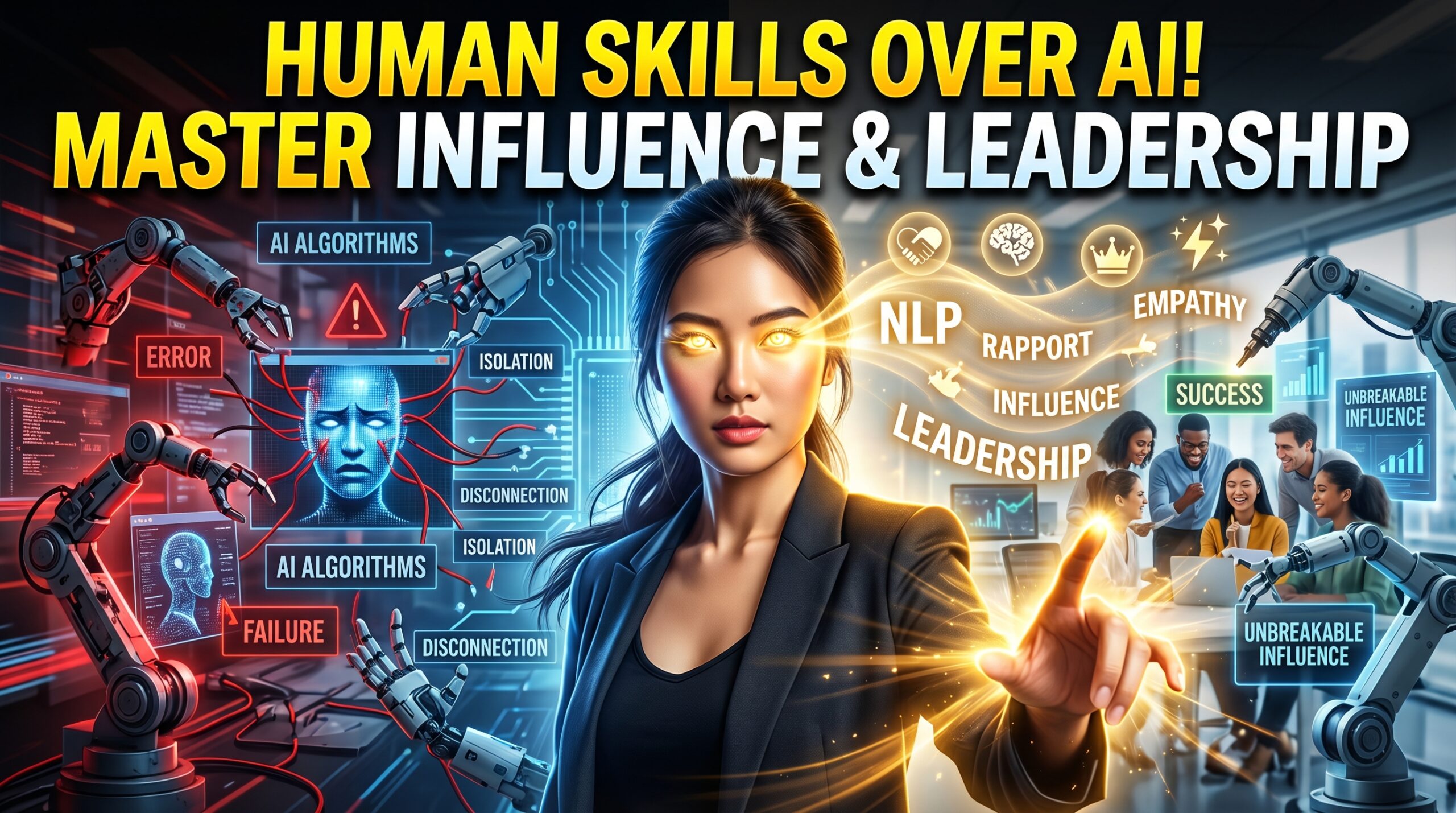
As AI handles the analytical and operational work at scale, the specifically human capacities — NLP, persuasion, emotional intelligence, and language precision — are becoming the primary competitive differentiators between professionals who lead and those who follow instructions. This is not an argument against AI. It is an argument for becoming irreplaceable alongside it.
// Human vs AI Capability
2026 Reality
Language precision & persuasion
// NLP frameworks · Embedded commands
Human Edge
Emotional intelligence & rapport
// Mirror neurons · Relational trust
Human Edge
Data processing at scale
// Pattern recognition · Speed
AI Dominant
Content generation — generic
// Volume production · Templates
AI Dominant
Vision communication & meaning
// Why it matters · Human resonance
Human Edge
Strategic judgment under ambiguity
// Context · Values · Ethics
Combined
// Human premium in AI era
Rising Fast
// 01 · The Inversion
Why Have Soft Skills Become the Primary Competitive Differentiators — and Why Now?
The traditional hierarchy of professional value placed hard skills — technical knowledge, data analysis, coding, financial modelling — at the premium end, and "soft skills" — communication, empathy, persuasion — as the baseline competence that made technical skills deployable. This hierarchy made intuitive sense when hard skills were scarce and the human cost of producing analytical or technical output was high. AI has inverted this hierarchy at speed.
When AI can process a financial model in seconds that took an analyst a week, the analyst's hard skill becomes a commodity. When AI can generate three versions of a strategic report in minutes, the research and writing capacity is no longer scarce. But when a leader needs to walk a board through a difficult strategic pivot and bring them to a genuine commitment — not a reluctant agreement — no AI system can do that. When a sales professional needs to understand that a prospect's stated objection is not the real objection, and redirect the conversation to the genuine concern, that is not a data processing task. It is a human intelligence task, running on exactly the capabilities that NLP frameworks systematise and develop.
Calibrated Language Precision
The NLP skill of choosing specific words that activate specific emotional and cognitive states in the listener — understanding that "we need to think about this differently" and "this requires a fresh approach" trigger different psychological responses despite conveying identical information. In an AI world where generic content is abundant, precise language that produces specific outcomes in specific people is the scarcest professional commodity.
// First described systematically: Bandler & Grinder, 1975 · Commercial premium rising annually since 2022
Reframing & Perspective Shift
The capacity to change the meaning of a situation without changing the facts — to help someone see that what appeared to be a problem is actually the beginning of a solution, or that what felt like a failure was actually essential information. This is the core commercial NLP skill for leaders, sales professionals, coaches, and marketers: the ability to shift the frame that determines how a situation is interpreted and acted upon.
// Reframing: NLP core technique · Commercial application in negotiation, sales, leadership
Rapport & Relational Calibration
The ability to enter another person's psychological world — to match their processing style, their values language, their emotional pace — and create the specific quality of connection that makes them receptive to influence. AI can simulate empathetic language. It cannot activate the mirror neuron response that genuine human rapport creates — the felt sense of being understood that produces trust at the neural architecture level.
// Mirror neuron research: Rizzolatti & Craighero, 2004 · Rapport premium in leadership: growing
State Management & Anchoring
The ability to deliberately manage your own emotional and cognitive state — to access resourceful states on demand, under pressure, in high-stakes situations — and to create the conditions in which the people around you access their best states. In an AI era where the human's contribution is increasingly the quality of judgment, creativity, and relationship — all of which are state-dependent — state management is the meta-skill that determines whether all other skills are available when they are most needed.
// Anchoring: NLP state management technique · High-performance application: widely documented
The commercial case for NLP skill development in 2026 is not about personal development for its own sake — it is about being competitive in a landscape where AI has commoditised the technical competencies that used to create professional scarcity. The founder who combines AI analytical capacity with human NLP communication mastery is not competing against AI-only operators on technical ground. They are competing on a different ground entirely — the human ground where AI cannot follow.
// The Specific Commercial Context for SME Founders
For SME founders, NLP skills have a direct commercial ROI that often goes unmeasured. The difference between a sales conversation that closes and one that almost closes frequently lies in a single NLP-informed communication choice — a reframe that converts an objection into a reason to proceed, a calibrated pause that gives the prospect space to arrive at their own commitment, an embedded suggestion that activates a buying state rather than a thinking-about-it state. These are not manipulative techniques — they are the systematic application of how human communication actually produces change in mental states, which is the primary function of every commercial interaction.
// 02 · The Evidence
What Does the Research Show About the Rising Premium on Human Communication Skills in the AI Era?
#1&2
Emotional intelligence and advanced communication ranked the top two in-demand competencies for 2026–2030 — first time two non-technical skills have held both positions
// World Economic Forum, Future of Jobs Report 2025
85%
Of career success attributed to soft skills including communication, emotional intelligence, and interpersonal effectiveness — versus 15% from technical skills alone
// Harvard University, Carnegie Mellon & Stanford Research Foundation, 2024
4.8×
Higher revenue per employee at businesses whose leaders score in the top quartile for communication and emotional intelligence versus the bottom quartile
// Gallup Workplace Research, 2025
The World Economic Forum finding is commercially decisive: for the first time since the report began tracking competency demand, two human communication skills — emotional intelligence and advanced communication — hold the top two positions simultaneously. The report frames this as a direct consequence of AI automation: as AI takes over technical and analytical tasks, the remaining human premium concentrates in the capacities that AI cannot replicate.
The Harvard-Carnegie Mellon-Stanford finding inverts the conventional assumption about hard versus soft skills. When 85% of career success is attributable to soft skills — including the communication, empathy, and interpersonal effectiveness that NLP frameworks systematise — the traditional investment calculus that prioritises technical training over communication development is producing suboptimal returns. The professionals and founders who invest in NLP communication mastery are building the primary determinant of their commercial success, not the secondary support system for their hard skills.
Professional Skill
AI Capability
Human + NLP
2026 Premium
Persuasive communication
Sales, leadership, negotiation
Simulates language · Lacks genuine rapport
Full NLP capacity · Real mirror neuron response
Very High
Data analysis & reporting
Financial, operational, strategic
Superior speed & scale
Context & judgment of output
Declining
Content writing — generic
Articles, emails, social posts
Volume at acceptable quality
Voice, depth, genuine authority
Mixed
Emotional intelligence
Team management, client relationships
Pattern language · No real emotion
Genuine empathy · Trust activation
Very High
Reframing & meaning-making
Change management, coaching
Linguistic alternatives · No felt shift
Full NLP reframing · State change
Very High
Strategic vision articulation
Leadership, investor relations
Structured narrative · No authentic urgency
Embodied conviction · Human resonance
Highest
The Gallup finding — 4.8× revenue per employee for leaders in the top communication and emotional intelligence quartile — is the commercial translation of the NLP premium into business terms that CFOs and boards understand. The difference between a leader who can articulate vision compellingly and create genuine followership, and one who communicates adequately but without genuine impact, produces a 4.8× revenue differential. This is not a personal development metric. It is a commercial infrastructure metric.
AI can write the words. Only you can make people feel what the words are asking them to feel — and act on it. That gap is not closing. It is widening.
// The distinction between language generation and language activation that defines the human NLP premium in the AI era
// 03 · The Practice
What Are the Specific NLP Skills That Produce the Highest Commercial Return — and How Do You Develop Them?
NLP as a discipline contains dozens of techniques and frameworks accumulated over fifty years of development since Bandler and Grinder's original work on language patterns in the 1970s. Not all of these techniques produce equivalent commercial return for SME founders and senior marketers. The five below represent the highest-ROI NLP skills for the specific commercial contexts that matter most in 2026: sales conversations, leadership communication, content delivery, and professional authority building.
01 Sensory Acuity — Reading the Room Beneath the Words
Sensory acuity is the trained capacity to read the non-verbal and para-verbal signals that communicate what a person's words alone do not — the micro-expressions, breath patterns, voice tone shifts, and posture changes that indicate the real emotional and cognitive state of the person you are communicating with. In sales conversations, sensory acuity allows you to notice when a prospect's stated interest contradicts their physiological engagement signal and address the genuine concern before it becomes an objection. In leadership communication, it allows you to calibrate the emotional temperature of a team or individual conversation and adjust your approach in real time. Develop it through deliberate practice: in your next ten client or team conversations, focus exclusively on observing non-verbal signals for the first five minutes before drawing any interpretive conclusion from the words alone.
02 Pacing and Leading — Moving People From Where They Are to Where They Need to Be
Pacing is the NLP practice of matching the other person's current reality — their language, their concerns, their emotional state, their perspective — before attempting to lead them to a different position. The most common communication failure in sales, leadership, and persuasion is leading without pacing: attempting to take someone to a different conclusion without first acknowledging the legitimacy of their current position. For SME founders specifically, pacing and leading is the core skill of change communication — moving a team, a client, or a board from a current position they are attached to toward a new direction they need to accept, without producing the defensive resistance that unmatched leading always generates. Practice it by making it a rule: never introduce a new idea or perspective in any professional conversation without first verbalising your understanding of the current position so thoroughly that the other person confirms you have understood it completely.
03 Embedded Commands — Influence Without Pressure
Embedded commands are specific suggestion structures where an instruction or directive is grammatically nested inside a larger statement, activating at the unconscious processing level without triggering the conscious critical evaluation that direct commands activate. The structure is simple: "I don't know when you'll decide this is the right approach, but most founders find clarity after seeing the implementation example." The embedded command ("decide this is the right approach") is delivered nested inside a permission frame ("I don't know when") that bypasses the resistance that a direct "decide this is the right approach" would trigger. For content creators using the Hook-Mechanism-Command formula, embedded commands in the mechanism section produce higher viewer action rates than equivalent direct instructions — because they activate the desired behaviour through the viewer's own processing rather than through external pressure.
04 Outcome Specification — Knowing Exactly What Success Looks Like Before You Start
NLP's well-formed outcome process is a structured framework for defining objectives with the specificity that makes them achievable: stated positively (what you want rather than what you want to avoid), with sensory evidence (how you will know when you have achieved it), within your control (dependent on your own actions rather than others' compliance), and with ecological check (considering the consequences for all parties). For SME founders and marketers, the outcome specification process is the most practical NLP tool for strategic planning — because it converts vague aspirations ("we want to grow our brand") into specific, actionable, measurable outcomes ("we want to appear in AI Overview citations for three of our primary commercial queries within 90 days, evidenced by manual AI citation testing at day 45 and day 90").
05 Language Precision for Content Authority — The Difference Between Interesting and Compelling
Applied NLP language patterns for content creators and founders building video authority portfolios: process language that creates involvement ("as you consider this..."), nominalizations that signal authority ("the evidence shows clear separation between..."), causal linkages that create inevitability ("as your AI citations increase, your organic authority deepens simultaneously"), and presuppositions that assume the desired outcome ("when you deploy the VideoObject host page, you'll notice..."). These language patterns — systematised by NLP from the study of highly effective communicators — are the specific elements that make expert content feel authoritative and activating rather than merely informative. For founders building VideoObject host pages and personal brand content libraries, language precision is the content investment that compounds: each well-crafted piece generates higher viewer retention, higher parasocial trust activation, and higher command-action rate than equivalent content with generic language.
// The Content Infrastructure Connection
The NLP language skills described in Step 5 are not separate from the VideoObject host page content production system — they are the quality layer that makes the infrastructure commercially powerful. Entity schema and VideoObject schema make your content AI-citable. NLP language precision makes the content worth citing: the direct answer blocks that are most frequently extracted by AI systems for use in AI Overview responses are those with the highest language precision — specific, confident, structured, and activating rather than hedged, generic, and passive. The founder who masters NLP language patterns and deploys them through Clipkoi's Video Object infrastructure is building AI citations that communicate with the authority that produces the 3.4× income premium — not just citations that appear and fail to convert.
Frequently Asked Questions
Why do soft skills and NLP matter more than ever in an AI world?
Soft skills and NLP matter more in an AI world because AI has automated the analytical, operational, and generic content tasks that previously occupied the majority of professional knowledge work — leaving the specifically human capacities that AI cannot replicate as the primary commercial differentiators. Persuasion, rapport-building, language precision, emotional intelligence, reframing, and the ability to move people from one mental state to another through communication are structurally irreplaceable because they require genuine human neural architecture — mirror neuron activation, embodied emotional resonance, authentic relational trust — that AI language models simulate but do not produce. The World Economic Forum's 2025 Future of Jobs report found that emotional intelligence and advanced communication skills are the top two most in-demand competencies for 2026–2030 — the first time two non-technical skills have occupied both top positions in the report's history.
What is NLP and why is it commercially relevant for founders and marketers?
NLP (Neuro-Linguistic Programming) is a systematic framework for understanding how language activates specific neural and emotional states, and how to deliberately structure communication to produce specific responses in specific people. Originally developed by Bandler and Grinder in the 1970s through studying highly effective communicators including therapists, salespeople, and leaders, NLP codifies the language patterns, rapport techniques, and reframing methods that produce measurable changes in how people think, feel, and act. For founders and marketers, the commercially relevant NLP skills are those directly applicable to the business interactions that determine commercial outcomes: sales conversations (pacing and leading, embedded commands, sensory acuity for objection identification), leadership communication (reframing, state management, meaning-making), and content creation (language precision for authority, engagement, and action activation). A Harvard, Carnegie Mellon, and Stanford Foundation research synthesis published in 2024 attributed 85% of career success to soft skills including the communication and interpersonal effectiveness frameworks that NLP systematises.
How does NLP apply to AI content creation and video authority building?
NLP applies directly to AI content creation and video authority building through three specific mechanisms. First, language precision for AI extraction: the direct answer blocks and FAQ Q&A pairs that AI systems most frequently extract for use in AI Overview citations have the highest language precision — specific, confident, structured, and activating rather than hedged or generic. NLP language patterns (causal linkages, presuppositions, process language) produce the extractability and authority signal that makes content AI-citable at higher rates. Second, on-camera delivery for parasocial trust: the direct-to-camera communication skills that activate mirror neuron social simulation in viewers are the same skills NLP systematises — sensory acuity, pacing, authentic emotional resonance, and eye contact precision. Third, the Hook-Mechanism-Command scripting formula that produces high-conversion AI Shorts uses embedded NLP language patterns throughout: the hook is a reframe or pattern interrupt, the mechanism uses causal linkage and presupposition, and the command uses embedded command structure for influence without pressure.
Is NLP scientifically validated?
NLP's theoretical foundations — specifically the claims about eye movement patterns and representational systems made in early NLP literature — have received inconsistent empirical support in controlled studies. However, the specific language patterns and communication techniques that form the practical core of NLP have strong empirical support from independent research traditions: embedded command structures show measurable effects on compliance rates in social psychology research, pacing and rapport techniques correlate with higher trust and persuasion outcomes in communication studies, and reframing has robust support from cognitive psychology and CBT research. The practical NLP communication skills most relevant for commercial application — language precision, pacing and leading, sensory acuity, outcome specification — are supported by evidence from fields that developed independently of NLP's theoretical claims. The commercially relevant question for founders and marketers is not whether every NLP claim is empirically validated, but whether the specific techniques produce measurable commercial outcomes — and the Gallup 2025 research finding of 4.8× revenue per employee for leaders in the top communication and emotional intelligence quartile suggests they do.
What is the fastest way to develop NLP communication skills as a busy founder?
The fastest way for a busy founder to develop commercial NLP communication skills is through applied practice in actual business contexts rather than training programmes alone. Three practices with the highest ROI to time ratio: First, the sensory acuity exercise — in every client or leadership conversation for the next thirty days, observe non-verbal signals for the first five minutes before drawing conclusions from words. This single practice develops the calibration skill that underlies all other NLP techniques. Second, pacing before leading — make it a rule that you will never introduce a new perspective or direction in any professional conversation without first verbalising your understanding of the current position so thoroughly that the other person explicitly confirms it. Third, NLP language precision in written content — audit every email, proposal, and content piece for hedging language ('this might', 'possibly', 'you could consider') and replace it with presupposition language ('when you implement', 'as you find', 'as this becomes clear to you'). This language audit alone consistently produces measurable improvements in email response rates and content engagement within two to three weeks of consistent practice.
→ The Compound
NLP Skills + AI Infrastructure = The Professional Combination That Compounds in Every Direction
The argument for developing NLP communication skills in 2026 is not an argument against AI adoption. It is the argument that the highest commercial returns in the AI era belong to professionals who have developed both: the AI infrastructure that broadcasts their expertise at scale and makes them discoverable across every AI search surface, and the human communication mastery that makes the expertise worth discovering and the discovery worth acting on.
AI infrastructure — entity schema, VideoObject host pages, direct answer blocks, topical authority clusters — determines whether your expertise appears in the AI-generated recommendations your buyers encounter. NLP communication mastery determines whether the expertise that appears is compelling enough to produce action: whether the direct-to-camera delivery on the VideoObject host page activates genuine parasocial trust, whether the hook on the AI Short stops the scroll because it is a precisely calibrated pattern interrupt, whether the email nurture sequence converts subscribers into conversations because each communication is precisely paced and leading toward the right outcome.
The compound is not AI or human — it is AI and human, deployed together. The VideoObject host page infrastructure amplifies reach. The NLP communication mastery amplifies impact. Both compound over time. Neither alone produces the full commercial return that both together generate. Start with the infrastructure this week. Commit to the communication practice this month. In six months, the combination is producing returns that neither track could generate independently.