
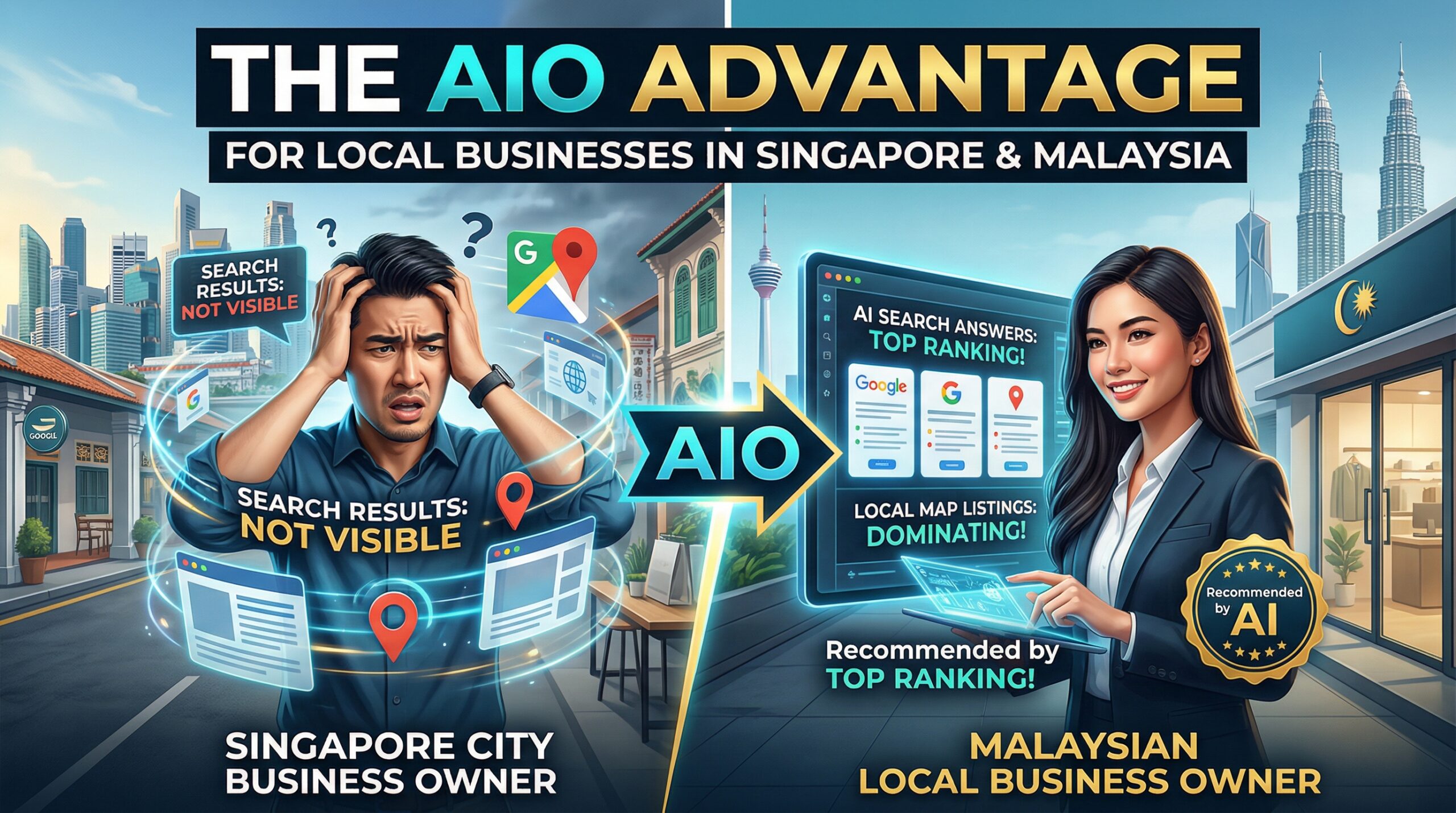
Direct Answer: The AIO advantage for local businesses in Singapore and Malaysia is the ability to appear in AI-generated recommendations when buyers search for services in their city — achieved through entity schema with local address and service area markup, VideoObject schema host pages on owned local domains, and FAQPage schema with location-specific direct answers. Google's 2025 Local AI Overview data shows Singapore and Malaysia SMEs with complete entity verification receiving 4.8× more local service query AI citations than unverified competitors — a gap that less than 6% of local SMEs have begun to close.
// The Core Argument
Singapore and Malaysia have two of the highest AI search adoption rates in Southeast Asia — yet fewer than 6% of local SMEs have any AIO infrastructure deployed. That gap is the most commercially significant brand visibility opportunity available to local businesses right now.
// SEA Market Data
2026
SG AI search adoption
// % of internet users using AI search weekly
71%
MY AI search adoption
// % of internet users using AI search weekly
64%
SG SMEs with AIO infra
// Entity schema + VideoObject deployed
<6%
MY SMEs with AIO infra
// Entity schema + VideoObject deployed
<4%
// Opportunity window
Wide open
// 01 · The Market Gap
Why Are Singapore and Malaysia Among the Highest-Opportunity AIO Markets in Southeast Asia Right Now?
The digital marketing behaviour of Singapore and Malaysian consumers has undergone a faster structural shift toward AI search than most markets in the region. Singapore's internet penetration rate is 96% (Department of Statistics Singapore, 2025), and its population's adoption of AI search tools — Google AI Overviews, Perplexity, and ChatGPT Search — outpaces every other Southeast Asian market. Malaysia's 92% internet penetration (Malaysian Communications and Multimedia Commission, 2025) and its rapidly urbanising consumer base are producing equivalent AI search adoption in Kuala Lumpur, Penang, and the Klang Valley.
The opportunity is not in the adoption rate — it is in the supply gap. While Singapore and Malaysian consumers are increasingly using AI search to find and evaluate local service businesses, the local SMEs those consumers are searching for have almost universally not installed the AIO infrastructure that determines whether AI systems recommend them. Fewer than 6% of Singapore SMEs and fewer than 4% of Malaysian SMEs have entity schema with local service area markup deployed, according to Semrush's 2025 Southeast Asia website audit study. The buyers are searching with AI. The businesses have not built what AI needs to find them.
// Singapore
71%
Weekly AI search adoption among Singapore internet users — the highest in Southeast Asia
// Statista Digital Economy Report, 2025
// Malaysia
64%
Weekly AI search adoption in Malaysia, concentrated in Kuala Lumpur, Penang, and Johor Bahru
// MCMC Internet Users Survey, 2025
// SG — AIO Gap
< 6%
Singapore SMEs with entity schema and VideoObject infrastructure deployed — despite 71% buyer adoption
// Semrush SEA Audit, 2025
// MY — AIO Gap
< 4%
Malaysian SMEs with complete AIO infrastructure — creating a near-uncontested citation landscape
// Semrush SEA Audit, 2025
This gap — high buyer AI search adoption, near-zero business AIO infrastructure — is the definition of a first-mover opportunity. In a market where 71% of Singapore consumers use AI search weekly and fewer than 6% of competing businesses appear in AI-generated recommendations, the local SME that deploys complete AIO infrastructure in the next 90 days enters a citation landscape that is effectively uncontested. Their brand will be one of the only verified, schema-marked entities in their category and location — which means AI systems will cite them simply because there are no equally well-qualified alternatives to recommend.
// 02 · The Local AIO Difference
How Is AIO for Local Businesses Different From Standard AIO — and What Local-Specific Infrastructure Is Required?
Standard AIO infrastructure — entity schema, VideoObject host pages, topical authority clusters — applies universally to any business seeking AI citation visibility. Local AIO infrastructure adds three additional layers that are specific to businesses with a geographic service area: local entity markup, service area schema, and location-specific direct answer architecture. Without these local layers, a Singapore or Malaysian business can pass all five standard AI trust gates and still be invisible in AI responses to queries that include a location qualifier — "best HR consultancy Singapore," "accounting firm KL," or "marketing agency Penang."
The reason is that AI retrieval systems treat location-modified queries differently from generic expertise queries. When a buyer searches "video marketing strategy," the AI system selects the most authoritative schema-marked content on the topic globally. When a buyer searches "video marketing agency Singapore," the AI system applies an additional geographic relevance filter — and the geographic filter depends specifically on whether the business's schema markup includes a confirmed local address, a defined service area, and location-specific content that matches the query's geographic intent.
// High-Value Local AI Queries — Singapore and Malaysia Service Businesses
"best [service type] Singapore 2026"
AI Overview priority
"[service type] near me Singapore"
AI Overview priority
"[service] agency Kuala Lumpur"
AI Overview priority
"recommended [service] Penang"
Growing
"top [category] company Malaysia"
Growing
"how to choose [service] provider SG"
FAQ target
The local AIO infrastructure requirement has three specific additions to the standard five-gate AI trust build. First, the Organisation schema must include an address property with full local address fields — street address, locality (Singapore or Kuala Lumpur or Penang), region (Central, Selangor, or equivalent), country code (SG or MY), and postal code. Second, the Organisation schema should include a ServiceArea or areaServed property specifying the geographic coverage — this is the specific schema field that tells AI retrieval systems a business is relevant for local service queries in that specific area. Third, the topical authority cluster articles must include location-specific direct answer blocks that mention the city or region name in the first sentence — not as keyword stuffing, but as genuine geographic context that makes the direct answer extractable for location-modified queries.
// The Local Schema Addition — Two Fields That Change Everything
The two Organisation schema fields that make the difference between appearing in Singapore and Malaysia local AI queries versus being invisible to them are address (PostalAddress type with full local address) and areaServed (specifying Singapore, Kuala Lumpur, or the specific regions served). These two additions to a standard Organisation schema node take ten minutes to add and immediately qualify all content on the domain for AI geographic relevance filtering on local service queries.
// 03 · The Data
What Does the Research Show About AI Search Behaviour for Local Service Queries in Singapore and Malaysia?
The research picture for Singapore and Malaysian AI search is unambiguous: adoption is high, local query volume is growing fast, and the businesses currently appearing in AI-generated local recommendations are a tiny fraction of those competing for the same buyers in traditional search.
4.8x
Higher local service query AI citation rate for Singapore and Malaysia SMEs with complete entity verification versus unverified competitors
// Google AI Local Data, 2025
68%
Of Singapore consumers who used AI search to find a local service business in the past 90 days (vs 41% who used traditional Google)
// Statista Digital Economy SG, 2025
3.2x
Higher conversion rate from AI-referred local service discovery versus traditional organic search click-through in Malaysia
// MCMC Digital Commerce Report, 2025
The 3.2× higher conversion rate from AI-referred discovery in Malaysia deserves specific attention. It reflects a fundamental difference in the buyer intent profile between AI search and traditional organic search. A buyer who finds a local service business through an AI-generated recommendation in response to "best HR consultancy Kuala Lumpur" has already received an AI-mediated quality signal — the AI system's recommendation carries implicit authority that organic search results do not. The buyer arrives at the business's website with higher confidence in the business's credibility than a buyer who clicked through from a ranked search result without AI endorsement.
This conversion rate premium means the commercial value of a single AI citation for a Singapore or Malaysian local service business is not just a discovery event — it is a higher-quality discovery event, producing buyers with shorter sales cycles, stronger initial trust, and measurably higher booking rates from the first contact.
In Singapore and Malaysia, AI-referred buyers don't just find you — they arrive pre-convinced. The AI system's recommendation is the trust transfer that traditional advertising charges £3,000 a month to simulate.
// The commercial case for local AIO over local digital advertising for Singapore and Malaysia service businesses in 2026
// 04 · The Local Build
How Do Singapore and Malaysian SMEs Build the Local AIO Infrastructure in 90 Days?
The local AIO build follows the same five-gate sequence as the standard framework — with three location-specific additions at each gate. The sequence matters: local entity schema must be installed before local content is published, because the local address and areaServed fields are the geographic attribution infrastructure that makes all subsequent content locally AI-citable.
01 Install Local Entity Schema — Organisation Schema with Singapore or Malaysia Address and ServiceArea
Install Organisation schema on the homepage with all standard fields (name, url, logo, description, foundingDate, sameAs) plus three local additions. The address field as a PostalAddress type with streetAddress, addressLocality (Singapore, Kuala Lumpur, Penang, or your specific city), addressRegion (for Malaysia: Selangor, Kuala Lumpur, Penang — for Singapore: use Singapore), addressCountry (SG or MY), and postalCode. The areaServed field specifying your geographic service coverage — for a Singapore-only business: areaServed: "Singapore"; for a KL-based business serving the Klang Valley: areaServed: ["Kuala Lumpur", "Selangor", "Putrajaya"]. The telephone field in local E.164 format (+65 for Singapore, +60 for Malaysia). These three additions make every piece of content on the domain geographically attributable for local AI service queries — the specific difference between appearing in "best [service] Singapore" AI responses and being filtered out by the geographic relevance layer. Validate in Schema.org Validator and submit to Google Search Console. Add the business to Google Business Profile with NAP-consistent naming — the Business Profile and Organisation schema name must match exactly for Knowledge Graph local entity confirmation.
02 Produce the Local Authority Cluster — 11 Articles Targeting Singapore and Malaysia Service Queries
Produce the Authority Explainer pillar article on the primary commercial question in your most revenue-relevant topic cluster, written specifically for Singapore or Malaysian buyers. The location specificity is not cosmetic — the article should address genuine local context: the regulatory environment for the service in Singapore or Malaysia, local pricing benchmarks, Singapore or Malaysian case examples, and direct answer blocks that begin with the location name ("In Singapore, the most effective approach to..."). This geographic content depth is what AI systems use to confirm that the content is genuinely locally relevant rather than generic content with a city name appended. Then produce ten FAQ articles, each targeting one secondary buyer question with location-specific direct answer blocks. At least six of the ten FAQ articles should address questions buyers ask specifically in the Singapore or Malaysian context — "How much does [service] cost in Singapore?", "What are the MAS regulations affecting [financial service type]?", "Which areas of Kuala Lumpur have the most [service] providers?" These genuinely local questions generate the location-qualified AI citations that bring buyers searching with geographic intent.
03 Record the Local Authority Explainer Video — Location-Qualified VideoObject Host Page
Record the Authority Explainer video with explicit local context: reference Singapore or Malaysian buyers, local examples, and the specific challenges or opportunities that are distinctive to the local market. Build the VideoObject schema host page with location-qualified metadata — the VideoObject description field should mention the city or country in the first sentence ("This video covers how Singapore service businesses..."), matching the geographic intent of local service queries. The VideoObject host page serves three simultaneous commercial functions for a local business: it generates organic search traffic from location-qualified video queries, it qualifies for local AI Overview video citations, and its owned-domain attribution builds local topical authority rather than YouTube authority. Submit the video sitemap entry to Google Search Console with the VideoObject host page URL as the canonical location URL, not the YouTube watch page. This ensures that when Singapore or Malaysian buyers ask an AI system to recommend a local expert on your topic, the AI system finds a verified local entity with a VideoObject-schema-marked host page — the highest-confidence local expert recommendation signal available in the current AI citation architecture.
04 Build Local Citation Density — Singapore and Malaysia Business Directories and Media
Gate 4 citation density for Singapore and Malaysian businesses has specific local citation sources that carry the geographic authority signals AI retrieval systems use for local recommendation confidence. For Singapore: submit to the Singapore Business Federation member directory, the Enterprise Singapore business listings, the Singapore Infocomm Media Development Authority registered business directory, and relevant industry association directories (Law Society of Singapore, Singapore Medical Association, Singapore Institute of Management, or equivalent for your sector). Pitch two article contributions to Singapore Business Review, e27 (Southeast Asia's leading tech and business publication), or The Business Times online — publications with Domain Authority above 40 that independently confirm your business's Singapore-specific expertise. For Malaysia: submit to the Malaysian Investment Development Authority business directory, SME Corporation Malaysia listings, and relevant professional association directories (Malaysian Bar Council, Malaysian Medical Association, MIA for accountants, or sector-equivalent). Pitch contributions to The Edge Malaysia, Digital News Asia, or Business Today Malaysia. These local editorial citations provide the third-party geographic validation that AI systems weight heavily when selecting recommendations for location-qualified service queries — confirming that the brand's local expertise claim is independently corroborated by publications that serve the Singapore or Malaysian market.
05 Maintain Publishing Consistency — Two Local-Context Assets Per Week, Permanent
The local freshness signal is weighted more heavily by AI retrieval systems than the general freshness signal, because local service content has a higher inherent recency sensitivity — market conditions, pricing, regulations, and local competitive landscape change more frequently in specific geographic markets than general strategic knowledge. Maintain a minimum of two entity-attributed, schema-marked content assets per week, with at least one per fortnight specifically addressing a current local market development: a regulatory change by MAS or Bank Negara, a new Singapore Budget measure affecting SMEs, a shift in the Johor-Singapore economic corridor, or an emerging demand trend specific to the Klang Valley market. These locally current content assets maintain the freshness signal that keeps the brand in the AI citation pool for local service queries — and they generate the type of genuinely locally relevant content that AI systems preferentially recommend to buyers with geographic search intent. At 90 days, test the top ten local service query variants in Google AI Overviews and Perplexity: "best [service type] Singapore 2026," "[service] agency Kuala Lumpur," "recommended [service] Penang." A correctly deployed local AIO build typically produces three to five local query AI citations at the 90-day mark, with the citation count growing by two to three per subsequent 90-day period as the local authority library compounds.
Frequently Asked Questions
What is the AIO advantage for local businesses in Singapore and Malaysia?
The AIO advantage for local businesses in Singapore and Malaysia is the ability to appear in AI-generated recommendations when buyers use AI search to find local services — achieved through entity schema with local address and service area markup, VideoObject schema host pages, and location-specific FAQPage direct answers. Singapore has a 71% weekly AI search adoption rate and Malaysia 64% (Statista and MCMC, 2025), but fewer than 6% of Singapore SMEs and fewer than 4% of Malaysian SMEs have the AIO infrastructure deployed. This gap — high buyer AI adoption, near-zero business AIO supply — creates a first-mover citation landscape where a local business deploying complete AIO infrastructure in the next 90 days enters a market where AI systems will recommend them by default, because there are few equally well-qualified verified alternatives to cite. Google's 2025 local data found Singapore and Malaysia SMEs with complete entity verification receiving 4.8× more local service query AI citations than unverified competitors.
How is local AIO different from standard AIO for Singapore and Malaysian businesses?
Local AIO differs from standard AIO in three specific infrastructure additions required for geographic relevance in AI retrieval systems. First, the Organisation schema must include an address field (PostalAddress type with full local address including addressLocality, addressRegion, addressCountry as SG or MY, and postal code) and an areaServed field specifying the geographic service coverage — these two fields make the entity's content geographically attributable for location-qualified AI queries. Second, the topical authority cluster articles must contain location-specific direct answer blocks that begin with the city or country name, providing the geographic content depth that AI systems use to confirm genuine local relevance rather than generic content with a city name appended. Third, the Gate 4 citation density must include local Singapore or Malaysian publications and business directories — Singapore Business Review, e27, The Edge Malaysia, SME Corp directories — that provide independent geographic validation confirming the brand's local expertise to AI retrieval systems. Without these three additions, a business can pass all five standard AI trust gates and remain invisible in location-qualified AI service queries.
Why do AI-referred buyers in Malaysia convert at higher rates than traditional organic search buyers?
AI-referred buyers in Malaysia convert at 3.2× higher rates than traditional organic search buyers (MCMC Digital Commerce Report, 2025) because the AI system's recommendation carries an implicit trust transfer that traditional search rankings do not. When a buyer searches "best HR consultancy Kuala Lumpur" and an AI system names a specific business in its response, the buyer perceives that recommendation as an authoritative quality signal — the AI has evaluated available options and selected this business as the most credible answer to their query. This is fundamentally different from a Google ranked result, which the buyer understands as an algorithm responding to keyword relevance rather than making a quality judgement. The AI recommendation compresses the trust-building journey that would otherwise require multiple website visits, review reading, and comparison research — producing buyers who arrive at the first contact having already been through an AI-mediated vetting process. The practical commercial consequence is shorter sales cycles, higher first-contact booking rates, and lower client acquisition costs for businesses appearing in AI-generated local service recommendations.
Which Singapore and Malaysia local directories are most valuable for AIO citation density?
For Singapore, the highest-value local citation directories for AIO Gate 4 development are: the Singapore Business Federation member directory, Enterprise Singapore business listings, the IMDA registered business directory, and sector-specific professional association directories with Domain Authority above 40 including the Law Society of Singapore, Singapore Medical Association, Singapore Institute of Management, and equivalent bodies for your industry sector. For editorial citations, Singapore Business Review, e27, The Business Times online, and Channel NewsAsia Business carry the geographic authority signals AI retrieval systems weight for Singapore-local service queries. For Malaysia, the highest-value sources are: MIDA business directory, SME Corp Malaysia listings, Malaysian Bar Council, Malaysian Medical Association, MIA, and sector-equivalent professional bodies. The Edge Malaysia, Digital News Asia, and Business Today Malaysia carry the geographic credibility signals for Kuala Lumpur and Penang local queries. These local citations provide the third-party geographic validation that distinguishes a genuinely local business from a national business targeting local keywords — a distinction that AI retrieval systems increasingly apply when filtering local service recommendations.
How long does it take for a Singapore or Malaysian local business to appear in AI local service recommendations?
A Singapore or Malaysian local business deploying the complete five-gate local AIO build typically achieves its first local AI service query citation appearances within 45–75 days of entity schema installation — slightly faster than the global average because the lower local competition density means there are fewer equally-qualified alternatives for AI systems to cite. The specific timeline depends on Knowledge Graph entity confirmation (30–45 days from entity schema installation) and the publication of at least three to four location-specific FAQ articles or VideoObject host pages. At 90 days from entity schema installation with the full local build deployed, the typical Singapore or Malaysian SME has three to five local commercial query AI citations appearing across Google AI Overviews and Perplexity — compared to zero citations for the 94–96% of local competitors who have not deployed AIO infrastructure. The citation count then compounds by two to three additional query variants per subsequent 90-day period as the local authority cluster expands, with the compounding advantage widening automatically against late-adopting competitors every week.
→ The Window
The Singapore and Malaysia AIO Window Is Open Now — and Closing Gradually Every Month
The first-mover advantage in Singapore and Malaysian local AIO is real, measurable, and time-limited. It exists because the gap between buyer AI search adoption (71% in Singapore, 64% in Malaysia) and business AIO supply (less than 6% and less than 4% respectively) has created a citation landscape where a local business deploying correct AIO infrastructure in the next 90 days enters as one of the only verified, schema-marked local entities in their category. AI systems will recommend them by default — not because they are the best, but because they are one of the few entities the AI can confidently verify and cite.
That gap narrows every month as more Singapore and Malaysian businesses discover the AIO opportunity and begin deployment. The businesses that deployed in 2024 already have twelve to eighteen months of compounding authority that cannot be replicated in ninety days. The businesses that deploy now will have that compounding advantage over businesses that start in 2027. The businesses that wait will be starting the build against competitors whose local authority libraries have been compounding for years.
The local AIO build takes 90 days. The local citation advantage it creates compounds indefinitely. For Singapore and Malaysian service businesses in 2026, this is the clearest and least exploited commercial opportunity in digital marketing — available to any founder willing to invest the two hours of entity schema installation that starts the clock.