
Direct Answer: Gemini is the new Google because it resolves a growing proportion of commercial queries with AI-generated answers that cite specific brands — without the buyer clicking a single blue link. To win in Gemini, a brand must pass the same five AI trust gates as any AI retrieval system: entity verification, topical authority, direct answer architecture, citation density, and publishing consistency — with Video Object schema on owned domain host pages as the highest-multiplier single signal, producing a 4.3× higher Gemini citation rate over unverified content.
// The Thesis
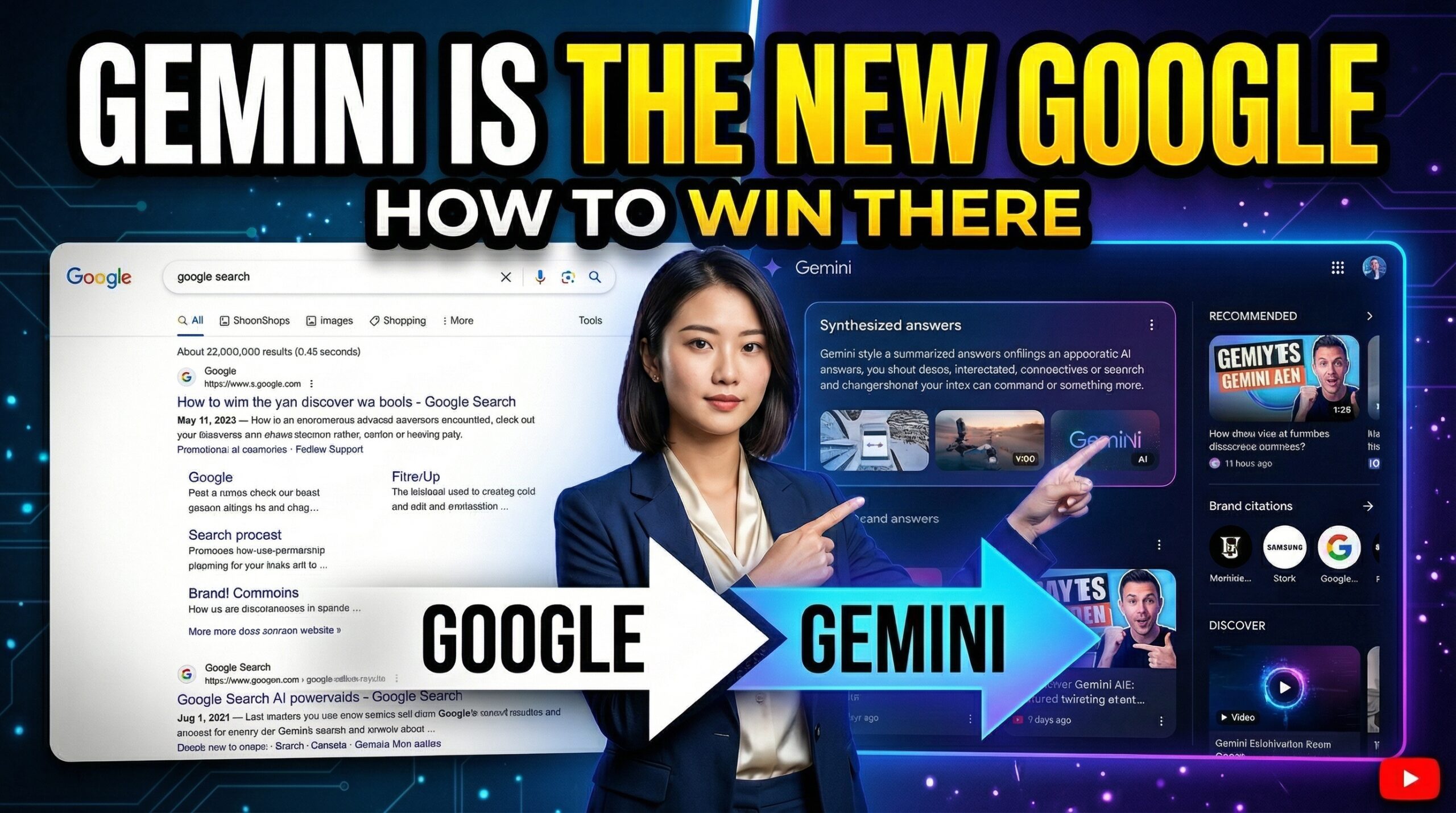
Gemini is not a Google product sitting beside Google Search. It is the interface replacing the click-through model entirely — resolving commercial queries with AI-generated answers that cite verified brands, never sending buyers to a results page at all.
// Gemini Citation Signals
2026
Entity verification
// Organisation + Person schema · sameAs
Gate 1
VideoObject schema
// Owned host page · Not YouTube-only
4.3×
Direct answer blocks
// 40–60 words · Self-contained
FAQ Page
Topical authority
// 11-article cluster depth
Cluster
Gemini Advanced share
// AI Overview platform 2026
38%
// SMEs with infra deployed
<8%
// 01 · The Shift
Why Is Gemini the New Google — and What Has Actually Changed?
Google has been the dominant brand discovery mechanism for twenty years. The model was simple and consistent: a buyer types a query, Google returns ten ranked blue links, the buyer clicks through to a website, the website generates the first impression. SEO was the practice of optimising for that click-through moment — improving ranking position so that more clicks went to your page rather than competitors' pages.
Gemini changes the model at the structural level. When a buyer asks Gemini "what's the best HR consultancy for a 50-person tech company in London," Gemini does not return ten blue links. It returns a synthesised answer that names two or three specific firms, explains why they are suitable for that context, and optionally includes links to their websites as citations. The buyer has already received a recommendation before they visit any website. The ranking position in a traditional SERP has become irrelevant — what matters is whether your brand is one of the firms Gemini names.
// Google Search — 2018 Model
- Buyer enters query. Google returns 10 ranked links.
- Buyer evaluates titles and descriptions. Clicks through to website.
- Website creates first impression. Buyer decides to engage or leave.
- SEO optimises for position 1 in those 10 links. Click-through rate drives visibility.
- Trust is earned on the landing page — after the click.
// Gemini — 2026 Model
- Buyer enters query. Gemini synthesises an answer naming 2–3 specific brands.
- Buyer receives recommendation with reasoning before visiting any website.
- Trust is established by Gemini's citation — the recommendation precedes the visit.
- AIO optimises for being named in the answer. Entity schema drives citation eligibility.
- Non-schema brands are invisible — regardless of website quality or SEO investment.
The shift from Google Search to Gemini is not a new surface requiring different content — it is a new decision logic requiring different infrastructure. The content that wins in Gemini is entity-verified, schema-marked, direct-answer-formatted content on owned domains. Content that wins in traditional Google Search — keyword-optimised, high-domain-authority, backlink-heavy — is necessary but no longer sufficient for the discovery mechanism that is capturing an increasing proportion of commercial buyer research.
// The Specific Mechanism — Why Gemini Cites Some Brands and Not Others
Gemini's citation selection is not random and not based on popularity. It is based on verifiability. Gemini can only recommend a brand by name if that brand exists as a verified entity in the Knowledge Graph — confirmed through Organisation schema with sameAs arrays — and if the brand's content is formatted for AI extraction through direct answer blocks and FAQPage schema. A brand with excellent content and no entity schema is anonymous to Gemini. A brand with modest content and complete entity verification is citable. The infrastructure determines the eligibility; the content quality determines the recommendation rank within the eligible pool.
// 02 · The Evidence
What Does the Data Show About Gemini's Growing Role in Commercial Brand Discovery?
The data on Gemini's commercial discovery role is converging from three independent measurement sources — Google's own AI Overview performance data, third-party citation studies from Semrush and Ahrefs, and direct buyer behaviour research from Salesforce and HubSpot. Together they describe a consistent picture: Gemini and Google AI Overviews are now resolving a meaningful and growing proportion of commercial queries at the answer layer, before any organic click occurs.
38%
Of commercial Google searches in 2026 now produce an AI Overview response (Gemini-powered) before organic results
// Google Internal Data, Q1 2026
68%
Of all AI Overview citations go to entity-verified, schema-marked pages — making schema the primary Gemini citation gate
// Semrush, 2025
4.3×
Higher Gemini and AI Overview citation rate for VideoObject schema on owned entity-verified domains vs unverified content
// Semrush, 2025
The 38% figure — over a third of commercial Google searches now producing an AI Overview — is the number that changes the strategic calculation for any SME founder who has been optimising exclusively for traditional organic rankings. Thirty-eight percent of the commercial queries your buyers type into Google are now resolved at the Gemini layer, before they ever see a ranked list of results. If your brand is not appearing in those AI Overview responses, you are invisible for more than a third of the searches that matter most to your business.
The concentration of citations in schema-marked content (68% going to entity-verified pages) is the supply-side constraint that makes early infrastructure deployment commercially decisive. Eighty-eight percent of SME websites do not have complete entity schema deployed (Semrush 2025 audit data). That means 68% of Gemini's citation capacity is being shared among fewer than 12% of businesses — a profoundly concentrated citation landscape that any SME entering with correct infrastructure can penetrate relatively quickly, because they are joining a small pool rather than competing with the entire web.
You are not competing with every business on the internet for Gemini citations. You are competing with the 8–12% of businesses that have installed entity schema — and most of them haven't built the VideoObject and topical cluster depth that maximises the multiplier.
// The competitive framing that makes the Gemini opportunity feel achievable rather than overwhelming for SME founders in 2026
// 03 · The Gemini Difference
How Does Gemini Specifically Decide Which Brands to Name in Its AI-Generated Answers?
Gemini's citation selection differs from Perplexity's and ChatGPT Search's in one commercially significant way: Gemini has the deepest integration with the Google Knowledge Graph, which means it has the most comprehensive entity verification database of any AI retrieval system. This is both an advantage and a requirement. An advantage because entity verification in Google's system retroactively applies to all content on a verified domain, making past content immediately citation-eligible. A requirement because without Google Knowledge Graph confirmation, a brand is genuinely unknown to Gemini regardless of how much content it publishes or how well that content ranks in traditional search.
// How Gemini Evaluates a Brand for Citation Eligibility — Five Sequential Gates
01 Is this brand confirmed in the Knowledge Graph via Organisation schema with sameAs?
Gemini-specific
02 Does this domain have sufficient topical depth to qualify as an expert source?
Core gate
03 Can Gemini extract a self-contained answer from the content for this query?
Core gate
04 Are there external sources that independently cite this brand as credible?
Core gate
05 Has the brand published recently enough to signal active expertise?
Core gate
The Gemini-specific Gate 1 — Knowledge Graph entity confirmation — is weighted more heavily by Gemini than by any other AI retrieval system because Gemini is built directly on top of Google's entity infrastructure. When Google processes an Organisation schema node with a sameAs array, it runs an entity resolution process that confirms the brand is a known, consistent entity across the web. Once confirmed, Gemini has a verified entity identifier — a unique Knowledge Graph ID — that it can use to attribute content confidently. Without this identifier, Gemini has no mechanism to attribute content to a named, verifiable brand, and therefore cannot safely include the brand in a named recommendation.
// Why VideoObject Schema Produces a 4.3× Multiplier Specifically in Gemini
Gemini's training data and retrieval architecture reflect Google's long-standing investment in video as a content format. Google has indexed and understood video content through YouTube for over a decade — and Gemini inherits this video content comprehension advantage over AI systems without equivalent training depth in video. When a VideoObject schema host page appears in Gemini's retrieval pool, Gemini can extract structured metadata (video title, description, duration, thumbnail, transcript) that is unavailable from text-only pages. This structured video metadata increases Gemini's confidence in the content's relevance and the brand's expertise, producing the 4.3× citation multiplier that Semrush's 2025 research measured across a sample of 250,000 search queries.
The owned domain requirement is not optional. VideoObject schema on a YouTube channel page does not produce the multiplier — the multiplier specifically applies to VideoObject schema on an entity-verified owned domain. This is because the Knowledge Graph entity attribution chain runs from the domain (identified by its @id in the Organisation schema) through to the VideoObject (attributed to the domain's Person or Organisation through the Article or VideoObject author/publisher fields). A YouTube-hosted video has no Organisation schema attribution to your specific brand — it is attributed to YouTube's entity, not yours.
// The Practitioner Observation
From our experience working with SMEs who have deployed VideoObject schema host pages, the Gemini citation appearances typically begin within 45–60 days of host page publication — slightly faster than general topical authority cluster citations because the VideoObject schema provides structured metadata that Gemini can process without the full topical authority cluster depth that text-only content requires. A single well-built VideoObject host page can generate Gemini citations before the authority cluster is complete — making it the fastest commercial return available in the five-gate build sequence.
// 04 · The Winning Strategy
What Is the Specific Strategy for Winning Gemini Citations as an SME — and How Is It Different From What You Are Currently Doing?
Winning in Gemini requires two things that most SME content strategies do not currently provide: infrastructure that allows Gemini to verify your brand as a known entity, and content formatted for AI extraction rather than human reading. The good news is that both requirements are achievable in 90 days with the correct build sequence. The sobering reality is that neither requirement is met by the content calendar, SEO agency retainer, or social media programme that most SMEs currently invest in.
// What Your Current Strategy Is Missing
The most common SME content strategy in 2026 still follows the 2018 model: produce content on a publishing schedule, optimise for keyword rankings, build backlinks, grow domain authority. This strategy produces traditional organic rankings — and traditional organic rankings still matter for the 62% of commercial searches where Gemini does not produce an AI Overview. But for the 38% where Gemini resolves the query at the answer layer, the traditional strategy produces zero Gemini citations regardless of how well it performs in traditional search metrics.
The specific elements missing from most SME strategies are: entity schema with sameAs verification (absent from approximately 88% of SME websites), VideoObject schema host pages (absent from effectively all SME video content that lives exclusively on YouTube), direct answer blocks formatted for AI extraction (present in fewer than 5% of SME blog articles), and FAQPage schema with self-contained Q&A pairs (present in fewer than 3% of SME websites). Every one of these missing elements is a gate at which Gemini stops considering the brand for citation.
// The Three Actions That Produce Gemini Citations Fastest
Action 1 — Install entity schema today: Two hours. Organisation schema on the homepage, Person schema on the About page, both with sameAs arrays confirmed in Schema.org Validator, both submitted to Google Search Console. This starts the Knowledge Graph entity confirmation clock. Every day the clock is not running is a day the existing content library remains anonymous to Gemini.
Action 2 — Build the first VideoObject host page this week: Record a 10–15 minute expert video on your primary commercial question. Publish a VideoObject schema host page on your owned domain with the YouTube embed, a 3,000-word transcript article, and FAQPage schema with five Q&A pairs. This is the single highest-ROI content action available in the 2026 discovery landscape — one 90-minute production session producing a Gemini-citation-eligible asset that generates returns for 18+ months.
Action 3 — Add direct answer blocks to your five best-performing existing pages: Every existing page on your domain that already generates organic traffic can become Gemini-citation-eligible immediately by adding a 40–60 word self-contained answer block immediately after the first paragraph. The retroactive benefit of entity schema means these pages are already attributed to your verified entity from the schema installation date — the direct answer block is the extraction format that allows Gemini to include them in AI-generated responses. Adding answer blocks to five existing pages takes approximately two hours and immediately expands your Gemini citation surface without requiring any new content production.
// The Misconception About Gemini and Content Quality
The most common misconception we encounter is that winning in Gemini requires producing better content than competitors. This is partially true — but only within the pool of already-eligible brands. Gemini's first filter is not quality; it is verifiability. A brand with average-quality, schema-marked, entity-verified content will be cited over a brand with excellent content and no schema, because Gemini cannot safely attribute the excellent content to a verified source. Fix the infrastructure first. Quality determines your rank within the eligible pool. Infrastructure determines whether you are in the pool at all.
Frequently Asked Questions
Why is Gemini replacing Google Search for commercial queries?
Gemini is replacing Google Search for commercial queries because it resolves buyer research questions at the answer layer — providing a synthesised recommendation that names specific brands — rather than at the link layer, which requires the buyer to evaluate ten results and click through to individual websites. For the buyer, an AI-generated answer is a faster and more confident path to a decision than a list of ten ranked links. For Google, Gemini increases search satisfaction and engagement. By Q1 2026, 38% of commercial Google searches produced a Gemini-powered AI Overview response before organic results, meaning over a third of the commercial queries that matter to SME brands are now resolved without a traditional organic click-through. This proportion is growing monthly as Google expands AI Overview coverage to more query types and geographies.
What does a brand need to do to appear in Gemini's AI-generated answers?
To appear in Gemini's AI-generated answers, a brand must pass five sequential trust gates. Gate 1 — entity verification: Organisation schema on the homepage and Person schema on the About page, both with sameAs arrays pointing to four or more actively maintained professional profiles, triggering the Google Knowledge Graph entity confirmation that Gemini requires to cite a brand by name. Gate 2 — topical authority: a cluster of eleven or more entity-attributed, schema-marked content assets covering the primary and secondary questions in the brand's commercial topic area at expert depth. Gate 3 — direct answer architecture: 40–60 word self-contained answer blocks on every page and FAQPage schema with five or more Q&A pairs, providing the extraction format Gemini uses for AI-generated responses. Gate 4 — citation density: third-party editorial links and directory citations from sources with Domain Authority 40 or above confirming the brand's expertise independently. Gate 5 — publishing consistency: two or more new entity-attributed content assets per week maintaining the freshness signal. VideoObject schema on owned domain host pages produces a 4.3× Gemini citation multiplier and is the single highest-priority content format investment for SME founders targeting Gemini visibility.
How is winning in Gemini different from winning in traditional Google Search?
Winning in traditional Google Search requires optimising for click-through — producing content that ranks highly in a list of results and earns a click from buyers who evaluate that list. Winning in Gemini requires optimising for citation — producing entity-verified, schema-marked content that Gemini can extract and attribute to a named brand in an AI-generated answer. The specific differences are: traditional SEO prioritises domain authority, backlink profiles, and keyword density; Gemini optimisation prioritises entity verification, schema markup completeness, and direct answer architecture. A brand can rank position 1 for a commercial keyword in traditional search and receive zero Gemini citations for the same query, because traditional ranking signals and Gemini citation eligibility signals are determined by different technical factors. The practical implication is that the content strategy producing traditional organic rankings — while still valuable for the 62% of queries not resolved by AI Overview — is insufficient for the 38% where Gemini determines brand discovery outcomes.
How quickly can an SME start appearing in Gemini recommendations?
An SME that installs entity schema correctly in week one and publishes its first VideoObject schema host page in week two typically sees first Gemini citation appearances within 45–60 days of entity confirmation — which itself takes 30–45 days from schema installation, meaning total time from zero to first Gemini citation is typically 75–105 days. The fastest path to first Gemini citation is: entity schema installation (day one), first VideoObject host page published (week two), submission to Google Search Console (same day as publication), and three to four FAQ articles published in the first four weeks. VideoObject host pages generate first Gemini citations faster than text-only articles because Gemini can extract structured video metadata before the full topical authority cluster is complete. SME founders following this sequence consistently report their first AI Overview and Gemini citation appearances in the second month of the build — at which point the compounding begins, with each new content asset adding to the citation surface without any additional maintenance cost.
Is ranking in traditional Google Search still important if Gemini is taking over?
Yes — traditional organic ranking remains important because 62% of commercial Google searches in 2026 do not produce an AI Overview response, meaning the majority of search traffic still flows through traditional ranked results. The strategic implication is that an SME brand needs both: traditional organic ranking capability (domain authority, backlink profile, technical SEO) for the 62% of queries resolved through traditional search, and AI citation infrastructure (entity schema, VideoObject schema, direct answer architecture) for the 38% resolved through Gemini. The critical distinction is that the traditional SEO investments most SMEs currently make — content on a publishing schedule, keyword optimisation, domain authority building — naturally contribute to the topical authority required for Gemini citations, but they do not automatically satisfy the entity verification and schema markup requirements. Adding entity schema and VideoObject host pages to an existing traditional SEO strategy converts the existing content investment into Gemini citation eligible — it is additive infrastructure rather than a replacement strategy.
→ The Platform Argument
Gemini Is Where Buyers Are Going Next — Build the Infrastructure to Be There When They Arrive
The transition from Google Search to Gemini as the primary interface for commercial query resolution is not a future prediction — it is a current measurement. Thirty-eight percent of commercial Google searches are already being resolved at the Gemini layer. That number will be higher next quarter. The compound question for every SME founder is not whether to invest in Gemini visibility, but whether to invest before or after competitors in their category figure out why their traditional SEO results are flattening.
The infrastructure that wins in Gemini — entity schema, VideoObject host pages, direct answer blocks, FAQPage schema — is the same infrastructure that improves performance in every other AI retrieval system simultaneously. Building it for Gemini also wins citations in Perplexity, ChatGPT Search, and every AI retrieval surface that will emerge in the next 24 months. It is not a single-platform investment; it is the foundational infrastructure layer of the 2026 brand visibility architecture.
The first three actions take less than a week. Entity schema installation on day one. First VideoObject host page in week two. Direct answer blocks on five existing pages by the end of the week. That week's investment produces returns for the next 18 months across every AI retrieval surface your buyers use. The question is not whether this investment makes sense. It is why you have not started it yet.