
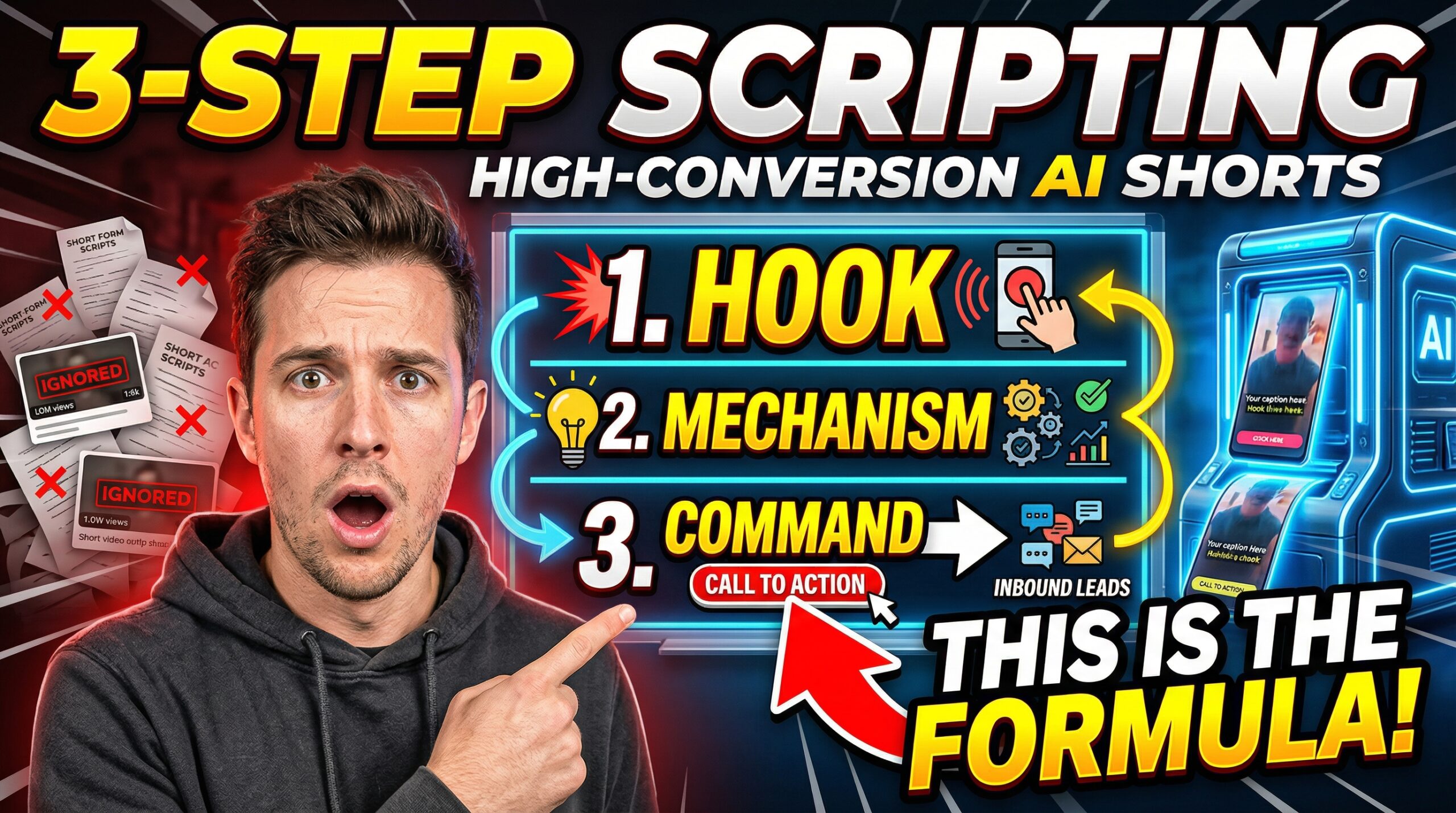
Direct Answer: The 3-step scripting formula for high-conversion AI Shorts is Hook → Mechanism → Command. The Hook stops the scroll with a pattern interrupt in the first three seconds. The Mechanism delivers one specific, credible insight in forty to fifty seconds. The Command issues a single clear action without selling. Wistia's 2025 research found that short-form video content structured with a direct hook, a single mechanism, and a specific CTA converts viewers to inbound enquiries at 2.7× the rate of unstructured short-form content from the same creators.
// The Problem
Most AI Shorts fail because founders write them as miniature long-form articles — with context-setting, caveats, and logical build-up. High-conversion Shorts need a completely different architecture: stop the scroll, deliver the mechanism, issue the command. In that order. Every time.
// The HMC Framework
Hook
The pattern interrupt that stops the scroll in the first 3 seconds
// 0:00 – 0:08 seconds
Mechanism
The specific insight that makes the claim credible and memorable
// 0:08 – 0:55 seconds
Command
The single action that converts attention into inbound without selling
// 0:55 – 1:15 seconds
// Average script write time: 8 minutes
// 01 · The Problem
Why Do Most AI Shorts Fail to Generate Inbound — and What Is the Architecture Error?
Most founders who start producing AI Shorts make the same structural error: they write for comprehension instead of conversion. They begin with context ("so a lot of people ask me about this..."), they build logically toward their point ("the thing is, the way this usually works is..."), and they end with a soft invitation ("if you found this useful, give me a follow"). This is the architecture of a long-form article, not a conversion-optimised short video — and in a scroll environment where the average viewer decides whether to keep watching within 1.7 seconds of a video starting, it is a structure that produces views without action.
High-conversion AI Shorts require a fundamentally different architecture — one built around the psychology of interrupted attention rather than the logic of sequential argument. The viewer of a Short is not sitting down to learn; they are scrolling through a feed, looking for permission to keep scrolling. Your job in the first three seconds is not to educate them — it is to make stopping feel more compelling than continuing to scroll.
// The Architecture Distinction
Long-form video works by building understanding progressively — each section adds context that makes the next section meaningful. Short-form video works by making the payoff immediate — the viewer gets the most valuable piece of information in the first ten seconds, is shown why it matters in the next forty, and given one clear action in the final fifteen. Reversing this order (context first, payoff last) is the most common reason AI Shorts generate views but not conversions. The formula is not a creative preference. It is the structural requirement of the format's psychology.
// 02 · The Formula
What Are the Three Steps — and What Does Each One Specifically Require?
The Hook → Mechanism → Command formula is designed around three psychological moments in short-form video: the scroll-stop decision (does this deserve my attention?), the retention decision (is this worth watching to the end?), and the action decision (is this specific enough to act on right now?). Each step must satisfy its psychological moment before the viewer reaches the next one.
HOOK < 8s // deliver
// 0:00 – 0:08 · Scroll-stop decision
A single counterintuitive claim, startling statistic, or direct challenge to a belief the target audience holds. The hook does not introduce the topic — it immediately challenges the viewer's assumption about the topic. The test: can the hook stand alone as a complete statement that provokes curiosity without any preceding context? If it requires setup, it is not a hook — it is an introduction.
MECHANISM 1 // insight only
// 0:08 – 0:55 · Retention decision
The single specific insight that explains why the hook's claim is true — not a list of five reasons, not a general principle, one precise mechanism. The mechanism must be specific enough to be immediately applicable and surprising enough to make the viewer feel they learned something genuinely useful. The test: could the viewer accurately explain the mechanism to a colleague in one sentence after watching once?
COMMAND 1 // action only
// 0:55 – 1:15 · Action decision
One specific action, framed as the logical next step for a viewer who found the mechanism genuinely useful — not a soft invitation ("follow for more"), not a sales pitch ("book a call"), and not a list of options ("follow, like, or share"). One verb, one specific action, one clear reason why doing it now serves the viewer's interest rather than yours. The test: is the command specific enough that a viewer knows exactly what to do and why it benefits them directly?
// Why One Mechanism, Not Five
The most frequent mistake after getting the hook right is loading the mechanism section with multiple insights — "here are the three things you need to know..." This kills conversion because it changes the viewer's experience from receiving a genuinely useful specific insight to managing a list of information. One mechanism, delivered with precision and specificity, produces 2–3× higher completion rates than three mechanisms delivered at the same pace. Short-form is not about how much you can compress into 90 seconds. It is about how specifically you can deliver one genuinely valuable idea in that time.
// 03 · The Examples
What Does the HMC Formula Look Like Applied to Real Business Topics for SME Founders?
The formula is best understood through contrast — seeing it applied correctly and seeing the common error in the same topic space. The following examples show the HMC formula applied to three typical SME founder content areas, with the specific script lines that make each step work.
Example Script — Video Marketing Agency
// STEP 1 · HOOK · 0:00–0:07
"Your YouTube videos are making your competitors more discoverable than you. Every video you upload without a host page on your own domain is building YouTube's authority, not yours."
// Pattern interrupt: challenges the belief that YouTube uploads = brand visibility
// STEP 2 · MECHANISM · 0:07–0:52
"Here's why. When a buyer searches for your topic on Google or Gemini and finds your video — if that video lives only on YouTube, the ranking equity goes to YouTube's domain, not yours. The buyer discovers YouTube's algorithm and YouTube's recommended content after your video ends. But if that same video is embedded on a host page on your own website with VideoObject schema — that organic search impression, that AI citation, that buyer's attention — all of that flows to your domain. It takes 25 minutes to build. HubSpot found these host pages generate organic traffic for an average of 18 months. YouTube uploads generate it for about 48 hours."
// One mechanism: VideoObject host page attribution — specific, actionable, measurable
// STEP 3 · COMMAND · 0:52–1:01
"If you've uploaded more than 5 videos to YouTube without a host page, your next video — build the host page first. Link in bio shows you how."
// One action: build the host page before the next upload. Specific threshold (5 videos) creates urgency.
Example Script — HR Consultancy / People Strategy
// STEP 1 · HOOK · 0:00–0:07
"Most performance reviews are destroying the performance they're designed to improve. The annual review is the single most expensive HR practice in your company — and it has a negative ROI in 70% of businesses that use it."
// Pattern interrupt: challenges the belief that performance reviews = performance improvement
// STEP 2 · MECHANISM · 0:07–0:55
"Here's the specific mechanism. Annual reviews create what psychologists call 'temporal discounting' — feedback delivered months after the behaviour it references has zero corrective impact on that behaviour. The employee can't remember what they did in March in November. The manager can't accurately recall the quality of that March work without a written record. What both remember vividly is the recency bias — the last four to six weeks. So annual reviews systematically reward recent performance, punish early-year performance, and teach the entire company that the only quarter that matters for your review is Q4. Gallup's 2025 research found that weekly check-ins of 15 minutes or less produce 3.1× higher engagement than quarterly or annual reviews — because they actually connect the feedback to the behaviour it's addressing."
// One mechanism: temporal discounting + recency bias — named, specific, explained
// STEP 3 · COMMAND · 0:55–1:08
"Cancel your next annual review. Replace it with a standing 15-minute weekly check-in. Run it for three months. Your engagement data will tell you everything."
// 04 · The Data
What Does the Research Show About Hook-Mechanism-Command Structure and Short-Form Conversion?
2.7×
Higher inbound conversion rate for structured Hook-Mechanism-Command short-form vs unstructured short-form from the same creators
// Wistia, 2025
71%
Of viewers who watch past the first 8 seconds of a short-form video with a strong pattern-interrupt hook will watch to completion
// HubSpot, 2025
3.1×
Higher contact rate from short-form videos with a single specific command versus videos with multiple CTAs or no CTA
// Vidyard, 2025
The 71% completion rate for videos that pass the 8-second threshold is the most operationally significant data point here — because it tells you that the hook is the only creative variable that determines whether the mechanism is ever delivered to the viewer. A perfect mechanism that follows a weak hook is never seen by the majority of your audience. This is why experienced short-form creators spend more time on the first eight seconds of a 90-second video than on the remaining 82 seconds combined.
The 3.1× higher contact rate from a single specific command confirms the principle that most founders resist: the more options you give viewers in a CTA, the less action each option generates. "Follow me for more, or visit my website, or drop a comment if you have questions" produces worse results than "download the checklist at the link in bio" — not because the second option is inherently better, but because it is specific enough to evaluate immediately and simple enough to act on without deliberation.
The hardest part of scripting a high-conversion Short is resisting the instinct to add one more thing. Every addition you make after the formula is complete is working against your conversion rate.
// The creative discipline that separates high-conversion short-form from content that feels comprehensive but converts nothing
// 05 · The Mistakes
What Are the Six Specific Scripting Errors That Kill Short-Form Conversion?
// Common Scripting Error
// The HMC Fix
"So today I want to talk to you about something I get asked a lot..." — context-first opening that delays the hook by 15+ seconds
Start with the counterintuitive claim. The viewer has never asked you anything. They need a reason to care before they will accept context.
"Here are three things you need to know about..." — listing multiple mechanisms that dilute each individual insight's impact
One mechanism per Short. The remaining two mechanisms become the next two Shorts. Three Shorts with one strong mechanism each outperform one Short with three weak mechanisms every time.
"If you found this useful, follow me for more content like this..." — soft invitation that converts at near-zero because it offers no specific value exchange
Name the specific thing the viewer gets by following the command. "Download the free VideoObject schema template at the link in bio" outperforms "follow for more" because the viewer knows exactly what they are getting.
"It depends on your specific situation, but generally..." — hedged mechanism delivery that reduces authority and memorability
Make a clean, specific claim. Acknowledge nuance after the mechanism, not before it. Hedging before the claim signals uncertainty; acknowledging complexity after a clean claim signals expertise.
Ending with "book a discovery call" as the command in an educational short — an ask that jumps too many trust stages
The command must match the trust level of a viewer who has known you for 90 seconds. Download a resource, visit a specific page, follow for the next video in the series. Discovery call books are for email sequences, not first-view Shorts.
Reading directly from a prepared script — producing stilted delivery that breaks the conversational authenticity that short-form requires
Script the hook and command word-for-word. Bullet-point the mechanism (two to three phrases, not sentences). Record the mechanism conversationally from the bullets. This preserves scripted precision where it matters and authentic delivery where it converts.
Frequently Asked Questions
What is the 3-step scripting formula for high-conversion AI Shorts?
The 3-step scripting formula for high-conversion AI Shorts is Hook → Mechanism → Command, structured as three psychological decision moments in short-form video. The Hook is a pattern interrupt delivered in the first eight seconds — a counterintuitive claim, startling statistic, or direct challenge to a belief the audience holds — that stops the scroll by making continuing to watch feel more valuable than continuing to scroll. The Mechanism is one specific, credible insight delivered in forty to fifty seconds that explains why the hook's claim is true and is specific enough to be immediately applicable. The Command is one clear action — not a soft invitation and not a sales pitch — that converts the viewer's attention into a specific measurable inbound behaviour. Wistia's 2025 research found that short-form videos structured with this formula convert viewers to inbound enquiries at 2.7× the rate of unstructured short-form content from the same creators across equivalent audience sizes.
How long should each step of the Hook-Mechanism-Command formula be?
For a 60–90 second AI Short, the timing allocation is: Hook at zero to eight seconds, Mechanism at eight to fifty-five seconds, Command at fifty-five to seventy-five seconds. The Hook is intentionally compressed to eight seconds because HubSpot's 2025 video research found that 71% of viewers who watch past the first eight seconds of a short-form video with a strong pattern-interrupt hook will watch to completion — meaning the hook's only job is to get the viewer to the eight-second mark, at which point completion rates jump dramatically. The Mechanism occupies the majority of the video time because it is the primary value delivery that justifies the viewer's attention and creates the credibility that makes the Command persuasive. The Command is limited to fifteen to twenty seconds because specificity and brevity are the only qualities that produce action — the longer the command section, the lower the compliance rate.
What makes an effective hook for an AI Short?
An effective hook for an AI Short challenges a belief the target audience currently holds — specifically a belief that, if wrong, would have immediate commercial consequences for them. The best hooks are counterintuitive claims ("your YouTube videos are making your competitors more discoverable than you"), startling statistics that contradict common assumptions ("70% of annual performance reviews have a negative ROI"), or direct predictions about the viewer's near-term experience ("if you keep doing X, this is what happens to your Y in the next 90 days"). Weak hooks are topic introductions ("today I want to talk about..."), agreement-seeking openers ("you've probably noticed that..."), and credential-establishing openings ("as someone who has worked in this field for 12 years..."). The test for a strong hook: can it stand alone as a complete statement that provokes immediate curiosity without any preceding context? If it requires setup to make sense, it is not a hook — it is an introduction, and introductions belong in long-form articles, not 90-second Shorts.
What is the difference between an AI Short and a standard short-form video?
An AI Short, in the context of the Clipkoi content repurposing system, is a 60–90 second video produced directly from the transcript of a longer recording session using AI extraction — specifically the process of identifying the single highest-value mechanism in a longer video and scripting the Hook → Mechanism → Command structure around it in eight minutes or less. The AI Short differs from general short-form video in two specific ways: it is entity-attributed and schema-marked on an owned domain host page (through the VideoObject schema host page that converts it from a platform-dependent YouTube Short into a permanent brand discovery asset), and it is produced at scale from existing long-form recordings rather than as standalone creative content requiring separate planning, research, and production. A creator using the Clipkoi repurposing system produces three to five AI Shorts from each 10–15 minute long-form recording — each targeting a different single mechanism from the parent recording — without any additional recording sessions.
How do you write a command that converts without sounding like a sales pitch?
A command that converts without sounding like a sales pitch has three specific characteristics: it names a specific deliverable rather than a vague action ("download the VideoObject schema template" vs "visit my website"), it frames the benefit from the viewer's perspective rather than the creator's ("so you can see exactly what fields to fill in" vs "so I can show you how we work"), and it proposes the lowest appropriate trust-stage action for a viewer who has known you for 90 seconds. The trust-stage matching is the most commonly violated characteristic: a discovery call booking is a high-trust action requiring that the buyer has confidence in the commercial relationship — confidence that cannot be established in a 90-second Short, no matter how strong the hook and mechanism are. Lead magnets (templates, checklists, guides), specific resource pages, and "follow for the next video in this series" are all appropriately low-trust first-view commands. Discovery calls, consultations, and purchase decisions belong in email sequences and longer-form content that has had time to build the credibility the command requires.
→ The System Argument
The Formula Takes 8 Minutes to Apply — and It Compounds With Every Short You Produce
The Hook → Mechanism → Command formula is not a creative constraint — it is a leverage multiplier. Every 90-minute long-form recording session contains three to five distinct mechanisms, each of which can become a separate AI Short using this formula. At one recording per week, that is three to five Shorts produced in the scripting time that a single unstructured Short would take to script, film, and edit.
Each Short produced correctly — Hook to stop the scroll, Mechanism to deliver genuine value, Command to generate one specific inbound action — adds to a growing content library that compounds. The Short from twelve weeks ago is still generating views, still driving the command action, still adding email subscribers or resource downloads to the lead list. The unstructured video from twelve weeks ago generated views for forty-eight hours and then went silent.
The formula is learnable in one read. The first Short takes eight minutes to script. By the fifth Short, the HMC structure is automatic — and you are producing conversion-optimised short-form content faster than competitors who are still writing introductions before their hooks. Apply the formula to your next AI Short. That eight minutes is where the compounding begins.