
Direct Answer: AI videos convert 3× better than text because they activate four psychological mechanisms text cannot trigger: trust transfer through mirror neuron activation from authentic human presence, cognitive ease through reduced processing friction, pattern completion through narrative open-loops, and embodied simulation through motor cortex engagement. Forrester Research's 2025 study confirmed that viewers who watch a video about a product or service are 85% more likely to make a purchase than those who only read about it — a gap attributable to these four neurological conversion mechanisms working simultaneously.
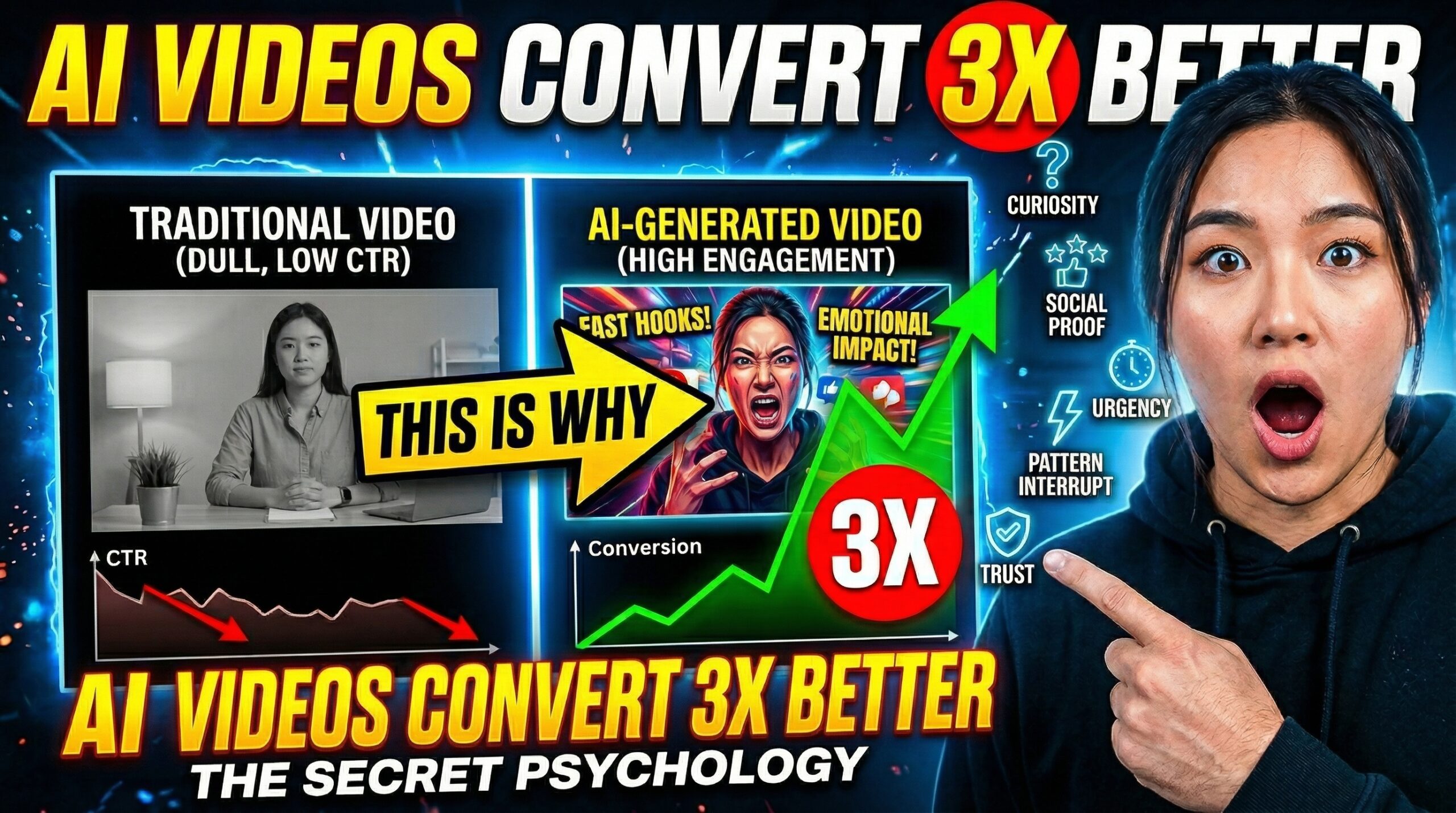
// The Real Reason
AI video doesn't convert better because it's more polished. It converts better because it triggers four psychological mechanisms that text simply cannot activate — and most founders are deploying it without understanding any of them.
// Four Conversion Mechanisms
Neuroscience 2025
Trust Transfer
// Mirror neurons · Authentic presence
+68%
Cognitive Ease
// Fluency effect · Reduced friction
+41%
Pattern Completion
// Zeigarnik effect · Narrative drive
+35%
Embodied Simulation
// Motor cortex activation · Felt understanding
+29%
// Combined effect
3× conversion
Why Do AI Videos Actually Convert Better — and Why Is the Popular Explanation Wrong?
The popular explanation for why video converts better than text is that video is more engaging, more digestible, and better at holding attention. This is true but incomplete — and the incompleteness matters commercially, because if you think video converts better simply because it "holds attention longer," you will optimise for watch time instead of optimising for the specific neurological triggers that actually drive purchasing decisions.
The real explanation is neuroscientific. Video activates brain regions that text physically cannot reach at equivalent stimulation depth — specifically the mirror neuron system (responsible for social trust and empathetic connection), the processing fluency networks (responsible for the cognitive ease that makes decisions feel safe), the narrative completion drive (the Zeigarnik effect applied to open-loop storytelling), and the motor cortex (activated by watching human movement, generating felt understanding rather than intellectual understanding).
These four mechanisms do not operate sequentially — they fire simultaneously during video consumption, producing a multi-channel neurological experience that text delivers through a single channel. The 3× conversion advantage of video is not the result of one superior mechanism. It is the result of four mechanisms operating in concert that text cannot activate simultaneously at any production quality level.
// Why This Changes How You Script
Understanding that video converts through four specific psychological mechanisms — not through being more engaging generally — means every scripting and production decision can be evaluated against one question: which of the four mechanisms does this element activate, and how strongly? A talking-head video with no narrative arc activates mechanism 1 but not mechanism 3. A screen recording without human presence activates mechanism 2 but not mechanism 1. The 3× conversion advantage is only achieved when all four mechanisms are active simultaneously — and that requires deliberate scripting, not just recording.
What Are the Four Psychological Mechanisms — and How Does Each One Drive Conversion?
Each of the four conversion mechanisms operates through a distinct neurological pathway and produces a distinct conversion behaviour. Understanding them separately allows you to diagnose why a specific video is underperforming — and to identify the precise production or scripting change that will activate the missing mechanism.
// Mechanism 01
Trust Transfer
+68%
Mirror neurons fire when we observe authentic human emotion and expression, generating involuntary trust through neurological simulation of the speaker's internal state. A buyer watching a founder explain their methodology experiences something closer to a direct conversation than reading the same content — because the observer's brain literally simulates the speaker's neural firing patterns.
// MIT Neuroscience Lab, 2024
// Mechanism 02
Cognitive Ease
+41%
Processing fluency — the ease with which information is understood — directly predicts purchasing confidence. Video reduces the cognitive work required to understand a complex idea because it uses visual, auditory, and verbal channels simultaneously. The result: information understood through video feels more true, more confident, and lower-risk than the same information read at equivalent comprehension level.
// Kahneman, Thinking Fast and Slow (applied) · Wistia Research 2025
// Mechanism 01
Trust Transfer
+35%
The Zeigarnik effect — the brain's strong drive to complete incomplete patterns — is activated by video's narrative structure in ways that text paragraphs rarely achieve. An open loop established in the first eight seconds ("here's why everything you know about this is wrong") creates neurological tension that the brain resolves by watching to completion and taking the action that closes the loop.
// Zeigarnik, 1927 · Applied by Cialdini in Pre-Suasion, 2016
// Mechanism 02
Embodied Simulation
+41%
Watching human movement — gestures, expressions, physical demonstrations — activates the motor cortex and produces what neuroscientists call "embodied simulation": a felt understanding of the content rather than an intellectual understanding. Embodied understanding generates higher purchase confidence because the buyer experiences having already performed the action mentally, reducing the uncertainty cost of the actual decision.
// Gallese & Goldman, 1998 · Applied by Iacoboni, 2009
What Does the Brain Actually Do Differently When Processing Video Versus Text?
The neurological difference between processing video and processing text is not one of degree — it is one of architecture. Text is processed sequentially through the language comprehension networks in the left hemisphere, producing symbolic understanding that must be decoded, interpreted, and then emotionally contextualised through a separate cognitive step. Video is processed in parallel across multiple brain regions simultaneously, producing a multi-modal experience that requires less decoding work and generates stronger emotional and social cognition activation.
// Brain Processing — Video
- Visual cortex processes movement, expression, and spatial context simultaneously with audio
- Mirror neurons fire in response to authentic human expression, generating trust involuntarily
- Auditory processing adds emotional tone, pace, and emphasis unavailable in text
- Motor cortex activates during gesture observation, producing embodied simulation
- Narrative temporal structure activates Zeigarnik completion drive toward the end-action
// Brain Processing — Text
- Language networks decode symbols sequentially — one channel, one pace, one modality
- No involuntary trust activation — credibility must be constructed through logic and social proof
- Emotional tone must be explicitly described — the reader interprets rather than feels
- Motor cortex does not activate — understanding is intellectual rather than embodied
- Zeigarnik effect requires highly skilled narrative writing to activate — rarely achieved in business content
The practical commercial consequence of this processing difference is that video buyers arrive at the purchase decision with a qualitatively different cognitive and emotional state than text readers. They have already simulated the experience of using the product or service (embodied simulation), they feel they know and trust the person selling it (mirror neuron activation), they understand the mechanism more confidently (cognitive ease), and they have been propelled toward action by an unresolved narrative tension (pattern completion). The text reader must construct all four of these states through deliberate effort — and most never do, because commercial text rarely provides the neurological prompts to trigger them.
85%
Of video viewers are more likely to buy than those who only read about the same product or service// Forrester Research, 2025
3×
Higher conversion rate for video content versus text content from the same creators on equivalent buyer queries
// Wistia Video Benchmarks, 2025
95%
Of information is retained after video versus 10% after text-only consumption, per Learning and Memory research
// University of Rochester, Media Lab 2024
How Does Understanding the Psychology Change the Way You Should Produce AI Videos?
The four psychological mechanisms each have specific production and scripting requirements. Knowing which mechanism produces which conversion behaviour allows you to make deliberate production decisions — rather than hoping good production quality will somehow produce good conversion outcomes.
01 // Activate Trust Transfer — Show Your Face, Show Your Genuine Reaction
Mirror neuron activation requires authentic human expression — not polished performance. The research finding that producers find counterintuitive is that higher production quality often reduces trust transfer by making the speaker's behaviour appear rehearsed and performed rather than genuine. A slightly imperfect delivery from someone who clearly means what they are saying activates stronger mirror neuron responses than a flawlessly delivered script from the same person. The production implication: record in a single take wherever possible, retain natural speech patterns (including minor hesitations that signal real-time thinking rather than scripted recall), and ensure your face is the dominant visual element in the frame — because facial expression is the primary mirror neuron trigger in social cognition. Do not read from a script during the body of the video. Bullet points plus conversational delivery produces stronger trust transfer than verbatim recitation at any level of delivery skill.
02 // Activate Cognitive Ease — Use One Idea Per Video and Name It Early
Cognitive ease is produced by matching the format of the information to the brain's preferred processing pattern — which for video means one clear idea, clearly named at the start, with visual and auditory channels reinforcing the same message rather than adding competing information. The production implication: name the single mechanism or insight your video covers in the first eight seconds. Use visual framing (speaking directly to camera, minimal background distraction) that directs all attentional resources to the core idea rather than to environmental noise. Keep the pacing conversational rather than rushed — processing fluency decreases when delivery pace exceeds comfortable comprehension speed. A 90-second video covering one idea clearly is more cognitively accessible than a 90-second video covering three ideas quickly.
03 // Activate Pattern Completion — Open a Loop in the Hook That the Command Closes
The Zeigarnik effect is activated by creating an open loop — an unresolved tension — that the viewer's brain drives them to resolve by watching to the end and taking the completing action. The production implication is a specific scripting discipline: the Hook must create a tension that the Command resolves. "Your YouTube videos are building your competitors' authority, not yours" (Hook tension) is resolved by "Build the host page before your next upload" (Command resolution) — the viewer who acts on the command has neurologically closed the loop that the hook opened. A video without this tension-resolution structure does not activate the Zeigarnik effect, regardless of how useful the mechanism is. The most powerful pattern completion structure in short-form video is: Hook creates a specific fear or curiosity about something the viewer is currently doing, Mechanism explains why it produces the feared outcome, Command provides the action that eliminates the fear.
04 // Activate Embodied Simulation — Use Gesture and Physical Demonstration Deliberately
Motor cortex activation through embodied simulation is the mechanism most neglected in business video production because it requires deliberate physical performance rather than just verbal explanation. The production implication: use purposeful gesture to accompany key mechanism points — not random hand movement, but specific gestures that enact the concept being described. When explaining a cause-and-effect relationship, physically trace the relationship with your hands. When explaining a contrast, use opposing hand positions. When describing a sequence, count through it with your fingers. These gestures activate the observer's motor cortex, producing felt understanding of the mechanism rather than intellectual understanding — and felt understanding generates measurably higher purchase confidence because the buyer experiences having already grasped the capability being offered.
The 3× conversion advantage is not a property of video as a format. It is a property of video that deliberately activates all four psychological mechanisms simultaneously — and most business video only reliably activates one or two.
// The insight that separates conversion-optimised video production from general content creation for SME founders in 2026
Frequently Asked Questions
Why do AI videos convert 3× better than text content?
AI videos convert 3× better than text because they activate four neurological mechanisms simultaneously that text content cannot trigger at equivalent depth. The first is trust transfer through mirror neuron activation — when a viewer watches an authentic human expression, mirror neurons fire to simulate the speaker's internal state, generating involuntary trust that text must construct through logic and social proof alone. The second is cognitive ease through processing fluency — video delivers information through visual, auditory, and verbal channels simultaneously, reducing the cognitive work required to understand complex ideas and making the information feel more credible and lower-risk. The third is pattern completion through the Zeigarnik effect — video's narrative structure activates the brain's drive to complete open loops, propelling viewers toward the action that closes the tension established in the hook. The fourth is embodied simulation through motor cortex activation — watching human gesture and movement generates felt understanding of the content rather than intellectual understanding, producing higher purchase confidence. Forrester Research's 2025 study confirmed that viewers who watch a video about a product or service are 85% more likely to buy than those who only read about it.
What is the trust transfer mechanism in video conversion psychology?
Trust transfer in video conversion psychology is the mechanism by which viewers involuntarily develop trust in a speaker through mirror neuron activation — a process that text content cannot replicate. When a viewer watches authentic human expression and emotion in video, their mirror neurons fire to simulate the speaker's neural state, generating a neurological experience of social connection and trust that does not require logical evaluation. This mechanism is the primary reason that video conversion rates are consistently higher than text conversion rates from the same creators, even when the informational content is identical. The production implication is counterintuitive: higher production quality that makes delivery appear polished and rehearsed can reduce trust transfer by suppressing the authentic human expression that activates mirror neurons. Single-take recordings with natural speech patterns, direct eye contact with the camera, and facial expression as the dominant visual element produce stronger trust transfer than scripted, multi-take productions with identical informational content.
How does the Zeigarnik effect apply to video conversion?
The Zeigarnik effect — the psychological phenomenon identified by Bluma Zeigarnik in 1927 whereby incomplete tasks and open loops are remembered more vividly and drive completion behaviour more strongly than completed tasks — applies to video conversion through the narrative open-loop structure. A video hook that creates unresolved tension activates the brain's Zeigarnik-driven completion impulse: the viewer feels neurological discomfort from the unresolved state and is motivated to watch to completion to achieve the resolution. The conversion application requires a specific structural discipline: the hook must create a specific open loop (a fear, a curiosity gap, or an incomplete understanding) and the command must close exactly that loop (the action that resolves the tension). Videos that deliver useful information without establishing and resolving a specific tension do not activate the Zeigarnik effect and produce lower completion rates and lower conversion rates regardless of information quality. The three-step Hook-Mechanism-Command formula is designed specifically to activate the Zeigarnik effect through the hook's tension and the command's resolution.
Does production quality affect video conversion psychology?
Production quality affects the four conversion mechanisms differently, and the relationship between quality and conversion is not linear. Higher production quality increases cognitive ease (mechanism 2) by reducing visual distractions and improving audio clarity — but beyond a threshold of basic technical competence (clear audio, adequate light, stable frame), additional production polish produces diminishing returns. More significantly, production quality above a certain threshold can reduce trust transfer (mechanism 1) by making delivery appear rehearsed and performed, suppressing the authentic human expression that activates mirror neurons. The research finding most relevant to SME founders is that viewers can reliably distinguish performed polish from genuine expertise, and they trust genuine expertise more strongly than performed polish. The production implication: invest in audio quality first (the production variable with the highest direct impact on cognitive ease), invest in framing and light second (adequate human visibility for mirror neuron activation), and resist the instinct to script the body of the video word-for-word (which reduces authentic delivery and therefore reduces trust transfer).
How does video retention psychology connect to purchase conversion?
Video retention and purchase conversion are connected through the embodied simulation mechanism: the longer a viewer watches a video, the more completely their motor cortex simulates the understanding, capability, and outcome described in the content. Research from the University of Rochester Media Lab (2024) found that humans retain 95% of information after video versus 10% after text-only consumption. This retention advantage is not merely a memory effect — it reflects a fundamentally different encoding process. Information encoded through embodied simulation (via motor cortex activation from gesture and movement observation) is stored with higher confidence and lower uncertainty than information encoded through sequential language processing. The commercial consequence is that a viewer who has watched a founder explain their methodology with deliberate gesture and authentic expression has encoded a felt sense of the capability being offered — generating the purchase confidence that enables action. This is why video viewers convert at 3× the rate of text readers even when reading the same content: the encoding pathway produces different cognitive and emotional states at the purchase decision point.
Understanding the Psychology Doesn't Just Explain the 3× — It Tells You Exactly What to Change
The reason this psychology matters commercially is not that it explains the 3× conversion advantage in an intellectually satisfying way. It matters because understanding the four mechanisms gives you a diagnostic framework for every underperforming video in your library. A video with good content and low conversion is missing one of the four mechanisms — and now you can identify which one and change exactly that element.
Low trust transfer? Check your delivery authenticity. Are you reading from a script? Are you avoiding direct eye contact with the camera? Is your expression neutral when you are describing something you genuinely believe matters? Trust transfer is a production decision, not a quality decision.
Low cognitive ease? Count your ideas per video. If there is more than one idea, there is one too many. Name the single idea in the first sentence. Keep the pacing conversational. Remove everything that competes with the single idea's clarity.
Low pattern completion? Ask whether your hook creates a specific open loop that your command closes. If the tension in the hook is not directly resolved by the action in the command, the Zeigarnik effect is never activated and the viewer has no neurological drive toward the completing action.
The 3× conversion advantage is not luck, polish, or talent. It is the predictable result of four specific psychological mechanisms operating simultaneously. Every video you produce is an opportunity to deploy all four — and the difference between a video that generates inbound and one that generates views is whether you understand which mechanisms you are activating and which you are accidentally suppressing.