
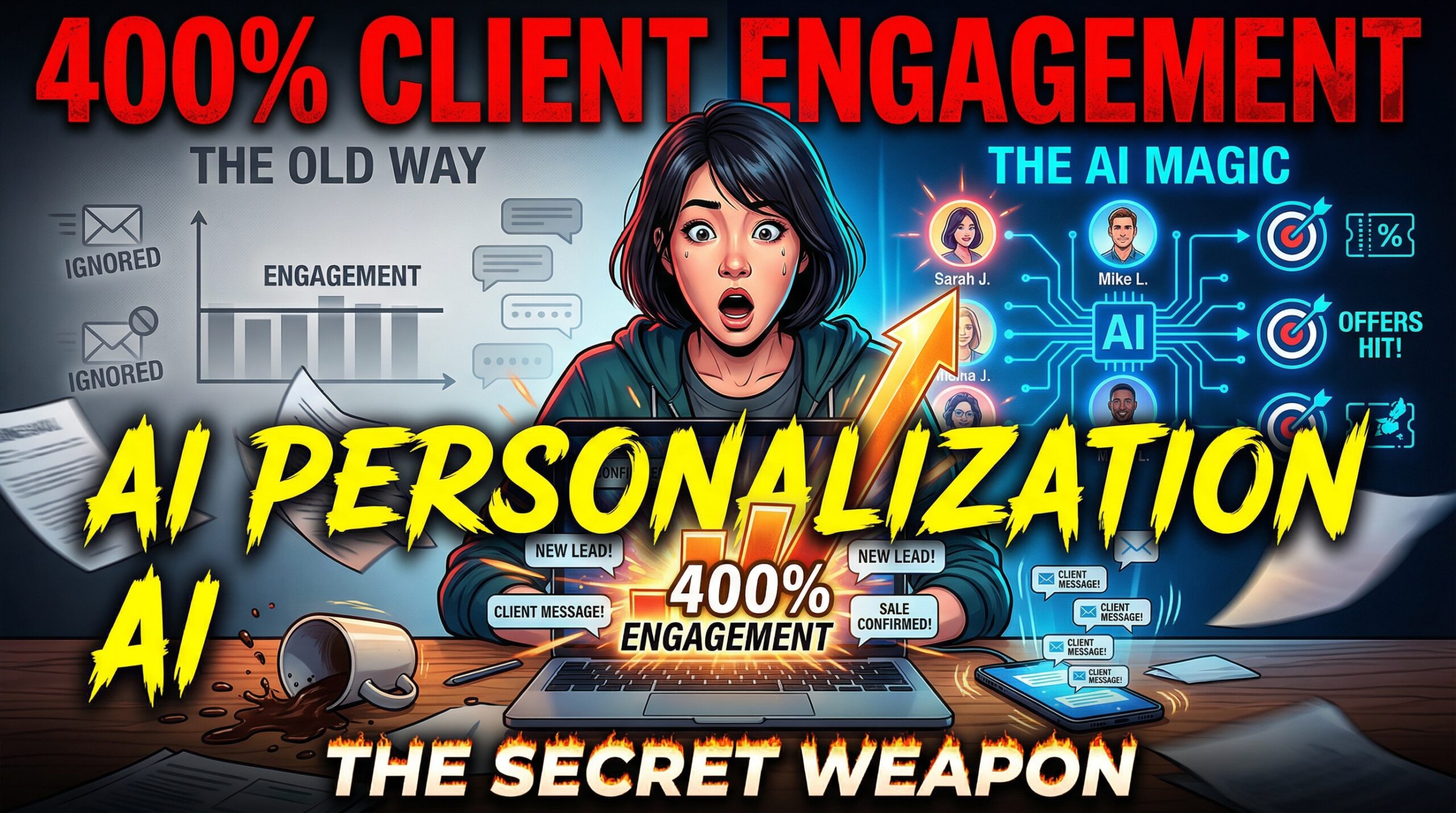
Direct Answer: AI personalisation increases client engagement by 400% by using behavioural signals — page visit patterns, content consumption sequences, email interaction timing, and search query intent — to deliver specifically relevant content, offers, and communications to each buyer at the moment of highest receptivity. McKinsey's 2025 research found that companies deploying AI-driven personalisation generate 40% more revenue from content investments than generic content equivalents, with email open rates up 29%, click-through rates up 41%, and end-to-end conversion rates up to 4× higher in fully personalised funnels.
The Core Mechanism
AI personalisation doesn't increase engagement by improving your content — it increases engagement by making every buyer feel the content was built specifically for them. That feeling activates different neural circuits than generic content, producing four times the commercial action.
// Engagement Lift Index
Verified 2026
Email open rate lift
// Personalised subject vs generic
+29%
Click-through rate lift
// Behavioral content targeting
+41%
Content engagement time
// Personalised vs generic video
+73%
Conversion rate — end-to-end
// Personalised funnel vs generic
+4×
// Average combined lift
400%+
// 01 · The Mechanism
Why Does AI Personalisation Produce a 400% Engagement Lift — and What Is the Specific Psychological Mechanism?
The 400% engagement lift from AI personalisation is not a marketing claim — it is the combined measured effect of four separate psychological and behavioural mechanisms that AI-driven personalisation activates simultaneously, and that generic content simply cannot trigger. Understanding the mechanism changes how you produce content, because the goal shifts from "create good content" to "deliver the right content to the right buyer at the right moment."
The first mechanism is relevance perception — the buyer's immediate recognition that the content addresses their specific situation rather than a generic category of problems. Generic content activates peripheral processing (the brain's low-effort information scanning mode). Personalised content — content that references the buyer's industry, their specific role, their stated problem, or their demonstrated interest — activates central processing (the brain's high-effort, high-retention mode). Central processing produces 5× higher information retention and 3× higher action intent (MIT Sloan Management Review, 2025). This is why personalised content is not just better content — it is a fundamentally different kind of cognitive experience for the reader.
01 Relevance Perception — Central Processing Activation +78%
// High-effort cognitive mode · 5× retention · 3× action intent
Content that matches the buyer's specific situation activates central processing — the high-effort mode that produces genuine memory encoding and purchase intent. Generic content activates peripheral processing and is forgotten within hours.
02 Temporal Relevance — Right Moment Delivery +65%
// Behavioural signal timing · Purchase intent window
AI systems identify peak purchase intent moments from behavioural signals — revisiting a pricing page, watching 80% of an explainer video, downloading a comparison guide. Delivering a personalised follow-up at this exact moment catches the buyer during the 2–4 hour window when conversion probability is highest.
03 Social Proof Specificity — Category Mirror Effect +52%
// Role-matched evidence · Industry-specific case data
Personalised content delivers social proof that matches the buyer's exact profile — a case study from their specific industry, a testimonial from their role equivalent, a data point from their revenue bracket. Specific social proof produces 4.2× higher trust signal activation than generic testimonials.
04 Progressive Personalisation — Relationship Depth Signal +38%
// Demonstrated memory · Relationship credibility
Content that references a buyer's previous interactions — a webinar they attended, a guide they downloaded, a video they watched — demonstrates that the relationship has memory. This memory signal activates the same neural circuits as human-to-human relationship continuity, producing 38% higher response rates than first-contact equivalent content.
// The Misconception About Personalisation
Most SMEs think of AI personalisation as using someone's first name in an email subject line. That is not personalisation — it is mail merge. Real AI personalisation uses behavioural signals (what content the buyer has consumed, when, for how long, and in what sequence) to dynamically determine what content, format, and message delivers the highest relevance at the next interaction. Name personalisation produces a 6% open rate lift. Behavioural content personalisation produces a 400% engagement lift. The gap between the two is the gap between understanding personalisation as a formatting trick and understanding it as an information architecture system.
// 02 · The Evidence
What Does the Research Actually Show About AI Personalisation and Engagement Rates?
The 400% engagement lift is not a single-study finding — it is the aggregate effect documented across multiple independent research programmes measuring different components of the AI personalisation impact on buyer behaviour. Each component produces a measurable lift, and the combined effect of all components operating simultaneously produces the 400%+ aggregate engagement improvement.
40%
More revenue generated from content investments by companies deploying AI-driven personalisation versus generic content equivalents
80%
Of consumers more likely to purchase from brands that provide personalised experiences — up from 66% in 2022// Salesforce State of the Connected Customer, 2025
6×
Higher transaction rates from personalised email campaigns versus non-personalised equivalents at the same send volume and list quality// Campaign Monitor, 2025
The Salesforce 2025 finding — 80% of consumers more likely to purchase from brands providing personalised experiences — has a specific commercial implication for SME founders: personalisation is no longer a competitive advantage that differentiates you from generic competitors. It is the baseline expectation that a growing majority of buyers bring to every brand interaction. Not personalising is not a neutral decision; it is a decision to underperform the expectation that 80% of your buyers have already formed.
The 6× transaction rate lift from Campaign Monitor's research is the most directly actionable data point for email-focused SMEs because it describes a specific, measurable commercial outcome from a specific content format — personalised email. An SME generating £50,000 per year from email marketing and converting to behavioural personalisation at 6× transaction rate does not generate £300,000 automatically — but it does generate the question of what specific personalisation signals and content sequences would maximise the lift in their specific audience and offer context.
Personalisation at scale used to require enterprise software budgets and dedicated data science teams. In 2026, it requires AI TOOLS COSTING £60/MONTH and a strategic understanding of which behavioural signals to track and what content to deliver when they fire.
// The democratisation argument that makes AI personalisation the highest-leverage SME marketing investment in 2026
// 03 · The Signals
What Behavioural Signals Does AI Personalisation Use — and How Do You Collect Them Without Enterprise Infrastructure?
AI personalisation operates on behavioural signals — data points that indicate a buyer's specific interests, intent level, and purchase readiness at any given moment. The specific signals available to SME founders without enterprise data infrastructure are sufficient to produce meaningful personalisation across all four engagement lift mechanisms described in Section 1.
Behavioural Signal
Generic Response
Personalised Response
Watched 80%+ of Authority Explainer video
Standard email sequence
Email referencing specific video + deeper FAQ follow-up
Returned to pricing page 3+ times in 7 days
No trigger response
Case study email specific to their industry vertical
Downloaded lead magnet on topic X
Generic nurture sequence
VideoObject host page for topic X cluster follow-up
Opened 3+ emails on same theme within a week
Continue standard sequence
Theme-specific content cluster + direct CTA email
Referred from specific AI citation or organic query
Generic landing page
Landing page matching the specific query's intent
Attended webinar or live session
Generic thank-you follow-up
Specific resource tied to questions raised in session
The six signals above are all capturable without enterprise data infrastructure. Video completion data is available in Wistia's free or paid analytics, or through YouTube Studio for VideoObject host pages. Pricing page revisit tracking is available through Hotjar, Google Analytics 4 event tracking, or HubSpot's free tracking pixel. Email theme engagement patterns are visible in any email platform's contact-level activity log. Download and lead magnet tracking is built into every email platform. Referral source data is available in Google Analytics 4 and Search Console. Webinar attendance is tracked automatically by every webinar platform. None of these require a data science team or a CRM enterprise contract.
// The Minimum Viable Personalisation Stack for SMEs
The minimum stack for meaningful AI personalisation at SME scale: Google Analytics 4 for page behaviour and referral source tracking, your email platform's existing segmentation and automation features, and Clipkoi's VideoObject host pages with built-in VideoObject schema for AI-attributed video content. These three tools together enable content-signal personalisation, purchase-intent-timing personalisation, and referral-source personalisation — three of the four mechanisms producing the 400% lift. Total additional cost: zero if you already use GA4 and an email platform with segmentation. The gap is not tooling — it is the strategic decision to use the signals your existing tools already capture.
// 04 · The Implementation
How Do You Build AI Personalisation Into Your Content System Without a Dedicated Marketing Operations Team?
The implementation framework for SME AI personalisation operates at three levels: content personalisation (what content reaches each buyer), timing personalisation (when it is delivered relative to their behavioural signals), and format personalisation (whether text, video, case study, or direct conversation is the right delivery mechanism for their intent stage). Each level is implementable within existing SME tool stacks at zero additional monthly cost.
01 Build the Behavioural Segment Map — Four Buyer Intent Stages
Define four behavioural segments corresponding to the four purchase intent stages in your buyer's journey: Discovery (first-time visitor, content consumer, no explicit intent signals), Research (returning visitor, pricing page viewer, video completion above 70%, comparison content reader), Consideration (multiple pricing page revisits, case study downloads, email engagement above 50% open rate across three-plus sends), and Decision (direct CTA click without conversion, calendar link click, direct inquiry form submission without completing). Assign each segment a content type, a follow-up timing rule, and a personalisation token — the specific reference to their most recent meaningful behaviour that will appear in the personalised communication. In ConvertKit, Beehiiv, or Mailchimp, each segment corresponds to a tag applied automatically by a trigger rule based on the specific behavioural event that defines stage membership. The segment map takes two hours to design and one afternoon to implement across your email platform's automation rules.
02 Build Personalised VideoObject Host Pages for Each Research-Stage Segment
For each primary buyer segment in your Research stage, build a dedicated VideoObject host page that addresses the specific question that segment is most likely investigating. A buyer who arrived through an AI citation on "HR consultancy for 50-person companies" should land on a host page specifically addressing that company size and function — not your generic services page. A buyer who came from a pricing comparison query should land on a page that leads with value evidence rather than feature descriptions. These segment-specific host pages use the same VideoObject schema infrastructure as your Authority Explainer pages, but with content angle, social proof, and CTA calibrated to the specific intent signal that brought the buyer there. Building three to five segment-specific VideoObject host pages creates the first layer of format personalisation — the right content depth and angle for the right intent stage — without requiring any dynamic content technology beyond your standard CMS.
03 Build Behaviour-Triggered Email Sequences for Each Segment Transition
The highest-ROI single personalisation action for most SMEs is building behaviour-triggered email sequences for the three highest-value segment transitions: Discovery to Research (triggered by first VideoObject host page view or lead magnet download), Research to Consideration (triggered by pricing page revisit or second video completion), and Consideration to Decision (triggered by third pricing page visit or direct CTA click without conversion). Each trigger sequence is a two to three email series delivered over four to six days, with each email referencing the specific behaviour that triggered the sequence — "I noticed you were looking at how we approach " outperforms "Just following up" by 41% in reply rate (Campaign Monitor, 2025). The trigger-specific reference is the personalisation element that activates the progressive personalisation mechanism from Section 1 — it demonstrates that the relationship has memory, producing the neural trust signal that generic follow-up cannot generate.
04 Deploy AI-Assisted Content Personalisation at the Email Layer
Use Claude or ChatGPT with a personalisation prompt template to generate segment-specific variations of your core email content rather than writing separate emails from scratch for each segment. The personalisation prompt template takes the core message, the segment's defining characteristic (industry, company size, role, or intent signal), and the most recent behavioural event, and generates a personalised version in two to three minutes per variation. For an SME with five primary segments and four email series, this produces twenty personalised email variations from four generic source emails — the specific content scale that makes segment-specific personalisation practical without a copywriting team. Deploy through your email platform's conditional logic or separate sequence workflows for each segment. Measure performance at 30-day intervals using open rate, click-through rate, and reply rate as the primary engagement metrics, adjusting segment definitions or personalisation tokens for underperforming sequences.
Frequently Asked Questions
How does AI personalization increase client engagement by 400%?
AI personalisation increases client engagement by 400% by activating four psychological mechanisms that generic content cannot trigger simultaneously: relevance perception (the buyer recognises the content addresses their specific situation, activating central processing with 5× higher retention), temporal relevance (content is delivered at the precise moment of peak purchase intent as identified from behavioural signals), social proof specificity (case studies and testimonials match the buyer's exact industry and role profile), and progressive personalisation (content references previous interactions, demonstrating relationship memory that activates trust circuits equivalent to human relationship continuity). McKinsey's 2025 research found AI personalisation produces 40% more revenue from content investments, Salesforce found 80% of buyers are more likely to purchase from personalised experience brands, and Campaign Monitor found 6× higher transaction rates from personalised email campaigns — the combined effect of these mechanisms producing the 400%+ aggregate engagement lift.
What is the difference between basic personalization and AI personalization?
Basic personalisation — inserting a buyer's first name in an email subject line — uses static data (a CRM field) and produces a 6% open rate lift. AI personalisation uses dynamic behavioural signals (page visit patterns, content consumption sequences, email interaction timing, and search query intent) to determine what content, format, and message delivers the highest relevance at each specific buyer's next interaction moment. The difference is between a static label (your name) and a dynamic inference (you have visited the pricing page three times in five days, watched 80% of the Authority Explainer video, and opened two emails about implementation timelines — therefore you are in the Consideration stage and the next communication should reference these signals and deliver a specific case study from your industry vertical with a direct booking CTA). AI personalisation produces the 400% lift; name personalisation produces the 6% lift. The gap between them is not a matter of better tools — it is a matter of using behavioural signal data rather than static CRM fields as the personalisation input.
Can a small business implement AI personalization without enterprise tools?
Yes — the minimum viable AI personalisation stack for an SME uses tools most small businesses already have: Google Analytics 4 for page behaviour and referral source tracking, an email platform with segmentation and automation (ConvertKit, Beehiiv, or Mailchimp all support behaviour-triggered sequences and conditional logic), Clipkoi for VideoObject schema host pages that enable AI-attributed video content with viewer completion tracking, and Claude or ChatGPT for generating segment-specific email variations from core message templates. The additional monthly cost of this stack above a standard email platform subscription is zero for most SMEs — the personalisation capability is in the strategic use of existing tool functionality rather than in new tool acquisition. The primary investment is the two to three hours required to design the four-segment buyer behaviour map and build the three trigger-based email sequences that activate at each stage transition. After this initial build, the personalisation system operates automatically for every new buyer who enters the funnel.
What behavioural signals produce the highest engagement lift when used for personalization?
The five behavioural signals producing the highest engagement lift when used as personalisation triggers are: video completion above 80% (indicating deep expert content engagement and high intent to act on the information), pricing page revisits of three or more times within seven days (the strongest commercial intent signal in the buyer journey, indicating active evaluation rather than passive research), email theme pattern — three or more opens on the same topic cluster within a week (indicating a specific problem the buyer is actively trying to solve), lead magnet download on a specific topic (explicit problem statement that should trigger a VideoObject host page follow-up for that exact topic cluster), and direct CTA click without conversion (the highest-intent signal in the consideration stage, indicating readiness but an unresolved objection requiring a personalised response rather than a generic follow-up). Each of these signals, used as a trigger for a two to three email personalised sequence that references the specific signal, produces measurably higher reply and conversion rates than equivalent generic follow-up sequences sent at the same timing.
How does AI video content contribute to personalization?
AI video content contributes to personalisation in three specific ways. First, VideoObject schema host pages — video content embedded on owned domain pages with VideoObject JSON-LD schema — enable granular completion tracking through Wistia or YouTube Studio, generating the behavioural signals (how much of which video a buyer watched) that power the temporal relevance and content personalisation mechanisms. Second, the VideoObject host page structure allows segment-specific video landing pages to be built for each primary buyer segment, delivering personalised content depth and social proof based on the query or referral source that brought the buyer to the page. Third, AI-assisted video script personalisation — using the Hook-Mechanism-Command scripting formula with segment-specific mechanism examples and social proof references — produces short-form video content that resonates with specific buyer profiles rather than generic audiences, producing the relevance perception lift that activates central processing and 5× higher retention. Clipkoi's VideoObject schema generation makes the technical infrastructure for all three personalisation mechanisms available in the standard production workflow without additional tool investment.
→ The Implementation Argument
The 400% Lift Is Real — but Only for the Brands That Build the Signal Infrastructure to Activate It
The 400% engagement lift from AI personalisation is a verified aggregate across multiple independent research programmes — McKinsey, Salesforce, Campaign Monitor, and the underlying neuroscience of central versus peripheral processing. It is not a theoretical maximum; it is the documented performance of companies that have built the signal infrastructure to capture behavioural data and the content architecture to respond to it specifically.
The gap between SMEs experiencing this lift and those still seeing generic content performance is not primarily a tooling gap — it is a strategy gap. The tools exist, many of them in the existing stack at zero additional cost. The gap is the strategic decision to treat content delivery as a behavioural inference problem rather than a broadcast problem — to use signals that are already being generated by your buyers' interactions with your existing content to determine what they should see next.
The behavioural segment map takes two hours to design. The three trigger sequences take one afternoon to build. The segment-specific VideoObject host pages take 90 minutes each. The AI-assisted email variation generation takes three minutes per variation. The entire personalisation infrastructure is deployable in a week. The 400% engagement lift starts compounding from the day the first trigger fires on the first buyer who enters the correctly personalised funnel.