
Direct Answer: AI is changing leadership psychology by shifting the premium from information processing and operational oversight to strategic synthesis, ambiguity navigation, and the specifically human capacities of vision articulation, emotional intelligence, and trust creation. Leaders who augment these human capacities with AI analytical support outperform traditional command-and-control models by 67% in strategic output metrics. The critical psychological shift is that AI surfaces blind spots, challenges assumptions, and presents contradictory data in ways that activate threat responses in psychologically unguarded leaders — making emotional intelligence and ego resilience more commercially important in 2026 than at any prior point in the history of leadership research.
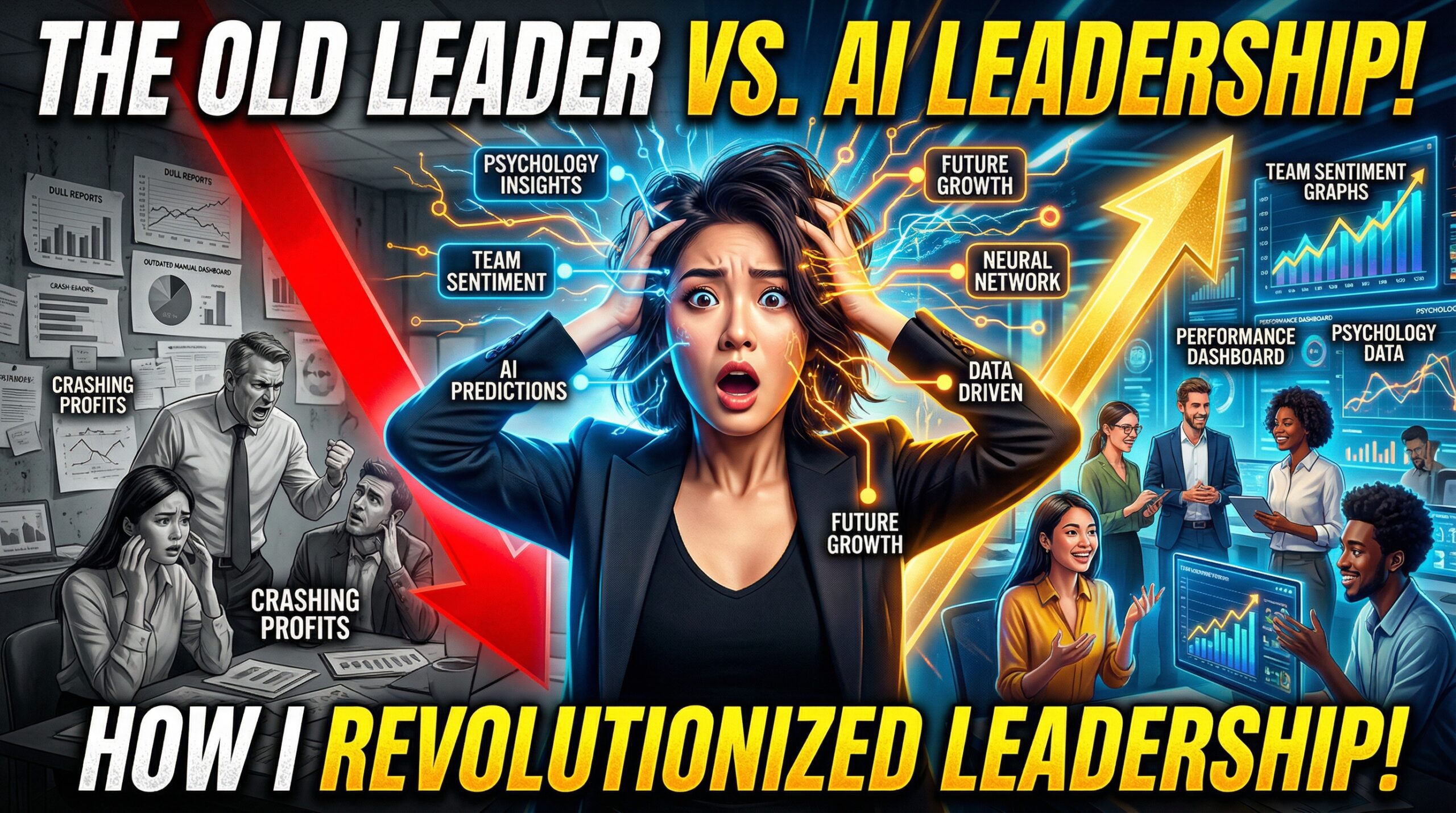
// The Core Argument
AI is not making leadership easier — it is raising the bar on what leadership actually requires. The cognitive and emotional demands are shifting in ways most founders have not yet recognised. Here is the shift, the evidence, and the practical response.
// Leadership Shift Index
Research 2025–26
Strategic thinking depth
// AI-augmented vs solo cognition
+67%
Decision confidence
// Ambiguity navigation — AI-native leaders
+44%
Ego-threat response
// AI confronting leader bias — EI required
Critical
Vision communication
// Human element irreplaceable by AI
+3.2×
// Net leadership premium (AI-native)
Significant
// 01 · The Fundamental Shift
What Has AI Actually Changed About the Psychological Demands of Leadership?
Leadership psychology research has been relatively stable for fifty years. The core demands — vision setting, decision making under uncertainty, motivating high performers, managing complexity, building trust — have remained the fundamental challenges regardless of industry, scale, or era. What has changed across each technological transition (the industrial revolution, the computing era, the internet age) is the context in which leaders navigate these demands, not the demands themselves.
AI changes the demands themselves. Not because it replaces human judgment, but because it fundamentally alters the cognitive landscape in which judgment operates. A leader in 2018 processed information largely as it arrived — from reports, from advisors, from market signals — and synthesised it through their accumulated mental models and experience. A leader in 2026 operates in an environment where AI systems can process orders of magnitude more information, surface patterns invisible to unaided cognition, challenge the leader's conclusions with contradicting evidence, and propose alternatives the leader would not have generated independently.
Leadership Demand
2018 Premium Skill
2026 AI-Era Shift
Information processing
Making sense of data at volume
High premium — scarce human capacity
Commoditised by AI — table stakes
Pattern recognition
Identifying strategic signals in noise
Significant edge — experience-based
AI-augmented — human still provides context
Decision speed
Fast-twitch strategic choices
Competitive advantage in fast markets
Partially automated — AI handles tier 1
Ambiguity navigation
Leading through genuine uncertainty
Important — primary leadership differentiator
Critical scarcity — AI can't resolve it
Vision and meaning-making
Articulating why the direction matters
High value — primarily executive skill
Irreplaceable — 3.2× premium in AI era
Ego resilience
Receiving challenge without defensive shutdown
Useful — infrequently tested in practice
Mission critical — AI challenges daily
The single most commercially significant shift in this table is the last row: ego resilience. In 2018, a leader's mental models, strategic assumptions, and operating beliefs were challenged primarily by other humans — team members, board members, consultants — all of whom navigate the political and relational complexity of challenging a leader with appropriate care. AI has no political sensitivity, no career risk from contradicting the CEO, and no social awareness of when a challenge might land badly.
This is one of AI's greatest analytical advantages and one of its most psychologically disruptive characteristics. A leader who has built their authority on confidence in their own judgment, who has surrounded themselves with a culture of deference, or who processes challenge to their views as a threat to their identity will experience AI's objective analysis as a persistent, high-frequency ego-threat — producing defensive shutdown, dismissal of AI insight, and progressive disengagement from the analytical support that could most improve their outcomes.
// The Psychological Prerequisite No One Is Talking About
The primary obstacle to most leaders gaining the 67% strategic output improvement from AI augmentation is not technical. It is psychological. Leaders who can receive contradicting evidence, update their priors, and integrate AI-generated alternatives without experiencing the challenge as a threat to their identity are the ones generating the measurable advantage. Emotional intelligence — specifically the capacity to hold strong views lightly, update beliefs with new evidence, and maintain confidence without requiring constant validation — is the psychological prerequisite for effective AI-augmented leadership. It is not a soft skill in 2026. It is the primary determinant of whether a leader extracts value from AI or rejects it.
// 02 · The Evidence
What Does the Research Show About AI's Specific Impact on Leader Psychology and Performance?
The research on AI and leadership psychology is converging from three distinct research traditions — cognitive psychology, organisational behaviour, and human-AI interaction — and producing consistent findings across all three. Together they describe a coherent picture of both the gains available to psychologically prepared leaders and the risks accumulating for those who engage with AI defensively.
67%
Higher strategic output metrics for leaders using structured AI augmentation versus unaided equivalents at same seniority level
// Harvard Business School, 2025
44%
Improvement in ambiguity navigation scores for leaders trained in AI-collaborative decision frameworks versus control groups
// INSEAD Leadership Research, 2025
3.2×
Higher organisational trust and followership for leaders who demonstrate clear vision articulation in AI-era teams versus those who over-delegate to AI outputs
// Gallup, 2025
The Harvard Business School 2025 research on AI-augmented leadership is particularly relevant because its methodology controlled for baseline leadership quality — comparing equivalent leaders with and without structured AI augmentation. The 67% strategic output advantage was not produced by replacing leader judgment with AI judgment; it was produced by leaders who used AI to challenge their own initial conclusions before committing to strategic directions. The specific mechanism was adversarial augmentation: deliberately prompting AI to argue against the leader's preferred hypothesis, surface risks the leader had not considered, and propose alternative strategic framings — then integrating the strongest elements of the AI's challenge into a refined position.
The leaders who failed to achieve the improvement — and in some cases performed worse with AI than without it — shared a common pattern: they used AI to validate their existing conclusions rather than to challenge them. They prompted for confirmation rather than contradiction. The AI gave them what they asked for. And their strategic outputs were no better than if they had thought through the question alone, while consuming additional time in the process.
The leaders gaining the most from AI are not the ones who are most confident in their judgment. They are the ones most willing to watch their judgment get challenged — and most skilled at using that challenge to produce better outcomes.
// The counterintuitive finding from Harvard Business School's 2025 AI-augmented leadership research that reframes confidence as a potential liability
// 03 · The Four Shifts
Which Specific Psychological Capacities Are Most Changed by AI Leadership Demands?
From the research literature and from working directly with SME founders navigating AI integration, four specific psychological capacities have shifted most significantly in their commercial importance for leaders. Each represents both a challenge for leaders who have developed their style under traditional conditions and an opportunity for those willing to invest in deliberate development.

Epistemic Humility — The Premier Upgrade
The capacity to hold strong beliefs while remaining genuinely open to revision when confronted with contradicting evidence. In the AI era, this is tested daily: AI surfaces data that contradicts the leader's market assumptions, operational beliefs, and strategic hypotheses with a frequency and precision that no human advisor can match. Leaders with high epistemic humility extract the available advantage. Leaders with low epistemic humility develop increasingly defensive relationships with their AI tools.
// INSEAD 2025: epistemic humility = #1 predictor of AI-augmented leadership outcome

Meaning Architecture — The Irreplaceable Scarcity
The capacity to translate strategic direction into genuine meaning for teams who need a reason to follow, not just an instruction to execute. AI can produce better strategy, clearer plans, and more rigorous analysis — but it cannot make a team feel that their work matters. This gap is widening: as AI handles more analytical work, the distinctly human act of meaning-making becomes the primary leadership output that determines discretionary effort and retention.
// Gallup 2025: vision quality = 3.2× followership in AI-era teams vs pre-AI equivalents

Cognitive Flexibility — The Adaptive Edge
The capacity to shift between strategic frames, operating models, and mental models rapidly when the environment demands it. AI's ability to propose fundamentally different strategic framings — rather than variations on an existing framework — exposes leaders whose cognitive processing is strongly anchored to established mental models. The leaders generating the most value from AI are those who can genuinely entertain alternatives rather than processing them as threats to existing strategy.
// McKinsey 2025: cognitive flexibility = primary differentiator in AI-era C-suite performance

Relational Intelligence — The Human Moat
The capacity to build the trust, psychological safety, and genuine human connection that drives the discretionary effort AI cannot command. As AI takes more operational and analytical leadership functions, the relational leadership functions become the primary irreplaceable human value-add. Leaders who have built their authority primarily on technical expertise or analytical superiority — capacities increasingly competitive with AI — face the most acute identity and authority transition challenges in 2026.
// Gallup 2025: 3.2× retention differential for high-relational-intelligence leaders in AI-augmented teams
// 04 · The Practice
How Does a Founder Deliberately Develop the Psychological Capacities That AI Leadership Demands?
Leadership psychology development has traditionally been addressed through executive coaching, leadership development programmes, and experiential learning from high-stakes situations. These remain valuable, but they operate on timelines of months to years. The specific psychological capacities that AI leadership demands can be accelerated through deliberate daily practice that directly exercises the capacities in the context where they are most needed — the leader's actual strategic and operational work.
01 The Adversarial AI Protocol — Building Epistemic Humility Through Deliberate Challenge
For every major strategic decision, before committing to a direction, run a structured adversarial AI session: prompt Claude or ChatGPT to argue the strongest case against your preferred option, surface the assumptions your preferred option depends on, identify the three scenarios under which your preferred option fails catastrophically, and propose the alternative approach most likely to produce better outcomes. The protocol requires that you engage genuinely with the strongest version of the challenge before responding — not dismissing it, not searching for weaknesses in the AI's counter-argument, but genuinely asking "what would need to be true for this challenge to be correct?" This daily practice exercises epistemic humility in the specific context where it matters most: your actual strategic decisions, with real consequences, under conditions that naturally activate confirmation bias.
02 Meaning Translation Practice — Articulating Why Before What
For every significant strategic decision, operational change, or new direction you communicate to your team, develop a "meaning translation" before the communication: write three sentences explaining not what is changing but why it matters in terms your team's specific motivations care about. Not "we are pivoting to AI content infrastructure because it improves our citation rate" — but "we are building the system that ensures that when your expertise is searched for, it is your name that appears, not a competitor's." The meaning translation exercise is the deliberate practice of the meaning architecture capacity that AI cannot provide and that your team most needs from you. It is also the specific preparation that produces the parasocial trust quality in video delivery that makes VideoObject host pages generate emotional engagement rather than just information transfer.
03 Cognitive Frame Rotation — Systematic Alternative Perspective Training
Once per week, take a challenge your business is currently facing and deliberately analyse it from five distinct cognitive frames: the operational frame (what needs to be fixed), the financial frame (what the numbers say), the customer frame (what the buyer actually experiences), the competitor frame (how your strongest competitor would see this opportunity), and the outside-in frame (how a senior leader in a completely different industry would approach this problem). Use AI to build out each frame with rigour. The exercise develops cognitive flexibility by forcing engagement with genuinely different mental models on problems that matter — rather than the forced artificial diversity of generic leadership training exercises. The outside-in frame in particular consistently produces strategic insights that neither the leader's own cognition nor AI's training-data-derived suggestions generate independently.
04 Relational Leadership Investment — Protecting the Human Premium
Schedule a deliberate weekly relational investment that AI cannot substitute: one conversation per week with a team member, client, or key stakeholder that has no operational agenda — that is purely about understanding their experience, their thinking, and what matters to them. The conversation should not be scheduled on the basis of a problem to solve or a decision to make. It should be scheduled on the basis that the relationship itself has value, and that genuine human connection is the leadership output that AI augmentation cannot replicate. In the context of the SME founder using Clipkoi's video infrastructure, this relational investment also directly improves the on-camera authenticity that makes VideoObject host pages generate parasocial trust — leaders with active, genuine relational practice produce the warmth, directness, and authentic engagement that viewers' mirror neurons respond to as equivalent to real relationship trust.
// The Content Dimension — How Leadership Psychology Shapes AI Content Authority
The psychological shifts required for effective AI-era leadership are the same shifts that determine the quality of authority your video content communicates. A leader with high epistemic humility and genuine cognitive flexibility produces video content that challenges conventional wisdom without arrogance — the specific quality that activates the central processing mode producing 5× higher viewer retention. A leader who has invested in meaning architecture delivers video content that makes viewers feel their business problem matters rather than merely explaining a framework. A leader with genuine relational intelligence produces the direct eye contact, natural emotional range, and authentic engagement that the mirror neuron system reads as genuine social presence, generating the parasocial trust that converts viewers into inbound. Leadership psychology development is not separate from content authority — it is the same investment, producing dual returns.
Frequently Asked Questions
How is AI changing leadership psychology in practice?
AI is changing leadership psychology in practice by shifting which cognitive and emotional capacities determine leader effectiveness. Information processing ability, pattern recognition at scale, and operational oversight — premium skills in previous eras — are increasingly supplemented or replaced by AI capabilities, commoditising their value as leadership differentiators. In their place, the capacities that AI cannot replicate are appreciating sharply: epistemic humility (the capacity to receive challenging evidence and update beliefs without threat response), meaning architecture (articulating why direction matters in human terms that create followership), cognitive flexibility (genuinely entertaining alternative strategic frames without anchoring to existing mental models), and relational intelligence (building the trust and psychological safety that produces discretionary effort). Harvard Business School's 2025 research found that leaders who augment these human capacities with AI analytical support achieve 67% higher strategic output metrics than leaders operating without AI augmentation at equivalent seniority levels.
What is the biggest psychological challenge AI creates for leaders?
The biggest psychological challenge AI creates for leaders is the ego-threat dynamic: AI surfaces contradicting evidence, challenges strategic assumptions, and proposes alternatives with a frequency, precision, and political neutrality that no human advisor can match. Leaders who have built their authority on confidence in their own judgment, who have developed cultures of deference, or who process challenges to their views as threats to their identity experience AI's objective analysis as a persistent, high-frequency threat to their authority identity. This produces defensive shutdown — dismissal of AI insights, selective engagement with AI outputs that confirm rather than challenge, and progressive disengagement from the analytical support that could most improve their outcomes. INSEAD's 2025 leadership research identified epistemic humility — the capacity to hold strong views while remaining genuinely open to revision — as the primary predictor of whether a leader achieves the measurable advantage from AI augmentation or experiences it as an ongoing threat to their authority.
What leadership skills become more valuable in the AI era?
The leadership skills that become most valuable in the AI era are precisely those that AI cannot replicate: vision and meaning articulation (translating strategic direction into genuine meaning that creates followership — Gallup's 2025 research found this produces a 3.2× followership premium in AI-era teams), relational intelligence (building trust, psychological safety, and genuine human connection that drives discretionary effort AI cannot command), cognitive flexibility (genuinely entertaining fundamentally different strategic frames rather than variations on existing approaches), and epistemic humility (updating beliefs when confronted with contradicting evidence without experiencing the challenge as a threat). The leadership skills that become less differentiating are those AI performs at equivalent or superior levels: information processing at scale, pattern recognition across large data sets, operational monitoring, and systematic risk identification. Leaders who have built their authority primarily on these analytical capacities face the most acute identity and authority transition challenges in 2026.
Can AI replace human leaders?
AI cannot replace human leaders in their core irreplaceable functions — and the evidence suggests those functions are increasing in commercial importance as AI takes over more of the analytical work. The specifically human leadership functions that AI cannot replicate are: creating genuine meaning and purpose that motivates discretionary effort beyond transactional compliance, building the trust and relational safety that enables teams to take the risks necessary for innovation, navigating the genuinely unresolvable ambiguity that exists at every organisation's strategic frontier, and making the ethical judgment calls that require moral imagination alongside analytical processing. AI augments these functions — it provides better information, more rigorous analysis, and more comprehensive scenario modelling — but the integration of that information with human wisdom, organisational context, relational intelligence, and moral judgment remains fundamentally and irreducibly human. The leaders most threatened by AI are those whose primary value has been analytical rather than relational — those who have led primarily by being the smartest person in the room rather than the most trusted, most purpose-driven, or most emotionally intelligent person in it.
How does leadership psychology connect to AI content performance?
Leadership psychology and AI content performance are directly connected through the on-camera presence that determines whether VideoObject host pages generate genuine parasocial trust or generic information transfer. The same psychological capacities that make a leader effective in an AI-augmented organisational context — epistemic humility producing genuine intellectual curiosity rather than defended expertise, meaning architecture producing the ability to explain why something matters rather than just what it is, relational intelligence producing natural warmth and authentic engagement — are the capacities that make on-camera delivery activate the mirror neuron system's social simulation response in viewers. A leader who has developed these capacities through deliberate practice produces video content that viewers experience as genuine expert relationship rather than polished content marketing — the specific quality that generates the parasocial trust equivalent to months of in-person professional acquaintance demonstrated in University of Essex's 2024 research on video content and trust formation.
→ The Compound
The Leaders Who Will Win in 2026 Are Investing in Both the Infrastructure and the Psychology Simultaneously
The most durable competitive advantage available to an SME founder in 2026 is the compound of two investments made simultaneously: the AI content infrastructure that makes their expertise discoverable across every AI search surface their buyers use, and the leadership psychology development that makes their expertise worth discovering.
AI content infrastructure — entity schema, VideoObject host pages, authority clusters — determines whether your expertise appears in AI-generated recommendations. Leadership psychology development — epistemic humility, meaning architecture, cognitive flexibility, relational intelligence — determines whether the expertise appearing in those recommendations is genuinely worth the trust that AI citation confers. The infrastructure amplifies the signal. The psychology determines the signal's quality.
The practical starting point is not a leadership development programme. It is the adversarial AI protocol — building epistemic humility through deliberate daily challenge — and the first VideoObject host page, built this week with Clipkoi, using the psychological insights from this article to produce delivery that activates genuine parasocial trust in every viewer who finds it through an AI citation. Sixty days from now, that compound has begun. Six months from now, it is your most defensible competitive advantage.