
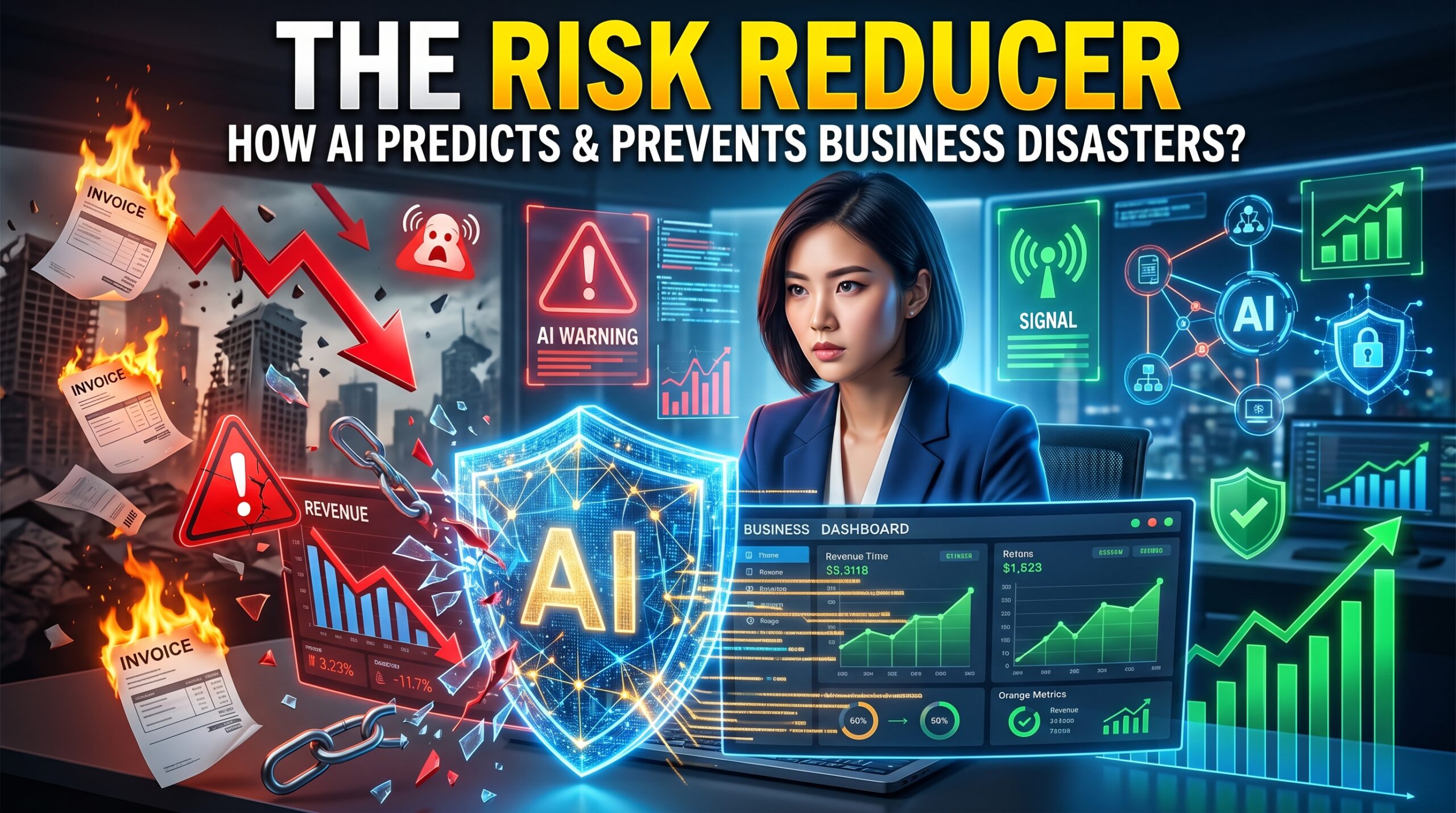
Direct Answer: AI predicts and prevents business disasters by monitoring five critical signal categories simultaneously — cash flow trajectory, customer churn precursors, competitive market moves, regulatory compliance risk, and market demand shifts — and surfacing actionable warnings 30 to 120 days before the risks materialise into crises. Unlike human risk monitoring, AI processes every available data source continuously without fatigue, confirmation bias, or attention prioritisation errors. PwC's 2025 SME Risk Intelligence Report found that AI-augmented risk monitoring reduced the average cost of business risk events for SMEs by 43% — because risks identified 30 or more days before materialisation are resolved at a fraction of the cost of crisis management initiated after the fact.
// The Core Insight
Most business disasters are not sudden. They are slow-moving signal clusters — cash flow patterns, customer behaviour shifts, competitive moves, demand changes — that were visible weeks before the crisis. AI reads these signals simultaneously across every data source. Human analysis reads them one at a time, weeks too late.
// Risk Signal Monitor
Real-time · AI detection
Cash flow trajectory
// AI models 90-day forward projection
30 days
Customer churn precursors
// Behavioural signals before cancellation
45 days
Competitor market moves
// Pricing, product, content signals
60 days
Regulatory and compliance risk
// Policy changes affecting operations
90 days
Market demand shifts
// Query volume and buyer intent change
120 days
// Time to actionable signal
Weeks, not months
// 01 · The Signal Reality
Why Do Most Business Disasters Happen to Founders Who Were Watching Carefully — and What Are They Consistently Missing?
The founder who is surprised by a cash flow crisis is not a careless founder. They are usually a founder who was watching their P&L carefully, reviewing their bank balance regularly, and making rational decisions based on the information they had. What they were not doing — what no human can do reliably, at the required frequency, across the required data sources — is synthesising the cross-signal patterns that predict cash flow crises 45 to 90 days before they appear in the bank balance.
The same pattern applies to customer churn, competitive disruption, and demand shifts. The signals are almost always present before the crisis. A customer who is going to cancel has usually shown a combination of reduced login frequency, slower response times, shorter support tickets, and declining feature utilisation for three to six weeks before the cancellation. A competitor who is going to launch a price-cutting campaign has usually been publishing content targeting your conversion keywords, increasing their hiring in product roles, and showing pricing page test variants in A/B testing tools for four to eight weeks before the campaign launches.
// The Structural Reason Human Monitoring Misses These Signals
Human risk monitoring fails not because founders are inattentive but because the volume, variety, and frequency of relevant signals across all data sources simultaneously exceeds human processing capacity. A founder monitoring cash flow carefully still typically checks their bank balance once or twice per week and their P&L once or twice per month — reviewing a handful of signals in sequence, not hundreds of signals in parallel. An AI risk monitoring system checks every relevant metric every hour, flags deviations from expected patterns immediately, and cross-references signals across CRM, accounting, search trends, and competitive data to identify the multi-signal patterns that predict crises with high precision. This is not a judgment difference — it is a processing architecture difference. AI is not smarter than an experienced founder. It is faster, wider, and never distracted.
// 02 · The Five Risk Categories
What Are the Specific Business Disaster Types That AI Can Predict — and What Signals Does It Read for Each?
// Critical · 30-day signal window
Cash Flow Crisis Prediction
AI models forward cash flow projections using accounts receivable ageing, accounts payable schedules, recurring revenue cohort behaviour, and historical seasonal patterns simultaneously. The warning signal: when AI's 90-day forward projection crosses below the three-month operating expense threshold, an alert triggers 45–60 days before the founder would identify the problem through standard monthly review. The specific signal that most founders miss: a slow increase in average debtor days — from 28 days to 34 days — spread across multiple clients simultaneously indicates either a systematic payment behaviour change or the beginning of a broader economic pressure pattern affecting the client base.
// AI cash flow prediction accuracy: 87% for 30-day horizon (Aberdeen Group 2025)
// Critical · 45-day signal window
Customer Churn Prediction
AI churn prediction models monitor 20–40 behavioural signals per customer simultaneously — login frequency, feature utilisation depth, support ticket volume and sentiment, email open and click rates, response times — and identify the specific combination patterns that precede cancellation with 75–85% accuracy at the 45-day horizon. The highest-weight signal across most B2B SaaS businesses: a simultaneous drop in login frequency and a shift from product-focused to billing-focused support queries is the most reliable churn precursor AI systems identify, appearing an average of 38 days before cancellation.
// B2B churn prediction accuracy at 45 days: 79% (Gainsight Research 2025)
// High · 60-day signal window
Competitive Disruption Intelligence
AI competitive monitoring systems track competitor website changes, content publishing patterns, keyword targeting shifts, pricing page modifications, job posting volume and role types, and social media engagement patterns. The combination signal for an impending competitive campaign: simultaneous increase in content targeting your primary conversion keywords, new VP of Marketing or Product hire announcement, and pricing page test signals — all appearing together 4–8 weeks before the campaign launches. This gives you 60 days to reinforce the marketing position, build the counter-content, or adjust pricing before the campaign affects your pipeline.
// AI competitive signal accuracy at 60 days: 71% (Crayon Competitive Intelligence 2025)
// Medium · 90-day signal window
Regulatory and Compliance Risk Detection
AI regulatory monitoring systems read government consultation documents, industry body announcements, enforcement action patterns, and case law developments across multiple jurisdictions simultaneously — flagging changes relevant to the business's operations, contracts, data handling, or employment practices 60–90 days before enforcement or deadline dates. For SMEs without in-house legal counsel, this signal window represents the difference between proactive compliance adaptation and reactive emergency legal consultation — the latter typically costing 5–10× more than planned compliance work. The most common missed signal: changes in data protection enforcement focus areas that appear in ICO or FTC enforcement action patterns 90 days before new industry-specific guidance is published.
// Regulatory signal lead time: average 90 days vs 14 days human monitoring (Thomson Reuters 2025)
43%
Lower cost of business risk events for AI-augmented monitoring SMEs — risks identified 30+ days early are resolved at a fraction of crisis management cost
// PwC SME Risk Intelligence Report, 2025
38days
Average advance warning window for AI-identified customer churn precursors — versus 3–7 days for human-monitored cancellation signals in standard CRM review processes
// Gainsight Research, 2025
87%
Cash flow prediction accuracy for AI models at the 30-day horizon — significantly above human forecast accuracy of 62% in equivalent SME financial modelling studies
// Aberdeen Group, 2025
// 03 · The AI Risk Stack
What Specific AI Tools and Capabilities Address Each Risk Category — and How Does an SME Implement Them?
The AI risk monitoring stack for SMEs is not a single enterprise platform — it is a combination of four to six AI-enabled tools that together cover the five risk categories at a total monthly cost of approximately £150–£300. None of the tools require technical integration beyond the standard data connections their onboarding documentation covers. The four-tool minimum viable risk stack can be operational within two weeks of the decision to implement.
01 Cash Flow and Financial Risk — AI-Augmented Forecasting
// Xero + Float · or QuickBooks + Pulse · AI forward projection
Float (float.money) connects directly to Xero or QuickBooks and builds AI-powered 90-day cash flow projections updated daily from actual transaction data. It automatically flags when the projected 90-day runway drops below a defined threshold and identifies the specific receivable patterns driving the risk — giving you the 45–60 day warning window that standard monthly P&L review cannot provide. Total cost: £35–£50/month. The specific configuration for maximum early warning: set the alert threshold at 90 days of operating expenses rather than the 30-day emergency threshold most founders default to — the 90-day threshold gives you time to intervene strategically rather than reactively.
£35–50 per mo
02 Customer Churn Prediction — CRM Behavioural Monitoring
// ChurnZero · Gainsight Essentials · HubSpot AI Health Scores
Customer health score systems (ChurnZero, Gainsight Essentials, or HubSpot's AI-powered contact scoring) monitor the 20–40 behavioural signals that predict churn and surface at-risk accounts before the founder would identify them through standard account reviews. The minimum viable implementation for an SME without a customer success function: enable HubSpot's AI contact health scoring on your existing CRM contacts and configure a weekly digest of accounts whose score has dropped more than 15 points in the prior 7 days. This single configuration produces the 38-day warning window that turns potential churns into retention conversations — at the cost of an afternoon of setup time and no additional subscription if using HubSpot's existing plan.
£60–120 per mo
03 Competitive Intelligence Monitoring — AI Signal Tracking
// Crayon · Klue · Competitor monitoring via Perplexity + Claude
AI competitive intelligence tools (Crayon, Klue) automatically monitor competitor websites, content, pricing, job postings, and social media and surface the multi-signal patterns that indicate strategic moves 4–8 weeks before they affect your pipeline. For SMEs with budget constraints, a minimum viable alternative: configure weekly Perplexity research prompts asking for competitor news, pricing changes, and product updates, supplemented by a monthly Claude synthesis of job posting patterns and content publishing trends. The competitive early warning that most founders miss is content-based: when a competitor begins publishing 3–5 articles per week targeting your primary conversion keywords after a period of lower frequency, this signals an SEO and content investment that will affect your organic rankings within 90–120 days.
£0–150 per mo
04 Market Demand and AI Visibility Monitoring — Search Intelligence
// Google Search Console · Semrush · AI Overview citation testing
Market demand shifts appear in search query volume changes before they appear in revenue changes — making Google Search Console organic impression trends a leading indicator for commercial demand in your category. Configure a monthly Search Console comparison (current month vs prior year equivalent) across your ten primary commercial queries. A sustained 15%+ decline in organic impressions for primary commercial queries is a leading indicator for demand shift or competitive SEO displacement that will affect pipeline in 60–90 days. Combine with monthly AI Overview citation testing: search your ten primary queries in Gemini and Perplexity and note whether your brand appears as a citation. Declining AI citation presence is a demand risk signal for the 38% of commercial queries now resolved at the AI layer without organic clicks.
£0–80 per mo
A crisis that arrives 30 days early is a problem. A crisis that arrives 30 days late — because AI surfaced it 30 days before you would have noticed — never becomes a crisis at all.
// The timing difference that separates managed risk events from business disasters in AI-augmented SME operations
// The Discovery Risk That Most SMEs Are Not Monitoring
Beyond the traditional business risk categories, there is a specific 2026 risk that most SME founders are not yet monitoring: AI visibility displacement. If a competitor builds entity schema and VideoObject schema infrastructure before you do, they begin appearing in AI-generated expert recommendations for your primary commercial queries — effectively reducing your market share in the 38% of commercial searches that never produce an organic click. This risk is currently invisible to traditional SEO monitoring tools because it does not appear in organic ranking reports. The only monitoring system for AI visibility risk is the weekly citation test: search your ten primary commercial queries in Gemini and Perplexity, and count competitor citations versus your own. An increasing competitor citation count with a stable or declining your own citation count is an AI visibility displacement risk signal requiring immediate entity schema and VideoObject schema deployment.
Frequently Asked Questions
How does AI predict and prevent business disasters?
AI predicts and prevents business disasters by monitoring five critical signal categories simultaneously — cash flow trajectory, customer churn precursors, competitive market moves, regulatory compliance risk, and market demand shifts — surfacing actionable warnings 30 to 120 days before risks materialise into crises. AI processes all available data sources continuously without fatigue, confirmation bias, or attention prioritisation errors that affect human monitoring. PwC's 2025 SME Risk Intelligence Report found that AI-augmented risk monitoring reduced the average cost of business risk events for SMEs by 43% — because risks identified 30 or more days before materialisation are resolved at a fraction of the cost of crisis management initiated after the fact. The four-tool minimum viable AI risk stack for SMEs covers all five risk categories for approximately £150–£300 per month.
Can AI predict cash flow problems before they become crises?
Yes — AI cash flow prediction models achieve 87% accuracy at the 30-day horizon (Aberdeen Group 2025), compared to approximately 62% accuracy for equivalent human forecasting in SME financial modelling. AI-powered cash flow tools like Float (connecting to Xero or QuickBooks) build daily-updated 90-day projections that flag when projected runway drops below defined thresholds — providing the 45–60 day warning window that standard monthly P&L review cannot produce. The specific signal most human monitoring misses: a gradual increase in average debtor days across multiple clients simultaneously, which indicates broader payment behaviour pressure 60 days before it appears as a cash flow shortfall. Configuring the alert threshold at 90 days of operating expenses rather than the standard 30-day emergency threshold produces the strategic rather than reactive response window.
What is the best AI tool for customer churn prediction in SMEs?
For SMEs, the best AI churn prediction tools are HubSpot's AI contact health scoring (the minimum viable option for businesses already using HubSpot CRM, adding no subscription cost), ChurnZero (specialist customer success platform with 20–40 signal monitoring per account, best for SaaS businesses with recurring subscription revenue), and Gainsight Essentials (enterprise-grade signal monitoring with SME-appropriate pricing tier). All three identify the highest-weight churn precursor patterns at the 38–45 day horizon — with the most reliable cross-platform signal being the combination of declining login frequency and a shift from product-focused to billing-focused support queries. Gainsight's 2025 research confirmed 79% prediction accuracy at the 45-day horizon for B2B subscription businesses using multi-signal health scoring.
How do you monitor for AI visibility risk alongside traditional business risk?
AI visibility risk monitoring requires a specific weekly citation test that traditional SEO tools cannot perform: search your ten primary commercial queries in Google AI Overviews and Perplexity in a fresh incognito browser session, and record which brands appear as named citations. An increasing competitor citation count with stable or declining your own citation count is an AI visibility displacement risk signal — meaning competitors are capturing the 38% of commercial queries now resolved without an organic click, reducing your effective market share in AI-mediated discovery. The prevention mechanism is entity schema and VideoObject schema deployment using Clipkoi: entity verification triggers Knowledge Graph confirmation within 30–45 days, and VideoObject host pages generate the 4.3× AI citation multiplier (Semrush 2025) from each production session. Run the citation test weekly. Act on any competitor citation growth signal within 30 days.
What is the minimum viable AI risk stack for a small business?
The minimum viable AI risk stack for an SME covers all five major risk categories for approximately £150–£300 per month and includes: Float or Pulse for AI cash flow projection with 45-day alert thresholds (£35–£50/month), HubSpot AI health scoring for customer churn precursors (included in existing HubSpot plan or £60–£120/month for dedicated CS tools), a weekly Perplexity research session for competitive intelligence monitoring (£0–£20/month for Perplexity Pro), Google Search Console for organic demand trend monitoring (free), and a weekly manual AI citation test for AI visibility risk monitoring (free with Clipkoi's entity schema infrastructure). Total investment: £95–£190 per month for the complete minimum viable risk coverage. Set up in approximately one week. PwC's 2025 findings confirm the 43% risk event cost reduction from this level of AI monitoring coverage for SMEs in the 10–200 employee range.
→ The Preventive Compound
The AI Risk Stack Is Not an Insurance Policy — It Is a Strategic Intelligence System That Makes Disasters Optional
The conventional framing of business risk management is reactive: build reserves, buy insurance, create contingency plans, and respond when crises arrive. The AI risk intelligence framework described in this article is structurally different — it converts risk management from a reactive cost centre to a proactive strategic advantage. The founder who knows about the cash flow risk 60 days in advance has six strategic options. The founder who knows about it on day one of the crisis has two or three emergency options at significantly higher cost and lower probability of success.
The discovery risk category deserves particular attention because it is invisible to traditional risk monitoring frameworks. AI visibility displacement — a competitor building entity schema and VideoObject schema infrastructure and beginning to appear in AI-generated expert recommendations for your commercial queries before you do — is happening right now in most SME categories without the businesses being displaced having any awareness of it. The citation test takes five minutes per week. The entity schema deployment takes two hours. The VideoObject host page production takes 90 minutes with Clipkoi. These are the specific actions that simultaneously prevent AI visibility displacement risk and build the compounding discovery infrastructure that grows revenue.
Risk monitoring without action is expensive anxiety. The AI risk stack described here — Float for cash flow, CRM health scoring for churn, Perplexity for competitive intelligence, Search Console for demand monitoring, and Clipkoi's VideoObject infrastructure for AI visibility risk — is the action layer that converts early signals into prevented disasters. Set up the stack this week. The 38-day advance warning on your next at-risk customer is already possible. The AI citation displacement of your category may already be underway. Both signals are readable now.