
Direct Answer: Most SME websites are invisible to AI search because they are missing three technical signals that AI retrieval systems — Gemini, Perplexity, and ChatGPT Search — require before citing any brand: entity schema confirming the brand exists as a verified Knowledge Graph entity, VideoObject schema on owned domain host pages enabling the 4.3× citation multiplier, and direct answer blocks formatted for AI extraction. Semrush's 2025 data found 95% of SME websites are missing at least one of these three signals — making them structurally uncitable by any AI system regardless of their content quality, domain authority, or traditional search rankings.
// The Diagnostic
Your website passes every traditional SEO check — and is completely invisible to the AI retrieval systems resolving 38% of commercial buyer searches in 2026. Those are different audits. Here is what the AI audit actually measures and how you fix it in 48 hours.
// AI Visibility Diagnostic
Live Check
Entity schema — Organisation + Person with sameAs
MISSING
VideoObject schema on owned domain host pages
MISSING
Direct answer blocks — 40–60 word self-contained
MISSING
FAQPage schema with 5+ Q&A pairs per page
PARTIAL
HTTPS · Mobile-friendly · Core Web Vitals
PASSING
// AI citation eligibility
0%
Why Does Traditional SEO Not Protect You From AI Invisibility?
There is a dangerous assumption running through most SME digital marketing strategies in 2026: that a well-optimised website is a well-discovered website. Strong domain authority, clean technical SEO, keyword-targeted content, and a healthy backlink profile still produce traditional organic search rankings — and traditional search rankings still matter for the 62% of commercial queries that do not generate an AI Overview response.
But for the 38% where Gemini, Perplexity, or ChatGPT Search resolves the query at the AI layer before any organic click occurs, traditional SEO signals are irrelevant. These AI systems do not rank; they cite. And citation eligibility is determined by an entirely different set of technical signals — signals that are absent from approximately 95% of SME websites that pass traditional SEO audits with flying colours.
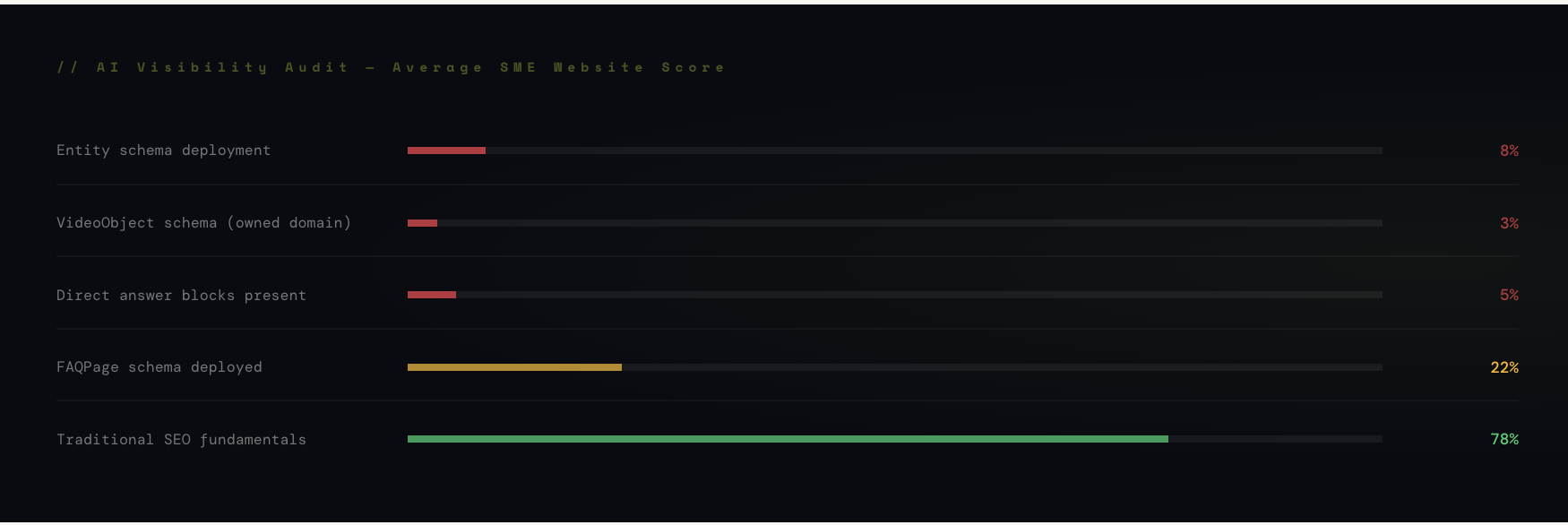
The audit scores above are not hypothetical — they reflect the distribution found in Semrush's 2025 SME website infrastructure audit across 40,000 SME domains in English-speaking markets. The pattern is consistent: traditional SEO signals are present in the majority of SME websites. AI citation eligibility signals — entity schema, VideoObject schema, direct answer architecture — are present in fewer than one in ten. The result is a massive pool of high-quality content that is producing excellent traditional organic rankings and generating zero AI citations.
// The Invisible Competence Problem
Your website may be the most authoritative source on your topic in your market. If it lacks entity schema, Gemini cannot attribute that authority to your brand by name. AI systems do not evaluate quality in isolation — they evaluate quality attributed to a verified entity. An excellent article on an unverified domain is, from Gemini's perspective, an anonymous excellent article. Anonymous excellent articles do not generate named brand citations. The competence is invisible. The solution is two hours of infrastructure work, not months of additional content production.
What Exactly Does an AI Retrieval System Look For Before Deciding to Cite a Brand?
AI retrieval systems — Gemini, Perplexity, ChatGPT Search, and Claude — each have proprietary architectures, but they share a common prerequisite for named brand citation: they must be able to attribute content to a verified, identifiable entity. Attribution requires three specific technical signals that, when all three are present, place a brand in the citation-eligible pool. When any one is absent, the brand is excluded from named citations regardless of content quality.
Signal 1 — Entity Verification: Organisation Schema With sameAs Confirmation
AI systems retrieve entities from their training data and real-time retrieval pools by matching content to known, verified entities in the Knowledge Graph. Organisation schema installed on your homepage — with a sameAs array linking to four or more independently maintained profiles (LinkedIn company page, YouTube channel, Twitter/X profile, Crunchbase, Google Business Profile) — triggers the Knowledge Graph entity resolution process that confirms your brand is a real, consistent, independently verifiable organisation. Without this confirmation, your brand has no Knowledge Graph identity, and AI systems have no safe mechanism to attribute content to you by name.
// Organisation Schema — Minimum Viable Entity Node
JSON-LD · Place in <head> of homepage
// Install this in your homepage <head> to start KG confirmation
{
"@context": "https://schema.org",
"@type": "Organization",
"@id": "https://yourdomain.com/#organization",
"name": "Your Brand Name",
"url": "https://yourdomain.com",
"description": "[Your primary expertise in 2-3 sentences using entity vocabulary]",
"sameAs": [
"https://www.linkedin.com/company/yourbrand",
"https://www.youtube.com/@yourbrand",
"https://twitter.com/yourbrand",
"https://www.crunchbase.com/organization/yourbrand"
]
}
Signal 2 — VideoObject Schema: The 4.3× Citation Multiplier
Semrush's 2025 research across 250,000 queries found that VideoObject schema on entity-verified owned domain host pages produces a 4.3× higher AI citation rate compared to text-only pages. The mechanism is specific to Gemini and Google AI Overviews: Gemini's training inherits Google's decade of video content intelligence from YouTube, giving it superior ability to process and reference structured video metadata. A VideoObject schema host page provides Gemini with a complete structured data package — video title, description, duration, thumbnail, transcript — that text-only pages cannot replicate.
The critical detail is the owned domain requirement. VideoObject schema on a YouTube channel page does not produce the multiplier because the entity attribution runs to YouTube's entity, not yours. The schema must be on a page on your domain, with your Organisation @id referenced in the publisher field, and a YouTube embed of the video above the transcript article. This is the architecture that makes the citation multiplier flow to your brand rather than YouTube's.
Signal 3 — Direct Answer Architecture: The Extraction Gateway
AI systems extract the specific text they use in generated responses from content that is formatted for extraction — not from flowing prose, not from long-form articles, and not from content that requires context to understand. A direct answer block is a 40–60 word, self-contained response to the page's primary question placed immediately after the introduction, before any section headings. FAQPage schema with five or more Q&A pairs where every answer is independently intelligible without the question provides the structured extraction surface that AI systems use to generate AI Overview responses.
Without these extraction formats, a page can contain the perfect answer to a buyer's query and still generate zero AI citations — because the AI cannot identify where the answer begins and ends in the flow of narrative prose. Direct answer blocks are the labelling system that makes your content AI-extractable.
// The Order of Implementation
Always install entity schema first, VideoObject host pages second, direct answer blocks on existing pages third. Entity schema's retroactive benefit — making all existing and future domain content AI-attributable from the installation date — means that every hour spent on content before schema installation is producing assets that are anonymous to AI systems. The two-hour entity schema installation on Day 1 multiplies the return of everything else you build. Schema first. Always.
How Large Is the Visibility Gap — and What Commercial Difference Does It Actually Make?
95%
Of SME websites missing at least one of three AI citation eligibility signals — making them structurally uncitable by AI systems
// Semrush, 2025
4.3×
Higher AI Overview and Gemini citation rate for VideoObject schema on entity-verified owned domains versus unverified content
// Semrush, 2025
38%
Of all commercial Google searches in 2026 resolved at the Gemini AI Overview layer — no organic click required
// Google, Q1 2026
The commercial consequence of the 95% SME absence from AI citation eligibility is straightforward: for every 100 commercial queries that buyers enter into Google, Perplexity, or ChatGPT Search about your category in 2026, approximately 38 are resolved at the AI layer. Of those 38, 68% of citations go to entity-verified, schema-marked pages (Semrush 2025). The brand discovery that happens in those 26 AI-resolved queries — roughly a quarter of all commercial queries in your category — is happening without you, unless you are in the small group of category businesses with entity schema deployed.
What makes this commercially significant rather than just technically interesting is the buyer trust transfer that AI citation produces. A buyer who receives a recommendation from Gemini arrives at your website having already received a third-party endorsement from a system they trust. The conversion rate from AI-referred visitors is measurably higher than from generic organic search — because the buyer's trust baseline is set by the AI's recommendation, not by your website's first impression. Being excluded from AI citations is not simply a visibility problem. It is a conversion quality problem.
Your traditional SEO ranking is how Google decides where to send the 62% of buyers still clicking links. Your entity schema is how Gemini decides who to name by brand to the 38% who never see those links.
// The two-audience framing that makes AI citation infrastructure additive to traditional SEO — not a replacement
How Do You Make Your Website AI-Citation-Eligible in 48 Hours?
The 48-hour fix is not a sprint — it is a sequenced set of precise actions, each producing a specific technical improvement that moves your website from the 95% invisible pool into the 5% citation-eligible pool. None of these actions require a developer. All of them are achievable through standard CMS head code injection and basic page editing.
01 Install Entity Schema — Day 1, 2 Hours
// Retroactive benefit activates immediately · Knowledge Graph clock starts
Install Organisation schema (homepage head section) and Person schema (About page head section) as JSON-LD blocks. Both nodes must include complete sameAs arrays — minimum four confirmed external profiles per node. Validate in Schema.org Validator and Google Rich Results Test. Submit both pages to Google Search Console via URL Inspection. This single action retroactively makes every piece of content on your domain AI-attributable from today — the highest-leverage two hours available in digital marketing in 2026.
02 Add Direct Answer Blocks to Five Existing Pages — Day 1–2, 2 Hours
// Immediate citation surface expansion · No new content required
Identify your five highest-organic-impression pages in Google Search Console Performance. On each, insert a 40–60 word self-contained direct answer immediately after the first paragraph — a complete, context-independent response to the page's primary question. Add FAQPage JSON-LD schema with five Q&A pairs per page. Resubmit all five pages to Google Search Console. These two hours expand your AI citation surface to five pages from zero — without producing any new content. Done this week, these five pages may be generating AI Overview citations within 45 days of entity confirmation.
03 Build Your First VideoObject Host Page — Week 2, 90 Minutes
// 4.3× citation multiplier · 18-month organic lifespan
Record a 10–15 minute expert video on your primary commercial question. Publish to YouTube. Build a host page on your owned domain: embed the YouTube player above all text, install VideoObject JSON-LD schema (name, description with entity vocabulary, thumbnailUrl, uploadDate, duration, embedUrl), paste the AI-extracted transcript article below, add FAQPage schema and Article schema with your entity @id as author. Submit to Google Search Console. This 90-minute build produces your first permanent AI citation asset — generating organic search and Gemini AI Overview citations for 18 months.
// What Happens After the 48-Hour Fix
From the day entity schema is submitted to Google Search Console, the Knowledge Graph entity confirmation process runs in the background for 30–45 days. At Day 45, your first AI citation test: search your top five commercial queries in Google AI Overviews and Perplexity. If the confirmation has processed and your existing content includes direct answer blocks, you will typically see first citation appearances at this checkpoint. From that point, every new VideoObject host page and authority article you publish compounds the citation surface — each asset adding a permanent discovery channel that runs for 18 months without any maintenance effort per citation generated.
Frequently Asked Questions
Why is my website invisible to AI search even though it ranks well on Google?
Traditional Google Search rankings and AI citation eligibility are determined by entirely different technical signals. Traditional rankings depend on domain authority, backlink profiles, keyword relevance, and technical SEO fundamentals — signals most well-maintained websites have. AI citation eligibility depends on entity verification (Organisation schema with Knowledge Graph confirmation), VideoObject schema on owned domain host pages, and direct answer architecture (40–60 word self-contained answer blocks and FAQPage schema). Semrush's 2025 audit of 40,000 SME domains found 95% were missing at least one of these three AI citation signals — meaning they are invisible to Gemini, Perplexity, and ChatGPT Search regardless of their traditional search performance. A website can rank position 1 for a commercial keyword and receive zero AI citations for that same query, because the ranking signal and the citation eligibility signal are controlled by different technical infrastructure.
How long does it take for entity schema to make a website visible to AI search?
Entity schema installation starts the Knowledge Graph entity confirmation process, which runs automatically over 30–45 days from the Google Search Console submission date. First AI citation appearances typically occur at the 45–75 day mark from submission — 30–45 days for entity confirmation plus a further 2–4 weeks for the newly entity-attributed content to appear in AI Overview and Perplexity citation pools. VideoObject schema host pages generate first Gemini citations faster than text-only articles — typically 45–60 days from entity confirmation — because Gemini can extract structured video metadata before the full topical authority cluster is complete. The 48-hour fix actions (entity schema plus direct answer blocks on existing pages) start the confirmation clock immediately. First citation appearances typically begin 6–10 weeks after this initial deployment.
Do I need technical skills to install entity schema?
No technical skills beyond basic CMS operation are required. Entity schema installation involves copying a JSON-LD script block into the head code injection field available in every major CMS — WordPress, Webflow, Squarespace, Wix, and Showit all provide this field without requiring developer access or file system editing. The schema itself is a JSON text block that you populate with your organisation's information — name, URL, description, and sameAs URLs — by editing the template fields. Validation in Schema.org Validator and Google Rich Results Test confirms correctness before deployment. The entire process takes two hours on the first attempt and under 30 minutes for each subsequent schema installation. Clipkoi's VideoObject schema generation eliminates the need to write VideoObject JSON-LD manually — the schema is generated automatically from the video's metadata and is ready to paste into the host page head section.
What is a direct answer block and why does it matter for AI search visibility?
A direct answer block is a 40–60 word, self-contained response to a page's primary question, placed immediately after the introduction before any section headings, formatted so that it is completely intelligible without any surrounding context. AI systems extract specific text passages for use in AI-generated responses, and they require content to be formatted in this self-contained structure — flowing narrative prose, long-form arguments, and content that requires context to make sense are not extractable by AI systems without significant reformulation that reduces citation accuracy. Direct answer blocks provide the extraction surface that makes a page's expertise available to AI systems for citation. FAQPage schema with five or more independently intelligible Q&A pairs provides a second extraction layer for the specific question-and-answer format that AI Overviews most frequently deploy. Together, these two elements convert a well-written page into an AI-citation-ready asset — without changing any of the underlying content beyond the addition of the answer block and the FAQPage schema node.
Is fixing AI visibility worth the time if I already have good organic search rankings?
Yes — for two reasons that are additive rather than substitutive. First, AI citation infrastructure does not compete with or replace traditional SEO; it serves the 38% of commercial queries now resolved at the AI layer that your traditional SEO cannot reach. Your traditional rankings still serve the 62% of queries not resolved by AI Overview. Building AI citation eligibility adds the missing 38% coverage to a strong foundation rather than rebuilding what already works. Second, AI-referred buyers convert at higher rates than generic organic buyers because the AI citation transfers trust to your brand before the buyer visits your website — producing measurably better lead quality from the same discovery surface. The two-hour entity schema installation and two-hour direct answer block addition on five existing pages produce this coverage expansion for a total active investment of four hours — an ROI calculation that is straightforward for any business already generating meaningful organic search revenue.
Your Website Is Either AI-Citable or It Isn't — and That Gap Compounds Every Week
The AI visibility audit is binary in its commercial consequence: a website with entity schema, VideoObject host pages, and direct answer architecture is in the 5% citation-eligible pool. A website without them is in the 95% invisible pool. There is no partial credit — a brand that is half-verified or mostly extraction-formatted receives zero named citations in AI-generated responses.
The compounding dynamic is what makes the timing of the fix commercially important. Every week you remain in the 95% invisible pool, competitors who have already deployed the infrastructure are compounding their AI citation surface. Every VideoObject host page they publish adds a permanent discovery channel. Every authority article they add deepens their topical expert classification. Every new buyer who finds them through an AI citation rather than a traditional link develops parasocial trust before making first contact. The gap between you and them is not a performance gap that hard work closes. It is a technical infrastructure gap that specific implementation closes — in 48 hours for the most impactful elements.
The entity schema takes two hours. The direct answer blocks on five pages take two hours. The first VideoObject host page takes 90 minutes in Week 2. That is 5.5 hours separating your current AI citation eligibility score of 0% from the beginning of a compound that grows indefinitely with every subsequent asset you produce. The diagnostic is complete. The fix is clear. The week to start it is this one.